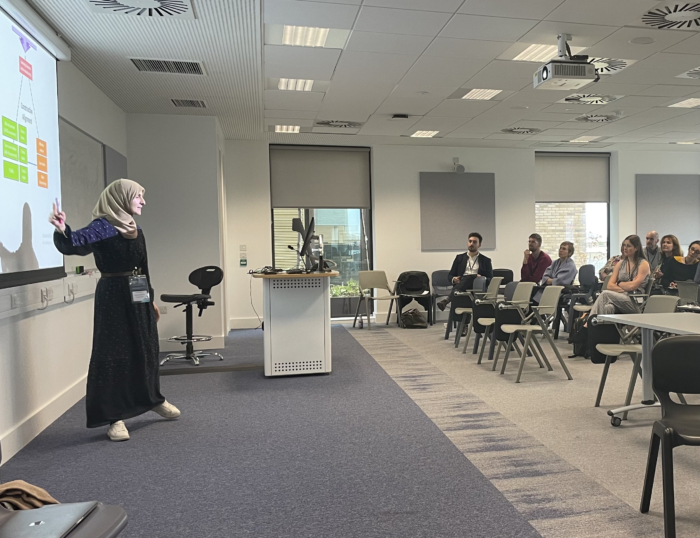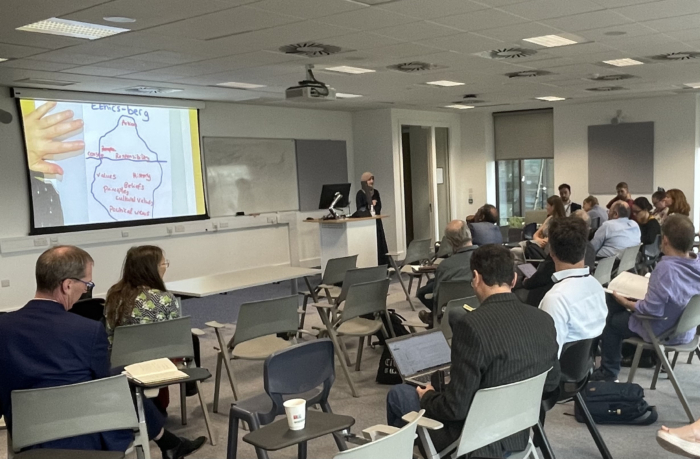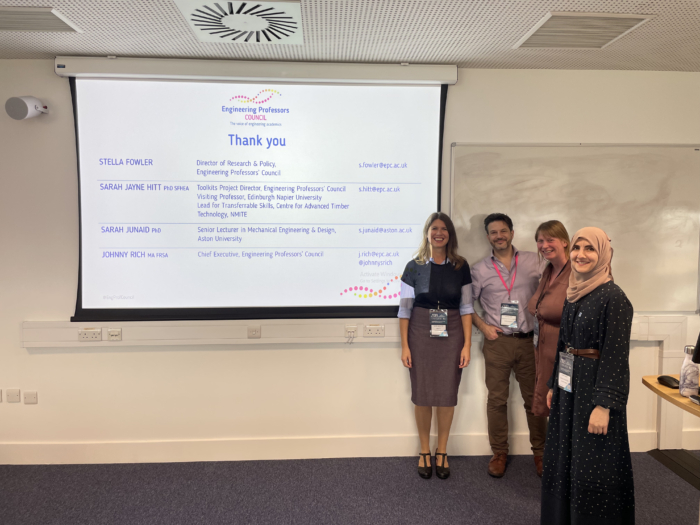
The workshop showcased the Engineering Ethics Toolkit and introduced a pragmatic approach to integrating ethics content into teaching, using examples and a detailed and interactive curriculum map, which connects the elements of the toolkit.
Any views, thoughts, and opinions expressed herein are solely that of the author(s) and do not necessarily reflect the views, opinions, policies, or position of the Engineering Professors’ Council or the Toolkit sponsors and supporters.
This call for contributions has now closed. However, if you wish to develop materials to contribute, become a reviewer, or suggest links to online resources that we can add to our growing database of engineering education resources for sustainability, please see our Get Involved page for updated guidance and contact details.
Background
Building capacities of educators and trainers is Priority Action Area 3 in UNESCO’s roadmap of Education for Sustainable Development. While many excellent resources explain the sustainability knowledge, skills, and mindsets essential for 21st century engineers, very few resources exist that support engineering educators to integrate these into their teaching in a comprehensive and effective way or indeed to upskill educators to be able to deliver this teaching.
To address this gap, a Sustainability Toolkitis being developed by the Engineering Professors’ Council with support from Siemens and the Royal Academy of Engineering. Its development is guided by a Steering Group comprised of academic, industry, and advocacy organisation experts.
If you have already registered an interest and we are expecting your submission, please do submit your contributions using this form by 3rd November 2023. If you wish to develop materials to contribute beyond this, we will be opening the next cycle in early 2024. However, if you wish to become a reviewer or suggest links to pages or online resources that we can add to our growing database of engineering education resources for sustainability, please contact us via sustainability@epc.ac.uk.
The Sustainability Steering Group seeks contributors to develop resources for inclusion in the toolkit. These resources will fit into two categories (Click on the arrows to expand the sections):
(1) Write guidance articles (Submit a guidance article)
The Sustainability Toolkit Steering Group seeks contributors to write guidance articles. These articles should connect the why (why must sustainability issues be central in engineering education?) to the how (how can this be done efficiently and effectively?).Through these tools, we aim to help upskill UK engineering educators so that they feel capable of and confident in integrating sustainability into their engineering teaching. Particularly, we invite guidance articles that explain the connection between engineering and sustainability. These may have the following foci:
1. An overview of why sustainability issues and the SDGs are entangled within engineering projects, products, and processes.
2. Explanations of the connections between sustainability issues and specific engineering disciplines such as Chemical, Mechanical, Electrical, Computing.
3. An explanation of how sustainability concerns are linked to different stages of the engineering process such as the design/concept stage, the manufacturing/production stage, the disposal/reuse stage, etc.
4. Explanations of the connections between sustainability in engineering and:
a. Legal, regulatory, policy, and/or political issues.
b. Ethical issues and/or engineering ethics.
c. Issues of equality, diversity, and inclusion.
5. An explanation of this new conception of engineering “from hubris to humility”.
6. Examples of how sustainability has been woven into a conventional subject.
Step 1: Read the guidance for submitting a guidance article
Guidance #1: Research Guidance #2: OverviewGuidance #3: PurposeGuidance #4: ContentGuidance #5: References and resourcesGuidance #6: Format
Research:
Before you begin, you may want to review guidance articles that form a part of the EPC’s Ethics Toolkit, since we hope that contributions to the Sustainability Toolkit will be fairly consistent in length, style, and tone.
Guidance articles are meant to be overviews that a reader with no prior knowledge of sustainability could refer to in order to develop a baseline understanding and learn where to look for additional information. They should be understandable to students as well—imagine that an educator might excerpt content from the article to provide their students context on a project or learning activity.
They should be approximately 500-1000 words and reference relevant open-source resources.
Overview:
The articles are meant to be able to stand on their own as a piece of guidance on a topic; they are also meant to work alongside other guidance articles so that taken together they form a sort of sustainability in engineering handbook.
Purpose:
Each article should inform, explain, and provide guidance on the topics. Put yourself in the perspective of an engineering educator who is new to sustainability.
Content:
The content of the article should be organised and well developed. That is, it should be presented in a logical way and thoroughly explained. Please click here for more details on the content that we’re seeking.
References and resources:
Where additional explanation could be given, it might point to other resources, and where information is presented from another source, it needs to be properly referenced.
Format
Guidance articles should follow this format:
Premise
Body of article, divided up into headed sections as necessary.
Does the article both make sense as a single piece of guidance as well as fit in with the rest of the articles to be developed?
Would someone new to sustainability understand the information presented and would it help them?
Do you need to expand on any ideas or reorganise them to make them clearer?
What additional resources or references have you included?
Before you submit your contribution, have you registered as a contributor? If not, please register your interest here.
Step 3: Submitting your guidance article
Guidance articles should be submitted in Word file format (.doc / .docx). Any corresponding images should be submitted in either (.jpeg, .jpg or .png)
To ensure that everyone can use and adapt the Toolkit resources in a way that best fits their teaching or purpose, this work will be licensed under a Creative Commons Attribution-ShareAlike 4.0 International License. Under this licence users are free to share and adapt this material, under terms that they must give appropriate credit and attribution to the original material and indicate if any changes are made.
You may download a PDF version of the guidelines (as outlined in Step 1) here.
Please submit your guidance article by clicking the following button:
(2) Develop teaching tools such as case studies, project briefs and technical tools (Submit a teaching tool)
The Sustainability Toolkit Steering Group seeks contributors to develop teaching tools such as case studies, project briefs and technical tools. These tools should explain pedagogies and teaching methods through resources (e.g. case studies, project briefs, and technical tools) that provide examples of the ways that sustainability issues can be embedded within technical problems and engineering practice. Through these tools, we aim to help upskill UK engineering educators so that they feel capable of and confident in integrating sustainability into their engineering teaching. Section Aprovides details about submitting a case study, Section Bprovides details about submitting a project brief, Section Cprovides details about submitting a technical tool.
SECTION A
Step 1: Read the guidance for submitting a case study
Guidance #1: Research Guidance #2: Overview Guidance #3: Authenticity Guidance #4: Complexity of issue Guidance #5: Activities and resourcesGuidance #6: Educational levelGuidance #7: Format
Research
You may develop the case in any way you see fit, but you should mimic the length, style, and tone of existing case studies found in the EPC’s Ethics Toolkit (scroll to the bottom of this page to view the subset of case studies from the EPC’s Ethics Toolkit which feature themes related to sustainability). While sustainability cases may not have the same learning outcomes as ethics cases, the format and approach should be similar. Remember that the audience for these case studies is educators seeking to embed sustainability within their engineering teaching.
The case study should be presented as a narrative about a sustainability issue in engineering. This issue should allow educators to address large-scale concerns (the SDGs and/or social, regulatory, economic, or environmental concerns) as well as small-scale concerns (individual issues such as personal choices, daily practice, relationships, etc.). Additionally, there should be enough emphasis on the engineering part of the case so that technical material could be introduced. Further ideas for case study topics could include approaches for maintaining / mending rather than new products, e.g. right to repair, up-to-date case studies from industry, understanding the sustainability implications within educational practice (e.g. 3D printing, cloud use, energy, whiteboards), etc.
Case studies are most effective when they feel like they are realistic, with characters that you can identify or empathise with, and with situations that do not feel fake or staged. Giving characters names and backgrounds, including emotional responses, and referencing real-life experiences help to increase authenticity.
Complexity of issue
Many cases are either overly complicated so that they become overwhelming, or so straightforward that they can be “solved” quickly. A good strategy is to try to develop multiple dimensions of a case, but not too many that it becomes unwieldy. Additionally, complexity can be added through different parts of the case so that instructors can choose a simpler or more complicated version depending on what they need in their educational context.
Activities and resources
You should provide a variety of suggestions for activities to engage learners as well as resources to both help educators prepare and to enhance students’ learning.
Educational level
When writing your case study, you should consider which level it is aimed at. A Beginner-level case is aimed at learners who have not had much experience in engaging with complex sustainability topics, and usually focuses on only one or two dimensions of a dilemma. An Advanced-level case is aimed at learners who have had previous practice in engaging with sustainability issues, and often addresses multiple levels of complexity. An Intermediate case is somewhere in between.
Format
The case study should follow the following format:
Learning and teaching notes: This is an overview of the case and its dilemma, and how it relates to AHEP’s themes.
Learning and teaching resources: You should provide a list of reliable, authoritative open-source online resources that relate to the case and its issue(s). These can be from a variety of sources, such as academic institutions, journals, news websites, business, and so on. We suggest a minimum of five sources that help to provide context to the case and its issues. You may want to flag up certain resources as suggested pre-reading for certain parts of the case, if you feel that this will enrich the learning experience.
Summary: This sets out the case’s initial situation and characters.
Issue – Part one: This elaborates on the case and provides a dilemma for the character.
Questions and activities: This is where you provide suggestions for discussions and activities related to the case and the dilemma.
Further issues: Some case studies are sufficiently complex at one dilemma, but if the case requires it you can provide further parts (up to a maximum of three).
Further questions and activities: After each part, you should provide further suggestions for discussions and activities related to the case and the issues.
If possible, suggest assessment opportunities for activities within the case, such as marking rubrics or example answers.
Step 2: Before you submit, review this checklist:
Is there a strong narrative to the case?
Can the topic be addressed at both a large and small scale?
Are there places where technical topics could be integrated?
Does the case have authentic characters and situations?
Is there a clear dilemma in the case?
Does the case provide enough complexity to challenge users, but not so much that people might avoid engaging with it?
Are there sufficient activities and resources suggested?
Before you submit your contribution, have you registered as a contributor? If not, please register your interest here.
Step 3: Submitting your case study
To ensure that everyone can use and adapt the Toolkit resources in a way that best fits their teaching or purpose, this work will be licensed under a Creative Commons Attribution-ShareAlike 4.0 International License. Under this licence users are free to share and adapt this material, under terms that they must give appropriate credit and attribution to the original material and indicate if any changes are made.
Case studies should be submitted in Word file format (.doc / .docx). Any corresponding images should be submitted in either (.jpeg, .jpg or .png)
You may download a PDF version of the guidelines (as outlined in Step 1) here.
Please submit your case study via the following button:
Step 1: Read the guidance for submitting a project brief
Guidance #1: Overview
Guidance for project briefs will be added in due course. Please check back soon. If you have any additional questions please contact s.hitt@epc.ac.uk or c.nwagboso@epc.ac.uk.
Step 2: Before you submit, review this checklist:
A checklist for project briefs will be added in due course. Please check back soon. If you have any additional questions please contact s.hitt@epc.ac.uk or c.nwagboso@epc.ac.uk.
Before you submit your contribution, have you registered as a contributor? If not, please register your interest here.
Step 3: Submitting your project brief
To ensure that everyone can use and adapt the Toolkit resources in a way that best fits their teaching or purpose, this work will be licensed under a Creative Commons Attribution-ShareAlike 4.0 International License. Under this licence users are free to share and adapt this material, under terms that they must give appropriate credit and attribution to the original material and indicate if any changes are made.
Project brief’s should be submitted in Word file format (.doc / .docx). Any corresponding images should be submitted in either (.jpeg, .jpg or .png)
Please submit your project brief via the following button:
Step 1: Read the guidance for submitting a technical tool
Guidance #1: Overview Guidance #2: Research
Overview:
An array of technical tools has been developed to support more sustainable engineering practices. These include:
Life cycle assessments or analysis (LCA) (e.g. single use plastics or health care packaging),
Life cycle inventory,
Embodied carbon calculators and assessments,
Sustainability assessment tools.
We are seeking examples of open-source technical tools that have been effectively integrated into engineering teaching explained through a lesson plan or guide for use.
Research:
The scientific and mathematical calculations that underpin engineering also offer an opportunity to integrate sustainability issues. Micro-insertion is a technique that introduces sustainability concerns into technical problems by providing context for what is already being taught. Most widely known as an approach for integrating ethics into engineering, we are seeking examples of micro-insertions of sustainability into common technical problems found in:
Chemical engineering,
Computing,
Mechanical engineering,
Civil engineering,
Electrical engineering,
General engineering modules
Step 2: Before you submit, review this checklist:
A checklist for technical tools will be added in due course. Please check back soon. If you have any additional questions please contact s.hitt@epc.ac.uk or c.nwagboso@epc.ac.uk.
Before you submit your contribution, have you registered as a contributor? If not, please register your interest here.
Step 3: Submitting your technical tool
To ensure that everyone can use and adapt the Toolkit resources in a way that best fits their teaching or purpose, this work will be licensed under a Creative Commons Attribution-ShareAlike 4.0 International License. Under this licence users are free to share and adapt this material, under terms that they must give appropriate credit and attribution to the original material and indicate if any changes are made.
Technical tools should be submitted in Word file format (.doc / .docx / .csv / .xlsx). Any corresponding images should be submitted in either (.jpeg, .jpg or .png)
You may download a PDF version of the guidelines (as outlined in Step 1) here.
Please submit your technical tool via the following button:
[Deadline extended] If you have already registered an interest and we are expecting your submission, we have extended the deadline to submit first drafts to 3rd November 2024. If you wish to develop materials to contribute beyond this, we will be opening the next cycle in early 2024. However, if you wish to become a reviewer or suggest links to pages or online resources that we can add to our growing database of engineering education resources for sustainability, please contact us via sustainability@epc.ac.uk.
Additional information:
In undertaking this work, contributors will become part of the growing community of educators who are helping to ensure that tomorrow’s engineering professionals sustainability skills, knowledge, and attributes that they need to provide a better future for us all. Contributors will be fully credited for their work on any relevant Toolkit materials, and will be acknowledged as authors should the resources be published in any form. Developing these resources will provide the chance to work with a dynamic, diverse and passionate group of people leading the way in expanding engineering teaching resources, and may help in professional development, such as preparing for promotion or fellowship. If contributors are not compensated by their employers for time spent on this type of activity, a small honorarium is available to encourage participation.
As part of the toolkit project, we are also developing tools for collaborating with our steering group, in-house. Stay tuned for further details.
Learn more about the Sustainability Toolkit:
Those interested in contributing to the Sustainability Toolkit should fill out this form and we will be in touch. [Update: For this cycle, this call has now closed. If you have already registered an interest and we are expecting your submission, please do submit your contributions by 3rd November 2023. If you wish to develop materials to contribute beyond this, we will be opening the next cycle in early 2024. However, if you wish to become a reviewer or suggest links to pages or online resources that we can add to our growing database of engineering education resources for sustainability, please contact us via sustainability@epc.ac.uk.]
Learn more about the members of the Sustainability Toolkit Steering Group, here.
Find out more about the Sustainability Toolkit development process in a blog post written by Siemens, here.
Please note: the Ethics Ambassadors community is being reorganised and the information below is no longer current.
Do you want to champion the teaching of ethics within engineering?
Do you want to help shape the future of the Engineering Ethics Toolkit?
Do you need support with integrating ethics into your own engineering teaching?
If you answered yes to one or more of these questions, then you should join our new Ethics Ambassadors community.
Ethics Ambassadors was launched in March 2023 in order to expand and develop the work and recommendations of the Engineering Ethics Advisory Group, whose expertise and advocacy was instrumental during the creation and development of the Engineering Ethics Toolkit.
The aims of the Ethics Ambassadors community are:
to champion the teaching of ethics within engineering courses and modules;
to support educators integrating ethics teaching within engineering courses and modules;
to share best practice in engineering ethics teaching;
to identify and address needs within engineering ethics teaching;
to source, review, develop and publish new materials for the Engineering Ethics Toolkit.
An initial meeting of Ethics Ambassadors was held in June 2023 and we are currently in the process of nominating and voting for key roles within the community.
You can learn more about Ethics Ambassadors here.
To join Ethics Ambassadors, please fill out this Membership request form.
Any views, thoughts, and opinions expressed herein are solely that of the author(s) and do not necessarily reflect the views, opinions, policies, or position of the Engineering Professors’ Council or the Toolkit sponsors and supporters.
The Engineering Ethics Toolkit is a suite of interactive resources, guidance and teaching materials that enables educators to easily introduce ethics into the education of every engineer. We would like to ensure that all universities with Engineering departments are aware of the toolkit and able to make use of it.
To this end, we’ve produced a pack of resources that can be distributed to relevant departments and staff members such as Engineering department heads, staff and administrators, as well as Vice-Chancellors, Deans, and anyone else who may find our resource useful in teaching or curriculum development.
We would be very grateful if you could share these resources, and encourage you to explore and use them in your teaching.
Our pack of resources to help you present and promote the Engineering Ethics Toolkit contains the following files, and can be downloaded individually below, or as a pack from here.
Any views, thoughts, and opinions expressed herein are solely that of the author(s) and do not necessarily reflect the views, opinions, policies, or position of the Engineering Professors’ Council or the Toolkit sponsors and supporters.
“In January 2022, GoodCorporation was tasked with undertaking a Review of Ethical Culture and Practices in UK engineering. The need for the review was one of several actions identified in a report by the Engineering Ethics Reference Group (EERG), whose remit is to provide leadership and advice to help develop an enhanced culture of ethical behaviour in UK engineering.
The overall objective was to develop a benchmark from which the UK engineering profession can periodically audit and report on ethical performance in UK engineering and identify areas for improvement in ethical culture and practice. The exercise would also allow benchmarking against other professions and identify relevant learnings from them.” – The Royal Academy of Engineering
Any views, thoughts, and opinions expressed herein are solely that of the author(s) and do not necessarily reflect the views, opinions, policies, or position of the Engineering Professors’ Council or the Toolkit sponsors and supporters.
Media release
15th June 2023
The Engineering Professors’ Council today announced the launch of innovative new content for their Engineering Ethics Toolkit, an online resource that helps educators to build ethics directly into their engineering teaching.
Created by the Engineering Professors’ Council (EPC) with support from the Royal Academy of Engineering, the Engineering Ethics Toolkit addresses the issue that relatively few university engineering courses explicitly embed ethics teaching throughout the curriculum.
The ability to tell right from wrong – and better from worse – is as vital to an engineer as maths or design skills, yet many UK higher education institutions fall short in effectively developing these abilities in future engineering professionals. The Engineering Ethics Toolkit solves this problem with a suite of interactive resources, guidance and teaching materials that aim to engage educators, and enable them to introduce ethics into the education and training of every engineer, allowing the UK to position itself as a leader in promoting engineering as a force to improve the world for people and the planet.
As well as offering advice to educators who want to teach ethics but are not sure where to begin, the Toolkit features ready-to-use classroom resources that are rooted in educational best practice and align with the Accreditation of Higher Education Programmes (AHEP) criteria, which are the conditions for courses to receive professional accreditation.
These case studies and other teaching materials highlight current and emerging real-world issues and can be used and adapted by anyone. The latest additions to the Engineering Ethics Toolkit include the interactive Ethics Explorer, which helps educators understand, plan for and implement ethics learning, and 30 new academic guidance articles, case studies and comprehensive classroom activities created and developed by academic and industry professionals.
Dr Rhys Morgan, Director of Education and Diversity at the Royal Academy of Engineering, comments: “There has never been a more crucial time to ensure that the next generation of engineers have the skills and training to critically address ethical questions around issues such as artificial intelligence and sustainability. It is vital for the future of our profession, as well as the future of our society and planet, that every engineer develops the ability to make responsible and informed decisions regarding the ethics of their work.”
Raffaella Ocone OBE FREng FRSE, Professor of Chemical Engineering at Heriot-Watt University and a Fellow of the Royal Academy of Engineering, remarks: “As engineers and as educators we want to improve the world. When we teach ethics within our engineering degrees, we teach the ability to determine what is wrong and what is right, what is a mistake and what is an improvement. The Engineering Ethics Toolkit makes it easy to include ethics in our teaching. It is a treasure trove for educators.”
To hear about forthcoming Engineering Ethics Toolkit webinars and workshops, join the EPC’s Ethics Ambassadors community by emailing press@epc.ac.uk
Ends
Notes to editors
The Engineering Professors’ Council (EPC) is the UK’s representative body for engineering academics in higher education.
The Royal Academy of Engineering is committed to supporting ethical practice in the engineering profession. Ethics is part of other behaviours such as inclusivity and sustainability, which ensure that both individuals and organisations are globally responsible. These behaviours help secure an inclusive economy and sustainable society for all. For more information on the Academy’s work in this area see https://raeng.org.uk/ethics
The Ethics Explorer is an interactive tool that was built to help engineering educators navigate the landscape of engineering ethics education. It is the newest resource in the Engineering Ethics Toolkit.
Whether you’re an ethics veteran or brand new to teaching ethics within engineering, the Ethics Explorer allows you to find your own path through what can sometimes seem like a wilderness.
Choose a path depending on what you want to do. Improve your own ethics learning? Plan for ethics learning? Integrate or assess an ethics activity? Each path leads you through content such as learning outcomes, graduate attributes, and accreditation criteria, while also pointing you to supporting activities and resources linked to the content.
The Ethics Explorer replaces the static engineering ethics curriculum map published in 2015, although there is also a printable version available in PDF form, that summarises content from the interactive Explorer.
The content in the Ethics Explorer is subject to changes in context and should be customised to suit the various forms that
an engineering degree can take. It is intended as a non-prescriptive resource – as a way of suggesting to educators how ethics might comprise a distinct theme in an engineering undergraduate degree. This version of the Ethics Explorer is focused on the UK higher education context, but it may be adapted for use in other countries.
The Ethics Explorer is a free to use resource, accessible to all. Start exploring here.
Have you used the Ethics Explorer? Tell us about your experience – what you loved, what is missing, and what could be improved.
Dr. Jude Bramton of the University of Bristol discusses her first-hand experience of using the Engineering Ethics Toolkit and what lessons she learnt.
Starting off
Let me set the scene. It’s a cold January morning after the winter break and I need to prepare some Engineering Ethics content for our third year Mechanical Engineers. The students have never been taught this topic, and I have never taught it.
I’m apprehensive – many of our students are fantastic engineering scientists/mathematicians and I’m not sure how they will engage with a subject that is more discussive and, unlike their more technical subjects, a subject with no single correct answer.
Nonetheless, my task is to design a 50-minute session for ca. 180 undergraduate Mechanical Engineers to introduce the concept of Engineering Ethics and start to build this thinking into their engineering mindset. The session will be in a flatbed teaching space, where students will be sitting in groups they have been working in for a number of weeks.
For a bit more context, the content is assessed eventually as part of a group coursework where students assess the ethical implications of a specific design concept they have come up with.
Designing the session with the help of the Toolkit
From doing a little bit of research online, I came across the Engineering Ethics Toolkit from the EPC – and I was so grateful.
I started off by reviewing all 8 case studies available at the time, and reading them in the context of my session. I picked one that I felt was most appropriate for the level and the subject matter and chose the Solar Panels in a Desert Oil Field case study.
I used the case study in a way that worked for me – that’s the beauty of this resource, you can make it what you want.
I put my session together using the case study as the basis, and including the Engineering Council’s principles of Engineering Ethics and some hand-picked tools from some of Toolkit’s guidance articles – for example, I used the 7-step guide to ethical decision making.
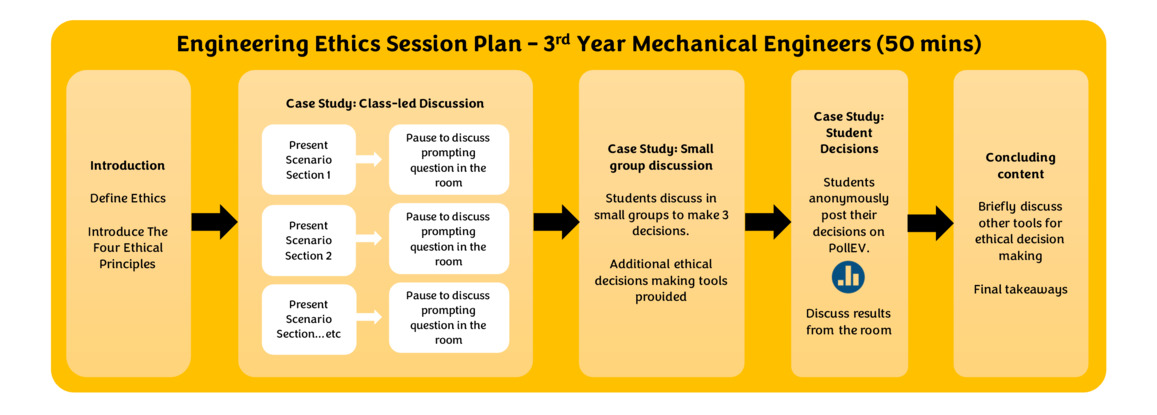
I used the text directly from the case study to make my slides. I introduced the scenario in parts, as recommended, and took questions/thoughts verbally from the students as we went. The students then had access to all of the scenario text on paper, and had 15-20 minutes to agree three decisions on the ethical dilemmas presented in the scenario. Students then had to post their group’s answers on PollEverywhere.
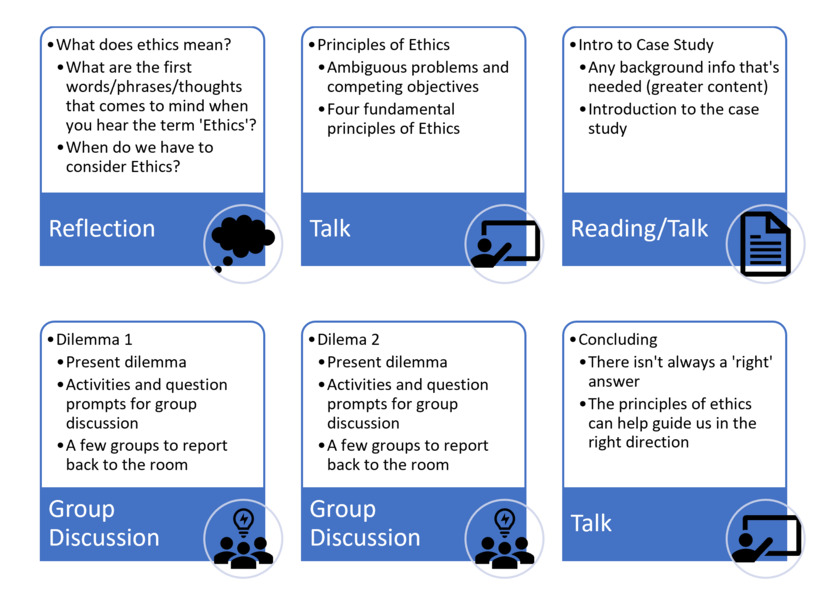
The overall session structure looked like this:
How did it go?
When I ran the session, one key component was ensuring I set my expectations for student participation and tolerance at the start of the session. I openly told students that, if they feel comfortable, they will need to be vocal and participative in the session to get the most from it. I literally asked them – “Is that something we think we can do?” – I got nods around the room (so far, so good).
Overall, the session went better than I could have expected. In fact, I think it was the most hands up I have ever had during a class. Not only did we hear from students who hadn’t openly contributed to class discussion before, but I had to actively stop taking points to keep to time. It made me wonder whether this topic, being presented as one with no wrong or right answers, enabled more students to feel comfortable contributing to a large class discussion. Students were very tolerant of each others’ ideas, and we encouraged differences of opinion.
For the small group discussions, I left a slide up with the three ethical dilemmas and the 7-step guide to ethical decision making as a prompt for those that needed it. During the small group discussions, I and supporting teaching staff wandered around the room observing, listening and helping to facilitate discussion, although this was rarely needed as engagement was fantastic. The small group sessions also allowed opportunities for contribution from those students who perhaps felt less comfortable raising points in the wider class discussion.
To my delight, the room was split on many decisions, allowing us to discuss all aspects of the dilemmas when we came to summarise as a larger class. I even observed one group being so split they were playing rock-paper-scissors to make their decision – not quite the ethical decision making tool we might advertise, but representative of the dilemma and engagement of students nonetheless!
Student feedback
I asked our Student Cohort Representative to gather some informal feedback from students who attended the session. Overall, the response was overwhelmingly positive, here are a few snippets:
“It was the best lecture I’ve had since I’ve been here.”
“The most interesting session, had me engaged.”
“It was the first time learning about the connections between engineering and ethics and it was really useful.”
“I enjoyed the participation and inclusion with the students during the lesson. It has favoured the growth of personal opinions and a greater clarity of the subject and its points of view. Furthermore, the addition of real-life examples gave more depth to the topic, facilitating listening and learning.”
“The session was very engaging and I liked the use of examples… This whole unit has showed me how there are more aspects of engineering to consider apart from just designing something. Engineers must always think of ethics and I believe this session has demonstrated that well.”
And finally, when asked “What was your overall impression of the session?” a student replied “Interesting and curious.” – what more could you ask for?
It was such a pleasant surprise to me that not only did students engage in the session, but they actively enjoyed the topic.
I’ve run it once, how would I improve it?
One thing I would do differently next time would be to allow even more time for discussion if at all possible. As discussed, I had to stop and move on, despite the engagement in the room at certain points.
I also reflect how it might have gone if the students weren’t as engaged at the start. If you have other teaching staff in the room, you can use them to demonstrate that it’s ok to have differences of opinion. A colleague and I openly disagreed with each other on a topic, and demonstrated that this was ok. Additionally, if larger class engagement doesn’t work for you, you could also go straight to the small group discussion.
In summary (and top tips!)
I now feel very comfortable, and excited, to be teaching engineering ethics. It has now also catalysed more content to be created to embed this theme further in our programme – so it doesn’t just become that “one off” lecture. However, I think providing specific time on this subject was very beneficial for the students, it gave them time and space to reflect on such a complex topic.
My takeaways and recommendations from this experience have been:
Don’t be worried about the engagement – students will enjoy it and find it interesting.
Set the expectations for participation and tolerance at the beginning, encouraging that there are no right or wrong answers.
Use the Toolkit as you need it for your context – don’t be afraid to take only snippets from certain parts and make something your own.
Use PollEV or similar to involve the whole cohort and demonstrate the overall difference of opinion in the room
Give a good amount of time for discussion in small groups as well as in the larger class.
All in all, I would recommend the resources on the Engineering Ethics Toolkit to anyone. They can be easily adapted to your own contexts and there is a plethora of resources and knowledge that are proven to engage students and get them thinking ethically.
You can find out more about getting involved or contributing to the Engineering Ethics Toolkit here.
Any views, thoughts, and opinions expressed herein are solely that of the author(s) and do not necessarily reflect the views, opinions, policies, or position of the Engineering Professors’ Council or the Toolkit sponsors and supporters.
In this blog, Dr Matthew Studley, Associate Professor of Technology Ethics at UWE, looks at using case studies from the Engineering Ethics Toolkit to engage students.
Over the last two years, I have been part of the team that created the Engineering Ethics Toolkit for the Engineering Professors Council and the Royal Academy of Engineering. The toolkit is based around case studies, which let students flex their ethical muscles on problems concerning a variety of applications of technology in different fields, and are structured for delivery with examples of exercises, discussion points, and further reading.
We have integrated ethics teaching into all our programmes in the School of Engineering at UWE, Bristol, and this has given me the chance to build lessons on the case studies. I first delivered a session to around 100 Degree Apprentices from a variety of industrial backgrounds. This was exciting!
We first warmed up by discussing how ‘ethics’ is different from ‘morals’, and I suggested that we could view ethics in some ways as like any engineering process; we’re optimising for moral good, rather than cost, strength, or some other non-functional metric. The big difference of course is that it’s hard to determine moral value – how do we measure it?
We discussed if ideas of good and bad are culturally determined and change with time, and whether there might be any universally accepted definitions. We agreed that it would be hard to argue against a course of action if my opinion holds the same weight as yours. Not only is ‘good’ hard to measure, but we can’t agree what it is. So what’s the answer?
The big revelation. The advantage of applied ethics is that we can call upon an external standard which solves part of this problem for us, defining the behaviours and outcomes which are desirable. The Engineering Council and the Royal Academy of Engineering have created a Statement of Ethical Principles for all engineers, which gives weight to our arguments about moral worth. We now know what ‘good’ is.
I used one of the case studies in the toolkit to frame an open discussion in the lecture theatre, with groups discussing the points suggested by the authors. Although our students were from a variety of backgrounds, it wasn’t a disadvantage to use the same case study for all. Feedback from the module leader suggested that the students found the session enjoyable and engaging (apparently, I should do a regular podcast).
After this pilot we have delivered a similar session on a wider scale by tutors to groups of all our final year students. My colleagues suggested that some students were less engaged. I think we might use some role-play next time; get them moving round the room, get them to use their bodies, get them to own the issues. Ethics should engage the heart!
The great biologist E. O. Wilson said, “The real problem of humanity is the following: We have Palaeolithic emotions, medieval institutions and godlike technology.” With more people, having greater resource needs, and the possibility that AI will accelerate our technological development still faster, it seems to me more important than ever to train engineers who are confident and empowered to make ethical decisions.
If you would like to contribute a resource to the Engineering Ethics Toolkit, you can find out how to get involved here.
Any views, thoughts, and opinions expressed herein are solely that of the author(s) and do not necessarily reflect the views, opinions, policies, or position of the Engineering Professors’ Council or the Toolkit sponsors and supporters.
Authors: Ahmet Omurtag (Nottingham Trent University); Andrei Dragomir (National University of Singapore / University of Houston).
Professional situations: Communication; Honesty; Transparency; Informed consent; Misuse of data.
Educational level: Advanced.
Educational aim: Practising Ethical Analysis: engaging in a process by which ethical issues are defined, affected parties and consequences are identified, so that relevant moral principles can be applied to a situation in order to determine possible courses of action.
Learning and teaching notes:
This case involves Aziza, a biomedical engineer working for Neuraltrix, a hypothetical company that develops Brain-computer interfaces (BCI) for specialised applications. Aziza has always been curious about the brain and enthusiastic about using cutting-edge technologies to help people in their daily lives. Her team has designed a BCI that can measure brain activity non-invasively and, by applying machine learning algorithms, assess the job-related proficiency and expertise level of a person. She is leading the deployment of the new system in hospitals and medical schools, to be used in evaluating candidates being considered for consultant positions. In doing so, and to respond to requests to extend and use the BCI-based system in unforeseen ways, she finds herself compelled to weigh various ethical, legal and professional responsibilities.
This case study addresses two of AHEP 4’s themes: The Engineer and Society (acknowledging that engineering activity can have a significant societal impact) and Engineering Practice (the practical application of engineering concepts, tools and professional skills). To map this case study to AHEP outcomes specific to a programme under these themes, access AHEP 4 hereand navigate to pages 30-31 and 35-37.
The dilemma in this case is presented in three parts. If desired, a teacher can use the Summary and Part one in isolation, but Parts two and three develop and complicate the concepts presented in the Summary and Part one to provide for additional learning. The case allows teachers the option to stop at multiple points for questions and/or activities as desired.
Learners have the opportunity to:
analyse the ethical dimensions of an engineering situation;
identify professional responsibilities of engineers in an ethical dilemma;
determine and defend a course of action in response to an ethical dilemma;
practise professional communication;
debate viable solutions to an ethical dilemma.
Teachers have the opportunity to:
highlight professional codes of ethics and their relevance to engineering situations;
address approaches to resolve interpersonal and/or professional conflict;
integrate technical content on software and/or cybersecurity;
informally evaluate students’ critical thinking and communication skills.
Brain-computer interfaces (BCIs) detect brain activity and utilise advanced signal analysis to identify features in the data that may be relevant to specific applications. These features might provide information about people’s thoughts and intentions or about their psychological traits or potential disorders, and may be interpreted for various purposes such as for medical diagnosis, for providing real-time feedback, or for interacting with external devices such as a computer. Some current non-invasive BCIs employ unobtrusive electroencephalography headsets or even optical (near-infrared) sensors to detect brain function and can be safe and convenient to use.
Evidence shows that the brains of people with specialised expertise have identifiable functional characteristics. Biomedical technology may translate this knowledge soon into BCIs that can be used for objectively assessing professional skills. Researchers already know that neural signals support features linked to levels of expertise, which may enable the assessment of job applicants or candidates for promotion or certification.
BCI technology would potentially benefit people by improving the match between people and their jobs, and allowing better and more nuanced career support. However, the BCI has access to additional information that may be sensitive or even troubling. For example, it could reveal a person’s health status (such as epilepsy or stroke), or it may suggest psychological traits ranging from unconscious racial bias to psychopathy. Someone sensitive about their privacy may be reluctant to consent to wearing a BCI.
In everyday life, we show what is on our minds through language and behaviour, which are normally under our control, and provide a buffer of privacy. BCIs with direct access to the brain and increasing capability to decode its activity may breach this buffer. Information collected by BCIs could be of interest not only to employers who will decide whether to hire and invest in a new employee, but also to health insurers, advertising agencies, or governments.
Optional STOP for questions and activities:
1. Activity: Risks of brain activity decoding – Identify the physical, ethical, and social difficulties that could result from the use of devices that have the ability to directly access the brain and decipher some of its psychological content such as thoughts, beliefs, and emotions.
2. Activity: Regulatory oversight – Investigate which organisations and regulatory bodies currently monitor and are responsible for the safe and ethical use of BCIs.
3. Activity: Technical integration – Investigate how BCIs work to translate brain activity into interpretable data.
Dilemma – Part one:
After the company, Neuraltrix, deployed their BCI and it had been in use for a year in several hospitals, its lead developer Aziza became part of the customer support team. While remaining proud and supportive of the technology, she had misgivings about some of its unexpected ramifications. She received the following requests from people and institutions for system modifications or for data sharing:
1. A hospital asked Neuraltrix for a technical modification that would allow the HR department to send data to their clinical neurophysiologists for “further analysis,” claiming that this might benefit people by potentially revealing a medical abnormality that might otherwise be missed.
2. An Artificial Intelligence research group partnering with Neuraltrix requested access to the data to improve their signal analysis algorithms.
3. A private health insurance company requested Neuraltrix provide access to the scan of someone who had applied for insurance coverage; they stated that they have a right to examine the scan just as life insurance agencies are allowed to perform health checks on potential customers.
4. An advertising agency asked Neuraltrix for access to their data to use them to fine-tune their customer behavioural prediction algorithms.
5. A government agency demanded access to the data to investigate a suspected case of “radicalisation”.
6. A prosecutor asked for access to the scan of a specific person because she had recently been the defendant in an assault case, where the prosecutor is gathering evidence of potential aggressive tendencies.
7. A defence attorney requested data because they were gathering potentially exonerating evidence, to prove that the defendant’s autonomy had been compromised by their brain states, following a line of argument known as “My brain made me do it.”
Optional STOP for questions and activities:
1. Activity: Identify legal issues – Students could research what laws or regulations apply to each case and consider various ways in which Neuraltrix could lawfully meet some of the above requests while rejecting others, and how their responses should be communicated within the company and to the requestor.
2. Activity: Identify ethical issues – Students could reflect on what might be the immediate ethical concerns related to sharing the data as requested.
3. Activity: Discussion or Reflection – Possible prompts:
Do you, as a biomedical engineer, have any duty to the people who have been scanned? Do you have more or less of a responsibility to these people or to Neuraltrix?
If you find that a fellow employee has already shared the data without telling others, how should you act? Should you worry that revealing this employee’s actions might cause distress or create distrust in the integrity of the entire system?Is there anyone else you should inform? Are there any risks you may be able to mitigate immediately?
Do you think the reasons and justifications given for the data requests listed above are legitimate?
Who owns the data collected by the BCI? Should it be protected? How, and for how long? Who should maintain it?
Dilemma – Part two:
The Neuraltrix BCI has an interface which allows users to provide informed consent before being scanned. The biomedical engineer developing the system was informed about a customer complaint which stated that the user had felt pressured to provide consent as the scan was part of a job interview. The complaint also stated that the user had not been aware of the extent of information gleaned from their brains, and that they would not have provided consent had been made aware of it.
Optional STOP for questions and activities:
1. Activity: Technical analysis – Students might try to determine if it is possible to design the BCI consent system and/or consent process to eliminate the difficulties cited in the complaint. Could the device be designed to automatically detect sensitive psychological content or allow the subject to stop the scan or retroactively erase the recording?
2. Activity: Determine the broader societal impact and the wider ethical context – Students should consider what issues are raised by the widespread availability of brain scans. This could be done in small groups or a larger classroom discussion.
Possible prompts:
On the one hand, human assessors can be subject to bias and inconsistencies and, from this point of view, algorithmic assessment leaving human assessors out of the loop may be viewed as progress. On the other hand, some “black-box” algorithms used by the BCI have been criticised for opacity, hidden biases, and the difficulty of scrutinising their decisions. If a user is dissatisfied with the BCI-enhanced assessment, should they be able to opt out of it?
If use of the Neuraltrix BCI became widespread, do you believe that humans could eventually irreversibly lose their assessment skills? Compare this with the potential loss of map-reading skills due to the easy access to Satellite Navigation systems.
Can we dispense with human opinion and make assessment processes entirely “objective”?
“Goodhart’s law,” named after the economist Charles Goodhart, states that when a measure is used as a tool, it becomes vulnerable to manipulation. Would Neuraltrix BCI create new opportunities for candidates to “game” the BCIs, and how would they do it?
Dilemma – Part three:
Neuraltrix BCI is about to launch its updated version, which features all data processing and storage moved to the cloud to facilitate interactive and mobile applications. This upgrade attracted investors and a major deal is about to be signed. The board is requesting a fast deployment from the management team and Aziza faces pressure from her managers to run final security checks and go live with the cloud version. During these checks, Aziza discovers a critical security issue which can be exploited once the BCI runs in the cloud, risking breaches in the database and algorithm. Managers believe this can be fixed after launch and request the engineer to start deployment and identify subsequent solutions to fix the security issue.
Optional STOP for questions and activities:
1. Activity: Students should consider if it is advisable for Aziza to follow requests from managers and the Neuraltrix BCI board and discuss possible consequences, or halt the new version deployment which may put at risk the new investment deal and possibly the future of the company.
2. Activity: Apply an analysis based on “Duty-Ethics” and “Rights Ethics.” This could be done in small groups (who would argue for management position and engineer position, respectively) or a larger classroom discussion. A tabulation approach with detailed pros and cons is recommended.
Should you, as a biomedical engineer, follow company rules and go ahead with manager’s requests or risk the future of the company (and possibly your job) and put deployment on hold until the security issue is fixed?
Act utilitarianism principle, as advocated by John Stuart Mill, focuses on individual actions rather than on rule, therefore, actions should be judged based on whether they resulted in the most good outcome in a certain situation. Should the Neuraltrix BCI management be guided by this principle or rather by a cost-benefit approach?
Any views, thoughts, and opinions expressed herein are solely that of the author(s) and do not necessarily reflect the views, opinions, policies, or position of the Engineering Professors’ Council or the Toolkit sponsors and supporters.