For both the Engineering Ethics and Sustainability toolkits, the strategy for promotion and dissemination will focus on 3 priorities:
a. Build awareness of the toolkit by highlighting the need/problem and the resource/solution;
b. Build understanding and engagement by helping educators to know and use the toolkit;
c. Motivate action by getting others to advocate for and champion the toolkits, and to submit further resources.
We can break this down into the following outputs and activities for the Engineering Ethics Toolkit:
|
Who/What/When |
Output or activity |
Notes |
|
|
|
|
|
|
|
|
|
|
|
|
|
|
|
|
|
|
|
|
|
|
|
|
|
|
New content to be informed by:
|
|
|
|
|
|
|
|
|
|
|
|
|
|
|
|
|
|
|
|
The Royal Academy of Engineering’s 2023 Ethics in the Engineering Profession report key findings and recommendations mapped to the Engineering Ethics Toolkit outputs and future activities |
||
| Key findings or recommendations | Output or activity | Notes |
|
Explicit guidance on:
|
|
|
|
|
|
|
|
|
|
|
|
|
|
|
|
|
|
|
|
|
|
|
The EPC’s Engineering Ethics Toolkit is produced in partnership with the Royal Academy of Engineering.We would like to thank everyone who has contributed to making the Toolkit such a useful and vital resource.
If you would like to add or update your bio, please contact Wendy Attwell.
Professor Raffaella Ocone OBE FREng FRSE Raffaella Ocone OBE, FREng, FRSE holds degrees from the Università di Napoli, Italy, and Princeton University, USA. She is the Chair of Chemical Engineering at Heriot-Watt University, UK, and Guest Professor at Ruhr University Bochum, Germany. Currently, she serves as the Deputy President of the Institution of Chemical Engineers (IChemE) and will become the 84th President in 2025. In 2007, Raffaella was honoured with the title of Cavaliere by the President of the Italian Republic. In 2019, she was recognised as one of the top 100 Most Influential Women in the Engineering Sector by Inclusive Boards, in partnership with the Financial Times. In 2017, she became the inaugural “Caroline Herschel Visiting Professor” in Engineering at Ruhr University Bochum, Germany, in recognition of her contributions to engineering ethics. Raffaella’s research primarily focuses on modelling multiphase reactive systems, with a particular emphasis on developing responsible technologies in the energy sector. Her current work centres on advancing low-carbon hydrogen production. Raffaella was Chair of the Engineering Ethics Advisory Group. She is also Royal Academy of Engineering Visiting Professor at Aston University teaching professional skills, ethics, sustainability, global responsibility, inclusive outcomes, and ESG to MSc and Degree apprenticeship students. She is a Fellow of the Royal Academy of Engineering and sits on the Education and Skills Committee, as well as the Africa Engineers Steering Group, and is UK representative of the World Federation of Engineering Organisations, and incoming President of the Commonwealth Engineers’ Council. She is also a Fellow of IOM3 where she sits on the Sustainable Development Group. Professor Mike Bramhall Mike is a Professor at The Engineering and Design Institute (TEDI-London) and has a strong track record in project-based learning and has published widely in innovations in engineering education. His technical subject area is in metallurgy and materials science, having worked in the steel industry before entering academia. In a previous role he was the Assistant Dean for Academic Development for the Faculty of Arts, Computing, Engineering & Sciences at Sheffield Hallam University of which he is now an Emeritus Professor. Mike has been on Quality Assurance Agency (QAA) teams for Subject Review, Higher Education Review, Quality Review Visits and Quality and Standards Review for a wide range of Universities, Further Education colleges and alternative providers. Mike is a Fellow of the Institute of Materials, Minerals and Mining and is also an active member and on the Board of the UK Engineering Professors’ Council, serving on the Ethics task group, and being the Chair of its Recruitment and Admissions sub-committee. Mike worked nationally as an Associate Director of the Materials Subject Centre from 2003 to 2012 at the University of Liverpool. Mike is also a National Teaching Fellow and a Principal Fellow of the Higher Education Academy (HEA). Emma Crichton Engineering shapes our world, and Emma dedicates her career to reshaping how we engineer to secure a safe and just future for all. Emma is a chartered civil engineer with over a decade of experience in the water and social sectors across the UK and India. A trained facilitator and passionate advocate for globally responsible engineering, Emma currently serves as Innovation Director at Engineers Without Borders UK, where she has expanded educational initiatives to deliver over a million hours of learning on globally responsible engineering annually. Beyond her role at Engineers Without Borders, Emma is a trustee at Azuko, an architecture charity, and chair at the Useful Simple Trust, a certified B-Corp and Social Enterprise. She also represents Engineering UK on the board of the Engineering Council, the UK’s regulator for the engineering profession. Claire Donovan Jarka Glassey Professor Jarka Glassey completed her biochemical engineering studies at the Slovak Technical University in Bratislava and currently works at Newcastle University, UK. Her research approach is based on the use of machine learning, AI and hybrid modelling for bioprocess development, scale-up and process intensification. She is currently VP Executive of EFCE and VP Executive of ESBES and is actively involved in the EFCE working party on Education as well as the Measurement, modelling, monitoring and control section of ESBES. She was elected a Fellow of Royal Academy of Engineering and is chairing the Board of Engineering Skills X, Engineering Skills for Safety. She is passionate about the education of future generations of chemical engineers and her research in this area includes active teaching methodologies (such virtual and augmented reality) in education and assessment of knowledge and professional skills. She has served as project manager for the EPC’s Ethics and Sustainability Toolkit initiatives, is Transferable Skills Lead for the Centre for Advanced Timber Technology at NMITE and is Visiting Professor in the School of Computing, Engineering, and the Built Environment at Edinburgh Napier University. She has led national and international workshops on interdisciplinary learning and teaching and worked with academic and industry partners on various engineering education initiatives. She has recent publications in the International Journal of Engineering Education and The Journal of Problem-Based Learning in Higher Education. Dr. Sarah Junaid Sarah Junaid, MEng, PhD, CEng (MImechE), PFHEA is a Senior Lecturer and former Programme Director in Mechanical Engineering and Design Engineering at Aston University, Birmingham, UK. Her pedagogical research interests include student learning, engineering ethics and professional skills development. She is one of the original Advisory Group members of the Engineering Ethics Toolkit, served as a Member-at-Large at the International CDIO Counsel, a member of the steering committee at the European Society for Engineering Education SEFI Special Interest Group in Ethics, team lead in ethics policy work, and a contributor to The Routledge International Handbook of Engineering Ethics Education 2025. She has led regional and international academic teams and workshops on developing ethical skills within engineering programmes. She is a collaborator in several British Council international partnerships enabling knowledge and skills exchange on engineering education and programme development with Pakistan and South Africa. Steven Kerry Steve Kerry is the Senior Manager: Ethics within the Group Ethics and Compliance Team at BT Group plc. He has been with BT Group plc for three years, and prior to this he spent sixteen years at Rolls-Royce. He’s been in the Ethics and Compliance space for eleven years. Prior to this he held several positions within the Human Resources function. His current main responsibilities include: Professor Thomas Lennerfors Thomas Taro Lennerfors is a professor and Head of the Division of Industrial Engineering and Management at Uppsala University, Sweden. He is interested in exploring the connections between ethics and philosophy on the one hand and business and technology on the other. His most recent ethics-related books are Ethics and Sustainability in Digital Cultures, co-edited with Kiyoshi Murata (Routledge, 2023), Ethics in Engineering (Studentlitteratur, 2019), and Tetsugaku Companion to Japanese Ethics and Technology, co-edited with Kiyoshi Murata (Springer, 2019). Dr. Darian Meacham Darian Meacham is Professor of Practical Philosophy and Chair of the Philosophy Department at Maastricht University in the Netherlands, He is also Principal Investigator for Ethics and Responsible Innovation at the BISS Institute. He studied at McGill University in Montreal, Canada (BA) and University of Leuven, Belgium (MA, PhD). Prior to working in the Netherlands, he worked in the United Kingdom at UWE, Bristol. Professor Chike Oduoza Chike F Oduoza CEng, FIChemE, SFHEA is a Professor in Process and Manufacturing Engineering and Head of Chemical Engineering at University of Wolverhampton, UK. He has been employed in UK HEI for almost 31 years, during which he won research grants from Industry, EPSRC, and EU FP7, and has published many research papers in journals and conferences, books and book chapters. He has a variety of research interests including on themes underpinned by NetZero carbon emissions, environmental sustainability, cleaner energy, and circular economy. He has supervised 32 PhD students to completion on topics such as electroplating and corrosion protection of metals, process risk management, management and economics of gas flaring, life cycle assessment and remediation of oil spills, cloud computing applied to oil exploration, modelling and characterisation of bidirectional multiphase flow in vertical tubes, and modelling of hydrogen blended combustion of natural gas. He was UK Chair, Society of the Chemical Industry, Electrochemical Technology Group (2006 – 2010), member EPSRC Peer Review College, and Evaluator for European Union Horizon 2020 and Horizon Europe. He sits on the UK Engineering Education and Employability Skills (EEES) committee of the Engineering Professors Council, and UK Engineering Ethics Committee. He is a member of several international scientific and technical committees, and a former member of the Board of Directors Supergen Hydrogen and Fuel Cell Research group. He is Guest Editor of Robotics and Integrated Manufacturing and International Journal of Advanced Manufacturing Technology. Dr. Ahmet Omurtag Goudarz Poursharif CEng SFHEA He is the Chair of Institute of Environmental Management and Assessment’s Birmingham Steering Group and the Chair of Sustainable Development in Teaching working group at Aston University. His two main passions are education and engineering for a sustainable development, so since 2012, Goudarz has combined his two main passions by embedding Education for Sustainable Development (ESD) in the Engineering curricula of both University of Sheffield and Aston University as well as working directly with industry to upskill their sustainability skills. He has funded the Engineering for People Design Challenge at Aston University and co-led the development and implementation of MSc Sustainable Engineering Aston University. Before joining the EPC, Johnny has already worked on many issues of concern to our members. Over the past 25 years, he led Push’s research – such as on drop-out rates and student debt – which has had direct impacts on policy. Johnny’s thought leadership, such as his papers for a graduate levy and a national access fund (2018) and on employability (2015) for the Higher Education Policy Institute, have been influential throughout the sector. Policy issues are also a significant part of his consultancy work, along with communications. His clients have included the European Commission, HEFCE, U-Multirank, as well as many universities, recruiters and charities. He’s a regular speaker at conferences, awards and in schools. In 2013, his novel A Human Script was published. Matthew Studley Matthew Studley’s career in robotics has been driven by a commitment that Godlike Technology results in more good than harm, and that it should be possible for citizens to influence the future beyond the laissez-faire approach of abnegating responsibility to market forces. As the co-Director of the Bristol Robotics Laboratory, he drives strategic initiatives, fosters international collaborations, and ensures research aligns with ethical standards. His work spans robotics, machine learning and AI, autonomous weapons, standards and sustainability, with a keen focus on embedding ethics into every stage of technological development. He serves as a board member for the European Robotics League via euRobotics aisbl, where he advances ethical frameworks and international robotics competitions. Professor Mike Sutcliffe Jonathan Truslove Dr Jonathan Truslove is the Education and Skills Lead for Engineers Without Borders UK. He develops opportunities to learn about how to put global responsibility at the heart of how engineering is taught and practiced, including learning pathways to develop competencies in global responsibility, practical ways of reimagining engineering curricula and driving change in engineering education, and international design challenges to broaden participants’ awareness of the social, environmental, economic, and ethical implications of engineering alongside technical skills. He leads the research and development of Engineers Without Borders UK’s educational portfolio, and monitoring and evaluation of the organisation’s impact. Jonathan is an interdisciplinary researcher with expertise in the value and relationship between sustainable infrastructure and communities. He has experience in water and sanitation access in rural and challenging environments in Scotland, Rwanda, Malawi and Cambodia. Jonathan was awarded his PhD in 2020, through the Scottish Government Climate Justice Fund Water Futures Programme which focussed on addressing the sustainability burden placed on rural communities in Malawi by the drive to meet global coverage targets. Dr. Nicola Whitehead William Bennett is a Lecturer and Chartered Civil Engineer in the Department of Civil Engineering at Swansea University, with a background in modelling coastal processes. He currently teaches on a range of modules and topics from fundamental theory, to professional skills, and is interested in approaches to integrate and embed skill development to scaffold support through the student journey. Dr. Jude Bramton Dr. Jude Bramton is a Senior Lecturer in the School of Electrical, Electronic & Mechanical Engineering, and Programme Director of Mechanical Engineering at the University of Bristol. She holds a PhD in Materials Science from the University of Oxford, and worked as a qualified Engineering Project Manager in industry before coming back to teaching in academia. She currently teaches design and manufacturing, and engineering management to primarily undergraduate students and is an accredited Fellow (FHEA) of the UK Higher Education Academy. Andrei Dragomir Kathryn Fee Nina Fowler Patric Granholm Martin Griffin Martin is a neurodivergent (autistic, dyslexic, dyspraxic) and visually impaired Geotechnical Engineer with the consultancy GHD. He has 20+ years of professional experience working for UK-based international consultancies on national and international engineering projects specialising in ground risk management, ground models and material characterisation. He is a Chartered Engineer, a Fellow of The Institute of Materials, Minerals & Mining, a Chartered Geologist, a European Geologist, and a Fellow of the Institute of Diversity and Equality Professionals. Currently, he is serving as the Geological Society Vice President for Equity, Diversity and Inclusion, a former committee member of several other national executives, and a Chartership Assessor. He is a mentor, blogger, writer, presenter, advisor, and collaborator with several UK universities concerning disability and neurodiversity in STEM. He is the inaugural chairperson of the Equal Engineers Neurodiversity Network and leads GHD’s Employees Resource Group for Neurodivergent staff. He spends approximately 20% of his work time on all aspects of EDI, from policy framing to coaching others. Finally, he is a national multiple-award winner Equity, Diversity and Inclusion for being a passionate role model, focused engineer, and tireless influencer making workplaces and society more equitable and inclusive to one and all. Isobel Grimley Alison Gwynne-Evans James E. Harper Senior Product Manager, Knovel /Elsevier Cortney Holles Dr. Irene Josa She is interested in interdisciplinary research at the intersection between engineering and socio-environmental systems. She believes in sustainable engineering as key for making this world a better place by improving people’s quality of life and solving several of today’s most important global challenges. She is also a member of the EPC’s Ethics Ambassadors community. Konstantinos Konstantis Konstantinos Konstantis is a PhD Candidate at the Department of History and Philosophy of Science, National and Kapodistrian University of Athens, Greece. The title of his dissertation is “Contextualizing the Emergence of Engineering Ethics”. He has a Master’s degree in STS and he has also graduated from the School of Electrical and Computer Engineering, National Technical University of Athens. He is a Visiting Student (January 2024 – April 2024) at the Leverhulme Centre for the Future of Intelligence, University of Cambridge and he was the 2022 Elizabeth & Emerson Pugh Young Scholar in Residence at the IEEE History Center. Dr. Gill Lacey Dr Gill Lacey is a Senior Lecturer in Electrical Engineering, MIEEE (2012), MIET (2017). Her focus is low carbon technologies, especially Smart Grid and the effect of EV charging on networks. She runs courses around decarbonising the electricity grid and renewable energy, together with entry level 3 courses designed to equip students with the relevant skills for undergraduate engineering. Partnerships with industry, such as offshore wind installers, community energy charities and local entrepreneurs, make the courses relevant, interesting and aspirational. She is passionate about sustainable technologies; with rooftop solar, domestic storage, and a driver of electric vehicles for ten years, this is more than a job, it is a way of life. Diana Martin Dr. Sandhya Moise Sandhya Moise, AMIChemE, FHEA completed her PhD in Biomedical Engineering from Keele University, UK, and is currently a Senior Lecturer at the Department of Chemical Engineering, University of Bath. Her research interests include bioprocess engineering and cancer diagnostics. She teaches Ethics in Engineering and has been involved in initiatives to introduce and integrate ethics and social justice topics within engineering education. Onyekachi Nwafor Onyekachi Nwafor is a seasoned professional in the field of renewable energy and energy transition, with a strong passion for sustainability and driving the transition towards a low-carbon economy. He is currently the CEO of KatexPower. His expertise includes designing and implementing solar PV systems to provide clean and sustainable energy services to off-grid and underserved communities. Onyekachi is also the membership manager for Western Africa at the Global Waste Cleaning Network, advocating for environmental protection and waste management. With a background in electrical engineering, green energy, and climate finance, he is also a certified energy transformation expert. He has actively participated in various international conferences and workshops, where he shares his knowledge and experiences with industry experts and institutions. Alasdair Reid Elizabeth Robertson Neil Rogers Neil is a solar PV engineer and renewables enthusiast, having spent many years designing, testing and commissioning solar PV systems throughout the world, for such applications as telecoms, cathodic protection and well-head control to name but a few. His expertise also includes product design of high volume solar powered consumer products, as well as low volume control and monitoring systems, to interact with both amorphous and crystalline solar cells with various battery technologies. Recently he spent his time as an academic, teaching and lecturing around the UK in electronic engineering and solar PV systems. Having experienced many years volunteering and working in developing countries throughout the world, he is aware that there is a need for a locally made solar power supply. He is currently helping to develop such a range of products with various companies in sub-Saharan Africa. Professor Manuela Rosa Dr Manuela Rosa graduated in Civil Engineering (University of Lisbon), holds an MSc in Renovation of Architectural and Landscape Heritage (University of Évora) and a PhD in Land Use Planning and Environmental Strategies (University of Seville). She is Associate Professor at Institute of Engineering of University of Algarve, where she lectures on Sustainability, Sustainable Urbanism, Sustainable Mobility and Inclusive Design. She was the scientific coordinator of the ACCES4ALL Project – Accessibility for all in Tourism (2017-2019) and the co-coordinator of the Project SusTowns – Enhancing SUStainable tourism attraction in small fascinating med TOWNS (2020-2022). She is an integrated member of the Research Centre for Tourism, Sustainability and Well-being – CINTURS. She is a contributor to the EPC’s Engineering Ethics Toolkit and Sustainability Toolkit, and a member of the EPC’s Ethics Ambassadors community. Dr. J.L. Rowlandson Karin Rudolph Karin Rudolph is the Founder of Collective Intelligence, a Bristol-based consultancy that provides resources and training to help startups, and SMEs embed ethics into the design and development of technology. She is currently preparing the launch of the Ethical Technology Network, a pioneering initiative to help businesses identify, assess, and mitigate the potential ethical and societal risks of AI and other emerging technologies. Ekaterina Rzyankina Paola Seminara Paola Seminara is a Research Assistant at Edinburgh Napier University (ENU) supporting the Housing, Construction, and Infrastructure (HCI) Skills Gateway in delivering integrated inclusive routes to construction careers. With research expertise in building performance, application, and utilization of wood-based materials, in 2023, right after completing the MSc in Architectural Technology & Building Performance at ENU, Paola started a new journey as a PhD candidate at the University of Edinburgh. Her research is titled “Experimental Performance Optimisation of Homegrown Natural Fibre Insulation for Building Decarbonisation”. Beyond her professional life, Paola is deeply passionate about engineering ethics and experiential learning. She believes in stakeholder engagement, integrated strategy, and gender equality as essential pillars for fostering a sustainable construction industry. Yann Serreau Dr Emma Taylor CISSP CEng Founder of E-DAP. Chartered Engineer with 30+ years across rail, energy, and space. Chief Engineer IET 2024 and RAEng Visiting Professor at Cranfield University. Dr. Fiona Truscott Fiona Truscott has a BA/MSc in Natural Science (Chemistry) from the University of Cambridge and a DPhil in Organic Chemistry from the University of Oxford. Following her PhD, she conducted postdoctoral research on the interface of Biology and Chemistry at the ICSN, part of the CNRS Delegation Ile-de-France Sud. She then moved to conduct postdoctoral research in the Department of Biochemical Engineering, UCL, working on the application of automation technology to Biochemical Engineering. Currently she is an Associate Professor (Teaching) with the Integrated Engineering Programme and Centre for Engineering Education in the Faculty of Engineering at UCL. She is the Engineering Challenges Module Lead, a cross faculty, large scale team project module for first year undergraduates. She is a Senior Fellow of the Higher Education Academy and co-chair of the SEFI DEI Special Interest Group. Her current research interests are interdisciplinary teaching, teamwork and the embedding of social factors in Engineering Education. Dr. Natalie Wint She is actively involved in the area of curriculum development and quality assurance and has published book chapters in the area of engineering ethics. She is Co-Editor of Studies in Engineering Education, Associate Editor of the Journal of Engineering Educations and co-hosts the SEFI Engineering Educators Podcast. Associate Professor Scarlett Xiao, PFHEA Dr. Yujia Zhai Madeline Polmear Madeline Polmear is a lecturer in engineering education at King’s College London. Her research interests relate to engineering ethics education and the development of societal responsibility through formal and informal learning. Madeline received her PhD in civil engineering at the University of Colorado Boulder, USA and completed a postdoc in engineering education research at the University of Florida. Prior to joining KCL, she was a Marie Sklodowska-Curie, EUTOPIA Science & Innovation Cofund Fellow at the Vrije Universiteit Brussel, Belgium where she led an interdisciplinary research project on macroethical development among civil and architectural engineering students. She is a contributor to The Routledge International Handbook of Engineering Ethics Education 2025 and The Routledge International Handbook of Engineering Education Research 2023. Madeline is the Content Review Coordinator for the Engineering Ethics Toolkit. 
Heriot-Watt University

TEDI-London

Engineers Without Borders UK

Royal Academy of Engineering

Newcastle University

Aston University

BT Group plc / Rolls-Royce

Uppsala University

Maastricht University

University of Wolverhampton

Nottingham Trent University

Aston University

UWE Bristol

TEDI-London

Engineers Without Borders UK

University of Wales Trinity Saint David
Engineering Professors’ Council (Research and Editorial Executive)

University of Bath

Ultra Group

Swansea University

University of Bristol

National University of Singapore, University of Houston

Queen’s University Belfast

Uppsala University

Åland University of Applied Sciences

Knight Piésold Consulting

Enginering Professors’ Council

University of Cape Town


Colorado School of Mines
University College London

National and Kapodistrian University of Athens
Teeside University

UCL

University of Bath

KatexPower

Edinburgh Napier University

University of Strathclyde
Independent Scholar

Algarve University

University of Bristol

Collective Intelligence

University of Cape Town

Edinburgh Napier University

CESI

Cranfield University

UCL

UCL

University of Hertfordshire

University of Hertfordshire

King’s College London
Have you used our Engineering Ethics Toolkit in your teaching? We want to hear from you!February 2022 saw the launch of our Engineering Ethics Toolkit, with a range of case studies and guidance articles available to help engineering educators embed ethics into their modules and curriculum.
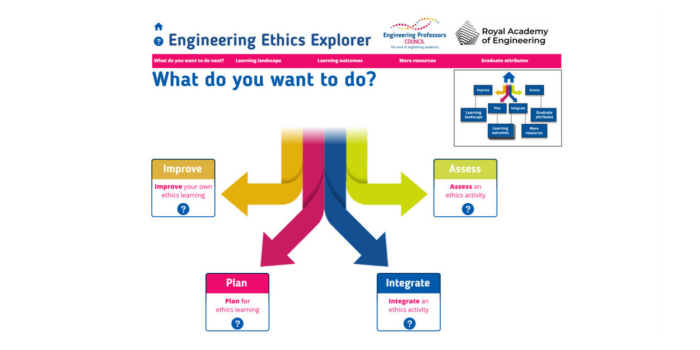
In March 2023 we published further guidance articles and case studies, as well as enhancements on some of the classroom activities suggested within our original cases. June 2023 saw the launch of the interactive Ethics Explorer, which replaced the static engineering ethics curriculum map from 2015. Since then the Toolkit has continued to grow.
More and more engineering educators are telling us that they use these resources, and are finding them invaluable in their teaching. A brave few have contributed blogs, detailing their methods of using and adapting our case studies and classroom activities, and giving an honest appraisal of their own learning curve in teaching ethics.
We’ve heard about leaning in to your discomfort, first time fear, and letting students flex their ethical muscles.
We would love to publish more of this type of content. We want to hear your experiences, good or bad, along with tips, potential pitfalls, what you added to our content in your teaching, and what you and your students got out of the experience. If you have students who are enthusiastic about sharing their thoughts, we would love to hear from them too.
We’d like you to send us your feedback, testimonials or blogs, whether that be a couple of sentences or paragraphs, or a full article with diagrams, or anything in between.
If you have just a few minutes, please complete our questionnaire.
If you have more to say, you can submit a blog post about your experiences.
We look forward to hearing from you.
This post is also available here.
Any views, thoughts, and opinions expressed herein are solely that of the author(s) and do not necessarily reflect the views, opinions, policies, or position of the Engineering Professors’ Council or the Toolkit sponsors and supporters.

We were very pleased to be accepted to present a workshop at the 2023 SEFI Conference in September: Using a practical toolkit for embedding ethics in the engineering curriculum.
This workshop emphasised the need to embed ethics into the engineering curriculum, highlighted that behaviours such as inclusivity and sustainability must become instinctive – golden threads running through everything that engineers think and do – and posited that engineering programmes must be proactive in bringing engineering ethics to the fore in order to equip future engineers with the skills and mindset they need to succeed.
The workshop, in which over two dozen engineering educators from around the world participated, showcased the Engineering Ethics Toolkit and introduced a pragmatic approach to integrating ethics content into teaching, using examples and a detailed and interactive curriculum map, which connects the elements of the toolkit.
One of the presentations used in the workshop – Using a constructive alignment tool to plan ethics teaching – can be accessed and downloaded from here.


You can also view this post here.
Use this form to submit a blog for inclusion in the EPC’s Engineering Ethics Toolkit.
Blogs should be written by academics and other engineering professionals. They can be on various topics related to engineering ethics education, including personal experience of using the Engineering Ethics Toolkit. Blog posts can be formal or informal, short and on a single topic, or longer and more considered. There are no hard and fast rules for blog content or style, as long as the theme is clear and related to engineering ethics, and the content will useful to engineering educators. You can see examples of the personal blogs that we publish here.
Note: If you worked with co-authors, they must complete this form.
The Engineering Ethics Toolkit is a suite of interactive resources, guidance and teaching materials that enables educators to easily introduce ethics into the education of every engineer. We would like to ensure that all universities with Engineering departments are aware of the toolkit and able to make use of it.To this end, we’ve produced a pack of resources that can be distributed to relevant departments and staff members such as Engineering department heads, staff and administrators, as well as Vice-Chancellors, Deans, and anyone else who may find our resource useful in teaching or curriculum development.
We would be very grateful if you could share these resources, and encourage you to explore and use them in your teaching.
Our pack of resources to help you present and promote the Engineering Ethics Toolkit contains the following files, and can be downloaded individually below, or as a pack from here.
Information on the toolkit (PDF)
01. Engineering Ethics Toolkit – key talking points
02. Media release July 2023 – Engineering Professors’ Council
03. Engineering Ethics – overview
Sample resources (PDF)
04. Engineering Ethics Toolkit – Advice and Guidance – Why integrate ethics in engineering
05. Engineering Ethics Toolkit – Case study – Developing an internet constellation
06. Engineering Ethics Toolkit – Case enhancement – Developing an internet constellation
Promotional display posters (PDF)
07. Engineering Ethics Toolkit – poster
08. Ethics Explorer – poster
09. [Item removed]
Promotional images (JPG)
10. Engineering Ethics Toolkit Logo
11. Ethics Explorer front page
12. Students at TEDI-London
13. Students in discussion
PowerPoint slides (pptx)
14. Engineering Ethics Toolkit – Overview
15. Engineering Ethics Toolkit – Talking points
16. [Item removed]
You can download the entire pack from here.
If you have any questions or comments about this resource, please contact w.attwell@epc.ac.uk.
This post is also available here.
Within the EPC family, our members have continued to face enormous challenges and the EPC offers thoughtful leadership and representation to ensure we can best support our members in meeting these challenges. Alongside events and blogs, members can access the EPC’s online bank of best practice resources such as out toolkits and our data explorer. Click on each of the tabs below to see some of our highlights:
We are excited to inform you that we are starting work on our Sustainability Toolkit, to be launched around the beginning of 2024. We are grateful to receive support and funding from Siemens and The Royal Academy of Engineering on this project.
There is an urgent need to increase sustainability awareness and skills. This is especially important for Engineering education so that all new graduates are motivated and equipped to tackle the serious sustainability challenges facing the environment and society.
To achieve this the Engineering Professors’ Council (EPC) is developing a toolkit for UK Engineering academics to ensure that sustainability is essential to and fully integrated within the learning of Engineering students. The toolkit will be open source and in time it will be connected with similar projects to create a global resource for Engineering educators.
While many excellent resources explain the sustainability knowledge, skills, and mindsets essential for 21st-century engineers, very few resources exist that support engineering educators to integrate these into their teaching in a comprehensive and effective way.
The aim of this project is to develop and curate a toolkit of resources that help academics explicitly embed sustainability in their day-to-day practice of engineering teaching, and to help make sustainability integral to rather than tangential to engineering learning.
Work has already begun and we are making progress with guidance from our Sustainability Toolkit Steering Group. The steering group is composed of academic, industry, and advocacy leaders who are passionate about sustainability and it will help guide the development of outputs such as those created for the EPC’s Engineering Ethics Toolkit. It will work alongside our project partners, including the Royal Academy of Engineering, Siemens, and the Lemelson Foundation which has supported work on a similar initiative in the US. The project will run from February through December 2023.
We will update you on the progress and look forward to launching the toolkit in 2024.
The EPC was delighted to announce the official third phase of our Engineering Ethics Toolkit in February 2023. This growing resource is being developed by the EPC with the generosity and support of the Royal Academy of Engineering, as part of the profession’s on-going work to embed ethical practice into the culture of engineering.
The EPC’s 2021-2023 President Prof. Mike Sutcliffe wrote a short blog to welcome you to this ambitious new initiative to ensure engineering education is a force for good, which you can read here.
The first and second phases in the development of the ethics toolkit involved the creation and publication of a range of case studies and guidance articles to help engineering educators integrate ethics content into their teaching.
The launch of our case studies and guidance articles, and the importance of these resources and embedding ethics into engineering education was reiterated by Prof. David Bogle just before our toolkit was live at the launch of the 2022 “Engineering Ethics: maintaining society’s trust in the engineering profession” report from the joint Engineering Council / RAEng, Engineering Ethics Reference Group. Our case studies come under the Education and Training actions of this report, which aim to support and improve how ethics is understood by those in the engineering profession.
2023 has seen the development of activity enhancements for nine of our case studies, as well as the publication of thirteen new case studies and eight new guidance articles, bringing our total up to 25 case studies, nine enhancements, and twelve guidance articles.
In addition, we have updated the static ethics curriculum map into the interactive Ethics Explorer, which helps educators to get started on or develop their ethics journey, meeting them where they are at any stage of experience, and helping them to understand, plan for and implement ethics learning.
This new content was launched in a well-attended webinar in March this year.
March 2023 also saw the launch of Ethics Ambassadors – a new community of practice created to champion the Toolkit and support educators embedding ethics into engineering.
We are currently working on further projects to enhance and promote the Engineering Ethics Toolkit, including:
These will all be rolled out by the end of 2023.
The EPC’s Research, Innovation and Knowledge Transfer (RIKT) Committee put out a call in July 2021 for members to submit academia-industry partnership case studies. By the end of the call, nearly 50 applications were received and a sub-group of the RIKT Committee shortlisted 25 of these to be presented at an online launch webinar for the Crucible Project on the 16th February 2022. Over 120 attendees joined us for this online event which saw a huge range of case studies outlining innovative and engaging collaborations between academia and industry, as well as a guest lecture by Prof. John Patsavellas (Cranfield University).
Subsequent to this, the Crucible Project Toolkit was launched on the EPC website in April 2022 to showcase the case studies presented at the event but also many more – access to these individual case studies is an exclusive EPC member benefit. The RIKT Committee envisions this toolkit as a living and growing resource to help EPC members to find research funding, place graduates in employment, create work-based learning opportunities and so on. Next steps for the Crucible Project Toolkit include a system to allow members to contribute their own, or further case studies to ensure that this resource continually grows.
As part of the development of EPC Online we have created the Data Explorer feature – this members-only resource presents data visualisations specially designed to help EPC members explore a wealth of engineering sector datasets and to show data customised to the interest of Engineering academics in any discipline. The data is arranged according to population:
These sections each contain a variety of questions that can be explored through interactive charts and tables. Additionally, members are able to download the dataset can be downloaded to allow sorting and presenting in ways that will be most helpful to them.
This led to the clear action for the EPC to promote engineering ethics more proactively and adopt clear ethical positions.
A key aspect of this is enabling the embedding of ethical best practice into the UK engineering higher education curriculum through creation of an ‘Engineering Ethics Toolkit’.
Please find a wide selection of resources related to this campaign below, including the Engineering Ethics toolkit (created by the Engineering Professors’ Council with support from the Royal Academy of Engineering).