Who is this article for?: This article should be read by educators at all levels of higher education looking to embed and integrate complex systems topics into curriculum, module, and / or programme design.
Premise:
Teaching and learning engineering carries with it a double layer of complexity. On the one hand, this complexity is connected to the growing interdisciplinary nature of engineering itself. On the other hand, the complexity is connected to the growing diversity of engineering students that are often present in one project team. This multifaceted complexity requires a re-envisioned understanding of the role and purpose of the engineering educator.
With the growing trend of a global classroom reality, we often find that learners in the classroom are representing different cultures, which in turn are rooted in them unconsciously carrying historical and socio-cultural baggage relating to these cultures. Thus, it becomes crucial to unpack the challenge and potential that such a diverse collective intelligence can offer to an engineering learning experience.
As our understanding of the engineering discipline gets more rooted and interconnected with the precarious reality that our world is witnessing today, it becomes essential that the engineering education community would take up a proactive role in actively contributing to the formation of engineering citizenship. In other words, every engineering student should be educated as a citizen that has mastered the engineering cross-cutting fields in such a way that they are free to create and solve problems of the present and the future.
With this in mind, it becomes very clear that the one-size-fits all model of a single discipline engineering classroom can no longer sustain itself. It does not factor in the richness that a diverse student body can offer, and it dilutes the value and potential of an engineering learner to think clearly or solve problems. It is therefore imperative that engineering educators grasp the complex reality of an integrated engineering discipline and address it in a way that fosters scaffolding of diverse knowledge. Some students might specialise in one core technical discipline. Yet, future projections for most students showcase the need to have a wide level of exposure to broader competency development. Students need to learn to understand the field of engineering at large and to develop system thinking skills that enable them to exist, challenge and have an impact on the system that they are a part of.
How to scaffold learning outcomes in a complex engineering curriculum:
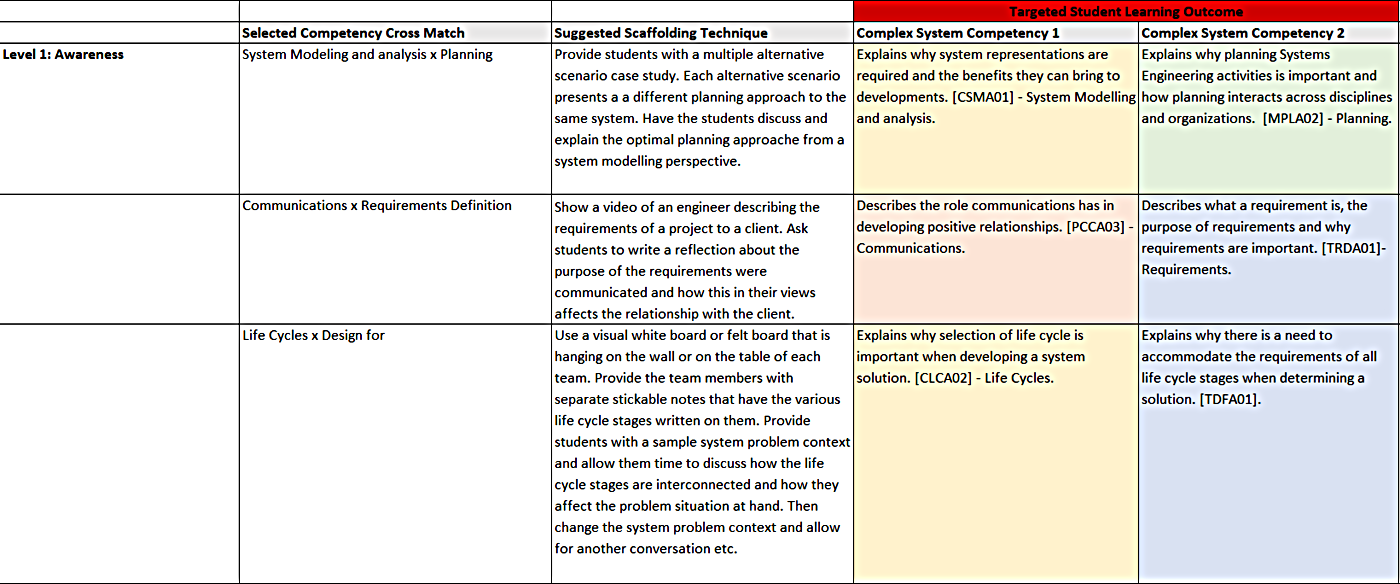
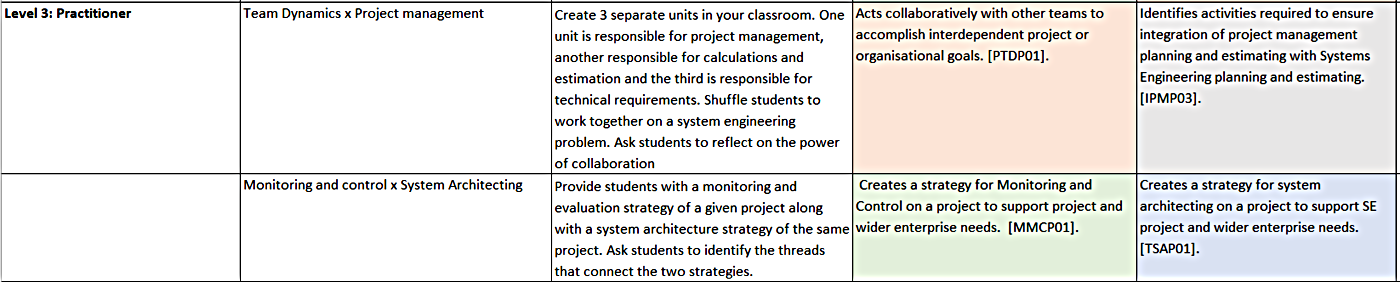
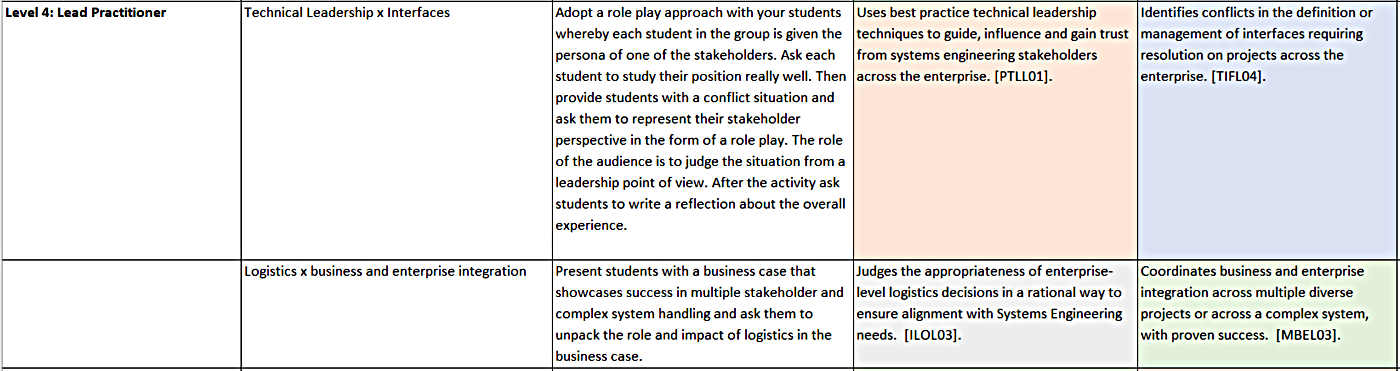
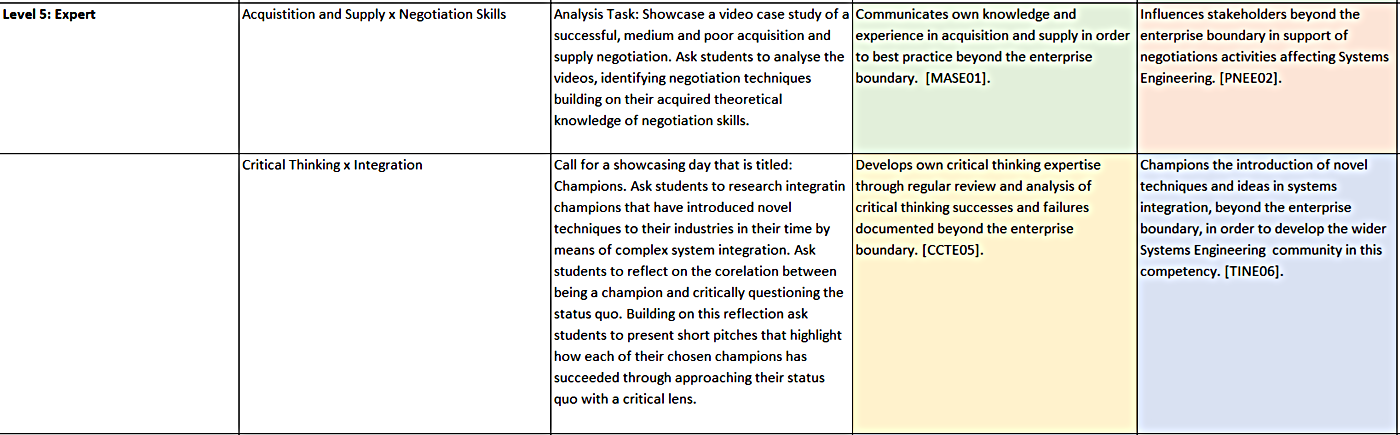
The below table has been designed for embedding Complex Systems Learning Outcomes across an engineering curriculum. It maps against competencies and suggests scaffolding techniques across educational levels. It is also important to note, that efforts need to be made to align to the relevant AHEP requirements or other accreditation standards. Table 1 presents the different strands of the Complex Systems Engineering Curriculum, colour coded in line with the INCOSE Competency Framework outline (INCOSE, 2025). Table 2 presents a practical guide for educators to scaffold Complex Systems learning outcomes across a curriculum. The intention is for the scaffolding framework to compare the trade-offs between different elements of the competency group. For example, system modelling and analysis as an element from the core competency and planning from the management competency. The table suggests activities that would integrate different competencies together in a scaffolded approach.
Table 1 presents Competency Areas for Complex Systems. As mentioned, the skills range to include a wide variety of competencies, thereby enabling a solid and grounded systems thinking approach for students. As students approach their learning, they go through a series of development stages that gradually build up student level of expertise until they reach the stage of what the INCOSE competency framework refers to as a lead practitioner role. Building on the competencies of the complex system toolkit presented in Table 1, Table 2 presents a potential outline for a scaffolding framework that maps varying threads of the framework in a way that enables scaffolded activities at every developmental stage for learners. Depending on the learning context and educational level, educators can choose which level of attainment is appropriate to their curriculum.
As we are approaching the fuzzy front end to complexity in engineering pedagogy, as educators we need to be constantly toggling between devising frameworks, being informed by literature, contextualising ideas, validating these in our classrooms and repeating this cycle to continually fine-tune our complex teaching navigational complexity framework. The invitation is open for all educators who would like to connect as we continue to explore different ways of developing responsible engineers who leave a lasting and sustainable mark transforming their stationed realities.
Any views, thoughts, and opinions expressed herein are solely that of the author(s) and do not necessarily reflect the views, opinions, policies, or position of the Engineering Professors’ Council or the Toolkit sponsors and supporters.
Related INCOSE Competencies: Toolkit resources are designed to be applicable to any engineering discipline, but educators might find it useful to understand their alignment to competencies outlined by the International Council on Systems Engineering (INCOSE). The INCOSE Competency Framework provides a set of 37 competencies for Systems Engineering within a tailorable framework that provides guidance for practitioners and stakeholders to identify knowledge, skills, abilities and behaviours crucial to Systems Engineering effectiveness. A free spreadsheet version of the framework can be downloaded.
This resource relates to the Systems Thinking, Systems Modelling and Analysis, Ethics and Professionalism, Technical Leadership and Critical Thinking INCOSE Competencies.
AHEP4 mapping: This resource addresses several of the themes from the UK’s Accreditation of Higher Education Programmes fourth edition (AHEP4): Analytical Tools and Techniques (critical to the ability to model and solve problems), and Integrated / Systems Approach (essential to the solution of broadly-defined problems). In addition, this resource addressesAHEP themes of Design, Ethics and Communication.
Educational level: Intermediate; Advanced.
Learning and teaching notes:
The case is built around 3 × 90-minute sessions and independent report writing. A suggested breakdown of the activities can be seen below.
Learners have the opportunity to:
Explore how technical, human, and organisational factors interact in complex socio-technical systems.
Apply Fault Tree Analysis (FTA) to diagnose ambiguous real-world engineering failures.
Practice making judgements under uncertainty with incomplete and conflicting data.
Analyse competing stakeholder perspectives and the ethical trade-offs in engineering decision-making.
Develop professional communication skills by producing expert reports and presenting findings to a stakeholder panel.
Reflect on their own reasoning, assumptions, and handling of complexity.
Teachers have the opportunity to:
Use an authentic, narrative-driven case to introduce systems thinking and failure analysis.
Facilitate active learning through group FTA construction and peer review.
Engage students in interdisciplinary learning that links materials science, engineering practice, regulation, and ethics.
Adapt the complexity of the case (technical vs organisational) depending on learners’ level and course focus.
Provide formative and summative assessment using expert reports, presentations, and reflective writing.
Encourage metacognitive development by prompting students to examine uncertainty and assumptions in engineering practice.
20 min: Introduce case scenario and system context; 30 min: Group discussion on initial impressions, key stakeholders, and potential causes; 40 min: Begin Fault Tree Analysis (FTA) construction using initial evidence.
2
Investigation and analysis
30 min: Continue FTA construction and data evaluation; 30 min: Peer review of other groups’ fault trees; 30 min: Consolidate findings and prepare draft report outline.
3
Reporting and reflection
30 min: Present findings to a simulated stakeholder panel; 30 min: Discuss feedback and defend conclusions; 30 min: Individual reflection on complexity, uncertainty, and assumptions.
Summary of the system or context:
Rail transport systems consist of thousands of interdependent components, including rails, fasteners, sleepers, signalling systems, and maintenance processes. Failures in a single component can cascade, affecting:
Safety: Malfunctions may cause derailments or delays.
Economics: Service interruptions lead to financial losses and reputational damage.
Public trust: Media scrutiny increases scrutiny of operational practices.
On a cold January morning, a commuter train was halted after inspectors discovered a fractured rail joint component. Services were disrupted for several hours, stranding thousands of passengers. The media quickly picked up the story, raising questions about safety and reliability.
The rail operator urgently commissioned an engineering consultancy (the students) to investigate the failure. Their findings will inform both the safety authority’s decision on whether the line can reopen and the legal proceedings to determine liability.
The dilemma:
The operator demands a rapid report to resume services.
The manufacturer insists the component was produced to specification and blames poor maintenance.
The regulator requires an unbiased, defensible technical opinion before approving operations.
The public expects transparency and reassurance about safety.
As consultants, students face incomplete evidence: some lab tests are missing, inspection logs are inconsistent, and eyewitness accounts conflict. They must use Fault Tree Analysis (FTA) to map possible causes, evaluate data, and produce an expert opinion report — knowing that their conclusions could influence legal outcomes and public safety decisions.
Groups: 3–5 students per group; 3-4 groups can run in parallel.
Materials required: case narrative handouts, sample inspection log, example FTA, whiteboards/flipcharts, sticky notes for FTA mapping.
Activity flow:
1. Introduce case and assign roles.
2. Construct initial fault trees using evidence.
3. Peer-review across groups.
4. Draft expert report and present to simulated stakeholder panel.
5. Individual reflection on complexity and uncertainty.
Why use Fault Tree Analysis (FTA):
FTA is a structured approach to trace a failure from an observed event back to potential causes, including technical, human, and organisational factors.
FTA is particularly suitable for this case because it allows students to structure complex, uncertain information in a logical and transparent way. It helps them trace the chain of causes behind the rail component failure, linking material, human, and organisational factors into one coherent framework. By visualising how small events combine into system-level failures, FTA encourages learners to think critically about interdependencies, data gaps, and assumptions. It also mirrors real-world engineering investigations, where professionals must justify conclusions under uncertainty and demonstrate clear reasoning to stakeholders such as regulators or courts.
Visualises cause-effect relationships, interdependencies, and failure paths.
Encourages discussion of assumptions and uncertainties.
Questions and activities:
Discussion prompts:
Prompt
Expected insight / reflection
What technical, human, and organisational factors might have contributed to this failure?
Students identify multiple interacting factors, illustrating interdependencies and emergent risks.
How does Fault Tree Analysis help structure uncertainty in this investigation?
Learners recognise FTA’s role in visualising cause-effect pathways and clarifying assumptions.
Which assumptions are you forced to make, and how might they affect your conclusions?
Students reflect on data gaps, biased observations, and ethical implications of assumptions.
How do different stakeholders’ interests shape urgency and framing of your analysis?
Learners understand trade-offs, pressures from conflicting priorities, and the precautionary principle.
What are the risks of issuing a preliminary report under time pressure?
Students explore implications for safety, liability, professional integrity, and public trust.
Classroomactivities:
Activity
Focus
What “good practice” looks like
Facilitator notes / tips
1. FTA construction
Collaborative problem analysis
Teams discuss evidence openly, question assumptions, and co-create a logical tree linking technical, human, and organisational causes.
Encourage each group to identify at least one “human/organisational” branch and to label any data gaps explicitly.
2. Peer review
Critical reflection and systems perspective
Groups provide constructive critique, highlighting hidden assumptions, missing branches, or unclear logic. Dialogue stays professional and evidence-based.
Provide coloured sticky notes or digital comments to record feedback; model how to frame critique as questions (“Have you considered…?”).
3. Report writing (in-class drafting)
Synthesis and professional communication
Drafts show a clear, defensible reasoning chain from evidence to conclusion. Teams justify assumptions and note uncertainties.
Remind students to separate “facts” from “interpretations.” Encourage use of structured headings (Findings – Analysis – Conclusions).
4. Simulation role-Play
Perspective-taking and communication under pressure
Presentations are concise (≤5 min), factual, and adapted to stakeholder roles. Learners respond respectfully and clearly to challenging questions.
Provide role cards for the panel (operator, regulator, manufacturer, public). Rotate students if possible.
5. Reflection
Metacognition and learning from uncertainty
Students identify what surprised them, what they found ambiguous, and how their view of engineering judgment evolved.
Offer prompts like “What would you do differently next time?” or “Where did your reasoning feel uncertain?”
Further challenge:
Instructors may choose to introduce a second “reveal” phase: a new metallurgical test result or a whistle-blower statement emerges halfway through the case. Students must revise their fault tree and defend whether and how their conclusions change. This highlights the evolving nature of complex systems investigations.
Assessment opportunities:
Fault Tree Diagram (30%) – accuracy, depth, clarity.
Presentation and defence (20%) – clarity, stakeholder awareness, handling questions.
Reflective summary (20%) – insight into uncertainty, assumptions, systems thinking.
Any views, thoughts, and opinions expressed herein are solely that of the author(s) and do not necessarily reflect the views, opinions, policies, or position of the Engineering Professors’ Council or the Toolkit sponsors and supporters.
Who is this article for?: This article should be read by educators at all levels in higher education who are seeking an overall perspective on teaching approaches for integrating complex systems in engineering education.
Related INCOSE Competencies: Toolkit resources are designed to be applicable to any engineering discipline, but educators might find it useful to understand their alignment to competencies outlined by the International Council on Systems Engineering (INCOSE). The INCOSE Competency Framework provides a set of 37 competencies for Systems Engineering within a tailorable framework that provides guidance for practitioners and stakeholders to identify knowledge, skills, abilities and behaviours crucial to Systems Engineering effectiveness.A free spreadsheet version of the framework can be downloaded.
This resource relates to the Systems Thinking, Systems Modelling and Analysis, and Critical Thinking INCOSE competencies.
AHEP mapping:This resource addresses several of the themes from the UK’s Accreditation of Higher Education Programmes fourth edition (AHEP4): Analytical Tools and Techniques (critical to the ability to model and solve problems), and Integrated / Systems Approach (essential to the solution of broadly-defined problems). Additionally, this resource addresses the Problem Analysis theme.
Downloads: A PDF of this resource will be available soon.
Learning and teaching resources:
Glossary: This article refers to many concepts and terms which are more fully described and explained in this companion resource.
From smart cities and power grids to global supply chains, complex systems undeniably form the backbone of modern engineering challenges, integrating diverse technical and human domains to deliver resilient solutions that are capable of addressing emerging global demands. Traditional engineering approaches are limited in their ability to address increasingly complex and nonlinear problems, as they often fail to consider systems holistically. Complex systems exhibit dynamic behaviours and patterns that emerge from interactions within the whole, offering insights that go beyond what can be deduced from individual components (Martin, 2025).
However, recognising complexity alone is insufficient. To engage meaningfully with such systems, engineers and educators require systematic methods and analytical tools that make the structure, behaviour, and evolution of complex systems more transparent and tractable. Methods such as system dynamics, network analysis, agent-based modelling and causal loop mapping enable the identification of affected points, feedback mechanisms and unintended consequences providing a structured way to explore “what if” scenarios and support informed decision making. Without these tools, understanding remains largely intuitive and fragmented, limiting the capacity to model interactions, predict emergent behaviours or design resilient interventions.
There are many different ways to model complex systems, each suited to exploring particular types of interactions, timeframes, or behaviours. The following sections outline several commonly used tools and illustrate the contexts in which they can be effectively applied within engineering education. This guidance therefore focuses on the practical application and pedagogical integration of key complex systems methods and tools, with the aim of equipping engineering educators to embed systems thinking effectively in their teaching and practice.
Systems thinking and mapping tools:
Systems thinking provides a holistic perspective for students to explore the interdependencies, feedback loops, and emergent behaviours that characterise complex engineering challenges. A range of mapping and modelling tools can be used to visualise and analyse system structures and behaviours. These tools can be broadly categorised into three categories: qualitative mapping tools (such as rich pictures and influence diagrams) that support shared understanding and problem framing; causal modelling tools (such as causal loop diagrams) that reveal feedback structures and dynamic behaviour; and quantitative simulation tools(such as system dynamics models) that enable experimentation and testing of hypotheses.
Rich pictures, influence diagrams and causal loop diagrams are adaptable for both conceptual exploration and analytical modelling in engineering education. Each offers distinct advantages and limitations. Rich pictures are highly flexible, enabling diverse stakeholders to collaboratively capture multiple perspectives of a system. Their visual and narrative style promotes inclusivity and creativity but can lack analytical precision and consistency between users. Influence diagrams provide a more structured representation by showing directional relationships between variables, supporting clearer causal reasoning and decision making. However, they do not capture feedback or temporal dynamics, which limits their use in modelling evolving systems. Causal loop diagrams offer an advantage as they explicitly map, reinforcing and balancing feedback loops, giving powerful insights into system behaviour over time. However, these can become complex and difficult to interpret without adequate guidance and their qualitative nature may oversimplify quantitative relationships. When used in sequence, these tools can scaffold students’ systems thinking skills from exploratory mapping (rich pictures), through structural reasoning (influence diagrams), to dynamic analysis (causal loop diagrams). Embedding this progression in engineering education not only enhances students’ critical and reflective capabilities but also enables them to identify leverage points, anticipate unintended consequences and design resilient solutions that respond effectively to the complexity of real-world complex systems.
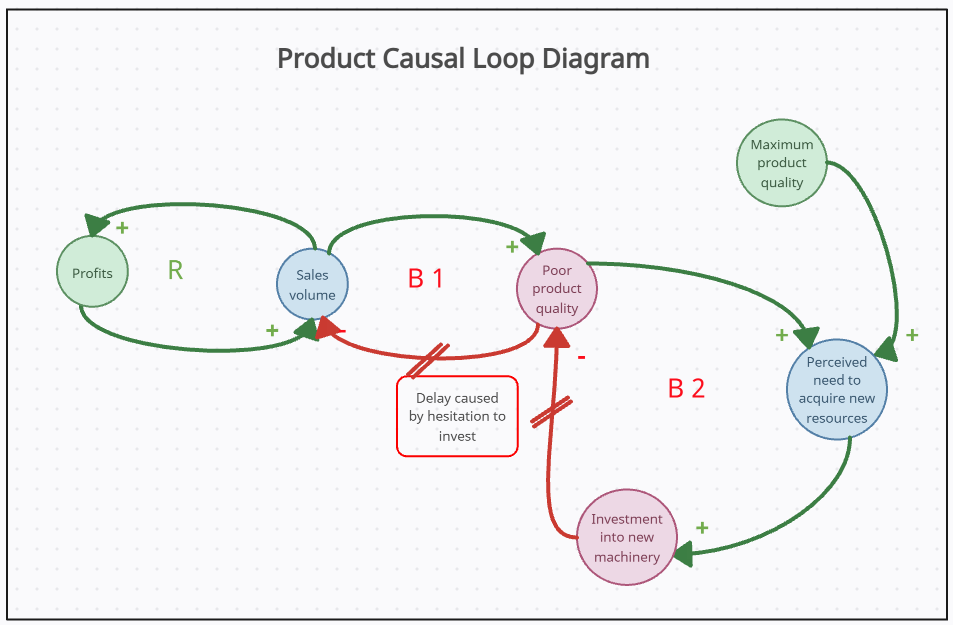
Figure 1 presents a product causal loop diagram illustrating how product quality, sales, investment and profitability interact through reinforcing and balancing feedback loops. Two reinforcing loops (R1 and R2) show how profitability and product quality can drive self-sustaining growth: higher profits enable reinvestment in sales, while improved quality enhances customer satisfaction and market demand, both improving overall performance. In contrast, two balancing loops (B1 and B2) act as stabilising forces. When rapid sales growth strains production capacity, quality declines, prompting corrective investment to restore standards (B1). Meanwhile, as quality improves, it eventually reaches a maximum threshold where further gains lead to diminishing returns (B2), reflecting real-world technological and resource limits. Together, these loops demonstrate the dynamic interaction between growth and constraint in complex systems. The model highlights how feedback processes shape organisational performance and underscore the value of systems thinking for anticipating unintended consequences and supporting sustainable decision making in educational contexts where understanding system dynamics enhances learning and design practice.
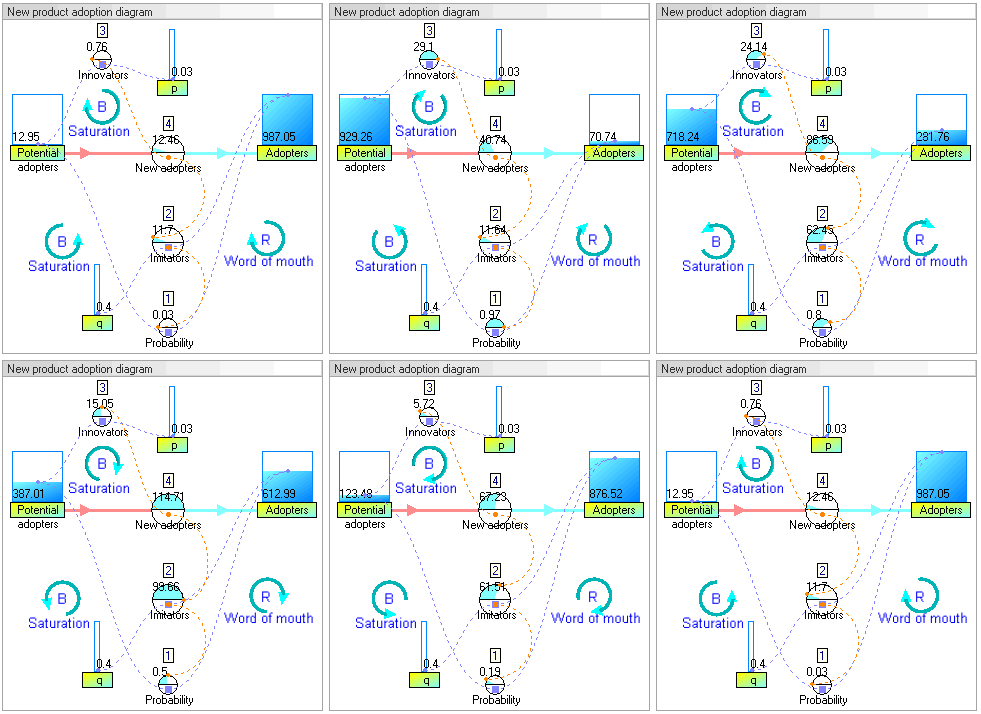
System dynamics (SD) models simulate system behaviour over time by representing key elements such as stocks, flows, feedback loops, and time delays. This approach is particularly useful for understanding long-term patterns and testing interventions in complex contexts, such as modelling energy demand, tracking carbon emissions, or optimising supply chain dynamics. By using accessible tools like Stella, Vensim, or Insight Maker, educators can create interactive learning experiences that allow students to experiment with ‘what-if’ scenarios, deepen their understanding of dynamic behaviours, and develop the skills needed to make informed, data-driven decisions. Figure 2 illustrates a dynamic stock-and-flow diagram of a model for new product adoption. The diagram demonstrates how stock and flow structures can capture accumulations and delays within a system, providing insights into how adoption rates evolve over time in response to feedback processes.
Figure 2. Dynamic stock and flow diagram of model New product adoption(taken from Wikipedia: model from article by John Sterman 2001 - True Software)
Agent-based modelling:
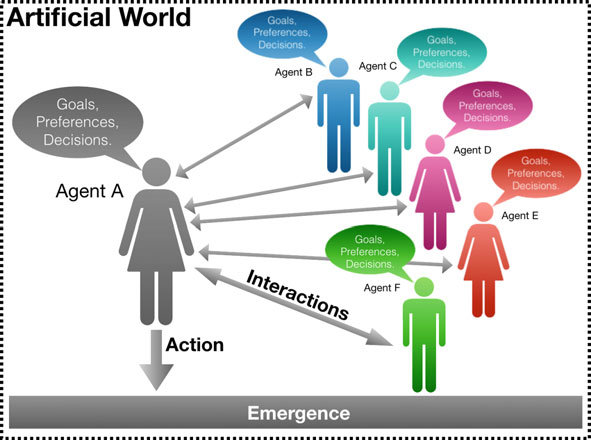
Agent-Based Modelling (ABM) analyses complex systems by simulating the actions and interactions of many individual “agents” each following simple behavioural rules. Agents can represent people, vehicles, organisations or even machines depending on the context and their collective behaviour gives rise to larger system patterns that are often unexpected or counterintuitive. For example, in a traffic flow model, each car (agent) follows basic rules for acceleration, braking and lane changing. While these rules are simple in isolation, their combined effects can lead to emergent phenomena such as traffic jams or wave-like congestion patterns, behaviours not explicitly programmed into the system. Similarly, in a disease transmission model, each agent might represent a person whose movement and interactions influence infection spread across a population, providing valuable insight into intervention strategies.
ABM is particularly useful in systems where differences among agents and local interactions matter. Whereas System Dynamics (SD) captures aggregate feedback through mathematical relationships, ABM reveals the distributional and spatial dimensions of system behaviour by modelling individual actions and decisions. Educators may choose ABM to help students see how microscale decisions lead to macroscale outcomes, reinforcing the concept that system-level order often emerges from local and uncoordinated interactions. Open-source platforms such as NetLogo provide accessible environments for teaching these principles, offering pre-built models that allow students to experiment with agent rules and parameters. Through such interactive exploration, engineering students can observe how small behavioural changes can cascade into large-scale effects deepening their understanding of emergence, adaptability and complexity in real-world complex systems. Figure 3 presents a schematic of an agent-based model, illustrating how interactions among individual agents within an artificial environment can lead to emergent system-wide patterns.
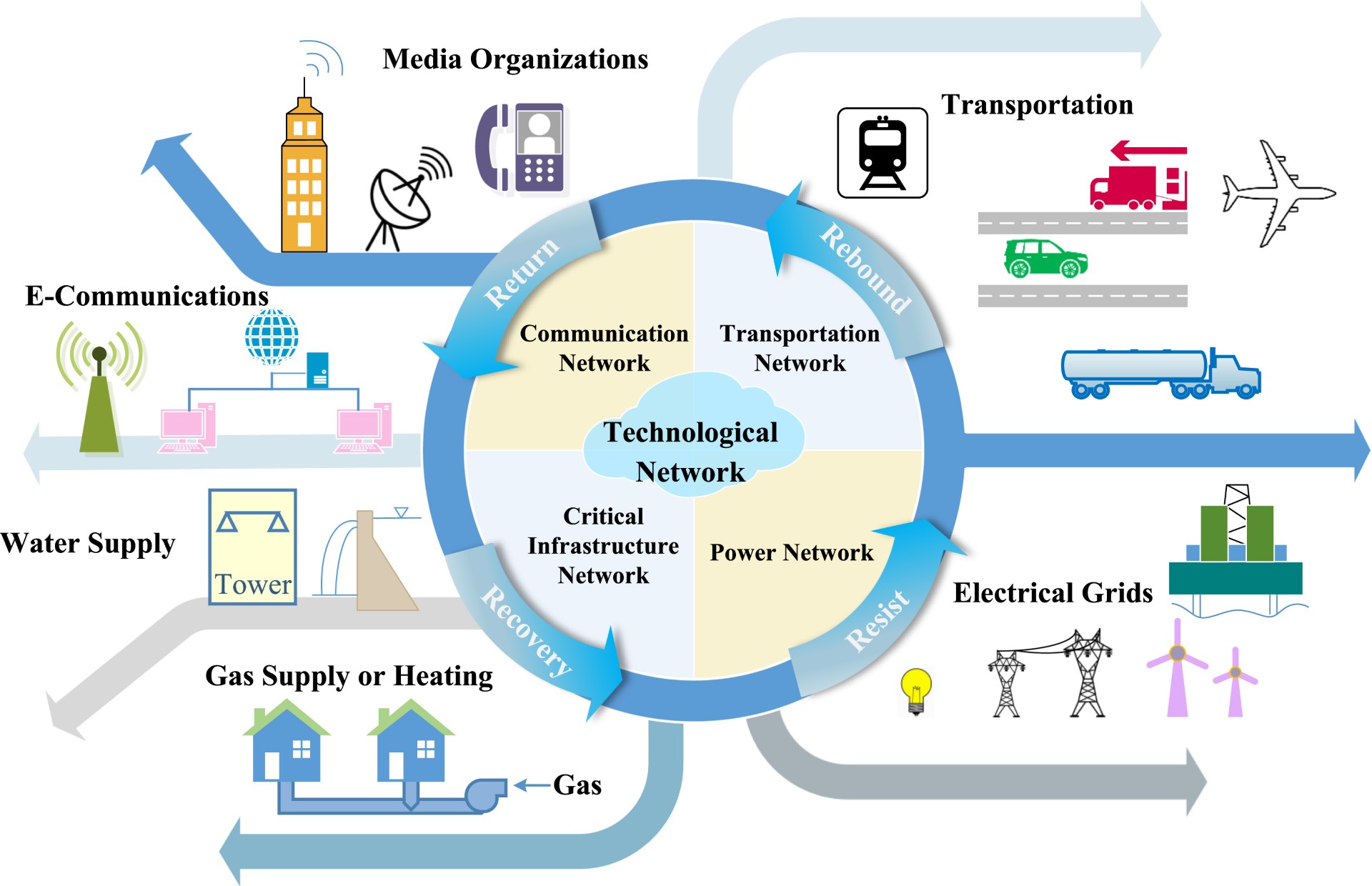
Network analysis looks at how the pattern of connections within a system affects how it behaves, performs, and recovers from disruption. Instead of focusing on individual parts, this approach studies the relationships between elements whether they are people, machines, or data points and how these connections shape the overall outcome of the system. In network science, two important ideas help describe how a network is organised: degree distribution and clustering coefficients. Degree distribution shows how many connections (or “links”) each element, known as a node, has. If most nodes have a similar number of links, the network tends to behave in a steady and predictable way. However, if a few nodes have many more connections such as major airports in a flight network, the system can operate very efficiently but may also become more vulnerable if one of those key nodes fails. Clustering coefficients measure how connected a node’s neighbours are to each other. A high clustering coefficient means that a node’s connections are also well connected, forming strong local groups. This structure can improve communication and resilience within the network, though it may also limit flexibility or slow the spread of new information.
By analysing these features, students learn that the way parts of a system are connected is just as important as the parts themselves. Real-world complex systems examples include power grids, transport networks, and organisational systems, where understanding connectivity helps engineers identify weaknesses and design for greater robustness. Tools such as Gephi and NetworkX make it possible to visualise and measure these network properties, helping turn complex data into clear, interpretable diagrams. Figure 4 shows the structure and properties of a technological network, illustrating how node connectivity and clustering together influence the system’s overall resilience.
Understanding and managing complexity is now an essential skill for modern engineers. By gradually introducing students to different systems thinking tools from qualitative mapping to dynamic simulation and network analysis, educators can help them build a deep and transferrable understanding of how complex systems behave. Each tool offers a different perspective: mapping tools encourage exploration and shared understanding, dynamic models reveal feedback and time-based behaviour, and network analysis exposes structural patterns and resilience. Taken together, these approaches form a developmental pathway that strengthens students’ ability to think critically, reason systematically, and make informed design and management decisions. Embedding this progression within engineering education cultivates curiosity, adaptability, and a mindset equipped to tackle the interconnected social, environmental and technological challenges of the future. In doing so, educators prepare graduates not just to work with complex systems, but to improve and transform them.
References:
Avison, D. E., Golder, P. A. and Shah, H. U. (1992) ‘Towards an SSM toolkit: rich picture diagramming’, European Journal of Information Systems, 1(6), pp. 397–408. doi.org/10.1057/ejis.1992.17
Barabási, A.-L. & Albert, R. (1999) ‘Emergence of scaling in random networks’, Science, 286(5439), pp.509-512. doi: 10.1126/science.286.5439.509
Bonabeau, E. (2002) ‘Agent-based modeling: Methods and techniques for simulating human systems’, PNAS, 99 (Suppl_3), 7280–7287. doi.org/10.1073/pnas.082080899
Checkland, P. (1981) Systems Thinking, Systems Practice, Chichester: John Wiley & Sons.
Forrester, J.W. (1997) ‘Industrial dynamics’, Journal of the Operational Research Society, 48(10), pp.1037-1041.
Sterman, J.D. (2000), Business Dynamics: Systems Thinking and Modeling for a Complex World, Boston, MA: Irwin/McGraw-Hill. Accessed online 27 August 2025: https://dspace.mit.edu/handle/1721.1/102741
Any views, thoughts, and opinions expressed herein are solely that of the author(s) and do not necessarily reflect the views, opinions, policies, or position of the Engineering Professors’ Council or the Toolkit sponsors and supporters.
Who is this article for?: Thisarticle should be read by educators at all levels in higher education who are seeking an overall perspective on teaching approaches for integrating complex systems in engineering education.
Related INCOSE Competencies: Toolkit resources are designed to be applicable to any engineering discipline, but educators might find it useful to understand their alignment to competencies outlined by the International Council on Systems Engineering (INCOSE). The INCOSE Competency Framework provides a set of 37 competencies for Systems Engineering within a tailorable framework that provides guidance for practitioners and stakeholders to identify knowledge, skills, abilities and behaviours crucial to Systems Engineering effectiveness. A free spreadsheet version of the framework can be downloaded.
This resource relates to the Systems Thinking andCritical Thinking INCOSE competencies.
AHEP mapping: This resource addresses several of the themes from the UK’s Accreditation of Higher Education Programmes fourth edition (AHEP4): Analytical Tools and Techniques (critical to the ability to model and solve problems),and Integrated / Systems Approach (essential to the solution of broadly-defined problems).
Premise:
We live in a complex world. Complexity is a key challenge, captured in leadership terms by the VUCA framework: volatile, uncertain, complex and ambiguous (Lanucha 2024). Engineers have the privilege of creating products and processes for humans to use in this landscape. Each of these likely has numerous parts which interact, as well as interacting with the environment, people, and needing to meet a host of safety, quality, sustainability, ethics, and financial obligations. Traditionally, engineers analyse problems by breaking them down into simple parts. This helps understanding and makes calculations feasible, but it’s easy to lose understanding of the whole system. Any change can easily create a problem elsewhere. From a technical viewpoint, engineers need to understand this interconnectedness in order for their creations to work. In a wider sense, ‘systems thinking’ is a skill central to engineering quality and management techniques, which seek to rationalise the complexity of entire organisations and their ever-changing market pressures.
The case for understanding systems:
Systems is perhaps one of the most misunderstood words in engineering. It is often found combined with mathematical modelling or control – topics often perceived as challenging – and is used in other fields like Computer Science, where tools and models are different. In all cases, the idea revolves around a group of interacting or interrelated elements which form a unified whole. Those elements can be physical or information, hardware or software, or any combination of mechanical, electrical, and other engineering domains. Thinking in terms of systems can therefore be thought of as a holistic approach.
The Engineering Council UK’s AHEP criteria include a systems approach: C/M6 – “Apply an integrated or systems approach to the solution of complex problems.” Several other AHEP criteria also reference complexity and complex problems, which they define as having “no obvious solution and may involve wide-ranging or conflicting technical issues and/or user needs that can be addressed through creativity and the resourceful application of engineering science. The Systems Thinking Alliance (2025) gives a broader definition of complexity as referring to “the condition of systems, objects, phenomena, or concepts that are challenging to understand, explain, or manage due to their intricate and interconnected nature. It involves multiple elements or factors that interact in unpredictable ways, often requiring significant information, time, or coordinated efforts to address.” For these, there is no ‘one-size-fits-all solution’ (Ellis 2025). This is the reality that engineers need to manage by understanding the potential effects on all parts of the system.
In order to analyse, engineers dissect complexity into manageable components, and educators teach these simple components before moving onto more complex systems. For example, students initially learn basic electrical components, simple beams, rigid bodies, etc. before bringing these together in case studies, and then moving onto topics like mechatronic systems. Historically, engineers specialised on graduation, perhaps becoming a stress engineer or fluid dynamicist in dedicated offices and functional teams. A design decision by one team could have unintended consequences for another, as well as additional uncertainty. The advent of cross-functional project and ‘matrix’ organisations mitigated against this, and companies have moved towards attribute teams which can consider the balance of behaviour. Even so, some uncertainty remains in the form of assumptions in calculations, changes in material properties with temperature or stress, or small variations in composition and manufacturing tolerances, which can all accumulate. Any parts which are bought ‘off-the-shelf’ or made by other companies under license must be carefully specified. Relationships can be nonlinear – or even chaotic – and contain feedback loops which can amplify changes (Kastens et al 2009). This all increases the risk of a product’s comfort, performance, and safety being impacted in ways that weren’t anticipated. Any problem that doesn’t come to light until the testing phase – late in the design process – represents costly redesigns and delays. In the unlikely event that a problem isn’t captured during testing either, the outcome could be disastrous.
Systems engineers will bring the product together and establish these complex behaviours through models and testing. Identifying potential problems early in the design phase can save significant money and facilitate better designs. This can be challenging, especially for systems using novel materials or operating in extreme environments, which aren’t accurately captured by standard calculations. Models may be linearised, neglect external forcing, or be derived for an assumed air density or ambient temperature which may not be valid. In recent decades, the engineering industry has moved towards model-based design and virtual prototyping, facilitated by advances in computer tools. These are increasingly sophisticated, but models still need to be built by engineers with an appreciation of complexity and the mechanisms by which a problem could arise. As humans develop new materials and technologies, and explore the limits of what is possible, engineering techniques and calculations need constant revision, and software tools are frequently updated to facilitate this.
That holistic view of problems has benefits outside of designing engineering artefacts. The manufacturing process is itself a complex system with potentially long supply chains. As is the organisation, which is comprised of numerous people operating in a landscape of financial pressures, employment law, politics and culture. Quality guru William Deming’s 14 Points for Management (Deming 2018) can be viewed as a systems approach to handling this complexity, by breaking down barriers between departments and instigating continuous improvement. Once a product is produced, it exists in a wider world and continues to interact with it. From a sustainability viewpoint, this can be the user and surrounding community, the environmental impact over a product’s lifecycle, and the financial markets which dictate whether a product is viable. It can also be the social, political, and legal landscapes: these can place direct constraints in the forms of laws governing safety and emissions (such as the UK’s legally binding target of net zero by 2050), or through embargos, tariffs, and subsidies. Each country has its own regulations, which can necessitate multiple variations of a product: a good example is cars, which need to be produced in both left- and right-hand drive, satisfy varying safety and emissions regulations, and cater for differing personal and cultural preferences for size, noise, usage and driving styles. Even when not legislated, a company might choose to support fair trade, lead the way in sustainable practices, or refuse to do business with suppliers or regimes they find objectionable – potentially making this a key part of their brand.
An engineer’s ability to appreciate and understand the wider social and business landscape is a reason why finance and management consultancy companies can often be seen recruiting engineers at student careers fairs. The Sainsbury Management Fellowship (SMF) scheme notably develops UK engineers as industry leaders, and fellows have made a major contribution to the UK’s economic prosperity (RAEng 2025).
Conclusions:
Complex systems are the “real world” that engineers attempt to understand and design for. They are complicated, interconnected, changing, and uncertain. The well-known part of engineering is analysis: breaking systems into understandable parts. There needs to be a parallel operation where those parts are assembled or integrated into a whole, and that whole interacts with everything around it. This is where unforeseen problems can occur. Systems models and a holistic systems thinking approach can mitigate this risk. A systems approach and ability to manage complexity is a key skill for engineers, and positions them well for other fields like management.
Kastens, K., Manduca, C., Cervato, C., & Frodeman, R., Goodwin, C., Liben, L., Mogk, D., Spangler, T., Stillings, N., Titus, S. (2009). How Geoscientists Think and Learn. Eos, Transactions American Geophysical Union. 90. 10.1029/2009EO310001.
Any views, thoughts, and opinions expressed herein are solely that of the author(s) and do not necessarily reflect the views, opinions, policies, or position of the Engineering Professors’ Council or the Toolkit sponsors and supporters.
The Engineering Professors’ Council, with support from Quanser, has started work on a Complex Systems Toolkit, aimed at helping educators to integrate complex systems concepts into their teaching.
With our Call for Contributions now live, the Complex Systems Toolkit Working Group Co-Chairs discuss why this is a vital resource and why you should get involved.
Dr. Nikita Hari, Head of the Teaching and Research Design Support Group at the Department of Engineering Science, University of Oxford
“Engineering graduates of today are expected to design climate-resilient cities, ethically deploy AI, and weave circular-economy thinking into supply chains – and all this lives squarely in the messy realm of complex systems. Yet most engineering curricula still treat complexity as an afterthought or a niche elective. This is often misunderstood, misrepresented, or purely ignored, relegating complexity to a footnote.
The Engineering Professors’ Council’s Complex Systems Toolkit is our academic response, aiming to bridge this gap: a freely accessible, peer-reviewed, resource hub where academics can find, curate and share ready-to-teach resources, assessment blueprints and real-world case studies mapped to AHEP learning outcomes.
By contributing, you’ll help shift ‘complexity literacy’ from the periphery to the core of engineering education, accelerate programme accreditation, and equip students with the habits of mind our profession and planet now demand.
Join us in co-authoring this collective intelligence: your lecture notes, lab briefs or reflective prompts could become the catalyst that empowers thousands of educators – and the engineers they shape – to navigate, model and steward the intricate systems that define the 21st century.”
Peter Martin, Director of Research and Development, Quanser
“As the UK and many countries around the world jockey for position as leaders in areas like advanced manufacturing and autonomous systems, engineers increasingly work in environments where they are required to connect different disciplines, perspectives, and skills, to understand and navigate sociotechnical systems, and to communicate complexity to diverse audiences.
The Complex Systems Toolkit is focused on supporting educators that are taking on the challenge of integrating complexity into their course modules by providing resources that cover 1) understanding complex systems, 2) the tools and techniques used by professionals, and 3) case studies that aim to bring a more holistic view to many of the Engineering disciplines.
I had the pleasure of being invited to co-chair the development team, along with several academic and industry leaders from around the UK working together to develop the toolkit for launch later this year. As the team cannot accomplish this ambitious task alone, we have recently opened a call for contributions to develop and contribute knowledge articles, guidance material, and teaching activities.
The EPC team is committed to creating a comprehensive and valuable set of resources that will accelerate the adoption of Complex Systems into modules and programmes around the world, and we would love it if you would join us in the creation and deployment of these valuable resources.” – You can read Peter Martin’s full blog post here.
Please register your interest in developing a resource for the Complex Systems Toolkit by completing this form by 30th June 2025.
You can read more about our Call for Contributions here.
Complex intelligent systems, systems thinking competency, and understanding complexity are all critical to engineering in the 21st century, and when integrated holistically, complex systems in engineering teaching can align with other initiatives that promote responsible engineering. Learning approaches for integrating complex systems knowledge, skills, and mindsets in engineering supports educators in their own professional development, since many may have not learned about this topic that they are now expected to teach. Accreditation frameworks increasingly refer to complex problems and systems thinking in outcomes for engineering programmes, and yet very few resources exist that support engineering educators to integrate these into their teaching in a comprehensive and effective way or indeed to upskill educators to be able to deliver this teaching.
To address this gap, a Complex Systems Toolkitis being developed by the Engineering Professors’ Council with support from Quanser. Its development is guided by a Working Group comprised of academic, industry, and professional organisation experts.
Register your interest
Please register your interest in developing a resource by completing this form by 30th June 2025.
If you would like to suggest links to pages or online resources that we can add to our database of engineering education resources for complex systems teaching, please email Wendy Attwell: w.attwell@epc.ac.uk
The Complex Systems Toolkit Working Group seeks contributors to develop resources for inclusion in the toolkit
These resources will fit into three categories:
Knowledge articles: are resources that users can access to improve their knowledge or find more information. These are intended to provide theoretical and practical background on complex systems concepts and tools such as modelling or decision-making approaches. While guidance articles focus on “how”, knowledge articles focus on “what”.
Guidance articles: areresources that users can access to learn how to do something. These are intended to provide practical advice on subjects such as how to explain complex systems to students, or how to assess for skills and competencies in complex systems. While knowledge articles focus on “what”, guidance articles should focus on “how”.
Teaching activities: are resources that users can access to help them know what to integrate and implement. These include use cases/case studies which provide examples of complex systems which can be directly utilised in teaching with the suggested tools, as well as other classroom activities such as coursework, project briefs, lesson plans, demonstration simulations, or other exercises.
Read more about the specific content we are looking for (click on the arrows to expand the sections):
Submit a knowledge article
Submit a knowledge article
The Complex Systems Toolkit Working Group seeks contributors to write knowledge articles on the following subjects:
Why teach / learn about Complex Systems?
This should include reference to:
The increasing ubiquity of complex systems
The need to understand complexity as a concept
The need for systems thinking competency among engineers
How complex systems are related to all engineering disciplines
Why integrate Complex Systems into Engineering Education?
This should include reference to:
Why engineered systems require certain properties (e.g. resilience)
The consequences of system failures
Knock-on effects beyond engineering
Interaction with other systems (e.g. human and natural)
What are Complex Systems?
This should provide a real-world explanation and include:
Examples of engineered systems / Engineering Complexity
Examples of socio-technical systems and the wider context
These articles should also connect the why (why must teaching about complex systems be present in engineering education?) to the how (how can this be done efficiently and effectively?). Through these tools, we aim to help upskill UK engineering educators so that they feel capable of and confident in integrating complex systems into their engineering teaching.
The deadline for submitting a knowledge article is 15th August 2025.
Step 1: Read the guidance for submitting a knowledge article
Guidance #1: Research Guidance #2: OverviewGuidance #3: PurposeGuidance #4: ContentGuidance #5: References and resourcesGuidance #6: Format
Research:
Knowledge articles are resources that users can access to improve their knowledge or find more information. These are intended to provide theoretical and practical background on complex systems concepts and tools such as modelling or decision-making approaches. While guidance articles focus on “how”, knowledge articles focus on “what”.
Before you begin, you should review knowledge articles that form a part of the EPC’s Sustainability Toolkit, since we hope that contributions to the Complex Systems Toolkit will be fairly consistent in length, style, and tone.
Knowledge articles are meant to be overviews that a reader with no prior knowledge of complex systems could refer to in order to develop a baseline understanding and learn where to look for additional information (they can reference other sources). They should be understandable to students as well: imagine that an educator might excerpt content from the article to provide their students context on a project or learning activity.
They should be approximately 500-1000 words (although they can be more in depth if necessary) and reference relevant online open-source resources.
Overview:
The articles are meant to be able to stand on their own as a piece of knowledge on a topic; they are also meant to work alongside other articles so that taken together they form a sort of complex systems in engineering handbook.
Purpose:
Each article should inform, explain, and provide knowledge on the topics. Put yourself in the perspective of an engineering educator who is new to complex systems.
Content:
The content of the article should be organised and well developed. That is, it should be presented in a logical way and thoroughly explained.
References and resources:
Where additional explanation could be given, it might point to other resources, and where information is presented from another source, it needs to be properly referenced using Harvard referencing.
Format
Knowledge articles should follow this format:
Premise;
Body of article, divided up into headed sections as necessary;
Before you submit your contribution, have you registered as a contributor? If not, please register your interest here.
Step 3: Submitting your knowledge article
The deadline for submitting a knowledge article is 15th August 2025.
Knowledge articles should be submitted in Word file format (.doc or .docx). Any corresponding images should be submitted in either .jpeg, .jpg or .png format.
To ensure that everyone can use and adapt the Toolkit resources in a way that best fits their teaching or purpose, this work will be licensed under a Creative Commons Attribution-ShareAlike 4.0 International License. Under this licence users are free to share and adapt this material, under terms that they must give appropriate credit and attribution to the original material and indicate if any changes are made.
The Complex Systems Toolkit Working Group seeks contributors to write guidance articles on the following subjects:
1. Guide to Explaining Complex Systems to students
This guidance should mirror the tone and style of resources from the Ethics and Sustainability Toolkits which provide a “how to” approach.
2. How Complex Systems relate to AHEP 4.
This should include guidance in understanding language in AHEP 4 around “complex problems” and their connection to Complex Systems.
3. How to scaffold Complex Systems learning outcomes across a curriculum
This should include good practice and examples of learning outcomes or objectives integrated in engineering curricula at different levels, either in general or in a particular engineering degree.
4. How do we assess for skills / competencies in Complex Systems?
This resource could mirror the tone and style of resources from the Ethics and Sustainability Toolkits, and could contain:
These articles should also connect the why (why must teaching about complex systems teaching be present in engineering education?) to the how (how can this be done efficiently and effectively?). Through these tools, we aim to help upskill UK engineering educators so that they feel capable of and confident in integrating complex systems into their engineering teaching.
The deadline for submitting a guidance article is 15th August 2025.
Step 1: Read the guidance for submitting a guidance article
Guidance #1: Research Guidance #2: Overview Guidance #3: Purpose Guidance #4: ContentGuidance #5: References and resourcesGuidance #6: Format
Research:
Guidance articles are resources that users can access to learn how to do something. These are intended to provide practical advice on subjects such as how to explain complex systems to students, or how to assess for skills and competencies in complex systems. While knowledge articles focus on “what”, guidance articles should focus on “how.”
Before you begin, you should review guidance articles that form a part of the EPC’s Sustainability Toolkit, since we hope that contributions to the Complex Systems Toolkit will be fairly consistent in length, style, and tone.
Guidance articles aim to help situate our teaching resources in an educational context and to signpost to additional research and resources on complex systems theory and tools.
They should be approximately 500-1000 words (although they can be more in depth if necessary) and reference relevant online open-source resources.
Overview:
The articles are meant to be able to stand on their own as a piece of guidance on a topic; they are also meant to work alongside other articles so that taken together they form a sort of complex systems in engineering handbook.
Purpose:
Each article should inform, explain, and provide knowledge on the topics. Put yourself in the perspective of an engineering educator who is new to complex systems.
Content:
The content of the article should be organised and well developed. That is, it should be presented in a logical way and thoroughly explained.
References and resources:
Where additional explanation could be given, it might point to other resources, and where information is presented from another source, it needs to be properly referenced using Harvard referencing.
Format
Guidance articles should follow this format:
Premise;
Body of article, divided up into headed sections as necessary;
Are open resources or links to other toolkit materials included?
What additional resources or references have you included?
Before you submit your contribution, have you registered as a contributor? If not, please register your interesthere.
Step 3: Submitting your guidance article
The deadline for submitting a guidance article is 15th August 2025.
Guidance articles should be submitted in Word file format (.doc or .docx). Any corresponding images should be submitted in either .jpeg, .jpg or .png format.
To ensure that everyone can use and adapt the Toolkit resources in a way that best fits their teaching or purpose, this work will be licensed under a Creative Commons Attribution-ShareAlike 4.0 International License. Under this licence users are free to share and adapt this material, under terms that they must give appropriate credit and attribution to the original material and indicate if any changes are made.
The Complex Systems Toolkit Working Group seeks contributors to create teaching activities based on the following briefs:
1. Case Studies that, through a real-world situation, illustrate different types of complex systems, use cases for the tools that can be used to model / simulate these, techniques that promote development and use of systems architecture, and effects such as trade-offs, emergent properties, impacts, or unintended consequences. Case studies could also reference the implications for risk, security, ethics, sustainability, teamwork, and communication.
Case study topics could include:
Air traffic control
Smart agriculture
Autonomous driving
Robotics
Smart cities
2. Demonstrator simulations that provide examples of how systems can be modelled.
This could include:
Examples of simple, complicated, and complex systems
Interactive examples showing how well-intentioned action can lead to failure
Interactive examples showing the best approaches to handling complexity
3. Lesson plans, coursework and teaching activities that are useful in integrating learning around complexity, systems thinking, and complex systems.
These resources should promote active learning pedagogies and real-world teaching methods by showing how complex systems teaching can be embedded within technical problems and engineering practice. Through these resources, we aim to help upskill UK engineering educators so that they feel capable of and confident in integrating complex systems into their engineering teaching.
The deadline for submitting a teaching activity is 15th August 2025.
Step 1a: Read the guidance for submitting a case study
Guidance #1: Research Guidance #2: Overview Guidance #3: Authenticity Guidance #4: Complexity of issue Guidance #5: Activities and resourcesGuidance #6: Educational level & AssessmentGuidance #7: Format
Research
Teaching activities are resources that users can access to help them know what to integrate and implement. These include use cases/case studies which provide examples of complex systems which can be directly utilised in teaching with the suggested tools, as well as other classroom activities such as coursework, project briefs, lesson plans, demonstration simulations, or other exercises.
Before you begin, you should review case studies that form a part of the EPC’s Sustainability Toolkit or Ethics Toolkit, since we hope that contributions to the Complex Systems Toolkit will be fairly consistent in length, style, and tone. While complex systems cases may not have the same learning outcomes, the format and approach should be similar. Remember that the audience for these case studies is educators seeking to embed complex systems concepts within their engineering teaching.
Case studies present real-world scenarios that can be used in teaching about complex systems in engineering. They provide students with opportunities to explore complex systems tools, and trade-offs, in authentic contexts, and reflect on decisions made about them.
They are usually based on a real example, although fictionalised cases are acceptable when they are grounded in realistic detail. Case studies should enable students to identify or interpret key features of complex systems (feedback loops, interdependence or emergent behaviour) and apply relevant tools or frameworks to make sense of the situation.
Case studies will vary in length depending on scope and resource, but many are around 1500-2000 words. They should reference relevant online open-source resources.
Please see the current research on good practice in writing case studies, which you may find helpful as you write, as well as our article about a recipe for writing a case study. This ‘recipe’ can guide you as you write to include or develop other aspects of the case. Both articles are from our Engineering Ethics Toolkit, but the guidance given can be adapted for complex systems cases.
Overview
The case study should be presented as a narrative about a complex systems issue in engineering.
Narrative strength: the case should be clearly structured with a compelling and coherent story. System complexity: it should explore interdependencies, multiple stakeholders and/or competing goals. Tool integration: systems tools should be mentioned or incorporated (e.g. soft systems methodology, SysML, Agent-based modelling etc). Activities and Resources: there should be questions, prompts or teaching activities to guide discussion or classroom use.
Authenticity
Case studies are most effective when they feel like they are realistic, with characters that you can identify or empathise with, and with situations that do not feel fake or staged. Giving characters names and backgrounds, including emotional responses, and referencing real-life experiences help to increase authenticity.
Complexity of issue
Many cases are either overly complicated so that they become overwhelming, or so straightforward that they can be “solved” quickly. A good strategy is to try to develop multiple dimensions of a case, but not too many that it becomes unwieldy. Additionally, complexity can be added through different parts of the case so that instructors can choose a simpler or more complicated version depending on what they need in their educational context.
Activities and resources
You should provide a variety of suggestions for discussion points and activities to engage learners, as well as a list of reliable, authoritative open-source online resources, to both help educators prepare and to enhance students’ learning. Where information is presented from another source, it needs to be properly referenced using Harvard referencing.
Educational level and Assessment
Educational level: When writing your case study, you should consider which level it is aimed at. A Beginner-level case is aimed at learners who have not had much experience in engaging with a complex problem, and usually focuses on only one or two dimensions of a challenge. An Advanced-level case is aimed at learners who have had previous practice in engaging with complex systems, and often addresses multiple challenges. An Intermediate case is somewhere in between.
Assessment: If possible, suggest assessment opportunities for activities within the case, such as marking rubrics or example answers.
Format
The case study should follow the following format:
Teaching notes (with learning objectives, time needed, materials): This is an overview of the case and its dilemma, and how it relates to AHEP4 and INCOSE competencies.
Learning and teaching resources: A list of reliable, authoritative, open-source online resources that relate to the case and its dilemma. These can be from a variety of sources, such as academic institutions, journals, news websites, business, and so on. We suggest a minimum of five sources that help to provide context to the case and its dilemmas. You may want to suggest an author flag up certain resources as suggested pre-reading for certain parts of the case, if you feel that this will enrich the learning experience.
Summary of system or context.
Narrative of the case (presenting the complexity).
Questions and activities. This is where you provide suggestions for discussions and activities related to the case and the dilemma.
Further discussion or challenge (optional). Some case studies are sufficiently complex at one dilemma, but if the case requires it you can provide further parts (up to a maximum of three).
Teaching Tools are intended to support educators’ ability to apply and embed complex systems concepts within their engineering teaching.
Educators need to quickly and easily find help with:
Adapting and integrating existing complex systems resources to their disciplinary context;
Implementing new and different pedagogies that support complex systems learning.
Structuring lessons, modules, and programmes so that complex systems skills and outcomes are central themes.
Thus, these teaching tools will provide crucial guidance for those who may be teaching complex systems-related material for the first time, or who are looking for new and different ways to integrate complex systems concepts into their teaching.
They may take the form of learning activities, project briefs, modelling or simulation activities, technical content related to complex systems, worksheets, slides, or other similar teaching materials.
Imagine that you are an engineering educator who is new to teaching complex systems concepts. You turn to this teaching tool to help you apply and embed these in your module.
Does this resource help introduce or develop concepts related to complex systems or systems thinking so that learners can engage with these topics in the context of engineering?
If not, what is needed to make this possible?
Presentation and Clarity
Depending on the resource, you may choose to provide worksheets, slides, problem sets, or narrative prompts.
Is the resource explained in such a way that someone new to teaching complex systems could understand how to use it?
Is the material clearly introduced and described?
Resources and Guidance
Depending on the topic, educators may need additional resources or guidance to support their use of the material. For instance, background information may be required or a technical topic explained.
Have you provided sufficient material so that educators can easily employ the resource?
Short description of what the resource is and what it aims to do.
States how it is related to complex systems or systems thinking, referring to external content such as INCOSE Competencies and AHEP 4.
Provides an overview of the activity, suggesting how it might be implemented and in what contexts, how long it might take, and any other relevant delivery information.
Details any specific materials or software required for the activity, as well as any modelling or simulation tools to be used.
Lists any learning and teaching resources recommended in order to undertake the activity, including suggested pre-reading or other references.
Explains the activity in as much detail as is required (this will vary depending on the type of material the resource addresses.)
If relevant, provides assessment guidance–marking rubrics, sample answers, etc.
Step 2b: Before you submit, review this checklist:
Does this resource help introduce or develop concepts related to complex systems or systems thinking so that learners can engage with these topics in the context of engineering?
Is the resource explained in such a way that someone new to teaching complex systems could understand how to use it?
Is the material clearly introduced and described?
Have you provided sufficient material so that educators can easily employ the resource?
The deadline for submitting a teaching activity is 15th August 2025.
To ensure that everyone can use and adapt the Toolkit resources in a way that best fits their teaching or purpose, this work will be licensed under a Creative Commons Attribution-ShareAlike 4.0 International License. Under this licence users are free to share and adapt this material, under terms that they must give appropriate credit and attribution to the original material and indicate if any changes are made.
Teaching activities should be submitted in Word file format (.doc or .docx). Any corresponding images should be submitted in either .jpeg, .jpg or .png format.
If you wish to develop materials to contribute beyond this, we will be opening the next cycle in spring 2026.
If you would like to become a reviewer for the toolkit (initially between July and October 2025), please complete this form.
If you would like to suggest links to pages or online resources that we can add to our database of engineering education resources for complex systems teaching, please email Wendy Attwell: w.attwell@epc.ac.uk
Additional information
In undertaking this work, contributors will become part of the growing community of educators who are helping to ensure that tomorrow’s engineering professionals have the complex systems skills, knowledge, and attributes that they need to provide a better future for us all. Contributors will be fully credited for their work on any relevant Toolkit materials, and will be acknowledged as authors should the resources be published in any form. Developing these resources will provide the chance to work with a dynamic, diverse and passionate group of people leading the way in expanding engineering teaching resources, and may help in professional development, such as preparing for promotion or fellowship. If contributors are not compensated by their employers for time spent on this type of activity, a small honorarium may be available to encourage participation.
As part of the toolkit project, we are also developing tools for collaborating with our Working Group in-house. Stay tuned for further details.
Learn more about the Complex Systems Toolkit
Those interested in contributing to the Complex Systems Toolkit should fill out this form and we will be in touch.
We’re excited to share with you that we are starting work on a Complex Systems Toolkit, aimed at supporting educators in their teaching of the subject. Toolkit development will start in early 2025. The Complex Systems Toolkit is supported by Quanser. Read on to learn more and find out how you can get involved.
WHY is the EPC developing a Complex Systems Toolkit?
Complex systems shape our lives and day-to-day realities more than most people realise. At the intersection of computing, robotics, and engineering, ever more technology is dependent on complex systems, from AI to biomedical devices to infrastructure.
Understanding both complexity and systems is critical to today’s engineering graduates, especially as the UK seeks to position itself as a leader in areas like advanced manufacturing and autonomous systems.
Engineers increasingly work in environments where they are required to connect different disciplines, perspectives, and skills, to understand and navigate sociotechnical systems, and to communicate complexity to diverse audiences.
Employers today seek graduates who understand not just interdisciplinary engineering work, can work with teams, and understand complexity from different fields and specialisations, but also who can work with non-engineers on products and projects and translate that complexity effectively.
Systems thinking competency is seen as critical to education for sustainable development, and when integrated holistically, complex systems in engineering teaching can align with national and international initiatives that promote social and environmental responsibility.
Accreditation frameworks increasingly refer to complex problems and systems thinking in outcomes for engineering programmes.
Learning approaches for integrating complex systems knowledge, skills, and mindsets in engineering supports educators in their own professional development, since many may have not learned about this topic that they are now expected to teach.
WHAT is a Complex Systems Toolkit?
The Complex Systems Toolkit will be a suite of teaching resources, which may include a scaffolded framework of learning objectives, lesson plans, guidance, case studies, project ideas, and assessment models. These are intended to help educators integrate complex systems concepts into any engineering module or course.
The Toolkit’s ready-to-use classroom resources will be suitable for those who are new to teaching complex systems, as well as those who are more experienced.
Teaching materials will focus on the development of relevant knowledge, skills, and mindsets around complex systems and contain a variety of suggestions for implementation rooted in educational best practice.
Toolkit resources will help educators to understand, plan for, and implement complex systems learning across engineering curricula and demonstrate alignment with AHEP criteria and / or graduate attributes.
Guidance articles will explain key topics in complex systems education, highlighting existing resources and solutions and promoting engagement with a network of academic and industry experts.
HOW will the Toolkit be developed?
The Toolkit materials will be created and developed by diverse contributors from academia and industry, representing a variety of fields and coming from multiple continents.
The resources will be presented so that they can be used in many different settings such as online and hybrid teaching, lecture sessions, and problem-based learning scenarios.
The Toolkit will be a community-owned project, and anyone can suggest or submit a new resource or get involved.
The Toolkit will be developed by the Engineering Professors’ Council and is supported by Quanser.
WHO is involved in Toolkit development?
The development of the Toolkit will be managed by a Working Group of subject experts from academia and industry, put together by the EPC and Quanser.



 Dr. Nikita Hari, Head of the Teaching and Research Design Support Group at the Department of Engineering Science, University of Oxford
 Peter Martin, Director of Research and Development, Quanser