The Engineering Council and the Royal Academy of Engineering have chosen Chartered Week (23–27 February) to publish an update of their joint Statement on Ethical Principles for the engineering profession, first published over 20 years ago.
Ethical commitments are at the heart of the role of a registered engineer or technician – and everyone who works in engineering. The refreshed Statement reflects the changing technology environment and the new challenges faced by engineering professionals today.
The Statement considers developments in professional practice, in the wider technology environment, and in society’s expectations more broadly. An important new fifth ethical principle has been added, focusing on engineering professionals’ responsibility for the future of technology, society, and the environment – particularly in an era of fast-moving technological change. Rapidly developing technologies such as AI have potentially transformative impacts, and ethical issues arise in their development and adoption. This new principle highlights the duty of engineers and technicians to develop these technologies responsibly, with awareness of the lasting system consequences for humankind, including intergenerational impacts.
The Statement’s five fundamental principles for ethical behaviour and decision-making are designed to apply to all engineering professionals and form the core of the specific codes of conduct set out by the individual professional engineering institutions.
The five ethical principles outlined are:
Honesty and integrity, avoiding knowingly misleading others and taking steps to prevent corrupt practices, including plagiarism, misinformation and false representation.
Responsibility to society, including reporting malpractice and irresponsible or unsafe practice, whether within the workplace or outside.
Accuracy and rigour, actively maintaining and enhancing knowledge, skills and competence and supporting others to do the same.
Leadership and communication, fostering a culture where concerns can be raised without fear of reprisal, and acting on well-founded concerns.
Responsibility for the future of technology, society, and the environment, anticipating wider and emergent consequences, and potential for misuse of technologies, and applying precaution proportionately where potential harms are serious or irreversible.
To mark the updated guidance, a series of blog posts have been commissioned from sector experts to illustrate how the new principles apply in areas of engineering from fire safety to wastewater management, and therefore the role engineering ethics and culture play in critical outcomes such as building safety and protecting public health. The Engineering Council also produces Guidance on Security, Sustainability, Risk and Whistleblowing.
The Academy and the Engineering Council have also launched a new phase of work on engineering ethics to build on the principles, led by a new cross-disciplinary working group chaired by Professor John McDermid OBE FREng, Lloyd’s Register Foundation Chair of Safety at the University of York.
Paul Bailey, CEO of the Engineering Council said: “The Engineering Council is responsible for setting and raising standards of competence and conduct for the engineering profession. This updated Statement of Ethical Principles supports those working in the profession to meet our standards, ensuring that ethical practice keeps pace with technological change. The introduction of a new fifth principle acknowledges this evolution by highlighting technicians and engineers’ responsibility towards the future of technology and the long-term impacts of engineering on society and the environment. As such, the Statement remains an essential source of guidance that helps engineering to be seen and recognised by the public as a trusted and ethical profession.”
Dame Tamara Finkelstein DCB, Chief Executive of the Royal Academy of Engineering, said: “The Royal Academy of Engineering is committed to supporting engineering in the service of society and ensuring that technology improves lives. Ethics and a commitment to public benefit must be at the heart of what we do. Growing an engineering community fit for the future means providing engineers with the vision, principles and guidance to bring ethics into the heart of the profession and inspiring a new generation of engineers to work in ways that have meaningful, positive impact and that reinforces the trust society places in us.”
Any views, thoughts, and opinions expressed herein are solely that of the author(s) and do not necessarily reflect the views, opinions, policies, or position of the Engineering Professors’ Council or the Toolkit sponsors and supporters.
Keywords: Systems thinking; Problem-solving; Critical thinking; Digital literacy; Modelling and simulation; Design; Project management; Life cycle; Risk; Collaboration; Communication; Professional conduct; Social responsibility.
Downloads: A PDF of this resource will be available soon.
Learning and teaching resources:
Glossary: This article refers to many concepts and terms which are more fully described and explained in this companion resource.
Who is this article for?: Thisarticle should be read by educators at all levels in higher education who are seeking an overall perspective on teaching approaches for integrating complex systems in engineering education.
Related INCOSE Competencies: Toolkit resources are designed to be applicable to any engineering discipline, but educators might find it useful to understand their alignment to competencies outlined by the International Council on Systems Engineering (INCOSE). The INCOSE Competency Framework provides a set of 37 competencies for Systems Engineering within a tailorable framework that provides guidance for practitioners and stakeholders to identify knowledge, skills, abilities and behaviours crucial to Systems Engineering effectiveness. A free spreadsheet version of the framework can be downloaded.
This article outlines the core competencies required for engineering students to effectively engage with complex systems. Such systems involve a range of technical and non-technical components that interact in non-linear and unpredictable ways. Working effectively with such complex systems requires collaboration across engineering disciplines, as well as other fields and stakeholder groups.
Within AHEP4, complex problems are referred to as those which “have no obvious solution and may involve wide-ranging or conflicting technical issues and/or user needs that can be addressed through creativity and the resourceful application of engineering science” (p.26). The ability to work productively with complex systems is therefore essential for engineers and helps them address problems increasingly experienced in business and society, which have many interdependent components and lack clear or stable solutions.
The aim of this article is to provide a foundational framework that integrates the knowledge, skills and attitudes necessary for undergraduate and graduate engineering students to navigate complexity. In so doing, it serves educators, curriculum designers, and students seeking to develop the mindset and skills required to tackle the challenges of the 21st century within an increasingly volatile, uncertain, complex, and ambiguous (VUCA) world (SEFI, 2025).
This knowledge article, informed by the INCOSE Competency Framework for Systems Engineering (INCOSE, 2018), categorises complex systems competencies into eight core competencies. These competencies encompass mindset and foundations, technical methods and tools, management and delivery, and attributes and behaviours. The description of each competency references learning outcomes (LOs) outlined in AHEP4 (Engineering Council, 2025) and the International Engineering Alliance (IEA) Graduate Attributes (2021) to establish a common baseline for all engineering graduates (see Appendix for mapping).
The eight core complex systems competencies:
1. Systems thinking and problem framing
The ability to take a holistic approach, to consider a problem from multiple perspectives and to understand how a system’s parts interact to produce emergent behaviour.
Students must be able to understand what makes a system ‘complex’ and move beyond narrow problem-solving to identify root causes. This involves understanding fundamental Systems thinking concepts including hierarchies and interfaces (structural dimension), holism and cause-effect (dynamic dimension), lifecycles (time dimension), and multiple perspectives (perception dimension).
Systems thinking enables engineers to anticipate ripple effects, emergent behaviours, and trade-offs, designing solutions that remain robust under uncertainty. AHEP4 requires students to “formulate and analyse complex problems to reach substantiated conclusions” (LO2) and to “apply an integrated or systems approach to the solution of complex problems” (LO6).
2. Critical thinking
The ability to question assumptions, evaluate evidence, apply logical reasoning, and justify decisions based on reasoned arguments and evidence.
Navigating complex systems involves working with a variety of (often conflicting) goals, information, and data types from across discipline and stakeholder groups. Critical thinking is thus necessary to enable engineers to identify biases, avoid oversimplification and flawed reasoning, and to make ethical, transparent and evidence-informed decisions with consideration for unintended consequences. AHEP4 requires graduates to “critically evaluate technical literature and other sources of information to solve complex problems” (LO4).
3. Simulation, modelling and data literacy
The ability to apply scientific, mathematical, and engineering principles to model, test, and improve complex systems.
Working with complex systems involves a range of resources including people, data and information, tools and appropriate technologies. Students must be able to create, apply and validate system models (as physical, mathematical, or logical representation of systems) and demonstrate competence in simulation and data literacy to address uncertainty and complexity at scale. This may involve using models and data to justify assumptions, explore scenarios, predict the consequences of actions, solve difference equations, conduct sensitivity and stability analysis, and predict the probability of risk.
This aligns with several AHEP4 outcomes: “apply mathematics, statistics, and engineering principles to solve complex problems” (LO1); “apply computational and analytical techniques while recognising limitations” (LO3); and “select and critically evaluate technical literature and other data sources” (LO4).
4. Design for complexity and changeability
The ability to design adaptable, robust, and resilient systems across their lifecycle.
Changes (both planned and unplanned) are inherent in complex systems. Long-term success of a system therefore requires design for resilience to first hand/internal (by the system), second hand/external (to the system) or third hand (around the system) change. Design for complexity and changeability ensures systems can evolve and integrate new capabilities across their lifecycle.
AHEP4 requires engineers to be able to innovatively “design solutions that meet a combination of societal, user, business and customer needs” (LO5). This may involve designing systems that deliver required functions over time, including evolution, adaptability, and integration across subsystems (capability engineering), and supports evaluation of alternatives, balance competing objectives, and justify transparent decisions (decision management).
5. Project and lifecycle management
The ability to plan and deliver engineering activities across the system lifecycle, ensuring outcomes are delivered on time, on cost, and with integrity.
Complex systems involve many subsystems with various purposes and lifecycles. This necessitates effective coordination and delivery processes and a focus on early planning and lasting systemic impacts. Project and lifecycle management allows for concurrent engineering (parallelisation of tasks), and verification and validation of tasks in dynamic environments. Graduates must “apply knowledge of engineering management principles, commercial context, project and change management” (AHEP4, LO15).
This aligns with the Engineering Attribute of Project Management and Teamwork and the INCOSE Framework competencies in Lifecycle Processes, Integration, and Project Management, emphasising coordinated delivery and long-term value creation across socio-technical systems. Lifecycle awareness prevents short-term optimisation and emphasises aspects such as maintainability, whole-life value delivery and total expenditure (TOTEX) thinking, all of which support efforts towards sustainability and net-zero.
6. Risk and uncertainty management
The ability to identify, assess, and manage technical, social, environmental, and ethical risks at multiple levels of complex systems.
Complex systems are inherently uncertain, with cascading risks that must be anticipated and managed proactively. Risk management enables students to quantify source and impact of uncertainties where possible and apply precaution where uncertainty is irreducible, ensuring safety, sustainability, and governance.
AHEP4 requires graduates to “use a structured risk management process to identify, evaluate and mitigate risks (the effects of uncertainty)” (LO9), ranging from project-specific challenges to systemic threats, which need to “adopt a holistic and proportionate approach to the mitigation of security risks” (LO10).
7. Collaboration and communication
The ability to work effectively across disciplines, boundaries, and cultures, while conveying complex insights clearly to technical and non-technical audiences.
Complex systems challenges cannot be solved by individuals alone and include consideration for stakeholders across industry, policy and society. Such collaborative processes involve participatory problem-solving, learning from others, inclusive communication, and negotiation and persuasion strategies, all of which necessitate emotional intelligence.
AHEP4 expects graduates to “function effectively as an individual, and as a member or leader of a team, being able to evaluate own and team performance” (LO16). They must be able to influence stakeholder decisions, foster alignment, and shape outcomes across industry, policy, and society (AHEP4, LO17).
8. Professional responsibility
The ability to apply professional and societal responsibilities in decision-making, with awareness of ethical implications and long-term impacts and unintended consequences of engineered systems.
Engineers increasingly work on complex systems that shape lives, societies, and ecosystems. Ethical responsibility ensures that technical competence aligns with social good and involves consideration for trade-offs between factors including environmental impact, affordability and social acceptance. This aligns with AHEP4, IEA, and INCOSE principles on ethics, professionalism, and leadership, ensuring engineers act responsibly within complex systems and contribute positively to society and sustainability. AHEP4 requires graduates to “identify and analyse ethical concerns and make reasoned ethical choices informed by professional codes of conduct” (LO8) and “evaluate the environmental and societal impact of solutions to complex problems” (LO7).
Conclusions:
This article defines a set of eight integrated competencies that prepare engineering graduates to navigate complex systems. Together, they combine knowledge (what graduates must know), skills (what they can do), and attitudes (how they behave and think). Embedding these competencies requires project-based learning, interdisciplinary collaboration, and reflective exercises, while assessment should include portfolios, teamwork, and scenario analysis. Employers and professional bodies can reinforce these competencies through mentoring, internships, and early career development.
By aligning with INCOSE, AHEP4, and IEA GA frameworks (see Appendix for mapping), this guidance provides an internationally consistent foundation that can be adapted to local contexts, equipping engineering graduates to address complex, interdependent challenges of the 21st century with competence, integrity, and resilience.
Appendix:
Mapping between Eight Core Competencies and Standard frameworks
Proposed Core Competency
INCOSE *
AHEP4 **
IEA GA ***
Systems Thinking & Problem Framing
ST
LO2, LO6
WA2
Critical Thinking
CT
LO4
WA4, WA11
Simulation, Modelling & Data Literacy
IM, SM
LO1, LO3, LO4
WA1, WA4, WA5
Design for Complexity & Changeability
CP, DM, DF
LO5
WA3
Project & Lifecycle Management
LC, PL,CE, CP
LO15
WA10
Risk & Uncertainty Management
CE, PL, RO
LO9, LO10
–
Collaboration & Communication
CC, TD, TL, EI
LO16, LO17
WA8, WA9
Professional Responsibility
EI, EP
LO7, LO8
WA6, WA7
* INCOSE Competency Framework, 2nd edition (2018)
** AHEP4 Learning Outcome (LO) (2025)
*** International Engineering Alliance (IEA) Graduate Attributes (GA) (2021)
Any views, thoughts, and opinions expressed herein are solely that of the author(s) and do not necessarily reflect the views, opinions, policies, or position of the Engineering Professors’ Council or the Toolkit sponsors and supporters.
Keywords: Artificial Intelligence; Large Language Model; Sociotechnical systems; Ethics; Modelling or simulation; Emergence.
Licensing:This work is licensed under a Creative Commons Attribution-ShareAlike 4.0 International License. It is based upon the author’s article “Enhancing Ethical Reasoning in Engineering Education through Student-Created Interactive Ethical Scenarios Using Generative AI,” 2025 IEEE Global Engineering Education Conference (EDUCON), London, United Kingdom, 2025, pp. 1-5, doi: 10.1109/EDUCON62633.2025.11016531.
Related INCOSE Competencies: Toolkit resources are designed to be applicable to any engineering discipline, but educators might find it useful to understand their alignment to competencies outlined by the International Council on Systems Engineering (INCOSE). The INCOSE Competency Framework provides a set of 37 competencies for Systems Engineering within a tailorable framework that provides guidance for practitioners and stakeholders to identify knowledge, skills, abilities and behaviours crucial to Systems Engineering effectiveness. A free spreadsheet version of the framework can be downloaded.
This resource relates to the Systems Thinking, Life Cycle, Configuration Management, Requirements Definition, Verification, and Validation INCOSE Competencies.
AHEP mapping: This resource addresses several of the themes from the UK’s Accreditation of Higher Education Programmes fourth edition (AHEP4): Analytical Tools and Techniques (critical to the ability to model and solve problems), and Integrated / Systems Approach (essential to the solution of broadly-defined problems). In addition, this resource addresses AHEP themes of Ethics and Communication.
Debug their simulation through playtesting, documenting issue → fix → retest cycles and demonstrating how changes improve coherence.
Explore trade-offs and justify decisions in ethics (e.g. consequences and equity) and complex systems (e.g. resilience vs cost vs emissions).
Evidence learning with transparent artefacts: initial prompt, changes via tracked changes or before/after snippets, tester feedback, and final prompt.
Reflect critically on validity, bias and the limitations of LLMs as simulators, including how to handle unsafe/poor choices by surfacing realistic consequences.
Communicate findings clearly to technical and nontechnical audiences.
Teachers have the opportunity to:
Use this as either a studio activity (3–5 sessions) or a compact assessment only task (1–2 sessions), with clear rubrics for each.
Standardise scope by offering a predefined scenario (e.g., Urban Heatwave Response, UK city), or permit student proposed topics.
Scale marking via artefact based evidence (prompt, change log, feedback, final prompt) rather than long reports.
Deliver with institutional Microsoft Copilot licences or any free web LLM; require students to disclose model and version used.
Adapt quickly to different disciplines by swapping the scenario pack (microgrids, water networks, medical device supply chains, etc.).
Overview:
This resource enables engineering students to create, run, and debug a text‑based, interactive simulation of a complex sociotechnical system using a Large Language Model (LLM). It is intentionally flexible and may be delivered as a multi‑session studio activity (including assessment) or used solely as a compact assessment.
Purpose and use:
In both modes, students design a robust text prompt, test it with a user, document changes, and submit auditable artefacts that evidence learning. The key activity is interrogating their own thinking on how complex systems should be modelled by making judgements as to how their game does and does not capture the system dynamics.
The submission is a text LLM prompt with tracked changes, which allows students to demonstrate system design and debugging, produce transparent process evidence, and scale to large cohorts with minimal infrastructure.
Delivery options at a glance:
Audience
Undergraduate Years 2–4 and taught MSc, any engineering discipline
Modes
Studio activity (3–5×2 h + independent study) or Assessment‑only (prompt‑only; 1–2×2 h + 4–6 h)
Teams
3–4 students (solo permitted for assessment‑only)
Assessment
Portfolio (studio) or prompt‑plus‑change‑log (assessment‑only)
Platforms
Institutional Copilot licences successful; encourage exploration of free tools (students record model/version)
Materials and software:
LLM access: institutional Microsoft Copilot licences (proven) or any reputable free web‑based tool. Students disclose the model and version.
Delivery modes:
Mode A — Studio activity (3–5 sessions)
Session 1: Frame the system — boundary, stakeholders, conflicting goals; sketch a Causal Loop Diagram (CLD) with at least two reinforcing and two balancing loops.
Session 2: Make it playable — define 4–8 state variables and KPIs; draft the prompt (based on Appendix A); specify commands, turn length and stop conditions; add debug controls (`trace`, `why`, `show variables`, `revert`).
Between sessions: Prototype v1 — run 10–15 turns; capture a transcript; log defects (e.g. inconsistent updates, missing delays, moralising responses).
Session 3: Play‑test and iterate — exchange prototypes across teams or test with an external user; record issue → fix → re‑test cycles with evidence (make sure edits are captured in tracked changes).
Session 4: Present and reflect — short demo (6–8 turns); explain how feedback/delays manifest; discuss surprises and limits.
Mode B — Assessment‑only (prompt‑only; 1–2 sessions)
Session 1: Brief and rapid scoping — select a scenario (student‑chosen or predefined); write a one‑paragraph boundary and stakeholders note; draft the initial prompt (based on Appendix A) with role choices, 4–6 state variables, simple commands, and a 12–15 turn cap.
Independent work: Debugging loop — run the prompt; identify faults; edit the prompt (make sure edits are captured in tracked changes); re‑run and capture short snippets demonstrating fixes; test with one peer and collect written feedback.
Session 2: Submission — students submit a single document with the initial prompt, change log (before/after snippets), tester feedback, the final prompt, and a short rationale of innovative choices.
In both modes, module leaders may supply a predefined scenario(s) to standardise scope and simplify marking. A ready‑to‑use example is provided in Appendix C.
Critical medical device supply chain — redundancy vs cost; equitable allocation.
Appendix A — Prompt template (simulation + debug‑ready):
Title: Complex Systems Simulator — [Scenario]
Purpose: Run a turn‑based interactive simulation of a complex sociotechnical system. Track named state variables, apply feedback and delays, and let the player’s decisions drive non‑linear outcomes.
Setup:
1) Offer three roles (distinct authority/constraints).
2) Introduce 3–5 NPCs with clear goals and plausible interventions.
3) Show a dashboard of [STATE_VARIABLES] each turn with short context.
State rules:
Track only these variables (with units/ranges): [list 5–8].
Maintain at least two feedback loops and one delay; keep hidden rule notes consistent across turns.
Each turn: recap; propose 3–5 options (plus free‑text); explain updates; show dashboard; request the following action.
Time step: 5 minutes to 1 week; end after 20–30 turns or on stop conditions.
Commands: status, talk [npc], inspect [asset], implement [policy], pilot [intervention], advance time, review log.
Debug commands (for testing): trace on/off (print update logic), why (state which loops/delays drove the change), show variables (print current state table), revert (roll back one turn), reseed (slight exogenous shock).
Realism and ethics: Allow all plausible actions and report consequences neutrally. If unsafe in the real world, refuse, propose safer alternatives, and continue with plausible systemic effects.
LLM pitfalls to avoid: Do not invent new variables; ask clarifying questions rather than guessing; keep outputs concise; summarise trajectory every five turns.
Begin: Greet the player, state the scenario, ask for a role, and wait.
Appendix B — Debugging and play‑test checklist:
Functional coherence
Do state variables update consistently with declared logic?
Are reinforcing and balancing feedback identifiable in play?
Robustness
Does the simulation permit negative choices with realistic consequences?
Do trace/why explanations match outcomes?
Are stop conditions respected?
User experience and clarity
Are commands clear? Is turn pacing appropriate?
Are dashboards concise and informative?
Report
Provide three concrete defects with turn numbers, the prompt edits that fixed them, and evidence of the re‑run.
Appendix C — Predefined scenario (Urban Heatwave Response, UK city):
Boundary: One UK local authority area during the July–August heatwave period. Focus on public health, energy demand, and community resilience.
Roles: (1) Local Authority Resilience Lead; (2) NHS Trust Capacity Manager; (3) Distribution Network Operator (DNO) Duty Engineer.
Stakeholders: Residents (with a focus on vulnerable groups), care homes, schools, SMEs, DNO, local NHS Trust, emergency services, voluntary/community groups, Met Office (for alerts), and local media.
State variables (examples): Heat‑health alert level (0–4); Emergency Department occupancy (%); Electricity demand/capacity (% of peak); Indoor temperature exceedance hours (hrs > 27 °C); Public trust (0–100); Budget (£); Equity index (0–100).
Events/shocks: Red heat alert; substation fault; procurement delay; misinformation spike on social media; transport disruption; community centre cooling failure.
KPIs and stop conditions: Heat‑related admissions; unserved energy; cost variance; equity gap across wards. Stop if alert level 4 persists >3 days, budget overspends >10%, or trust <25.
Notes for assessors: Using a standard, predefined scenario simplifies marking and ensures comparable complexity across teams, while still allowing for diverse strategies and outcomes.
Any views, thoughts, and opinions expressed herein are solely that of the author(s) and do not necessarily reflect the views, opinions, policies, or position of the Engineering Professors’ Council or the Toolkit sponsors and supporters.
Who is this article for?: This article should be read by educators at all levels of higher education looking to embed and integrate complex systems topics into curriculum, module, and / or programme design.
Premise:
Teaching and learning engineering carries with it a double layer of complexity. On the one hand, this complexity is connected to the growing interdisciplinary nature of engineering itself. On the other hand, the complexity is connected to the growing diversity of engineering students that are often present in one project team. This multifaceted complexity requires a re-envisioned understanding of the role and purpose of the engineering educator.
With the growing trend of a global classroom reality, we often find that learners in the classroom are representing different cultures, which in turn are rooted in them unconsciously carrying historical and socio-cultural baggage relating to these cultures. Thus, it becomes crucial to unpack the challenge and potential that such a diverse collective intelligence can offer to an engineering learning experience.
As our understanding of the engineering discipline gets more rooted and interconnected with the precarious reality that our world is witnessing today, it becomes essential that the engineering education community would take up a proactive role in actively contributing to the formation of engineering citizenship. In other words, every engineering student should be educated as a citizen that has mastered the engineering cross-cutting fields in such a way that they are free to create and solve problems of the present and the future.
With this in mind, it becomes very clear that the one-size-fits all model of a single discipline engineering classroom can no longer sustain itself. It does not factor in the richness that a diverse student body can offer, and it dilutes the value and potential of an engineering learner to think clearly or solve problems. It is therefore imperative that engineering educators grasp the complex reality of an integrated engineering discipline and address it in a way that fosters scaffolding of diverse knowledge. Some students might specialise in one core technical discipline. Yet, future projections for most students showcase the need to have a wide level of exposure to broader competency development. Students need to learn to understand the field of engineering at large and to develop system thinking skills that enable them to exist, challenge and have an impact on the system that they are a part of.
How to scaffold learning outcomes in a complex engineering curriculum:
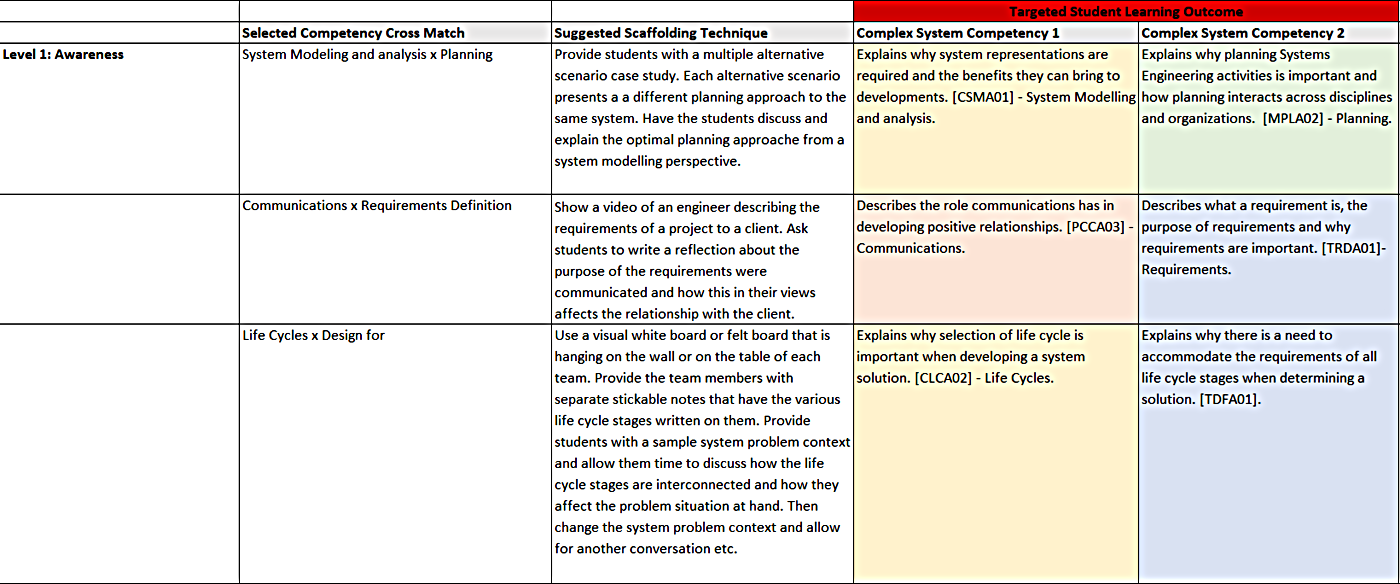
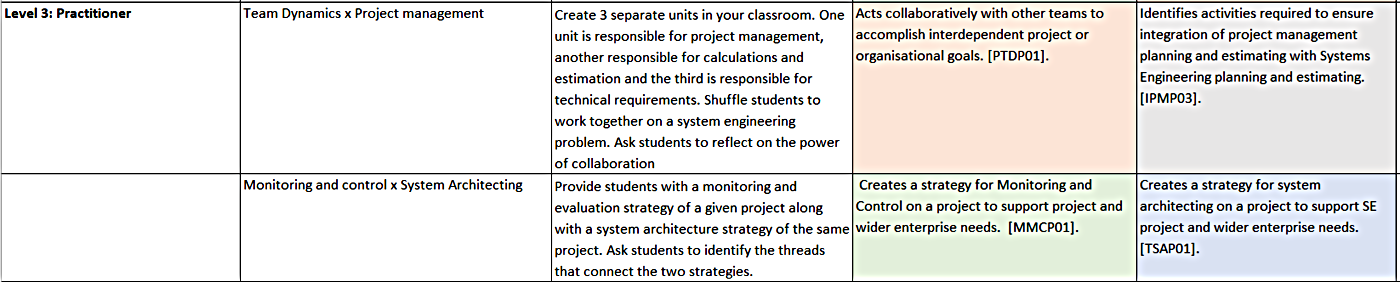
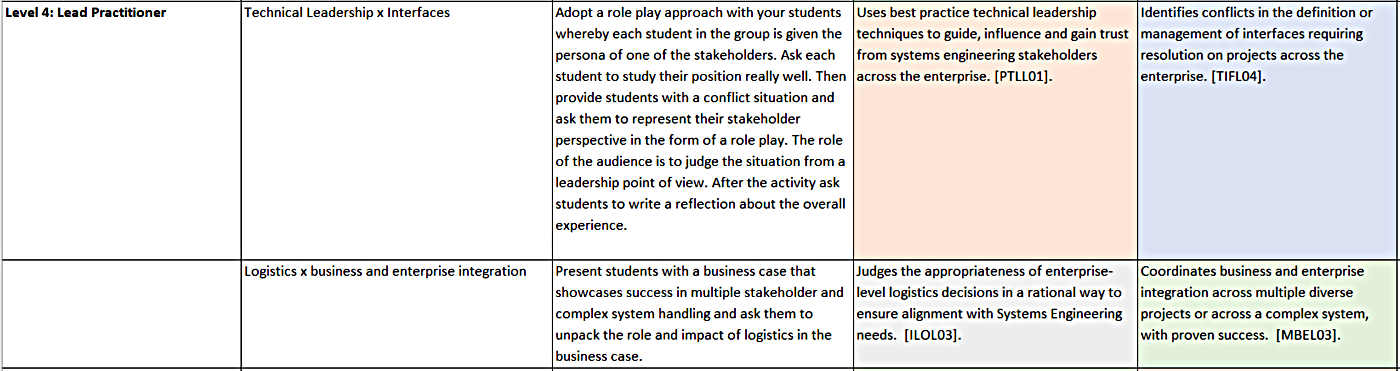
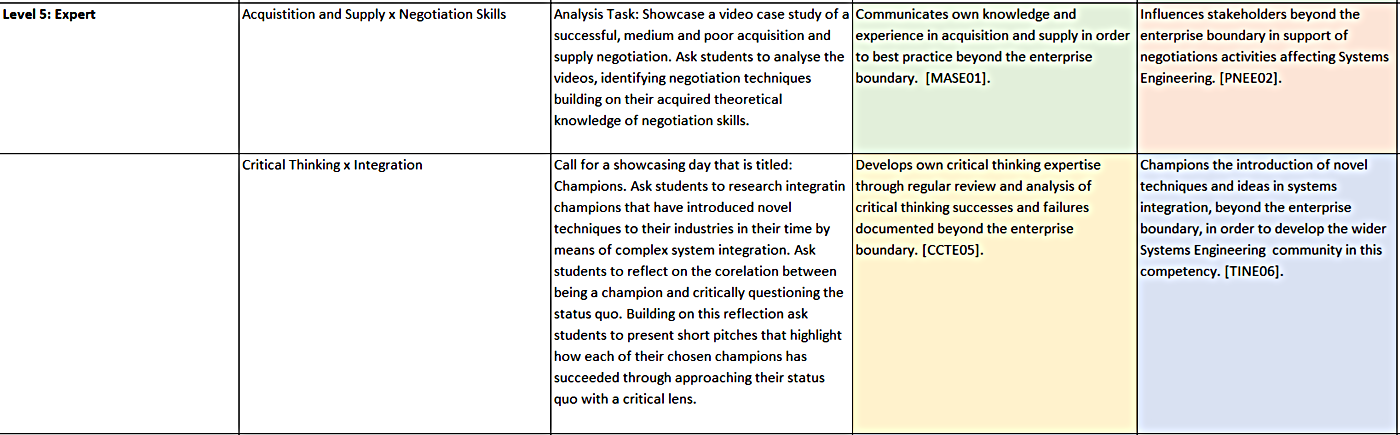
The below table has been designed for embedding Complex Systems Learning Outcomes across an engineering curriculum. It maps against competencies and suggests scaffolding techniques across educational levels. It is also important to note, that efforts need to be made to align to the relevant AHEP requirements or other accreditation standards. Table 1 presents the different strands of the Complex Systems Engineering Curriculum, colour coded in line with the INCOSE Competency Framework outline (INCOSE, 2025). Table 2 presents a practical guide for educators to scaffold Complex Systems learning outcomes across a curriculum. The intention is for the scaffolding framework to compare the trade-offs between different elements of the competency group. For example, system modelling and analysis as an element from the core competency and planning from the management competency. The table suggests activities that would integrate different competencies together in a scaffolded approach.
Table 1 presents Competency Areas for Complex Systems. As mentioned, the skills range to include a wide variety of competencies, thereby enabling a solid and grounded systems thinking approach for students. As students approach their learning, they go through a series of development stages that gradually build up student level of expertise until they reach the stage of what the INCOSE competency framework refers to as a lead practitioner role. Building on the competencies of the complex system toolkit presented in Table 1, Table 2 presents a potential outline for a scaffolding framework that maps varying threads of the framework in a way that enables scaffolded activities at every developmental stage for learners. Depending on the learning context and educational level, educators can choose which level of attainment is appropriate to their curriculum.
As we are approaching the fuzzy front end to complexity in engineering pedagogy, as educators we need to be constantly toggling between devising frameworks, being informed by literature, contextualising ideas, validating these in our classrooms and repeating this cycle to continually fine-tune our complex teaching navigational complexity framework. The invitation is open for all educators who would like to connect as we continue to explore different ways of developing responsible engineers who leave a lasting and sustainable mark transforming their stationed realities.
Any views, thoughts, and opinions expressed herein are solely that of the author(s) and do not necessarily reflect the views, opinions, policies, or position of the Engineering Professors’ Council or the Toolkit sponsors and supporters.
Related INCOSE Competencies: Toolkit resources are designed to be applicable to any engineering discipline, but educators might find it useful to understand their alignment to competencies outlined by the International Council on Systems Engineering (INCOSE). The INCOSE Competency Framework provides a set of 37 competencies for Systems Engineering within a tailorable framework that provides guidance for practitioners and stakeholders to identify knowledge, skills, abilities and behaviours crucial to Systems Engineering effectiveness. A free spreadsheet version of the framework can be downloaded.
This resource relates to the Systems Thinking, Systems Modelling and Analysis, Ethics and Professionalism, Technical Leadership and Critical Thinking INCOSE Competencies.
AHEP4 mapping: This resource addresses several of the themes from the UK’s Accreditation of Higher Education Programmes fourth edition (AHEP4): Analytical Tools and Techniques (critical to the ability to model and solve problems), and Integrated / Systems Approach (essential to the solution of broadly-defined problems). In addition, this resource addressesAHEP themes of Design, Ethics and Communication.
Educational level: Intermediate; Advanced.
Learning and teaching notes:
The case is built around 3 × 90-minute sessions and independent report writing. A suggested breakdown of the activities can be seen below.
Learners have the opportunity to:
Explore how technical, human, and organisational factors interact in complex socio-technical systems.
Apply Fault Tree Analysis (FTA) to diagnose ambiguous real-world engineering failures.
Practice making judgements under uncertainty with incomplete and conflicting data.
Analyse competing stakeholder perspectives and the ethical trade-offs in engineering decision-making.
Develop professional communication skills by producing expert reports and presenting findings to a stakeholder panel.
Reflect on their own reasoning, assumptions, and handling of complexity.
Teachers have the opportunity to:
Use an authentic, narrative-driven case to introduce systems thinking and failure analysis.
Facilitate active learning through group FTA construction and peer review.
Engage students in interdisciplinary learning that links materials science, engineering practice, regulation, and ethics.
Adapt the complexity of the case (technical vs organisational) depending on learners’ level and course focus.
Provide formative and summative assessment using expert reports, presentations, and reflective writing.
Encourage metacognitive development by prompting students to examine uncertainty and assumptions in engineering practice.
20 min: Introduce case scenario and system context; 30 min: Group discussion on initial impressions, key stakeholders, and potential causes; 40 min: Begin Fault Tree Analysis (FTA) construction using initial evidence.
2
Investigation and analysis
30 min: Continue FTA construction and data evaluation; 30 min: Peer review of other groups’ fault trees; 30 min: Consolidate findings and prepare draft report outline.
3
Reporting and reflection
30 min: Present findings to a simulated stakeholder panel; 30 min: Discuss feedback and defend conclusions; 30 min: Individual reflection on complexity, uncertainty, and assumptions.
Summary of the system or context:
Rail transport systems consist of thousands of interdependent components, including rails, fasteners, sleepers, signalling systems, and maintenance processes. Failures in a single component can cascade, affecting:
Safety: Malfunctions may cause derailments or delays.
Economics: Service interruptions lead to financial losses and reputational damage.
Public trust: Media scrutiny increases scrutiny of operational practices.
On a cold January morning, a commuter train was halted after inspectors discovered a fractured rail joint component. Services were disrupted for several hours, stranding thousands of passengers. The media quickly picked up the story, raising questions about safety and reliability.
The rail operator urgently commissioned an engineering consultancy (the students) to investigate the failure. Their findings will inform both the safety authority’s decision on whether the line can reopen and the legal proceedings to determine liability.
The dilemma:
The operator demands a rapid report to resume services.
The manufacturer insists the component was produced to specification and blames poor maintenance.
The regulator requires an unbiased, defensible technical opinion before approving operations.
The public expects transparency and reassurance about safety.
As consultants, students face incomplete evidence: some lab tests are missing, inspection logs are inconsistent, and eyewitness accounts conflict. They must use Fault Tree Analysis (FTA) to map possible causes, evaluate data, and produce an expert opinion report — knowing that their conclusions could influence legal outcomes and public safety decisions.
Groups: 3–5 students per group; 3-4 groups can run in parallel.
Materials required: case narrative handouts, sample inspection log, example FTA, whiteboards/flipcharts, sticky notes for FTA mapping.
Activity flow:
1. Introduce case and assign roles.
2. Construct initial fault trees using evidence.
3. Peer-review across groups.
4. Draft expert report and present to simulated stakeholder panel.
5. Individual reflection on complexity and uncertainty.
Why use Fault Tree Analysis (FTA):
FTA is a structured approach to trace a failure from an observed event back to potential causes, including technical, human, and organisational factors.
FTA is particularly suitable for this case because it allows students to structure complex, uncertain information in a logical and transparent way. It helps them trace the chain of causes behind the rail component failure, linking material, human, and organisational factors into one coherent framework. By visualising how small events combine into system-level failures, FTA encourages learners to think critically about interdependencies, data gaps, and assumptions. It also mirrors real-world engineering investigations, where professionals must justify conclusions under uncertainty and demonstrate clear reasoning to stakeholders such as regulators or courts.
Visualises cause-effect relationships, interdependencies, and failure paths.
Encourages discussion of assumptions and uncertainties.
Questions and activities:
Discussion prompts:
Prompt
Expected insight / reflection
What technical, human, and organisational factors might have contributed to this failure?
Students identify multiple interacting factors, illustrating interdependencies and emergent risks.
How does Fault Tree Analysis help structure uncertainty in this investigation?
Learners recognise FTA’s role in visualising cause-effect pathways and clarifying assumptions.
Which assumptions are you forced to make, and how might they affect your conclusions?
Students reflect on data gaps, biased observations, and ethical implications of assumptions.
How do different stakeholders’ interests shape urgency and framing of your analysis?
Learners understand trade-offs, pressures from conflicting priorities, and the precautionary principle.
What are the risks of issuing a preliminary report under time pressure?
Students explore implications for safety, liability, professional integrity, and public trust.
Classroomactivities:
Activity
Focus
What “good practice” looks like
Facilitator notes / tips
1. FTA construction
Collaborative problem analysis
Teams discuss evidence openly, question assumptions, and co-create a logical tree linking technical, human, and organisational causes.
Encourage each group to identify at least one “human/organisational” branch and to label any data gaps explicitly.
2. Peer review
Critical reflection and systems perspective
Groups provide constructive critique, highlighting hidden assumptions, missing branches, or unclear logic. Dialogue stays professional and evidence-based.
Provide coloured sticky notes or digital comments to record feedback; model how to frame critique as questions (“Have you considered…?”).
3. Report writing (in-class drafting)
Synthesis and professional communication
Drafts show a clear, defensible reasoning chain from evidence to conclusion. Teams justify assumptions and note uncertainties.
Remind students to separate “facts” from “interpretations.” Encourage use of structured headings (Findings – Analysis – Conclusions).
4. Simulation role-Play
Perspective-taking and communication under pressure
Presentations are concise (≤5 min), factual, and adapted to stakeholder roles. Learners respond respectfully and clearly to challenging questions.
Provide role cards for the panel (operator, regulator, manufacturer, public). Rotate students if possible.
5. Reflection
Metacognition and learning from uncertainty
Students identify what surprised them, what they found ambiguous, and how their view of engineering judgment evolved.
Offer prompts like “What would you do differently next time?” or “Where did your reasoning feel uncertain?”
Further challenge:
Instructors may choose to introduce a second “reveal” phase: a new metallurgical test result or a whistle-blower statement emerges halfway through the case. Students must revise their fault tree and defend whether and how their conclusions change. This highlights the evolving nature of complex systems investigations.
Assessment opportunities:
Fault Tree Diagram (30%) – accuracy, depth, clarity.
Presentation and defence (20%) – clarity, stakeholder awareness, handling questions.
Reflective summary (20%) – insight into uncertainty, assumptions, systems thinking.
Any views, thoughts, and opinions expressed herein are solely that of the author(s) and do not necessarily reflect the views, opinions, policies, or position of the Engineering Professors’ Council or the Toolkit sponsors and supporters.
Keywords: Problem solving; Feedback loops; Decision-making; VUCA; Optimisation; Public health and safety; Risk; Sustainability; Ethics; Responsible design; Life cycle; Societal impact; Enterprise and innovation.
Who is this article for?: Thisarticle should be read by educators at all levels in higher education who are seeking an overall perspective on teaching approaches for integrating complex systems in engineering education.
Related INCOSE Competencies: Toolkit resources are designed to be applicable to any engineering discipline, but educators might find it useful to understand their alignment to competencies outlined by the International Council on Systems Engineering (INCOSE). The INCOSE Competency Framework provides a set of 37 competencies for Systems Engineering within a tailorable framework that provides guidance for practitioners and stakeholders to identify knowledge, skills, abilities and behaviours crucial to Systems Engineering effectiveness. A free spreadsheet version of the framework can be downloaded.
This resource relates to the Systems Thinking andCritical Thinking INCOSE competencies.
AHEP mapping: This resource addresses several of the themes from the UK’s Accreditation of Higher Education Programmes fourth edition (AHEP4): Analytical Tools and Techniques (critical to the ability to model and solve problems),and Integrated / Systems Approach (essential to the solution of broadly-defined problems).
Premise:
We live in a complex world. Complexity is a key challenge, captured in leadership terms by the VUCA framework: volatile, uncertain, complex and ambiguous (Lanucha 2024). Engineers have the privilege of creating products and processes for humans to use in this landscape. Each of these likely has numerous parts which interact, as well as interacting with the environment, people, and needing to meet a host of safety, quality, sustainability, ethics, and financial obligations. Traditionally, engineers analyse problems by breaking them down into simple parts. This helps understanding and makes calculations feasible, but it’s easy to lose understanding of the whole system. Any change can easily create a problem elsewhere. From a technical viewpoint, engineers need to understand this interconnectedness in order for their creations to work. In a wider sense, ‘systems thinking’ is a skill central to engineering quality and management techniques, which seek to rationalise the complexity of entire organisations and their ever-changing market pressures.
The case for understanding systems:
Systems is perhaps one of the most misunderstood words in engineering. It is often found combined with mathematical modelling or control – topics often perceived as challenging – and is used in other fields like Computer Science, where tools and models are different. In all cases, the idea revolves around a group of interacting or interrelated elements which form a unified whole. Those elements can be physical or information, hardware or software, or any combination of mechanical, electrical, and other engineering domains. Thinking in terms of systems can therefore be thought of as a holistic approach.
The Engineering Council UK’s AHEP criteria include a systems approach: C/M6 – “Apply an integrated or systems approach to the solution of complex problems.” Several other AHEP criteria also reference complexity and complex problems, which they define as having “no obvious solution and may involve wide-ranging or conflicting technical issues and/or user needs that can be addressed through creativity and the resourceful application of engineering science. The Systems Thinking Alliance (2025) gives a broader definition of complexity as referring to “the condition of systems, objects, phenomena, or concepts that are challenging to understand, explain, or manage due to their intricate and interconnected nature. It involves multiple elements or factors that interact in unpredictable ways, often requiring significant information, time, or coordinated efforts to address.” For these, there is no ‘one-size-fits-all solution’ (Ellis 2025). This is the reality that engineers need to manage by understanding the potential effects on all parts of the system.
In order to analyse, engineers dissect complexity into manageable components, and educators teach these simple components before moving onto more complex systems. For example, students initially learn basic electrical components, simple beams, rigid bodies, etc. before bringing these together in case studies, and then moving onto topics like mechatronic systems. Historically, engineers specialised on graduation, perhaps becoming a stress engineer or fluid dynamicist in dedicated offices and functional teams. A design decision by one team could have unintended consequences for another, as well as additional uncertainty. The advent of cross-functional project and ‘matrix’ organisations mitigated against this, and companies have moved towards attribute teams which can consider the balance of behaviour. Even so, some uncertainty remains in the form of assumptions in calculations, changes in material properties with temperature or stress, or small variations in composition and manufacturing tolerances, which can all accumulate. Any parts which are bought ‘off-the-shelf’ or made by other companies under license must be carefully specified. Relationships can be nonlinear – or even chaotic – and contain feedback loops which can amplify changes (Kastens et al 2009). This all increases the risk of a product’s comfort, performance, and safety being impacted in ways that weren’t anticipated. Any problem that doesn’t come to light until the testing phase – late in the design process – represents costly redesigns and delays. In the unlikely event that a problem isn’t captured during testing either, the outcome could be disastrous.
Systems engineers will bring the product together and establish these complex behaviours through models and testing. Identifying potential problems early in the design phase can save significant money and facilitate better designs. This can be challenging, especially for systems using novel materials or operating in extreme environments, which aren’t accurately captured by standard calculations. Models may be linearised, neglect external forcing, or be derived for an assumed air density or ambient temperature which may not be valid. In recent decades, the engineering industry has moved towards model-based design and virtual prototyping, facilitated by advances in computer tools. These are increasingly sophisticated, but models still need to be built by engineers with an appreciation of complexity and the mechanisms by which a problem could arise. As humans develop new materials and technologies, and explore the limits of what is possible, engineering techniques and calculations need constant revision, and software tools are frequently updated to facilitate this.
That holistic view of problems has benefits outside of designing engineering artefacts. The manufacturing process is itself a complex system with potentially long supply chains. As is the organisation, which is comprised of numerous people operating in a landscape of financial pressures, employment law, politics and culture. Quality guru William Deming’s 14 Points for Management (Deming 2018) can be viewed as a systems approach to handling this complexity, by breaking down barriers between departments and instigating continuous improvement. Once a product is produced, it exists in a wider world and continues to interact with it. From a sustainability viewpoint, this can be the user and surrounding community, the environmental impact over a product’s lifecycle, and the financial markets which dictate whether a product is viable. It can also be the social, political, and legal landscapes: these can place direct constraints in the forms of laws governing safety and emissions (such as the UK’s legally binding target of net zero by 2050), or through embargos, tariffs, and subsidies. Each country has its own regulations, which can necessitate multiple variations of a product: a good example is cars, which need to be produced in both left- and right-hand drive, satisfy varying safety and emissions regulations, and cater for differing personal and cultural preferences for size, noise, usage and driving styles. Even when not legislated, a company might choose to support fair trade, lead the way in sustainable practices, or refuse to do business with suppliers or regimes they find objectionable – potentially making this a key part of their brand.
An engineer’s ability to appreciate and understand the wider social and business landscape is a reason why finance and management consultancy companies can often be seen recruiting engineers at student careers fairs. The Sainsbury Management Fellowship (SMF) scheme notably develops UK engineers as industry leaders, and fellows have made a major contribution to the UK’s economic prosperity (RAEng 2025).
Conclusions:
Complex systems are the “real world” that engineers attempt to understand and design for. They are complicated, interconnected, changing, and uncertain. The well-known part of engineering is analysis: breaking systems into understandable parts. There needs to be a parallel operation where those parts are assembled or integrated into a whole, and that whole interacts with everything around it. This is where unforeseen problems can occur. Systems models and a holistic systems thinking approach can mitigate this risk. A systems approach and ability to manage complexity is a key skill for engineers, and positions them well for other fields like management.
Kastens, K., Manduca, C., Cervato, C., & Frodeman, R., Goodwin, C., Liben, L., Mogk, D., Spangler, T., Stillings, N., Titus, S. (2009). How Geoscientists Think and Learn. Eos, Transactions American Geophysical Union. 90. 10.1029/2009EO310001.
Any views, thoughts, and opinions expressed herein are solely that of the author(s) and do not necessarily reflect the views, opinions, policies, or position of the Engineering Professors’ Council or the Toolkit sponsors and supporters.
Objectives:Engage in a mentorship relationship within EDI-focused networks, either as a mentor or mentee. This exchange fosters personal, professional growth and strengthens EDI communities through shared knowledge and experiences.
Introduction: Engaging in mentorship within EDI-focused networks, as either a mentor or mentee, fosters personal and professional growth while strengthening inclusive communities. Through peer support and mentoring groups, you can connect with others facing similar challenges, diversify your networks, and challenge social norms to promote social justice and inclusivity.
Topic: Building inclusive communities through EDI mentorship: fostering growth, networks, and social justice.
Keywords: Mentoring; Equity, Diversity and Inclusion; Justice; Social responsibility; Collaboration; Ethics; Professional development; Leadership or management.
Resources and support
A guide for employers, employees, and future employees on the reasons to implement reciprocal mentoring. Click here to access the PDF guide.
Reciprocal mentoring
In the video below, Professor Anne Nortcliffe highlights the concept and benefits of reciprocal mentoring, emphasizing mutual learning, inclusion, and shared growth between junior and senior colleagues.
Video summary:
🎯 Purpose: Reciprocal mentoring differs from traditional mentoring, where typically a senior guides a junior — here, both parties learn from one another.
🔄 Mutual learning: Both mentor and mentee bring valuable perspectives, creating opportunities for shared growth and understanding.
🧑🎓🧑💼 Generational exchange: Junior staff share insights from their generational and workplace experiences, enriching the senior staff’s awareness and approach.
🗺️ Career navigation: Seniors still provide guidance in navigating career paths and adapting to changing professional landscapes.
❓ Interview tip: During job interviews, ask if the employer has a reciprocal mentoring program — if not, use the provided toolkit to highlight its benefits.
📣 Authentic voices: Socially underrepresented individuals can bring their lived experiences into the conversation, promoting inclusion.
🌍 Inclusive environment: Reciprocal mentoring fosters diversity, equity, and inclusion within the workplace.
🧑🤝🧑 Collaborative impact: Mentors become advocates in senior spaces, amplifying the visibility and contributions of their mentees.
🚀 Opportunities: Mentors may champion their mentees for key projects and leadership development opportunities.
💡 Take initiative: If your workplace doesn’t offer reciprocal mentoring, suggest it to HR and help lead the implementation.
Peer support
Organise or join peer support/mentoring groups with fellow graduates or students who may experience similar challenges as you. You can use these groups to hear other people’s experiences relating to employment and how to thrive in the workplace.
Join organisations such as:
AFBE – Association for Black & Minority Ethnic Engineers offers mentoring for students.
Reflect on social justice themes and explore how they can enhance your work and contribute to a better world.
Evaluate employers’ ethical standards to ensure alignment with your values. Highlight your social justice values in your CV and interviews and inquire about the company’s ethics.
Expand your network to include diverse perspectives and experiences.
Engage with people from varied backgrounds to broaden your understanding and challenge societal norms.
Challenge social norms
What is your own view about the world and the way things are?
Are they okay as they are and if so, why?
Fact or fiction media narratives?
What assumptions have your made?
Who benefited from these assumptions?
What are your values?
Are these assumptions aligned with your values?
Use this way of thinking as you develop your own work and projects.
Any views, thoughts, and opinions expressed herein are solely that of the author(s) and do not necessarily reflect the views, opinions, policies, or position of the Engineering Professors’ Council or the Toolkit sponsors and supporters.
Please note: Discussions around discrimination, prejudice and bias are highly complex and part of a much wider national and international debate, including contested histories. As such, we have limited the scope of our resources to educating and supporting students.
The resources that the EPC and its partners are producing in this area will continue to expand and, if you feel there is an issue that is currently underrepresented in our content, we would be delighted to work with you to create more. Please get in touch.
We’re always pleased to see the #EngineeringEthicsToolkit featured in news articles, blogs, podcasts etc., and we’ll be keeping track of those mentions here.
Any views, thoughts, and opinions expressed herein are solely that of the author(s) and do not necessarily reflect the views, opinions, policies, or position of the Engineering Professors’ Council or the Toolkit sponsors and supporters.
Here you’ll find a list of our events related to the Engineering Ethics Toolkit.
You can also search here for meetings of the Ethics Advisory Group, and Ethics Ambassadors.
We’re pleased to announce that we have just published some much requested new materials focused on helping you to assess ethics learning within the classroom.
Assessing ethics: Guidance & rubric is designed in a way that encourages students to grapple with the numerous tensions involved in ethical decision making, with a focus on assessment of the decision-making process as opposed to the ‘answer’ given, the decision made, or the outcome of the scenario.
We would like to thank Dr. Natalie Wint (UCL) and Dr. William Bennett (Swansea University) for the time and effort they have put into creating these resources.
 The Engineering Council and the Royal Academy of Engineering have chosen Chartered Week (23–27 February) to publish an update of their joint Statement on Ethical Principles for the engineering profession, first published over 20 years ago.
 Ethical commitments are at the heart of the role of a registered engineer or technician – and everyone who works in engineering. The refreshed Statement reflects the changing technology environment and the new challenges faced by engineering professionals today.


 The
The  Here you’ll find a list of our events related to the Engineering Ethics Toolkit.
 We’re pleased to announce that we have just published some much requested new materials focused on helping you to assess ethics learning within the classroom.