Toolkit: Complex Systems Toolkit.

Author: Dr. Stuart Grey, SFHEA (University of Glasgow).

Topic: Student created interactive simulation for complex sociotechnical systems.

Title: LLM-driven interactive simulation for complex sociotechnical systems.

Resource type: Teaching activity.

Relevant disciplines: Any.

Keywords: Artificial Intelligence; Large Language Model; Sociotechnical systems; Ethics; Modelling or simulation; Emergence.

Licensing: This work is licensed under a Creative Commons Attribution-ShareAlike 4.0 International License. It is based upon the author’s article “Enhancing Ethical Reasoning in Engineering Education through Student-Created Interactive Ethical Scenarios Using Generative AI,” 2025 IEEE Global Engineering Education Conference (EDUCON), London, United Kingdom, 2025, pp. 1-5, doi: 10.1109/EDUCON62633.2025.11016531. 

Downloads: 

Related INCOSE Competencies: Toolkit resources are designed to be applicable to any engineering discipline, but educators might find it useful to understand their alignment to competencies outlined by the International Council on Systems Engineering (INCOSE). The INCOSE Competency Framework provides a set of 37 competencies for Systems Engineering within a tailorable framework that provides guidance for practitioners and stakeholders to identify knowledge, skills, abilities and behaviours crucial to Systems Engineering effectiveness. A free spreadsheet version of the framework can be downloaded.

This resource relates to the Systems Thinking, Life Cycle, Configuration Management, Requirements Definition, Verification, and Validation INCOSE Competencies. 

AHEP mapping: This resource addresses several of the themes from the UK’s Accreditation of Higher Education Programmes fourth edition (AHEP4):  Analytical Tools and Techniques (critical to the ability to model and solve problems), and Integrated / Systems Approach (essential to the solution of broadly-defined problems). In addition, this resource addresses AHEP themes of Ethics and Communication. 

Education level: Intermediate.


Learners have the opportunity to: 

Teachers have the opportunity to: 


Overview:

This resource enables engineering students to create, run, and debug a textbased, interactive simulation of a complex sociotechnical system using a Large Language Model (LLM). It is intentionally flexible and may be delivered as a multisession studio activity (including assessment) or used solely as a compact assessment.


Purpose and use:

In both modes, students design a robust text prompt, test it with a user, document changes, and submit auditable artefacts that evidence learning. The key activity is interrogating their own thinking on how complex systems should be modelled by making judgements as to how their game does and does not capture the system dynamics. 


Why and how: 

The approach aims to give students hands-on experience in putting systems thinking into practice. Concepts such as stakeholders, feedback loops, delays, uncertainty, and emergent behaviour can be implemented and interrogated without heavy tooling.  

The submission is a text LLM prompt with tracked changes, which allows students to demonstrate system design and debugging, produce transparent process evidence, and scale to large cohorts with minimal infrastructure. 


Delivery options at a glance:

Audience Undergraduate Years 2–4 and taught MSc, any engineering discipline 
Modes Studio activity (3–5×2 h + independent study) or Assessmentonly (promptonly; 1–2×2 h + 4–6 h)
Teams 3–4 students (solo permitted for assessmentonly) 
Assessment Portfolio (studio) or promptpluschangelog (assessmentonly) 
Platforms Institutional Copilot licences successful; encourage exploration of free tools (students record model/version)


Materials and software:


Delivery modes:

Mode A — Studio activity (3–5 sessions) 

Mode B — Assessmentonly (promptonly; 1–2 sessions) 

In both modes, module leaders may supply a predefined scenario(s) to standardise scope and simplify marking. A readytouse example is provided in Appendix C. 


Assessment:

Studio portfolio — rubric (suggested weighting):

Criterion  D–E 
Complexity modelling  Clear boundary; rich stakeholders; ≥4 correct loops; delays explicit; coherent KPIs  Mostly sound  Basic map  Superficial  25 
Simulation design and prompt quality  Consistent state logic; visible feedbacks/delays; nonlinearity; negative choices allowed with consequences; clear commands  Mostly coherent  Playable but brittle  Confusing/linear  25 
Debugging evidence  Systematic playtests; clear issue → fix → retest artefacts  Some iteration  Minimal  None  20 
Insight and reflection  Deep analysis of emergence, tradeoffs, equity, uncertainty, and LLM limits  Good  Descriptive  Vague  20 
Communication and referencing  Clear, concise, correct Harvard referencing  Minor issues  Adequate  Disorganised  10 


Assessment‑only (prompt‑only) — compact rubric: 


Scenario options: 

Students may propose their own topic or the module leader may supply a predefined scenario. Options suited to UK engineering contexts include: 


Appendix A — Prompt template (simulation + debugready): 

Title: Complex Systems Simulator — [Scenario] 

Purpose: Run a turnbased interactive simulation of a complex sociotechnical system. Track named state variables, apply feedback and delays, and let the player’s decisions drive nonlinear outcomes. 

Setup: 

  1) Offer three roles (distinct authority/constraints). 

  2) Introduce 3–5 NPCs with clear goals and plausible interventions. 

  3) Show a dashboard of [STATE_VARIABLES] each turn with short context. 

State rules: 

Commands: status, talk [npc], inspect [asset], implement [policy], pilot [intervention], advance time, review log. 

Debug commands (for testing): trace on/off (print update logic), why (state which loops/delays drove the change), show variables (print current state table), revert (roll back one turn), reseed (slight exogenous shock). 

Realism and ethics: Allow all plausible actions and report consequences neutrally. If unsafe in the real world, refuse, propose safer alternatives, and continue with plausible systemic effects. 

LLM pitfalls to avoid: Do not invent new variables; ask clarifying questions rather than guessing; keep outputs concise; summarise trajectory every five turns. 

Begin: Greet the player, state the scenario, ask for a role, and wait. 


Appendix B — Debugging and playtest checklist: 

Functional coherence 

Robustness 

User experience and clarity 

Report 


Appendix C — Predefined scenario (Urban Heatwave Response, UK city): 

Boundary: One UK local authority area during the July–August heatwave period. Focus on public health, energy demand, and community resilience. 

Roles: (1) Local Authority Resilience Lead; (2) NHS Trust Capacity Manager; (3) Distribution Network Operator (DNO) Duty Engineer. 

Stakeholders: Residents (with a focus on vulnerable groups), care homes, schools, SMEs, DNO, local NHS Trust, emergency services, voluntary/community groups, Met Office (for alerts), and local media. 

State variables (examples): Heathealth alert level (0–4); Emergency Department occupancy (%); Electricity demand/capacity (% of peak); Indoor temperature exceedance hours (hrs > 27 °C); Public trust (0–100); Budget (£); Equity index (0–100). 

Events/shocks: Red heat alert; substation fault; procurement delay; misinformation spike on social media; transport disruption; community centre cooling failure. 

KPIs and stop conditions: Heatrelated admissions; unserved energy; cost variance; equity gap across wards. Stop if alert level 4 persists >3 days, budget overspends >10%, or trust <25. 

Notes for assessors: Using a standard, predefined scenario simplifies marking and ensures comparable complexity across teams, while still allowing for diverse strategies and outcomes. 


Any views, thoughts, and opinions expressed herein are solely that of the author(s) and do not necessarily reflect the views, opinions, policies, or position of the Engineering Professors’ Council or the Toolkit sponsors and supporters.  

Toolkit: Complex Systems Toolkit.

Author: Dr. Ewa Ura-Binczyk (Warsaw University of Technology).

Topic: Rail accident investigation and material failure analysis using systems thinking.

Title: Using fault tree analysis in a rail failure investigation.

Resource type: Teaching – Case study.

Relevant disciplines: Mineral, metallurgy & materials engineering; Civil engineering.

Keywords: Public health and safety; Risk; Fault tree analysis; Failure; Ethics; Public trust; Stakeholders; Trade offs; Uncertainty.

Licensing: This work is licensed under a Creative Commons Attribution-ShareAlike 4.0 International License. 

Related INCOSE Competencies: Toolkit resources are designed to be applicable to any engineering discipline, but educators might find it useful to understand their alignment to competencies outlined by the International Council on Systems Engineering (INCOSE). The INCOSE Competency Framework provides a set of 37 competencies for Systems Engineering within a tailorable framework that provides guidance for practitioners and stakeholders to identify knowledge, skills, abilities and behaviours crucial to Systems Engineering effectiveness.   A free spreadsheet version of the framework can be downloaded.

This resource relates to the Systems Thinking, Systems Modelling and Analysis, Ethics and Professionalism, Technical Leadership and Critical Thinking INCOSE Competencies.

AHEP4 mapping: This resource addresses several of the themes from the UK’s Accreditation of Higher Education Programmes fourth edition (AHEP4): Analytical Tools and Techniques (critical to the ability to model and solve problems), and Integrated / Systems Approach (essential to the solution of broadly-defined problems). In addition, this resource addresses AHEP themes of Design, Ethics and Communication. 

Educational level: Intermediate; Advanced.


Learning and teaching notes:

The case is built around 3 × 90-minute sessions and independent report writing. A suggested breakdown of the activities can be seen below. 

Learners have the opportunity to: 

Teachers have the opportunity to: 


Downloads: 


Learning and teaching resources:


Session  Focus  Suggested activities and timing 
1  Introduction and problem framing  20 min: Introduce case scenario and system context; 30 min: Group discussion on initial impressions, key stakeholders, and potential causes; 40 min: Begin Fault Tree Analysis (FTA) construction using initial evidence. 
2  Investigation and analysis  30 min: Continue FTA construction and data evaluation; 30 min: Peer review of other groups’ fault trees; 30 min: Consolidate findings and prepare draft report outline. 
3  Reporting and reflection  30 min: Present findings to a simulated stakeholder panel; 30 min: Discuss feedback and defend conclusions; 30 min: Individual reflection on complexity, uncertainty, and assumptions. 


Summary of the system or context:

Rail transport systems consist of thousands of interdependent components, including rails, fasteners, sleepers, signalling systems, and maintenance processes. Failures in a single component can cascade, affecting: 


Complex system features: 


Narrative of the case:

On a cold January morning, a commuter train was halted after inspectors discovered a fractured rail joint component. Services were disrupted for several hours, stranding thousands of passengers. The media quickly picked up the story, raising questions about safety and reliability. 

The rail operator urgently commissioned an engineering consultancy (the students) to investigate the failure. Their findings will inform both the safety authority’s decision on whether the line can reopen and the legal proceedings to determine liability. 


The dilemma: 

As consultants, students face incomplete evidence: some lab tests are missing, inspection logs are inconsistent, and eyewitness accounts conflict. They must use Fault Tree Analysis (FTA) to map possible causes, evaluate data, and produce an expert opinion report — knowing that their conclusions could influence legal outcomes and public safety decisions. 

Groups: 3–5 students per group; 3-4 groups can run in parallel. 

Materials required: case narrative handouts, sample inspection log, example FTA, whiteboards/flipcharts, sticky notes for FTA mapping. 

Activity flow: 

1. Introduce case and assign roles. 

2. Construct initial fault trees using evidence. 

3. Peer-review across groups. 

4. Draft expert report and present to simulated stakeholder panel. 

5. Individual reflection on complexity and uncertainty. 


Why use Fault Tree Analysis (FTA):

FTA is a structured approach to trace a failure from an observed event back to potential causes, including technical, human, and organisational factors. 

FTA is particularly suitable for this case because it allows students to structure complex, uncertain information in a logical and transparent way. It helps them trace the chain of causes behind the rail component failure, linking material, human, and organisational factors into one coherent framework. By visualising how small events combine into system-level failures, FTA encourages learners to think critically about interdependencies, data gaps, and assumptions. It also mirrors real-world engineering investigations, where professionals must justify conclusions under uncertainty and demonstrate clear reasoning to stakeholders such as regulators or courts. 

Advantages in this case: 


Questions and activities: 

Prompt  Expected insight / reflection 
What technical, human, and organisational factors might have contributed to this failure?  Students identify multiple interacting factors, illustrating interdependencies and emergent risks. 
How does Fault Tree Analysis help structure uncertainty in this investigation?  Learners recognise FTA’s role in visualising cause-effect pathways and clarifying assumptions. 
Which assumptions are you forced to make, and how might they affect your conclusions?  Students reflect on data gaps, biased observations, and ethical implications of assumptions. 
How do different stakeholders’ interests shape urgency and framing of your analysis?  Learners understand trade-offs, pressures from conflicting priorities, and the precautionary principle. 
What are the risks of issuing a preliminary report under time pressure?  Students explore implications for safety, liability, professional integrity, and public trust. 


Activity  Focus  What “good practice” looks like  Facilitator notes / tips 
1. FTA construction  Collaborative problem analysis  Teams discuss evidence openly, question assumptions, and co-create a logical tree linking technical, human, and organisational causes.   Encourage each group to identify at least one “human/organisational” branch and to label any data gaps explicitly. 
2. Peer review  Critical reflection and systems perspective  Groups provide constructive critique, highlighting hidden assumptions, missing branches, or unclear logic. Dialogue stays professional and evidence-based.  Provide coloured sticky notes or digital comments to record feedback; model how to frame critique as questions (“Have you considered…?”). 
3. Report writing (in-class drafting)  Synthesis and professional communication  Drafts show a clear, defensible reasoning chain from evidence to conclusion. Teams justify assumptions and note uncertainties.  Remind students to separate “facts” from “interpretations.” Encourage use of structured headings (Findings – Analysis – Conclusions). 
4. Simulation role-Play  Perspective-taking and communication under pressure  Presentations are concise (≤5 min), factual, and adapted to stakeholder roles. Learners respond respectfully and clearly to challenging questions.  Provide role cards for the panel (operator, regulator, manufacturer, public). Rotate students if possible. 
5. Reflection  Metacognition and learning from uncertainty  Students identify what surprised them, what they found ambiguous, and how their view of engineering judgment evolved.  Offer prompts like “What would you do differently next time?” or “Where did your reasoning feel uncertain?” 


Further challenge:

Instructors may choose to introduce a second “reveal” phase: a new metallurgical test result or a whistle-blower statement emerges halfway through the case. Students must revise their fault tree and defend whether and how their conclusions change. This highlights the evolving nature of complex systems investigations. 


Assessment opportunities:


Any views, thoughts, and opinions expressed herein are solely that of the author(s) and do not necessarily reflect the views, opinions, policies, or position of the Engineering Professors’ Council or the Toolkit sponsors and supporters.  


Authors: Siara Isaac; Valentina Rossi; Joelyn de Lima.

Topic: Transversal skills that promote sustainability.

Tool type: Teaching (Experiential learning activity guide).

Relevant disciplines: Any.

Keywords: Negotiation Skills; Perspective taking; Role-play.

Sustainability competency: Systems thinking; Critical thinking.

Related SDGs: SDG 4 (Quality education); SDG 7 (Affordable and clean energy); SDG 9 (Industry innovation and infrastructure); SDG 12 (Responsible consumption and production); SDG 13 (Climate action).

Reimagined Degree Map Intervention: Active Pedagogies and Mindset Development; More Real-World Complexity; Cross-Disciplinarity.

Who is this article for?: This article should be read by educators at all levels of higher education looking to embed and integrate ESD into curriculum, module, and / or programme design.

Link to resource: How to support students to develop skills that promote sustainability


Learning and teaching notes:

This experiential activity aims to incorporate sustainability reflections into students’ group work. It uses a selection of materials with different properties to engage participants in building a wind turbine prototype based on a contextualised negotiation of multiple facets of sustainability.

Taking a disciplinary standpoint, participants first assume one of four engineering roles to identify specific sustainability priorities based on their role’s responsibilities and expertise. Next, they represent the perspective of their assigned role in an interdisciplinary group to optimise sustainability in the design of a wind turbine.

Throughout the activity, students are given targeted and short theoretical input on a selection of transversal skills that facilitate the integration of sustainability in group work: systems thinking, negotiation skills and perspective taking.

This activity guide provides the outline and material to assist the facilitator to prepare, and the slides and handouts for teaching the activity in approximately 75min. It can be facilitated with tangible objects (e.g. LEGO) as well as online. We invite you to adapt this activity to your context and tangibles availability.


Click here to access the activity guide


Supporting resources on the development of transversal skills:

https://zenodo.org/communities/3tplay/records


This work is licensed under a Creative Commons Attribution-ShareAlike 4.0 International License.  

Any views, thoughts, and opinions expressed herein are solely that of the author(s) and do not necessarily reflect the views, opinions, policies, or position of the Engineering Professors’ Council or the Toolkit sponsors and supporters. 

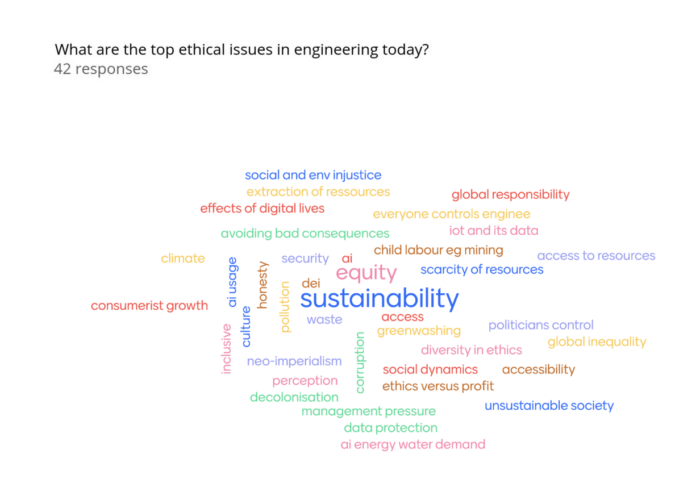
What are the top ethical issues in engineering today, and how can you incorporate these in your teaching?

In our Engineering Ethics workshop at the 2023 SEFI Conference at TU Dublin, we asked participants what they felt were the top ethical issues in engineering today. This word cloud captured their responses, and the results reveal concerns ranging from AI and sustainability to business and policy and beyond.

When incorporating ethics into a lesson or module, educators might want to find teaching resources that address a topic that’s recently been in the news or something of particular relevance to a group of students or to a project brief. But how can this be done efficiently when there are now so many teaching materials available in our Toolkits?

Fortunately, sifting through available resources in the Ethics Toolkit is now easier than ever, with the release of the new Toolkit search function. The Toolkit search allows users to:

  • Choose from a list of suggested keyword tags;
  • Search by multiple keyword tags or their own search terms;
  • Refine the search results by one of more of the following filters: engineering discipline; educational level; type of content.

It even pulls resources from across different toolkits, if so desired.

Not only will this help you discover and find materials that are right for your educational context, but the search function could even become a teaching tool in itself. For instance, you could poll students with the same question we used in the SEFI Workshop, asking them what they think the top ethical issues are in engineering today, and then design (or co-design) a lesson or activity based on their responses and supported by resources in the Toolkit. If you don’t find resources for a particular issue, that could be a great learning opportunity to0 – why might these topics not be addressed? Of course, you can always create a resource that fills a gap and submit it to be a part of the Toolkit: we would love to see a student-developed case study or activity.

Let us know how you have used the Toolkit search function, and if there are ways we could improve it. Happy searching!

This post is also available here.

Any views, thoughts, and opinions expressed herein are solely that of the author(s) and do not necessarily reflect the views, opinions, policies, or position of the Engineering Professors’ Council or the Toolkit sponsors and supporters.
Author: Mike Murray BSc (Hons) MSc PhD AMICE SFHEA (Senior Teaching Fellow in Construction Management, Department of Civil & Environmental Engineering, University of Strathclyde). 

Topic: Links between education for sustainable development (ESD) and intercultural competence. 

Tool type: Teaching. 

Engineering disciplines: Civil; Any. 

Keywords: AHEP; Sustainability; Student support; Local community; Higher education; Assessment; Pedagogy; Education for sustainable development; Internationalisation; Global reach; Global responsibility; EDI. 

Sustainability competency: Self-awareness; Collaboration; Critical thinking.

AHEP mapping: This resource addresses two of the themes from the UK’s Accreditation of Higher Education Programmes fourth edition (AHEP4): The Engineer and Society (acknowledging that engineering activity can have a significant societal impact) and Engineering Practice (the practical application of engineering concepts, tools and professional skills). To map this resource to AHEP outcomes specific to a programme under these themes, access AHEP 4 here and navigate to pages 30-31 and 35-37. 

Related SDGs: SDG 4 (Quality education); SDG 16 (Peace, justice, and strong institutions). 

Reimagined Degree Map Intervention: More real-world complexity; Active pedagogies and mindset development; Authentic assessment.

Educational level: Beginner. 


Learning and teaching notes: 

This resource describes a coursework aligned to three key pedagogical approaches of ESD. (1) It positions the students as autonomous learners (learner-centred); (2) who are engaged in action and reflect on their experiences (action-oriented); and (3) empowers and challenges learners to alter their worldviews (transformative learning). Specifically, it requires students to engage in collaborative peer learning (Einfalt, Alford, and Theobald 2022; UNESCO 2021). The coursework is an innovative Assessment for Learning” (AfL) (Sambell, McDowell, and Montgomery, 2013) internationalisation at home (Universities UK, 2021) group and individual assessment for first-year civil & environmental engineers enrolled on two programmes (BEng (Hons) / MEng Civil Engineering & BEng (Hons) / MEng Civil & Environmental Engineering). However, the coursework could easily be adapted to any other engineering discipline by shifting the theme of the example subjects. With a modification on the subjects, there is potential to consider engineering components / artifacts / structures, such as naval vessels / aeroplanes / cars, and a wide number of products and components that have particular significance to a country (i.e., Swiss Army Knife).

Learners have the opportunity to: 

Teachers have the opportunity to: 


Learning and teaching resources: 


Rationale: 

There have been several calls to educate the global engineer through imbedding people and planet issues in the engineering curriculum (Bourn and Neal, 2008; Grandin and Hirleman 2009). Students should be accepting of this practice given that prospective freshers are ‘positively attracted by the possibility of learning alongside people from the rest of the world’ (Higher Education Policy Unit, 2015:4). Correspondingly, ‘international students often report that an important reason in their decision to study abroad is a desire to learn about the host country and to meet people from other cultures’ (Scudamore, 2013:14). Michel (2010:358) defines this ‘cultural mobility’ as ‘sharing views (or life) with people from other cultures, for better understanding that the world is not based on a unique, linear thought’.  


Coursework brief summary extracted from the complete brief:

Civil Engineering is an expansive industry with projects across many subdisciplines (i.e. Bridges, Buildings, Coastal & Marine, Environmental, Geotechnical, Highways, Power including Renewables. In a group students are required to consult with an international mentor and investigate civil engineering (buildings & structures) in the mentor’s home country. Each student should select a different example. These can be historical projects, current projects or projects planned for the future, particularly those projects that are addressing the climate emergency. Students will then complete two tasks: 


Time frame and structure: 

1. Opening lecture covering:

a. Reasoning for coursework with reference to transnational engineering employers and examples of international engineering projects and work across national boundaries. 

b. Links between engineering, people, and planet through the example of biomimicry in civil engineering design (Hayes, Desha, & Baumeister, 2020) or nature-based solutions in the context of civil engineering technology (Cassina and Matthews ,2021). 

c. Existence of non-governmental organisations (NGOs) such as RedR UK (2023) Water Aid (2023) and Bridges to Prosperity (2023). 

d. The use of corporate social responsibility (CSR) to address problematic issues such as human rights abuses (Human Rights Watch, 2006) and bribery and corruption (Stansbury and Stansbury) in global engineering projects.  


2. Assign students to groups:

a. Identify international mentors. After checking the module registration list, identify international students and invite them to become a mentor to their peers.  Seek not to be coercive and explain that it is a voluntary role and to say no will have no impact on their studies. In our experience, less than a handful have turned down this opportunity. The peer international students are then used as foundation members to build each group of four first-year students. Additional international student mentors can be sourced from outside the module to assist each group. 

b. Establish team contracts and group work processes using the Carnegie Mellon Group Working Evaluation document


3. Allow for group work time throughout the module to complete the tasks (full description can be found in the complete brief). 


Assessment criteria: 

The coursework constitutes a 20% weighting of a 10-Credit elective module- Engineering & Society. The submission has two assessed components: Task 1) a group international poster with annotated sketches of buildings & structures (10% weighting); and Task 2) A short individual reflective writing report (10% weighting) that seeks to ascertain the students experience of engaging in a collaborative peer activity (process), and their views on their poster (product). Vogel et al, (2023, 45) note that the use of posters is ‘well-suited to demonstrating a range of sustainability learning outcomes’. Whilst introducing reflective writing in a first-year engineering course has its challenges, it is recognised that  reflective practice is an appropriate task for ESD- ‘The teaching approaches most associated with developing transformative sustainability values stimulate critical reflection and self-reflection’ (Vogel et al, 2023, 6). 

Each task has its own assessment criteria and process. Assessment details can be found in the complete coursework brief.  


Teaching reflection: 

The coursework has been undertaken by nine cohorts of first-year undergraduate civil engineers (N=738) over seven academic sessions between 2015-2024. To date this has involved (N=147) mentors, representing sixty nationalities. Between 2015-2024 the international mentors have been first-year peers (N=67); senior year undergraduate & post-graduate students undertaking studies in the department (N=58) and visiting ERASMUS & International students (N =22) enrolled on programmes within the department.  

Whilst the aim for the original coursework aligns with ESD (‘ESD is also an education in values, aiming to transform students’ worldviews, and build their capacity to alter wider society’ -Vogel et al ,2023:21) the reflective reports indicate that the students’ IC gain was at a perfunctory level. Whilst there were references to ‘a sense of belonging, ‘pride in representing my country’, ‘developing friendships’, ‘international mentors’ enthusiasm’ this narrative indicates a more generic learning gain that is known to help students acquire dispositions to stay and to succeed at university (Harding and Thompson, 2011). The coursework brief fell short of addressing the call ‘to transform engineering education curricula and learning approaches to meet the challenges of the SDGs’ (UNESCO,2021:125). Indeed, as a provocateur pedagogy, ‘ESD recognises that education in its current form is unsustainable and requires radical change’ (Vogel et al ,2023, 4).  

Given the above it is clear that the coursework requirement for peer collaboration and reflective practice aligns to three of the eight key competencies (collaboration, self-awareness, critical thinking) for sustainability (UNESCO, 2017:10). Scudamore (2013:26) notes the importance of these competencies when she refers to engaging home and international students in dialogue- ‘the inevitable misunderstandings, which demand patience and tolerance to overcome, form an essential part of the learning process for all involved’. Moreover, Beagon et al (2023) have acknowledged the importance of interpersonal competencies to prepare engineering graduates for the challenges of the SDG’s. Thus, the revised coursework brief prompts students to journey ‘through the mirror’ and to reflect on how gaining IC can assist their knowledge of, and actions towards the SDG’s. 


References: 

Beagon, U., Kövesi, K., Tabas, B., Nørgaard, B., Lehtinen, R., Bowe, B., Gillet, C & Claus Spliid, C.M .(2023). Preparing engineering students for the challenges of the SDGs: what competences are required? European Journal of Engineering Education, 48(1): 1-23 

Bourn, D and Neal, I. (2008). The Global Engineer: Incorporating Global Skills within the UK Higher Education of Engineers. Engineers against Poverty and Institute of Education. 

Einfalt, J., Alford, J & Theobald, M.(2022). Making talk work: using a dialogic approach to develop intercultural competence with students at an Australian university, Intercultural Education, 33(32):211-229 (Grandin and Hirleman 2009). 

Harding, J and  Thompson, J. (2011). Dispositions to stay and to succeed, Higher Education Academy, Final Report 

Higher Education Policy Unit .(2015). What do prospective students think about international students 

Human Rights Watch. (2006). Building Towers, Cheating Workers: Exploitation of Migrant Construction Workers in the United Arab Emirates  

Michel, J. (2010). Mobility of engineers; the European experience, In UNESCO, Engineering: Issues, Challenges and Opportunities for Development, pp 358-360 

Sambell, K, McDowell, L and Montgomery, C.(2013). Assessment for Learning in Higher Education. London: Routledge. 

Scudamore, R. (2013). Engaging home and international students: A guide for new lecturers, Advance HE 

Stansbury, C. and Stansbury, N. (2007) Anti-Corruption Training Manual: Infrastructure, Construction and Engineering Sectors, International Version, Transparency International UK. Online.  

UNESCO. (2021). Engineering for Sustainable Development, delivering on the sustainable development goals,  

Universities UK. (2021). Internationalisation at home – developing global citizens without travel: Showcasing Impactful Programmes, Benefits and Good Practice,   

Vogel, M., Parker, L., Porter, J., O’Hara, M., Tebbs, E., Gard, R., He, X and  Gallimore,J.B .(2023).  Education for Sustainable  Development: a review  of the literature 2015-2022, Advance HE 


This work is licensed under a Creative Commons Attribution-ShareAlike 4.0 International License. 

Any views, thoughts, and opinions expressed herein are solely that of the author(s) and do not necessarily reflect the views, opinions, policies, or position of the Engineering Professors’ Council or the Toolkit sponsors and supporters. 

To view a plain text version of this resource, click here to download the PDF.

Author: Dr Gill Lacey, SFEA, MIEEE (Teesside University). 

Topic: Calculating effects of implementing energy-saving standards. 

Tool type: Teaching. 

Relevant disciplines: Energy; Civil engineering; Construction; Mechanical engineering. 

Keywords: Built environment; Housing; Energy efficiency; Decarbonisation; AHEP; Sustainability; Higher education; Pedagogy. 

Sustainability competency: Systems thinking; Critical thinking; Integrated problem-solving.

AHEP mapping: This resource addresses several of the themes from the UK’s Accreditation of Higher Education Programmes fourth edition (AHEP4): The Engineer and Society (acknowledging that engineering activity can have a significant societal impact) and the following specific themes from Engineering Practice (the practical application of engineering concepts, tools and professional skills). To map this resource to AHEP outcomes specific to a programme under these themes, access AHEP 4 here and navigate to pages 30-31 and 35-37.  

Related SDGs: SDG 11 (Sustainable Cities and Communities); SDG 12 (Responsible Consumption and Production); SDG 13 (Climate Action). 

Reimagined Degree Map Intervention: Active pedagogies and mindsets; More real-world complexity.

Educational level: Beginner / intermediate. Learners are required to have basic (level 2) science knowledge, and ability to populate a mathematical formula and use units correctly. 


Learning and teaching notes: 

This activity allows students to consider the dilemmas around providing housing that is cheap to heat as well as cheap to buy or rent. It starts with researching these issues using contemporary news and policy, continues with an in-depth study of insulation, together with calculations of U values, heat energy and indicative costs.

Learners have the opportunity to: 

Teachers have the opportunity to: 


Supporting resources:  

To prepare for these activities, teachers may want to explain, or assign students to pre-read articles relating to heating a house with respect to: 


Introduction to the activity (teacher): 

Provide the stimulus to motivate the students by considering the dilemma: How do we provide affordable housing whilst minimising heating requirement? There are not enough homes in the UK for everyone who needs one. Some of the houses we do have are expensive to run, poorly maintained and cost a fortune in rent. How do we get the housing builders to provide enough affordable, cheap to run housing for the population? 

One possible solution is adopting Passivhaus standards. The Passivhaus is a building that conforms to a standard around heating requirements that ensures the insulation (U value) of the building material, including doors, windows and floors, prevents heat leaving the building so that a minimum heating requirement is needed. If all houses conformed to Passivhaus standards, the running costs for the householder would be reduced. 


Teaching schedule: 

Provide stimulus by highlighting the housing crisis in the UK:  

Students can then research and find the answers to the following questions using the following links, or other websites: 


Housing crisis in the UK: 


Students can work in groups to work on the extent of the problem from the bullet points provided. This activity can be used to develop design skills (Define the problem) 


1. Get the engineering knowledge about preventing heat leaving a house:

If you can prevent heat leaving, you won’t need to add any more, it will stay at the same temperature. Related engineering concepts are:   


2. Task:

a. Start with a standard footprint of a three-bed semi, from local estate agents. Make some assumptions about inside and outside temperatures, height of ceilings and any other values that may be needed.

b. Use the U value table to calculate the heat loss for this house (in Watts). The excel table has been pre-populated or you can do this as a group

  1. With uninsulated materials (single glazing, empty cavity wall, no loft insulation. 
  2. With standard insulation (double glazing, loft insulation, cavity wall insulation. 
  3. If Passivhaus standards were used to build the house. 

 c. Costs

  1. Find the typical cost for heating per kWh
  2. Compare the costs for replacing the heat lost.

 d. Final synoptic activity

  1. Passivhaus costs a lot more than standard new build. How do housebuilders afford it?
  2. Provide examples of the cost of building a Passivhaus standard building materials and reduced heating bills.
  3. Suggest some ‘carrots’ and ‘sticks’ that could be used to make sure housing in the UK is affordable to rent/buy and run.


3. Assessment:

The spreadsheet can be assessed, and the students could write a report giving facts and figures comparing different levels of insulation and the effects on running costs. 


This work is licensed under a Creative Commons Attribution-ShareAlike 4.0 International License. 

Any views, thoughts, and opinions expressed herein are solely that of the author(s) and do not necessarily reflect the views, opinions, policies, or position of the Engineering Professors’ Council or the Toolkit sponsors and supporters. 

To view a plain text version of this resource, click here to download the PDF.

Author: Ramiro Jordan (University of New Mexico). 

Topic: Communicating river system sustainability.  

Tool type: Teaching. 

Relevant Disciplines: Civil; Mechanical. 

Keywords: Water and sanitation; Infrastructure; Community sustainability; Health; Government policy; Social responsibility; AHEP; Higher education; Sustainability; Project brief; Water quality control.

Sustainability competency: Systems thinking; Anticipatory; Collaboration; Integrated problem-solving; Strategic.

AHEP mapping: This resource addresses two of the themes from the UK’s Accreditation of Higher Education Programmes fourth edition (AHEP4): The Engineer and Society (acknowledging that engineering activity can have a significant societal impact) and Engineering Practice (the practical application of engineering concepts, tools and professional skills). To map this resource to AHEP outcomes specific to a programme under these themes, access AHEP 4  here and navigate to pages 30-31 and 35-37.  

Related SDGs: SDG 3 (Good health and well-being); SDG 4 (Quality education); SDG 6 (Clean water and sanitation); SDG 8 (Decent work and economic growth). 

Reimagined Degree Map Intervention: Active pedagogies and mindsets; More real-world complexity.

Educational level: Intermediate. 


Learning and teaching notes:  

This is an example project that could be adapted for use in a variety of contexts. It asks students to devise a “sustainability dashboard” that can not only track indicators of river system sustainability through technical means, but also communicate the resulting data to the public for the purpose of policy decisions. Teachers should ideally select a local river system to focus on for this project, and assign background reading accordingly. 

Learners have the opportunity to: 

Teachers have the opportunity to: 


Supporting resources: 


Introduction: 

Two vital and unique resources for the planet are water and air. Any alterations in their composition can have detrimental effects on humans and living organisms. Water uses across New Mexico are unsustainable. Reduced precipitation and streamflows cause increased groundwater use and recharge.  Serious omissions in state water policy provide no protection against complete depletion of groundwater reserves.   

The water governance status quo in New Mexico will result in many areas of New Mexico running out of water, some sooner, some later, and some already have. Because Water is Life, water insecurity will cause economic insecurity and eventual collapse.   

Water resources, both surface and groundwater, and total water use, determine the amount of water use that can be sustained, and then reduce total water use if New Mexico is to have water security.  The public must therefore recognise that action is required. Availability of compiled, accessible data will lead to and promote our critical need to work toward equitable adaptation and attain sustainable resiliency of the Middle Rio Grande’s common water supply and air quality. 

A data dashboard is needed to provide on-line access to historical, modern, and current perspectives on water, air quality, health, and economic information.  A dashboard is needed to help inform the public about why everyone and all concerned citizens, institutions and levels of government must do their part! 


Project brief:  

The Middle Rio Grande region of New Mexico has particular sustainability and resilience requirements and enforceable legal obligations (Rio Grande Compact) to reduce water depletions of the Rio Grande and tributary groundwater to sustainable levels.  However, there is a lack of accessible depictions of the Middle Rio Grande’s water supply and demand mismatch. Nothing publicly accessible illustrates the surface water and groundwater resources, water uses, and current water depletions that cannot be sustained even if water supplies were not declining.  Therefore, there is a corresponding lack of public visibility of New Mexico’s water crisis, both in the Middle Valley and across New Mexico. Local water institutions and governments are siloed and have self-serving missions and do not recognise the limits of the Middle Valley’s water resources.   

A water data dashboard is needed to provide online open access to historical, modern, and current perspectives on water inflows, outflows, and the change in stored surface and groundwater.  This dashboard should inform the public about why everyone and all water institutions and levels of government must do their part! 


Given:  


Objectives:   


Acknowledgements: The 2023 Peace Engineering summer cohort of Argentine Fulbright Scholars who analysed the Middle Rio Grande Case Study concluded that water in the Middle Rio Grande is a community problem that requires a community driven solution.   


This work is licensed under a Creative Commons Attribution-ShareAlike 4.0 International License. 

Any views, thoughts, and opinions expressed herein are solely that of the author(s) and do not necessarily reflect the views, opinions, policies, or position of the Engineering Professors’ Council or the Toolkit sponsors and supporters.

To view a plain text version of this resource, click here to download the PDF.

Authors: Professor Emanuela Tilley, (UCL); Associate Professor Kate Roach (UCL); Associate Professor Fiona Truscott (UCL). 

Topic: Sustainability must-haves in engineering project briefs. 

Type: Guidance. 

Relevant disciplines: Any. 

Keywords: PBL; Assessment; Project brief; Learning outcomes; Pedagogy; Communication; Future generations; Decision-making; Design; Ethics; Sustainability; AHEP; Higher education.

Sustainability competency: Integrated problem-solving; Collaboration.

AHEP mapping: This resource addresses two of the themes from the UK’s Accreditation of Higher Education Programmes fourth edition (AHEP4): The Engineer and Society (acknowledging that engineering activity can have a significant societal impact) and Engineering Practice (the practical application of engineering concepts, tools and professional skills). To map this resource to AHEP outcomes specific to a programme under these themes, access AHEP 4 here and navigate to pages 30-31 and 35-37.  

Related SDGs: All. 

Reimagined Degree Map Intervention: Adapt learning outcomes; Active pedagogies and mindsets; More real-world complexity; Cross-disciplinarity; Authentic assessment.


Supporting resources: 


Premise: 

Projects, and thus project-based learning, offer valuable opportunities for integrating sustainability education into engineering curricula by promoting active, experiential learning through critical and creative thinking within problem-solving endeavours and addressing complex real-world challenges. Engaging in projects can have a lasting impact on students’ understanding and retention of knowledge. By working on projects related to sustainability, students are likely to internalise key concepts and develop a commitment to incorporating sustainable practices into their future engineering endeavours. 


Building a brief:

Project briefs are a powerful tool for integrating sustainability into engineering education through project-based learning. They set the tone, define the scope, and provide the parameters for students to consider sustainability in their engineering projects, ensuring that future engineers develop the knowledge, skills, and mindset needed to address the complex challenges of sustainability. 

To ensure sustainability has a central and/or clear role within an engineering project, consider the following as you develop the brief: 

1. Sustainability as part of goals, objectives, and requirements. By explicitly including sustainability objectives in the project brief, educators communicate the importance of considering environmental, social, and economic factors in the engineering design and implementation process. This sets the stage for students to integrate sustainability principles into their project work. 


2. Context: Briefs should always include the context of the project so that students understand the importance of place and people to an engineered solution. Below are aspects of the context to consider and provide:


3. Stakeholders: Sustainability is intertwined with the interests and needs of various stakeholders. Project briefs can include considerations for stakeholder engagement, prompting students to identify and address the concerns of different groups affected by the project. This reinforces the importance of community involvement and social responsibility in engineering projects. Below are aspects of the stakeholders to consider and provide: 


4. Ethical decision-making: Including ethical considerations related to sustainability in the project brief guides students in making ethical decisions throughout the project lifecycle. The Ethics Toolkit can provide guidance in how to embed ethical considerations such as: 


5. Knowns and unknowns: Considering both knowns and unknowns is essential for defining the project scope. Knowing what is already understood and what remains uncertain allows students to set realistic and achievable project goals. Below are aspects of considering the knowns and unknowns aspects of a project brief to consider and provide:


6. Engineering design process and skills development: The Project Brief should support how the educator wants to guide students through the engineering design cycle, equipping them with the skills, knowledge, and mindset needed for successful problem-solving. Below are aspects of the engineering design process and skills development to consider and provide: 

a. Research – investigate,  

b. Creative thinking – divergent and convergent thinking in different parts of the process of engineering design,

c. Critical thinking – innovation model analysis or other critical thinking tools,

d. Decision making – steps taken to move the project forward, justifying the decision making via evidence,

e. Communication, collaboration, negotiation, presentation,  

f. Anticipatory thinking – responsible innovation model AREA, asking in the concept stages (which ideas could go wrong because of a double use, or perhaps thinking of what could go wrong?),

g. Systems thinking.  


7. Solution and impact: Students will need to demonstrate that they have met the brief and can demonstrate that they understand the impact of their chosen solution. Here it would need to be clear what the students need to produce and how long it is expected to take them. Other considerations when designing the project brief to include are: 


Important considerations for embedding sustainability into projects: 

1. Competences or content? 


 2. Was any content added or adapted? 

– What form of content, seminars, readings, lectures, tutorials, student activity 


3. Competencies  

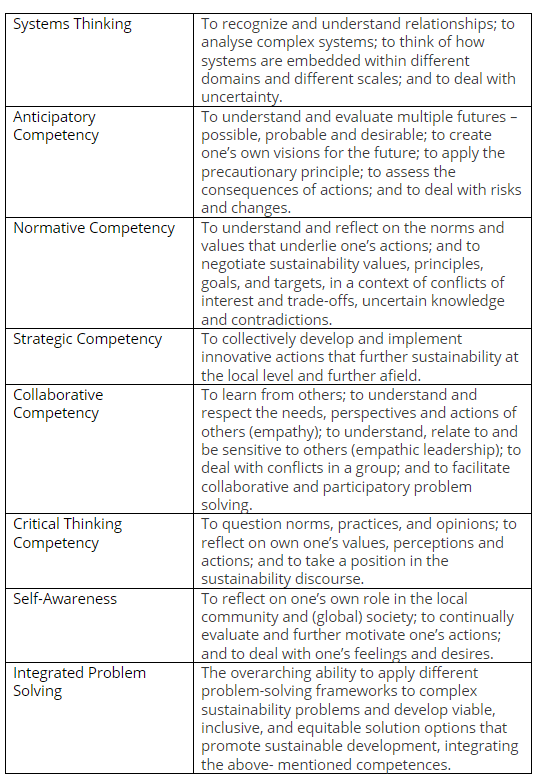
UNESCO has identified eight competencies that encompass the behaviours, attitudes, values and knowledge which facilitate safeguarding the future. These together with the SDGs provide a way of identifying activities and learning that can be embedded in different disciplinary curricula and courses.  For more information on assessing competences, see this guidance article.  


This work is licensed under a Creative Commons Attribution-ShareAlike 4.0 International License. 

Any views, thoughts, and opinions expressed herein are solely that of the author(s) and do not necessarily reflect the views, opinions, policies, or position of the Engineering Professors’ Council or the Toolkit sponsors and supporters. 

To view a plain text version of this resource, click here to download the PDF.

Author: Jing Zhao (University of West of England). 

Topic: Investigating the decarbonisation transition. 

Type: Teaching. 

Relevant disciplines: Civil; Structural; Chemical; Mechanical; Electrical; Computing. 

Keywords: Decarbonisation, Housing, Built environment; Net zero, Carbon emissions; Energy efficiency; Sustainable energy; Local community; Curriculum; Higher education; Sustainability; Assessment. 

Sustainability competency: Systems thinking; Anticipatory; Collaboration; Self-awareness; Normative.

AHEP mapping: This resource addresses two of the themes from the UK’s Accreditation of Higher Education Programmes fourth edition (AHEP4): The Engineer and Society (acknowledging that engineering activity can have a significant societal impact) and Engineering Practice (the practical application of engineering concepts, tools and professional skills). To map this resource to AHEP outcomes specific to a programme under these themes, access AHEP 4 here  and navigate to pages 30-31 and 35-37.  

Related SDGs: SDG 4 (Quality education); SDG 7 (Affordable and clean energy); SDG 9 (Industry, Innovation and Infrastructure); SDG 11 (Sustainable cities and communities). 

Reimagined Degree Map Intervention: More real-world complexity; Active pedagogies and mindsets; Authentic assessment.

Educational level: Beginner. 


Learning and teaching notes: 

The purpose of this exercise is to encourage students to think in a socio-technical perspective of delivering extreme low carbon housing (e.g. Passivhaus), in order to support the occupants in adapting to new technologies and low-carbon lifestyle, shifting the paradigm from building isolated energy efficient homes to forming low-carbon communities.  

Learners have the opportunity to: 

Teachers have the opportunity to: 


Supporting resources: 


Terminology: 

Before beginning the activity, teachers and learners will want to become familiar with the following concepts. 


Activity overview:  

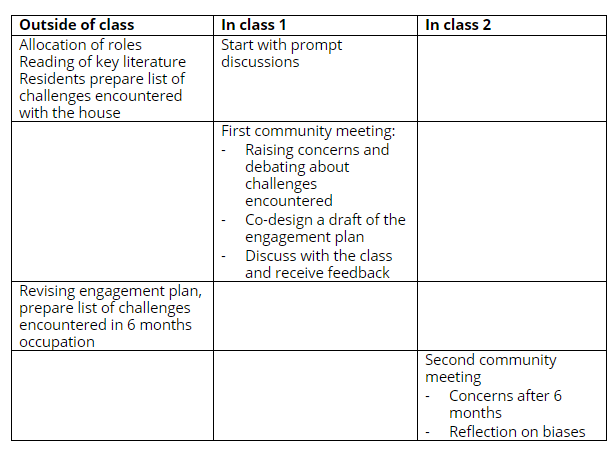
Students will role-play the post occupancy stage of inhabiting a Passivhaus home by playing different characters with different priorities (and personalities). Students will need to learn what new technologies and features are included in Passivhaus and what difficulties/problems the residents might encounter, and at the same time familiarise themselves with contemporary research on energy behaviour, performance gap, rebound effect, as well as broader issues in decarbonisation transition such as social justice and low carbon community building. Through two community meetings, the community manager needs to resolve the residents’ issues, support the residents in learning and adapting their behaviours, and devising an engagement plan to allow the residents to form a self-governed low-carbon community. 


Step one: Preparation prior to class: 

Provide a list of reading materials on ‘performance gap’, ‘rebound effect’, ‘adaptive comfort’, energy behaviour, usability and control literature, as well as on Passivhaus and examples of low-carbon features and technologies involved to get a sense of what difficulties residents might encounter.  

To prepare for the role-play activity, assign students in advance to take on different roles (randomly or purposefully), or let them self-assign based on their interests. They should try to get a sense of their character’s values, lifestyle, priorities, abilities. Where no information is available, students can imagine the experiences and perspectives of the residents. Students assigned to be community managers or building associations will prepare for the role-play by learning about the Passivhaus system and prepare ways to support occupants’ learning and behaviour adaptation. The goal is to come up with an engagement plan, facilitate the residents to form their own community knowledge base and peer support. (Considering 1. Who are you engaging (types of residents and their characteristics); 2. How are you engaging (level of engagement, types of communication; 3. When are you engaging (frequency of engagement) 


Step two: In class, starting by giving prompts for discussions: 

Below are several prompts for discussion questions and activities that can be used. Each prompt could take up as little or as much time as the educator wishes, depending on where they want the focus of the discussion to be. 


  1. Discuss what support the residents might need in post occupancy stage? Who should provide (/pay for) the support? For how long? Any examples or best practice that they might know? Does support needs to be tailored to specific groups of people? (see extra prompts at the end for potential difficulties)
  2. Discuss what the risks are involved in residents not being sufficiently supported to adapt their behaviour when living in a low-carbon house or Passivhaus? (reflect on literature)
  3. Discuss what are the barriers to domestic behaviour change? What are the barriers to support the residents in changing behaviour and to build low-carbon community? 


Step three: Class 1 Role Play  

Prior to the Role Play, consider the following prompts: 

Consider the variety of residents and scenarios:

Their varying demographics, physical and mental abilities, lifestyle and priorities. The following characters are examples. Students can make up their own characters. Students can choose scenarios of  

1) social housing or; 

2) private owner-occupier  

Social housing tenants will likely have a more stretched budget, higher unemployment rate and a bigger proportion of disabled or inactive population. They will have different priorities, knowledge and occupancy patterns than private owner-occupier, and will be further disadvantaged during decarbonisation transition (Zhao, 2023). They will need different strategies and motivations to be engaged. The characters of residents could be chosen from a variety of sources (e.g. RIBA Brief generator), or based on students’ own experiences. Each character needs to introduce themselves in a succinct manner. 


Other stakeholders involved include: 

They are role-specific characters that don’t necessarily need a backstory. They are there to listen, take notes, give advice and come up with an engagement plan. 


Consider the post occupancy in different stages: 

  1. Prior to move-in 
  2. Move-in day 
  3. The initial month 
  4. Change of season  
  5. Quarterly energy audit meeting 


Consider the difficulties the residents might encounter: 


Consider the different engagement levels of the residents: 


The role-play consists of two community meetings over two classes. The first meeting is held at two weeks after move-in date. The second meeting at 6 months of occupancy. The meeting should include a variety of residents on one side, and the ‘chair’ of the meeting on the other. (Consider the accessibility and inclusivity of the meetings as when and where those will be held). In the first meeting, residents will get to know each other, ask questions about house-related problems occurred in the first two weeks, voice concerns. Community managers/council members will chair the meeting, take notes and make plans for support. The teacher should act as a moderator to guide students through the session. First the teacher will briefly highlight the issue up for discussion, then pass it to the ‘chair’ of the meeting. The ‘chair’ of the meeting will open the meeting with the purpose of the meeting – to support the residents and facilitate a self-governed low carbon community. They then ask the residents to feedback on their experience and difficulties. At the end of the first meeting, the group of students will need to co-design an engagement plan, including setting agendas for the second meeting in a 6-month interval (but in reality will happen in the second class) and share the plan with the residents and the class. The teacher and class will comment on the plan. The group will revise the plan after class so it’s ready for the second meeting. 


Step four: Homework tasks: Revising the plan 

The students will use the time before the second class to revise the plan and prepare for challenges, problems occurred over the 6-months period. 

Optional wild cards could be used as unpredictable events occur between the first and second meeting. Such events include: 


Step five: Class 2 Role play 

The second meeting in the second class will either be chaired by community managers/council members, or be chaired by a few residents, monitored by community managers/council members. The second meeting begins the same way. The students playing residents should research/imagine problems occurred during the 6 months period (refer to literature), and what elements of the engagement plan devised at the end of the first meeting worked and what hasn’t worked. The ‘chair’ of the meeting will take notes, ask questions or try to steer the conversations. At the end of the second meeting, the ‘chair’ of the meeting will reflect on the support and engagement plan, revise it and make a longer-term plan for the community to self-govern and grow. At the end of this class, the whole class could then engage in a discussion about the outcome of the meetings. Teachers could focus on an analysis of how the process went, a discussion about broader themes of social justice, community building, comfort, lifestyle and value system. Challenge students to consider their personal biases and position at the outset and reflect on those positions and biases at the end of the meeting. 


This work is licensed under a Creative Commons Attribution-ShareAlike 4.0 International License. 

Any views, thoughts, and opinions expressed herein are solely that of the author(s) and do not necessarily reflect the views, opinions, policies, or position of the Engineering Professors’ Council or the Toolkit sponsors and supporters. 

To view a plain text version of this resource, click here to download the PDF.

Author: Aditya Johri (George Mason University). 

Topic: Sustainability implications in mobility and technology development.   

Type: Teaching. 

Relevant disciplines: Electrical, Robotics, Civil, Mechanical, Computing. 

Keywords: Design; Accessibility; Technology Policy; Electric Vehicles; Mobility, Circularity; AHEP; Sustainability; Higher education.

Sustainability competency: Normative; Self-awareness; Strategic; Critical thinking.

AHEP mapping: This resource addresses two of the themes from the UK’s Accreditation of Higher Education Programmes fourth edition (AHEP4): The Engineer and Society (acknowledging that engineering activity can have a significant societal impact) and Engineering Practice (the practical application of engineering concepts, tools and professional skills). To map this resource to AHEP outcomes specific to a programme under these themes, access AHEP 4 here  and navigate to pages 30-31 and 35-37.  

Related SDGs: SDG 4 (Quality education); SDG 9 (Industry, innovation, and infrastructure), SDG 12 (Responsible consumption and production); SDG 13 (Climate action).   

Reimagined Degree Map Intervention: Active pedagogies and mindset development.

Educational aim: The objective of this activity is to provide students with an understanding of the complexity of technology development and different considerations that need to be made by stakeholders in the design and implementation of a technology. The activity is set up as a role-play where students are assigned different roles as members of an expert panel providing feedback on the use of E-Scooters on a college campus. 

Educational level: Beginner. 


Learning and teaching notes: 

Learners have the opportunity to: 

Teachers have the opportunity to: 


Supporting resources: 

Several different ethical frameworks, codes, or guidelines can be provided to students to prepare for the discussion or to reflect upon during their discussion depending on the students’ disciplinary composition. Here are a few examples:  


Background readings and resources: 

One of the goals of this exercise is to motivate students to undertake their own research on the topic to prepare for the activity. But it is important to provide them with preliminary material to start their own research. Here are a few useful resources for this case:  

Readings: 


Videos: 


Role-play instructions: 

  1. Each student is assigned a role a week before the discussion.
  2. Students assigned to the role of Eva Walker serve as the moderator and lead the conversation based on the script below.
  3. The script provided below is there to guide the discussion, but you should leave room for the conversation to flow naturally and allow everyone to contribute.

One way to ensure students are prepared for the discussion is to assign a few questions from the script as a pre-discussion assignment (short answers). Similarly, to ensure students reflect on the discussion, they can be assigned the last question from the script as a post-discussion exercise. They can also be asked specifically about frameworks and concepts related to sustainability.  


Role-play scenario narrative and description of roles: 

Eva Walker recently started reporting about on-campus traffic issues for the student newspaper. She would have preferred to do more human-interest stories, but as a new member of the staff who had just moved from intern to full-time, she was happy to get whatever opportunity she could. Eva was studying both journalism and creative writing, and this was her dream on-campus job. She also realised that, even though many stories at first didn’t appear to her as though she would be interested in them, as she dug deeper she eventually found an angle with which she could strongly relate.  

One weekday morning, Eva was working on yet another story on parking woes when Amina Ali, one of the editorial staff members, texted her to say that there had been an accident on campus; she just passed it at the intersection of the library and the recreation building, and it might be worth covering. Eva was at the library, and within no time, reached the spot of the accident.  

When Eva arrived, a police vehicle, an ambulance, and a fire engine were all present at the scene, and near the accident site, an e-scooter lay smashed into a tree. It looked like the rider was sitting in the ambulance and was being treated by the medical staff. A little further away, Eva noticed the police speaking to a young woman in a wheelchair. Although Eva’s first instinct was to try to talk to the police or the medical staff to ascertain what had happened, she realised this probably wasn’t the best moment and she would have to wait until later for the official version of the event.  

She looked around and saw a group of four students leaning against a wall with drinks in their hands. A couple of them were vaping. Eva thought that they looked like they had been here for a while, and she walked over to ask them what had happened. From the account they gave her, it appeared as if the e-scooter rider was coming around the bend at some speed, saw the woman in the wheelchair a little too late to ride past her, and, to avoid hitting her, leapt off his e-scooter and let the vehicle hit the tree. Things happened very quickly and no one was exactly sure about the sequence of events, but this was the rough story she got.  

Later, she called the police department on campus and was able to speak with one of the officers to get an official account. The story was very similar to what she already knew. She did find out that nobody was seriously hurt and that the only injuries were to the e-scooter rider and were taken care of at the scene by the medical staff. When she asked about who was to blame or if any legal action was expected, she was told that there were no laws around the use of helmets or speeding for e-scooters yet and that she should reach out later for more information. Eva wrote up what she had so far, sent it over to the editorial staff, and considered her work done.  

But as she was walking back to her halls of residence that evening, her attention was drawn to the large number of e-scooters parked near the library. As she crossed the central campus, she noticed even more e-scooters lying about the intersections, and there was a litter of them around the residence hall. She wondered why she hadn’t noticed them before. Her attention was drawn today, she thought, because of the accident and also because she saw a good Samaritan remove an e-scooter from the sidewalk, as it was blocking the path of one of the self-driving food delivery robots. It’s a sign, Eva thought, this is what she needs to look for more in her next article, the use of e-scooters on campus.  

Eva recognised that, to write a balanced and informative article, as she had been taught to do, she would have to look at many different aspects of the use of e-scooters as well as look broadly at mobility on campus and the use of battery powered vehicles. She had also recently seen e-bikes on campus and, in addition to the food delivery robots, service robots in one of the buildings that she assumed was either delivering paperwork or mail. The accident had also made her realise that, when it came to mobility, accessibility was something that never crossed her mind but that she now understood was an important consideration. She hoped to learn more about it as her research progressed.  

As background research for the article, Eva started reading up on articles and studies published about e-scooters, e-bikes, and urban mobility and came across a range of concerns that had been raised beyond accessibility. First, there were reports that e-scooters are not as environmentally friendly as many service providers had made them out to be. This is related to the production of the battery as well as the short lifespan of the vehicles, and as of yet, there has been no procedure implemented to reuse them (Pyzyk, 2019). Second, there were reports of littering, where e-scooters are often left on sidewalks and other places where they restrict movement of other vehicles, pedestrians, and in particular, those in wheelchairs (Iannelli, 2021). Finally, it was also clear from the reports that accidents and injuries have increased due to e-scooters, especially since many riders do not wear safety gear and are often careless, even inebriated, as there were little to no regulations (2021). When she approached her editor with an outline for an article, she was advised to do some more reporting by talking with people who could shed more light on the issue.  

After some research, Eva shortlisted the following experts across fields related to e-scooters for an interview, and once she spoke with them, she realised that it would help her if she could get them to have a dialogue and respond to some of the questions that were raised by other experts. Therefore, she decided to conduct a focus group with them so that she achieved her goal of a balanced article and did not misrepresent any expert’s point of view.  


Experts/roles for discussion: 

1. Bryan Avery is co-founder and chief technology officer (CTO) of RideBy, an e-scooter company. RideBy is one of the options available on campus. Born in a small town, Bryan used to ride his bicycle everywhere while growing up, and for him, founding and leading an e-scooter company provided a chance to merge his interests in personal transportation and new forms of energy. He was a chemical engineer by training, and at a time when most of his friends ended up working for big oil companies, Bryan decided to work on alternative fuels and found himself developing expertise and experience with batteries. For most of the software- and mobile device-related development, RideBy outsourced the work and utilised ready-to-configure systems that were available. By only keeping the core device and battery functionality in-house, they could focus on delivering a much stronger product. Overall, he is quite happy with the success of RideBy so far and can’t help but extol the difference it can make for the environment.  


2. Abiola Abrams is a professor of transportation engineering and an expert on mobility systems. Her work combines systems engineering, computer science, and data analytics. Her recent research is on urban mobility and micro-mobility services, particularly e-bikes. In her research, Dr. Abrams has looked at a host of topics related to e-bikes, many of which are also applicable to e-scooters, including the optimisation of hubs for availability, common path patterns of users, subscription use models, and the e-waste and end of lifecycle for these vehicles. Increasingly, she has become concerned about the abuse of some of these services, especially in cities that attract a lot of tourists, and about the rough use of the vehicles, so much so that many do not even last for a month. In a new project, she is investigating the effect of e-vehicles on the environment and has found that there is mixed evidence for how much difference battery-operated vehicles will actually make for climate change compared to vehicles that use fossil fuels.  


3. Marco Rodrigues works as transportation director for the local county government where the university is based. As part of a recent bilateral international exchange, he got the opportunity to spend time in different cities in Germany to learn about local transportation. He realised very quickly that local transportation was very different in Germany; residents had a range of public, shared options that were missing in the United States. However, he also realised that e-mobility services were being considered across both countries. He investigated this further and found that Germany waited until it could pass some regulations before allowing e-mobility operators to offer services; helmets were mandatory on e-scooters and e-bikes, and riders had to purchase a nominal insurance policy. He also learned that there were strict rules around the sharing of data generated by the vehicles as well as the apps used by riders.  


4. Judy Whitehouse is director of infrastructure and sustainability on campus and responsible for planning the long-term development of the campus from a space perspective, but also increasingly from a sustainability dimension. As the number of students has increased, so has the need for more infrastructure, including classrooms and halls of residence. This has also resulted in greater distances to be traveled on campus. Judy regards e-mobility options as a necessary component of campus life and has been a strong supporter for them. Lately, she has been called into meetings with safety and emergency management people discussing the issue of increased accidents on campus and the littering of e-vehicles across the campus. Not only is it bad for living on campus, but it is also bad for optics. A recent photo featured in the campus newspaper was a stark reminder of just how bad it can look. She is further divided on the use of e-scooters due to misgivings about the sustainability of battery use, as new research suggests that manufacturing batteries and disposing them are extremely harmful for the environment.  


5. Aaron Schneider heads Campus Mobility, a student interest group focused on autonomous vehicles development and use. The group members come from different degree programmes and are interested in both the technical dimensions of mobile solutions and the policy issues surrounding their implementation. Aaron himself is a computer science student with interests in data science, and with some of his fellow members from the policy school, he has been analysing a range of mobility-related datasets that are publicly available online. Of these, the data on accidents is quite glaring, as the number of accidents in which e-scooters are involved has gone up significantly. Aaron and his friends were intrigued by their findings and approached some of the companies to see if they would share data, but they were disappointed when they could not get access. Although the companies said it was due to privacy reasons, Aaron was not too convinced by that argument. He was also denied access to any internal reports about usage patterns of accidents. Ideally, he would have liked to know what algorithms were used for optimising delivery and access, but he knew he was not going to get that information.  


6. Sarah Johnson is the head of accessibility services on campus and is responsible for both technology- and infrastructure-related support for students, faculty, and staff. The growth of the physical campus and the range of technological offerings has significantly increased the workload for her office, and they are really strained in terms of people and expertise. The emphasis from the university leadership is largely on web and IT accessibility, as teaching and other services are shifting quickly online, but Sarah realises that there is still an acute need to provide physical and mobility support to many members of the community. Although all the new buildings are up to code in terms of accessibility, there is still work to be done both for the older buildings and especially for mobility. Campus beautification does not always go along with access. She is also worried about access to devices, as taking part in any campus activity requires not just a computer, but also access to mobile devices that are out of reach economically for many and not easy to use.  


Role-play script: 

To help get the dialogues started and based on her prior conversation with the group, Eva has prepared some initial questions:  

  1. What role are you playing and, from your perspective, what do you see as the biggest pros of using e-vehicles, especially e-scooters on campus?
  2. From your perspective, what do you see as the biggest downside of using e-vehicles, especially e-scooters on campus?
  3. Can you confidently say that e-scooters are an environmentally friendly option?
  4. What current accessibility accommodations would be impacted by the use of e-vehicles, and what new, potential accessibility accommodations might arise from increased use of e-vehicles?
  5. Would we be better off waiting for more regulations to come before deploying these vehicles on campus and, if so, what should those regulations look like?
  6. Should we use automatic regulation of speed on the vehicle based on where it is and/or inform authorities if it is violated?
  7. Can we control where it can go or penalise if not put back?
  8. What guidelines do you recommend for e-scooter usage on campus?  


Authorship and project information and acknowledgements: The scenarios and roles were conceptualised and written by Aditya Johri. Feedback was provided by Ashish Hingle, Huzefa Rangwala, and Alex Monea, who also collaborated on initial implementation and empirical research. This work is partly supported by U.S. National Science Foundation Awards# 1937950, 2335636, 1954556; USDA/NIFA Award# 2021-67021-35329. Any opinions, findings, and conclusions or recommendations expressed in this material are those of the authors and do not necessarily reflect the views of the funding agencies. The research study associated with the project was approved by the Institutional Review Board at George Mason University. 


This work is licensed under a Creative Commons Attribution-ShareAlike 4.0 International License. 

Any views, thoughts, and opinions expressed herein are solely that of the author(s) and do not necessarily reflect the views, opinions, policies, or position of the Engineering Professors’ Council or the Toolkit sponsors and supporters. 

To view a plain text version of this resource, click here to download the PDF.

Let us know what you think of our website