Toolkit: Complex Systems Toolkit.

Authors: Dr Neil Carhart, University of Bristol; Dr. Francesco Ciriello, King’s College London; Richard Beasley, RB Systems.

Topic: Definitions of key terms relevant to Engineered Complex Systems.

Title: Engineering complex systems glossary. 

Resource type: Knowledge article.

Relevant disciplines: Any.

Keywords: Definitions; Emergence; Systems.

Licensing: This work is licensed under a Creative Commons Attribution-ShareAlike 4.0 International License. 

Downloads: 

Who is this article for?: This article should be read by educators at all levels in higher education who are seeking an overall perspective on teaching approaches for integrating complex systems in engineering education. 

Related INCOSE Competencies: Toolkit resources are designed to be applicable to any engineering discipline, but educators might find it useful to understand their alignment to competencies outlined by the International Council on Systems Engineering (INCOSE). The INCOSE Competency Framework provides a set of 37 competencies for Systems Engineering within a tailorable framework that provides guidance for practitioners and stakeholders to identify knowledge, skills, abilities and behaviours crucial to Systems Engineering effectiveness. A free spreadsheet version of the framework can be downloaded. 

This resource relates to the Systems Thinking and Critical Thinking INCOSE competencies. 

AHEP mapping: This resource addresses several of the themes from the UK’s Accreditation of Higher Education Programmes fourth edition (AHEP4): Analytical Tools and Techniques (critical to the ability to model and solve problems), and Integrated / Systems Approach (essential to the solution of broadly-defined problems).  


Premise: 

This document aims to provide definitions of key terms regarding engineered complex systems.  

There are many existing relevant glossaries (for example, the Systems Engineering Body of Knowledge or SEBoK) so we have implemented a process to select a curated list of 14 common terms that are fundamental when considering the idea of complexity in engineered solutions, and therefore of importance to educators in this space. Rather than adding new definitions for each term we offer appropriate and accessible definitions from the literature, together with commentary exploring wider context and consideration where relevant.  


Approach: 

Some care is needed when using any definition around terms relating to complexity – because complexity itself is complex. There are multiple valid perspectives and so any one definition is unlikely to capture the totality of nuance and satisfy the variety of viewpoints. The process for selecting these terms involved collating an initial long list for potential inclusion, along with the ways in which each has been previously defined. These are provided as a supplementary annex to the main glossary. The method is further described in the following sub-section.  

An initial list of potential terms to define was generated by cross-referencing existing glossaries. Terms that occurred in multiple glossaries were included in the long list. The definitions of these terms were extracted from these existing glossaries and are cited in the references. In addition, the relationship to the INCOSE Competencies is shown. The range of potential terms, and the variety of definitions that already exist, illustrate the complexity of describing complexity!  

The authors used three categorisations of the definitions to help further group and classify the terms. The following categories are tagged to relevant terms in the glossary: 

1. Property – whether or not the term describes a property applied to systems; 

2. Principle – whether or not the term represents a principle that should be used when engineering complex situations or systems; 

3. Approach – whether or not the term represents an approach, or element of an approach that should / could be used when engineering complex situations or systems. 

Finally, explanatory commentary was added to most definitions to more specifically address an engineering education context.  


Glossary:


Architecture 

Definition: “an abstract description of the entities of a system and the relationship between those entities.” Crawley et al. (2016) System Architecture: Strategy & Product Development for Complex Systems


Boundary 

#Property #Principle 

Definition: “Define the system to be addressed. A description of the boundary of the system can include the following: definition of internal and external elements/items involved in realizing the system purpose as well as the system boundaries in terms of space, time, physical, and operational. Also, identification of what initiates the transitions of the system to operational status and what initiates its disposal is important.” NASA (2007) NASA Systems Engineering Handbook, p304 

Commentary: The boundary defines the scope of the system being considered, and by implication, what sits outside of the system. As such, it is critically important to define the boundary of the system-of-interest. When dealing with complex systems this can be a challenging task and may even benefit from acknowledging multiple boundaries (e.g. physical, spatial, functional, logical etc.). For example, the boundary of the physical elements of a system could be considered within a wider boundary of the problem space.  


Complexity 

#Property 

Definition: “A complex system is a system in which there are non-trivial relationships between cause and effect: each effect may be due to multiple causes; each cause may contribute to multiple effects; causes and effects may be related as feedback loops, both positive and negative; and cause-effect chains are cyclic and highly entangled rather than linear and separable.” INCOSE (2019) INCOSE Systems Engineering and Systems Definitions 

Commentary: Early conceptions of complexity emphasised the difficulty in understanding, predicting or verifying the behaviours of a system. A key distinction arising from this is the complicated and complex are not synonymous.  This concept of the difficulty in predicting behaviours is reflected in the definitions of the NASA Systems Engineering Handbook, SEBoK and ISO 24765. This is the key resultant consideration but does not describe the underlying property which causes this difficulty. While this definition relates more to complex systems than complexity, it is chosen for the way in which it goes beyond the consequences of complexity.  


Coupling 

#Property #Principle 

Definition: “Coupling […] means to fasten together, or simply to connect things […] Coupling suggests a relationship between connected entities. If they are coupled, in some way they can affect each other […] For the system to be useful, its components have to be connected – coupled – so that they can work together. That said, putting them together arbitrarily won’t do the trick. The components have to be coupled in a way that achieves the goals of the system. Not only is coupling the glue that holds a system together, but it also makes the value of the system higher than the sum of its parts.” Khononov (2024) Balancing Coupling in Software Design: Universal Design Principles for Architecting Modular Software Systems, Ch1 

Commentary: Coupling is a very important concept. It is the interconnection and interdependence that makes the system more (or less) than the sum of its parts. Standard Systems architecture advice is to minimise coupling between system elements (or between the systems in a system-of-systems). This is because high coupling correlates to higher structural complexity, reduced resilience and flexibility in the system, and introduces challenges for modularity in the system design. Lower or looser coupling means changes in one part of the system (in design or operation) are less likely to induce or require changes in another part. However, this lower coupling is not always possible and may be necessary to improve system performance (for example communication through intermediate layers in a system to reduce coupling can introduce unacceptable amounts of overhead and latency in the system). In design terms, high coupling between system elements means that those elements cannot be designed independently.  


Emergence 

#Principle 

Definition: “As the entities of a system are brought together, their interaction will cause function, behaviour, performance and other intrinsic (anticipated and unanticipated) properties to emerge… Emergence refers to what appears, materializes, or surfaces when a system operates.” Crawley et al. (2016) System Architecture: Strategy & Product Development for Complex Systems 

Commentary: It is worth noting that Crawley et al. (2014) go on to add “As a consequence of emergence, change propagates in unpredictable ways. System success occurs when anticipated emergence occurs, while system failure occurs when anticipated emergent properties fail to appear or when unanticipated undesirable emergent properties appear.” This emergence that gives rise to the difficulty in understanding, predicting or verifying the behaviours of a system (see Complexity).


Form 

#Property 

Definition: “The shape, size, dimensions, mass, weight, and other measurable parameters which uniquely characterize an item.” SAE International (2019) ANSI/EIA-649C 


Function 

#Principle #Approach 

Definition: “A function is defined as the transformation of input flows, with defined performance targets for how well the function is performed in different conditions. A function usually has logical pre-conditions that trigger its operation. ”Systems Engineering Body of Knowledge v2.12 (2025)  

Commentary: In general usage it is common to hear reference to ‘Form and Function’ in tandem, but it is the distinction between them and their relationship to one another that is important to engineering complex systems. Thinking in terms of functionality is a good way of abstracting the system to define what it does (or is needed to do) rather than what it is (and therefore by extension its form).  Functions are normally allocated to single sub-elements of the system.  Complexity arises at functional interfaces, or when different elements perform the same function. Thinking in terms of functionality encourages creativity as designers consider all the different ways in which the function could be performed – and then apply requirement constraints to choose the best/most feasible option.  Thinking in terms of “objects” first constrains design by presupposing the solutions.  Equally, when the solution goes wrong, thinking in terms of what function is failing and why, rather than focusing on a failed part allows identification of the true root cause. Organisations also have functions (such as Engineering, Human Resources, etc.) as a group of roles that perform a specific set of activities. This is important for considering the organisation/System that creates the engineered solution (which is itself a complex system, but secondary to the main application of the idea of function). 


Iteration 

#Approach 

Definition: “Iteration is used as a generic term for successive application of a systems approach to the same problem situation, learning from each application, in order to progress towards greater stakeholder satisfaction.” Systems Engineering Body of Knowledge v2.12 (2025)  


Lifecycle  

#Property #Principle #Approach 

Definition: “The evolution of a system, product, service, project or other human-made entity from conception through retirement.” ISO (2024) ISO/IEC/IEEE 24748-1:2024 

Commentary: Understanding the lifecycle of an engineered artefact is very important. Issues arising in later stages (e.g. production, support/maintenance, upgrade and disposal) must be considered during the system’s initial development. In a system-of-systems or a capability system a significant source of complexity is the fact that different system elements have different lifecycles, and so may change or be changed independently of other elements with which they may interact or interdepend.  


Model 

#Approach 

Definition: “An abstraction of a system, aimed at understanding, communicating, explaining, or designing aspects of interest of that system” Dori, D. (2003) Conceptual modelling and system architecting, p286 

Commentary: An abstraction is a simplification. The selection of what to exclude, what to include, and at what level of granularity to depict it, is informed by the purpose of the model and the point of view from which it is created. Models do not have to be quantitative, nor is their purpose exclusively analytical. 


Stakeholder 

Definition: “A group or individual who is affected by or has an interest or stake in a program or project.” NASA (2019) NASA Systems Engineering Handbook SP-2016-6105 (Rev. 2) 

Commentary: It is worth noting the potential difference between a stakeholder of the project that develops the system, and a stakeholder of the system that is developed.  


System 

#Principle #Approach 

Definition: “A system is an arrangement of parts or elements that together exhibit behaviour or meaning that the individual constituents do not.” INCOSE (2019) INCOSE Fellows Briefing to INCOSE Board of Directors, January 2019 

Commentary: There are many similar definitions of a system, each may offer a slightly different phrasing which can resonate better with different individuals. The origins of this definition is explained in the Systems Engineering Body of Knowledge. In assessing complexity in engineered system, the concept of “systems” is of course of key value.  There are two important aspects two consider: 

1) Many schools of Systems Science argue that systems do not actually exist (apart from perhaps the complete universe) – they are defined for the convenience of consideration, and so the definition of the boundary of the “system of interest” is both important and somewhat arbitrary. As such, the system-of-interest can have multiple useful boundaries.  While it might be possible to identify and articulate the physical boundary of an engineered artefact (and it should be acknowledged), it might not be the most useful boundary to consider.  

2) The point of defining a “system of interest” includes being able to consider it as a system and so use the properties seen in systems (boundary, interface with outside, affected by/affecting environment, made up of parts, part of something larger, has a lifecycle, seen differently by different people (with different perspectives), are dynamic, exhibit emergence etc.) as a “framework for curiosity” (as the INCOSE SE competency framework defines systems thinking).

In engineered systems (rather than natural systems) it is important to distinguish between purpose (what those engineering or creating it want it do) and emergence (what it actually does). 


Systems Engineering 

#Principle #Approach 

Definition: “Systems Engineering is a transdisciplinary and integrative approach to enable the successful realization, use, and retirement of engineered systems, using systems principles and concepts, and scientific, technological, and management methods.” INCOSE (2019) INCOSE Systems Engineering and Systems Definitions 


Systems Thinking 

#Approach 

Definition: “Systems thinking is thinking about a question, circumstance, or problem explicitly as a system – a set of interrelated entities.” Crawley et al. (2016) System Architecture: Strategy & Product Development for Complex Systems 

Commentary: Crawley et al (2016) go on to add “This means identifying the system, its form and function, by identifying its entities and their interrelationships, its system boundary and context, and the emergent properties of the system based on the function of the entities, and their functional interactions.”  


References:


Any views, thoughts, and opinions expressed herein are solely that of the author(s) and do not necessarily reflect the views, opinions, policies, or position of the Engineering Professors’ Council or the Toolkit sponsors and supporters.  

Toolkit: Complex Systems Toolkit.

Author: James C Atuonwu, PhD, MIET, FHEA (NMITE).

Topic: Simulating pinch analysis and multi-stakeholder trade-offs.

Title: Modelling complexity in industrial decarbonisation.

Resource type: Teaching activity.

Relevant disciplines: Energy engineering; Chemical engineering; Process systems engineering; Mechanical engineering; Industrial engineering.

Keywords: Climate change; Modelling; Decarbonisation; Energy production; Heat integration; Optimisation; Stakeholders; Trade offs.

Licensing: This work is licensed under a Creative Commons Attribution-ShareAlike 4.0 International License. It is based upon the author’s 2025 article “A Simulation Tool for Pinch Analysis and Heat Exchanger/Heat Pump Integration in Industrial Processes: Development and Application in Challenge-based Learning”. Education for Chemical Engineers 52, 141–150. 

Related INCOSE Competencies: Toolkit resources are designed to be applicable to any engineering discipline, but educators might find it useful to understand their alignment to competencies outlined by the International Council on Systems Engineering (INCOSE). The INCOSE Competency Framework provides a set of 37 competencies for Systems Engineering within a tailorable framework that provides guidance for practitioners and stakeholders to identify knowledge, skills, abilities and behaviours crucial to Systems Engineering effectiveness.   A free spreadsheet version of the framework can be downloaded.

This resource relates to the Systems Thinking, Systems Modelling and Analysis and Critical Thinking INCOSE competencies.

AHEP mapping: This resource addresses several of the themes from the UK’s Accreditation of Higher Education Programmes fourth edition (AHEP4):  Analytical Tools and Techniques (critical to the ability to model and solve problems), and Integrated / Systems Approach (essential to the solution of broadly-defined problems). In addition, this resource addresses the themes of Science, mathematics and engineering principles; Problem analysis; and Design. 

Educational level: Intermediate.

Educational aim: To equip learners with the ability to model, analyse, and optimise pathways for industrial decarbonisation through a complex-systems lensintegrating technical, economic, and policy dimensionswhile linking factory-level design decisions to wider value-chain dynamics, multi-stakeholder trade-offs, and long-term sustainability impacts. 


Learning and teaching notes: 

This teaching activity explores heat integration for the decarbonisation of industrial processes through the lens of complex systems thinking, combining simulation, systems-level modelling, and reflective scenario analysis. It is especially useful in modules related to energy systems, process systems, or sustainability 

Learners analyse a manufacturing site’s energy system using a custom-built simulation tool to explore the energy, cost and carbon-emission trade-offs of different heat-integration strategies. They also reflect on system feedback, stakeholder interests and real-world resilience using causal loop diagrams and role-played decision frameworks.  

This activity frames industrial heat integration as a complex adaptive system, with interdependent subsystems such as process material streams, utilities, technology investments and deployments, capital costs, emissions, and operating constraints. 

Learners run the simulation tool to generate outputs to explore different systems integration strategies: pinch-based heat recovery by heat exchangers, with and without heat pump-based waste heat upgrade. Screenshots of the tool graphical user interface are attached as separate files:

The learning is delivered in part, through active engagement with the simulation tool. Learners interpret the composite and grand composite curves and process tables, to explore how system-level outcomes change across various scenarios. Learners explore, using their generated simulation outputs, how subsystems (e.g. hot and cold process streams, utilities) interact nonlinearly and with feedback effects (e.g., heat recovery impacts), shaping global system behaviour and revealing leverage points and emergent effects in economics, emissions and feasibility. 

Using these outputs as a baseline, and exploring other systems modelling options, learners evaluate trade-offs between heat recovery, capital expenditure (CAPEX), operating costs (OPEX), and carbon emissions, helping them develop systems-level thinking under constraints. 

The activity embeds scenario analysis, including causal loop diagrams, what-if disruption modelling, and stakeholder role-play, using multi-criteria decision analysis (MCDA) to develop strategic analysis and systems mapping skills. Interdisciplinary reasoning is encouraged across thermodynamics, economics, optimisation, engineering ethics, and climate policy, culminating in reflective thinking on system boundary definitions, trade-offs, sustainability transitions and resilience in industrial systems.  

Learners have the opportunity to: 

Teachers have the opportunity to: 


Downloads: 


Learning and teaching resources:


About the simulation tool (access and alternatives):

This activity uses a Streamlit-based simulation tool, supported with process data (Appendix A, Table 1, or an educator’s equivalent). The tool is freely available for educational use and can be accessed online through a secure link provided by the author on request (james.atuonwu@nmite.ac.uk or james.atuonwu@gmail.com). No installation or special setup is required; users can access it directly in a web browser. The activity can also be replicated using open-source or online pinch analysis tools such as OpenPinch, PyPinch PinCH, TLK-Energy Pinch Analysis Online. SankeyMATIC can be used for visualising energy balances and Sankey diagrams. 

Pinch Analysis, a systematic method for identifying heat recovery opportunities by analysing process energy flows, forms the backbone of the simulation. A brief explainer and further reading are provided in the resources section. Learners are assumed to have prior or guided exposure to its core principles. A key tunable parameter in Pinch Analysis, ΔTmin, represents the minimum temperature difference allowed between hot and cold process streams. It determines the required heat exchanger area, associated capital cost, controllability, and overall system performance. The teaching activity helps students explore these relationships dynamically through guided variation of ΔTmin in simulation, reflection, and trade-off analysis, as outlined below. 


Introducing and prioritising ΔTmin trade-offs:

ΔTmin is introduced early in the activity as a critical decision variable that balances heat recovery potential against capital cost, controllability, and safety. Students are guided to vary ΔTmin within the simulation tool to observe how small parameter shifts affect utility demands, exchanger area, and overall system efficiency. This provides immediate visual feedback through the composite and grand composite curves, helping them connect technical choices to system performance. 

Educators facilitate short debriefs using the discussion prompts in Part 1 and simulation-based sensitivity analysis in Part 2. Students compare low and high ΔTmin scenarios, reasoning about implications for process economics, operability, and energy resilience. 

This experiential sequence allows learners to prioritise competing factors (technical, economic, and operational), while recognising that small changes can create non-linear, system-wide effects. It reinforces complex systems principles such as feedback loops and leverage points that govern industrial energy behaviour. 


Data for decisions:

The simulator’s sidebar includes some default values for energy prices (e.g. gas and electricity tariffs) and emission factors (e.g. grid carbon intensity), which users can edit to reflect their own local or regional conditions. For those replicating the activity with other software tools, equivalent calculations of total energy costs, carbon emissions and all savings due to heat recovery investments can be performed manually using locally relevant tariffs and emission factors. 

The Part 1–3 tasks, prompts, and assessment suggestions below remain fully valid regardless of the chosen platform, ensuring flexibility and accessibility across different teaching contexts. 


Educator support and implementation notes:

The activity is designed to be delivered across 3 sessions (6–7.5 hours total), with flexibility to adapt based on depth of exploration, simulation familiarity, or group size. Each part can be run as a standalone module or integrated sequentially in a capstone-style format. 


Part 1: System mapping: (Time: 2 to 2.5 hours) – Ideal for a classroom session with blended instruction and group collaboration:

This stage introduces students to the foundational step of any heat integration analysis: system mapping. The aim is to identify and represent energy-carrying streams in a process plant, laying the groundwork for further system analysis. Educators may use the Process Flow Diagram of Fig. 1, Appendix A (from a real industrial setting: a food processing plant) or another Process Diagram, real or fictional. Students shall extract and identify thermal energy streams (hot/cold) within the system boundary and map energy balances before engaging with software to produce required simulation outputs. 


Key activities and concepts include: 


Discussion prompts: 


Student deliverables: 


Part 2: Running and interpreting process system simulation results (Time: 2 to 2.5 hours) – Suitable for lab or flipped delivery; only standard computer access is needed to run the tool (optional instructor demo can extend depth):

Students use the simulation tool to generate their own results. The process scenario of Fig. 1, Appendix A, with the associated stream data (Table 1) can be used as a baseline.
 

Tool-generated outputs:


Learning tasks:

1. Scenario sweeps
Run different scenarios (e.g., different ΔTmin levels, tariffs, emission factors, and Top-N HP selections).
Prompts: How do QREC, QHU/QCU, HX area, and CAPEX/OPEX/CO₂ shift across scenarios? Which lever moves the needle most? 

2. Group contrast (cases A vs B: see time-phased operations A & B in Appendix A)
Assign groups different cases; each reports system behaviours and trade-offs.
Prompts: Where do you see CAPEX vs. energy-recovery tension? Which case is more HP-friendly and why? 

3. Curve reading
Use the Composite & Grand Composite Curves to identify pinch points and bottlenecks; link features on the curves to the tabulated results.
Prompts: Where is the pinch? How does ΔTmin change the heat-recovery target and utility demands? 

4. Downstream implications
Trace how curve-level insights show up in HX sizing/costs and HP options.
Prompts: When does adding HP reduce utilities vs. just shifting costs? Where do stream temperatures/CP constrain integration? 

5. Systems lens: feedback and leverage
Map short causal chains from the results (e.g., tariffs → HP use → electricity cost → OPEX; grid-carbon → HP emissions → net CO₂).
Prompts: Which levers (ΔTmin, tariffs, EFs, Top-N) create reinforcing or balancing effects? 


Outcome:

Students will be able to generate and interpret industrial simulation outputs, linking technical findings to economic and emissions consequences through a systems-thinking lens. They begin by tracing simple cause–effect chains from the simulation data and progressively translate these into causal loop diagrams (CLDs) that visualise reinforcing and balancing feedback. Through this, learners develop the ability to explain how system structure drives performance both within the plant and across its broader industrial and policy environment. 

Optional extension: Educators may provide 2–3 predefined subsystem options (e.g., low-CAPEX HX network, high-COP HP integration, hybrid retrofit) for comparison. Students can use a decision matrix to justify their chosen configuration against CAPEX, OPEX, emissions, and controllability trade-offs. 


Part 3: Systems thinking through scenario analysis (Time: 2 to 2.5 hours) – Benefits from larger-group facilitation, a whiteboard or Miro board (optional), and open discussion. It is rich in systems pedagogy:

Having completed simulation-based pinch analysis and heat recovery planning, learners now shift focus to strategic implementation challenges faced in real-world industrial settings. In this part, students apply systems thinking to explore the broader implications of their heat integration simulation output scenarios, moving beyond process optimisation to consider real-world dynamics, trade-offs, and stakeholder interactions. The goal is to encourage students to interrogate the interconnectedness of decisions, feedback loops, and unintended consequences in process energy systems including but not limited to operational complexity, resilience to disruptions, and alignment with long-term sustainability goals. 

Activity: Stakeholder role play / Multi-Criteria Decision Analysis 
Students take on stakeholder roles and debate which design variant or operating strategy should be prioritised. They then conduct a Multi-Criteria Decision Analysis (MCDA), evaluating each option based on criteria such as CAPEX, OPEX savings, emissions reductions, risk, and operational ease. 

Stakeholders include:

The team must present a strategic analysis showing how the heat recovery system behaves as a complex adaptive system, and how its implementation can be optimised to balance technical, financial, environmental, and human considerations. 


Optional STOP for questions and activities:

Before constructing causal loop diagrams (CLDs), learners revisit key results from their simulation — such as ΔTmin, tariffs, emission factors, and system costs — and trace how these parameters interact to influence overall system performance. Educators guide this transition, helping students abstract quantitative outputs (e.g., changes in QREC, OPEX, or CO₂) into qualitative feedback relationships that reveal cause-and-effect chains. This scaffolding helps bridge the gap between process simulation and systems-thinking representation, supporting discovery of reinforcing and balancing feedback structures. 


Instructor guidance:
Each student or small subgroup first constructs a causal loop diagram (CLD) from the viewpoint of their assigned stakeholder (e.g., operations, finance, environment). They then reconvene to integrate these perspectives into a single, shared system map, revealing conflicting goals, reinforcing and balancing feedback, and common leverage points. This two-step approach mirrors real-world decision dynamics and strengthens collective systems understanding. Support materials such as a CLD starter template and a stakeholder impact matrix may be provided to assist instructors in scaffolding systems-thinking activities.


Discussion prompts:


Instructor debrief (engineering context with simulation linkage):
After students share their CLDs, the educator facilitates a short discussion linking their identified reinforcing and balancing loops to common dynamic patterns observable in the simulation results. For instance: 

This reflection connects quantitative model outputs (e.g. QREC, OPEX, CAPEX, emissions) to qualitative system behaviours, helping learners recognise leverage points and understand how design choices interact across technical, economic, and social dimensions of decarbonisation. 

Activity: Explore “What if?” scenarios 

Working in groups, students choose one scenario to explore using a systems lens:

Each group evaluates the resilience and flexibility of the proposed integration design. They consider:

Educators may add advanced scenarios (e.g. carbon tax introduction, supplier failure, or project delay) to challenge students’ resilience modelling and stakeholder negotiation skills.


Stakeholder impact reflection:

To extend systems reasoning beyond the technical domain, students assess how their chosen design scenarios (e.g., low vs. high ΔTmin, with or without heat pump integration) affect each stakeholder group. For instance: 

Each team member rates perceived benefits, risks, or compromises under each design case, and the results are summarised in a stakeholder impact matrix or discussion table. This exercise links quantitative system metrics (energy recovery, emissions, cost) to qualitative stakeholder outcomes, reinforcing the “multi-layered feedback” perspective central to complex systems analysis. 


Learning Outcomes (Part 3): 

By the end of this part, students will be able to:


Instructor Note – Guiding CLD and archetype exploration:

Moving from numerical heat-exchange and cost data to CLD archetypes can be conceptually challenging. Instructors are encouraged to model this process by identifying at least one reinforcing loop (e.g. “energy savings → lower OPEX → more investment in recovery → further savings”) and one balancing loop (e.g. “higher capital cost → reduced investment → lower heat recovery”). Relating these loops to common system archetypes such as “Limits to Growth” or “Balancing with Delay” helps students connect engineering data to broader system dynamics and locate potential leverage points. The activity concludes with students synthesising their findings from simulation, systems mapping, and stakeholder analysis into a coherent reflection on complex system behaviour and sustainable design trade-offs. 


Assessment guidance: 

This assessment builds directly on the simulation and systems-thinking activities completed by students. Learners generate and interpret their own simulation outputs (or equivalent open-source pinch analysis results), using these to justify engineering and strategic decisions under uncertainty. 

Assessment focuses on students’ ability to integrate quantitative analysis (energy, cost, carbon) with qualitative reasoning (feedbacks, trade-offs, stakeholder dynamics), demonstrating holistic systems understanding. 


Deliverables (portfolio; individual or group):

1. Reading and interpretation of simulation outputs

Use the outputs you generate (composite & grand composite curves: HX match/area/cost tables; HP pairing/ranking; summary sheets of QHU, QCU, QREC, COP, CAPEX, OPEX, CO₂, paybacks) for a different industrial process (from the one used in the main learning activity) to: 

2. Systems mapping and scenario reasoning 

3. Decision memo (max 2 pages) 

Students should include a short reflective note addressing assumptions, feedback insights, and how their stakeholder perspective shaped their recommendation. 


Appendix A: Example process scenario for teaching activity:

The following process scenario explains the industrial context behind the main teaching activity simulations. A large-scale food processing plant operates a milk product manufacturing line. The process, part of which is shown in Fig. 1, involves the following: 

In real operations, the evaporation subprocess occurs at different times from the cooking/separation, oven and pre-finishing operations. This means that their hot and cold process streams are not simultaneously available for direct heat exchange. For a realistic industrial pinch analysis, the process is thus split into two time slices: 

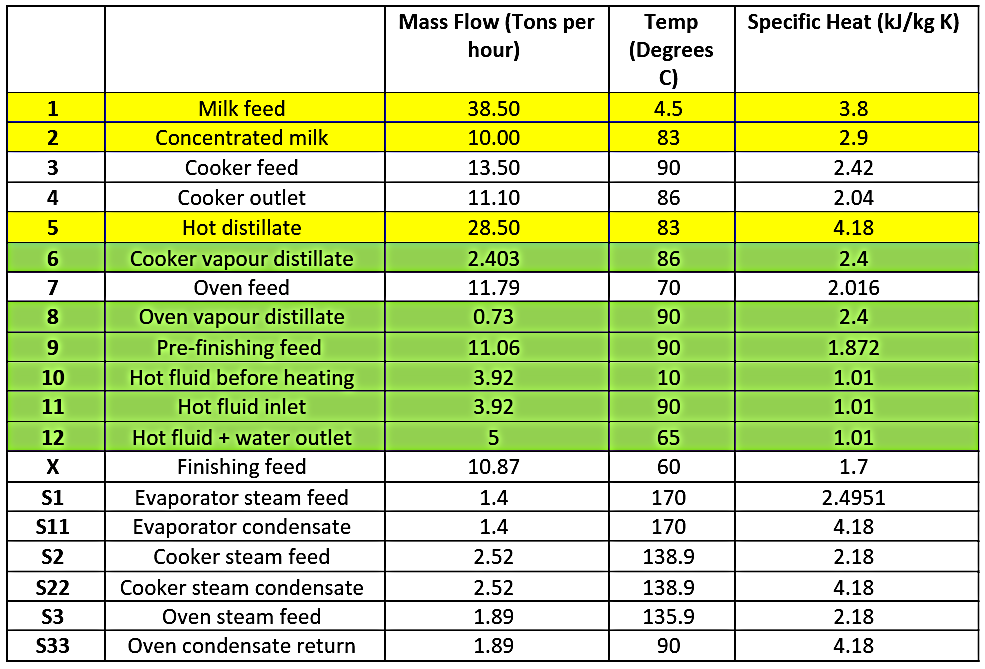
Separate pinch analyses are performed for each slice, using the yellow-highlighted sections of Table 1 as stream data for time slice A, and the green-highlighted sections as stream data for time slice B. Any heat recovery between slices would require thermal storage (e.g., a hot-water tank) to bridge the time gap. 
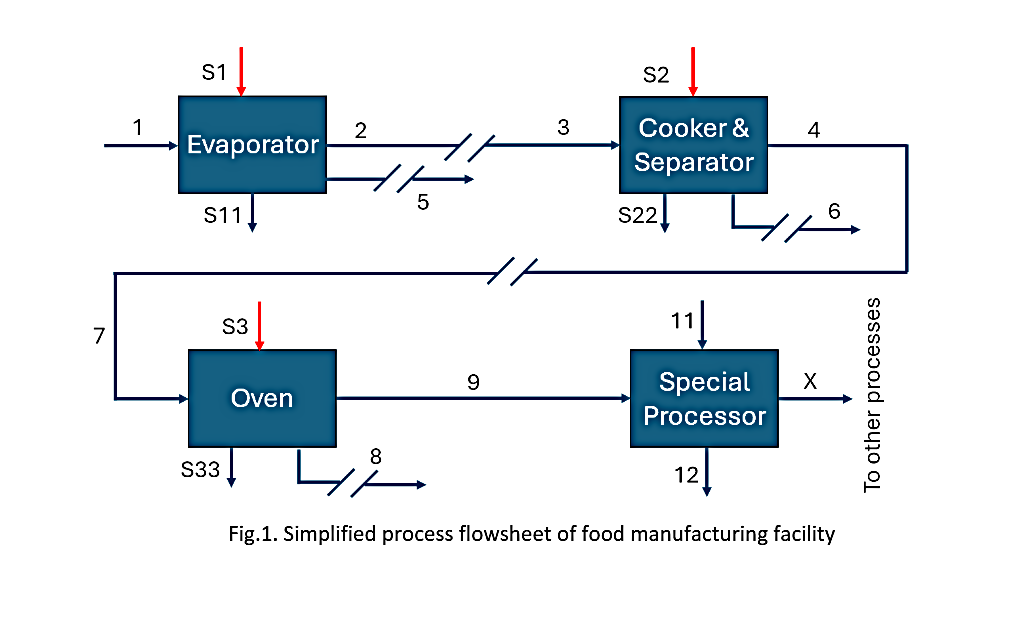
Fig.1. Simplified process flowsheet of food manufacturing facility.


Note on storage and system boundaries:

Because the two sub-processes occur at different times, direct process-to-process heat exchange between their streams is not possible without thermal storage. If storage is introduced: 


Table 1. Process stream data corresponding to flowsheet of Fig. 1. Yellow-highlighted sections represent processes available at time slice A, while green-highlighted sections are processes available at time slice B.


Appendix B: Suggested marking rubric (Editable):

Adopter note: The rubric below is a suggested template. Instructors may adjust criteria language, weightings and band thresholds to align with local policies and learning outcomes. No marks depend on running software. 

1) Interpretation of Simulation Outputs — 25% 

2) Systems Thinking & Scenario Analysis — 30% 

3) Stakeholder & Implementation Insight — 20% 

4) Decision Quality & Justification — 15% 

5) Communication & Presentation — 10% 


References:


Any views, thoughts, and opinions expressed herein are solely that of the author(s) and do not necessarily reflect the views, opinions, policies, or position of the Engineering Professors’ Council or the Toolkit sponsors and supporters.  

Toolkit: Complex Systems Toolkit.

Author: Dr. Rhythima Shinde (KLH Sustainability).

Topic: Applying Cynefin framework for climate resilience.  

Title: Managing floods in urban infrastructure.

Resource type: Teaching – Case study.

Relevant disciplines: Civil engineering; Environmental engineering; General engineering.

Keywords: Systems thinking; Climate change; Sustainability; Risk; Decision-making; Problem-solving; Disaster mitigation.

Licensing: This work is licensed under a Creative Commons Attribution-ShareAlike 4.0 International License. 

Related INCOSE Competencies: Toolkit resources are designed to be applicable to any engineering discipline, but educators might find it useful to understand their alignment to competencies outlined by the International Council on Systems Engineering (INCOSE). The INCOSE Competency Framework provides a set of 37 competencies for Systems Engineering within a tailorable framework that provides guidance for practitioners and stakeholders to identify knowledge, skills, abilities and behaviours crucial to Systems Engineering effectiveness.  A free spreadsheet version of the framework can be downloaded.

This resource relates to the Systems Thinking, Requirements Definition, Communication, Design For, and Critical Thinking INCOSE Competencies. 

AHEP4 mapping: This resource addresses several of the themes from the UK’s Accreditation of Higher Education Programmes fourth edition (AHEP4):  Analytical Tools and Techniques (critical to the ability to model and solve problems), and Integrated / Systems Approach (essential to the solution of broadly-defined problems). In addition, this resource addresses the themes of Sustainability and Communication. 

Educational level: Beginner; intermediate.


Acknowledgement

The case study underpinning this teaching activity was developed by Prof. Kristen MacAskill (University of Cambridge). The Module was first developed and implemented in teaching by TEDI- London, led by a team of learning technologists, Ellie Bates, Laurence Chater, Pratishtha Poudel, and academic member, Rhythima Shinde. This work was carried out in collaboration with the Royal Academy of Engineering through its Engineering X programme — a global partnership that supports safer, more sustainable engineering education and practice worldwide. With critical support from Professor Kristen MacAskill and involvement of Ana Andrade and Hazel Ingham, Aisha Seif Salim. This was a collective effort involving many individuals across TEDI-London and RAEng (advisors and reviewers), and while we cannot name everyone here, we are deeply grateful for all the contributions that made this module possible. 


Learning and teaching notes: 

This case study introduces a structured, systems-thinking–based teaching resource. It provides educators with tools and frameworks—such as the Cynefin framework and stakeholder mapping—to analyse and interpret complex socio-technical challenges. By exploring the case of the Queensland, Australia floods, it demonstrates how engineering decisions evolve within interconnected technical and social systems, helping students link theory with practice. 

The Cynefin framework (Nachbagauer, 2021; Snowden, 2002), helps decision-makers distinguish between different types of problem contexts—simple, complicated, complex, chaotic, and disordered. In an engineering context, this framework guides learners to recognise when traditional linear methods work (for simple or complicated problems) and when adaptive, experimental approaches are required (for complex or chaotic systems). 

Within this teaching activity, Cynefin is used to help students understand how resilience strategies evolve when facing uncertainty, incomplete information, and changing stakeholder dynamics. By mapping case study events to the Cynefin domains, learners gain a structured way to navigate uncertainty and identify appropriate modes of action. 

This case study activity assumes basic familiarity with systems concepts and builds on this foundation with deeper application to real-world socio-technical challenges.  


Summary of context:

The activity focuses on a case study of 2010–2011 floods in Queensland, Australia, which caused extensive damage to urban infrastructure. The Queensland Reconstruction Authority (QRA) initially directed resources to short-term asset repairs but subsequently shifted towards long-term resilience planning, hazard management, and community-centred approaches. 

The case resonates with global engineering challenges, such as flood, fire, and storm resilience, and can be easily adapted to local contexts. This case therefore connects systems thinking theory directly to engineering and governance decisions, illustrating how frameworks like Cynefin can support engineers in navigating uncertainty across technical and institutional domains. 


Learning objectives:

Aligned with AHEP4 (Engineering Council, 2020) – Outcomes 6, 10, and 16 on systems approaches, sustainability, and risk – this activity emphasises systems thinking, stakeholder engagement, problem definition, and decision-making under uncertainty. 

This teaching activity introduces learners to the principles and practice of systems thinking by embedding a real-world case study into engineering education (Godfrey et al., 2014; Monat et al.,2022). The objectives are to: 


Teachers have the opportunity to: 


Downloads: 


Learning and teaching resources:


Time required: 

The teaching activity is designed for 4–6 hours of structured learning, delivered across three modules: 

1. Context (1–2 hours) 

2. Analysis and insights (1–2 hours) 

3. Discussion and transferable learning (1–2 hours) 


Materials required:

1. Open access online learning platform: Engineering for a complex world

This dedicated platform hosts the interactive modules designed for this teaching activity. Students progress through three modules — Context, Analysis and Insights, and Discussion and Transferable Learning. Each module includes animations, narrative-driven content, scenario prompts, and interactive tasks. The platform ensures flexibility: it can be used in fully online, hybrid, or face-to-face settings. All necessary digital assets (readings, maps, videos, and quizzes) are embedded, so learners have a “one-stop” environment.

2. Case study pack: Queensland Reconstruction Authority flood response

The core teaching narrative is anchored in this Engineering X case study. It documents the evolution of the Queensland Reconstruction Authority (QRA) from a short-term flood recovery body to a long-term resilience institution. This resource provides students with authentic socio-technical detail — including stakeholder conflicts, institutional learning, and systemic barriers — which they then interrogate using systems thinking frameworks.

3. Facilitator’s guide: (Appendix A)

This guide equips educators to deliver the course consistently and effectively. It includes:

4. Timeline touchpoints: (Appendix B)

This resource provides a suggested delivery schedule for facilitators. It maps when live sessions, asynchronous tasks, and group discussions should occur, ensuring students remain engaged over the course. It also indicates where key reflective points and assessments (both formative and summative) can be integrated.

5. Pre- and post-module assessment form: (Appendix C)

This tool evaluates students’ systems thinking learning outcomes. It includes:

The form provides both quantitative data (Likert scales) and qualitative insights (open-ended reflections), enabling robust evaluation of teaching impact. 


Assessment:


Narrative of the case:

Learners are introduced to the case via a fictional guide, “Bernice,” who frames the scenario and supports navigation through the material. Students work through three stages that progressively apply the Cynefin framework and other systems tools to understand how resilience emerges through evolving governance and engineering responses: 

1. Context module: 

2. Analysis & insights module: 

3. Discussion & transfer learning module: 


Interactive learning design:

The teaching activity integrates multiple interactive elements to immerse students in systems thinking: 


Why this approach adds value: 

Although rooted in social-technical interactions, the activity explicitly connects systems thinking to core engineering design competencies—problem framing, stakeholder analysis, and iterative solution development under uncertainty 


Guided questions and activities: 

Facilitators can use these prompts to stimulate inquiry and structured reflection: 


Opportunities for extension: 

In addition to the Queensland floods and Sakura Cove examples, educators may draw parallels with urban heat planning in London, wildfire adaptation in Australia, or storm resilience in the Netherlands. These comparative cases allow learners to generalise systems insights beyond one event or geography. 

The activity is designed to be scalable and adaptable: 

This flexibility allows educators to tailor the activity to their students’ level of expertise, institutional context, and disciplinary focus. 


References:


Any views, thoughts, and opinions expressed herein are solely that of the author(s) and do not necessarily reflect the views, opinions, policies, or position of the Engineering Professors’ Council or the Toolkit sponsors and supporters.  

Toolkit: Complex Systems Toolkit.

Author: Dr. Ewa Ura-Binczyk (Warsaw University of Technology).

Topic: Rail accident investigation and material failure analysis using systems thinking.

Title: Using fault tree analysis in a rail failure investigation.

Resource type: Teaching – Case study.

Relevant disciplines: Mineral, metallurgy & materials engineering; Civil engineering.

Keywords: Public health and safety; Risk; Fault tree analysis; Failure; Ethics; Public trust; Stakeholders; Trade offs; Uncertainty.

Licensing: This work is licensed under a Creative Commons Attribution-ShareAlike 4.0 International License. 

Related INCOSE Competencies: Toolkit resources are designed to be applicable to any engineering discipline, but educators might find it useful to understand their alignment to competencies outlined by the International Council on Systems Engineering (INCOSE). The INCOSE Competency Framework provides a set of 37 competencies for Systems Engineering within a tailorable framework that provides guidance for practitioners and stakeholders to identify knowledge, skills, abilities and behaviours crucial to Systems Engineering effectiveness.   A free spreadsheet version of the framework can be downloaded.

This resource relates to the Systems Thinking, Systems Modelling and Analysis, Ethics and Professionalism, Technical Leadership and Critical Thinking INCOSE Competencies.

AHEP4 mapping: This resource addresses several of the themes from the UK’s Accreditation of Higher Education Programmes fourth edition (AHEP4): Analytical Tools and Techniques (critical to the ability to model and solve problems), and Integrated / Systems Approach (essential to the solution of broadly-defined problems). In addition, this resource addresses AHEP themes of Design, Ethics and Communication. 

Educational level: Intermediate; Advanced.


Learning and teaching notes:

The case is built around 3 × 90-minute sessions and independent report writing. A suggested breakdown of the activities can be seen below. 

Learners have the opportunity to: 

Teachers have the opportunity to: 


Downloads: 


Learning and teaching resources:


Session  Focus  Suggested activities and timing 
1  Introduction and problem framing  20 min: Introduce case scenario and system context; 30 min: Group discussion on initial impressions, key stakeholders, and potential causes; 40 min: Begin Fault Tree Analysis (FTA) construction using initial evidence. 
2  Investigation and analysis  30 min: Continue FTA construction and data evaluation; 30 min: Peer review of other groups’ fault trees; 30 min: Consolidate findings and prepare draft report outline. 
3  Reporting and reflection  30 min: Present findings to a simulated stakeholder panel; 30 min: Discuss feedback and defend conclusions; 30 min: Individual reflection on complexity, uncertainty, and assumptions. 


Summary of the system or context:

Rail transport systems consist of thousands of interdependent components, including rails, fasteners, sleepers, signalling systems, and maintenance processes. Failures in a single component can cascade, affecting: 


Complex system features: 


Narrative of the case:

On a cold January morning, a commuter train was halted after inspectors discovered a fractured rail joint component. Services were disrupted for several hours, stranding thousands of passengers. The media quickly picked up the story, raising questions about safety and reliability. 

The rail operator urgently commissioned an engineering consultancy (the students) to investigate the failure. Their findings will inform both the safety authority’s decision on whether the line can reopen and the legal proceedings to determine liability. 


The dilemma: 

As consultants, students face incomplete evidence: some lab tests are missing, inspection logs are inconsistent, and eyewitness accounts conflict. They must use Fault Tree Analysis (FTA) to map possible causes, evaluate data, and produce an expert opinion report — knowing that their conclusions could influence legal outcomes and public safety decisions. 

Groups: 3–5 students per group; 3-4 groups can run in parallel. 

Materials required: case narrative handouts, sample inspection log, example FTA, whiteboards/flipcharts, sticky notes for FTA mapping. 

Activity flow: 

1. Introduce case and assign roles. 

2. Construct initial fault trees using evidence. 

3. Peer-review across groups. 

4. Draft expert report and present to simulated stakeholder panel. 

5. Individual reflection on complexity and uncertainty. 


Why use Fault Tree Analysis (FTA):

FTA is a structured approach to trace a failure from an observed event back to potential causes, including technical, human, and organisational factors. 

FTA is particularly suitable for this case because it allows students to structure complex, uncertain information in a logical and transparent way. It helps them trace the chain of causes behind the rail component failure, linking material, human, and organisational factors into one coherent framework. By visualising how small events combine into system-level failures, FTA encourages learners to think critically about interdependencies, data gaps, and assumptions. It also mirrors real-world engineering investigations, where professionals must justify conclusions under uncertainty and demonstrate clear reasoning to stakeholders such as regulators or courts. 

Advantages in this case: 


Questions and activities: 

Prompt  Expected insight / reflection 
What technical, human, and organisational factors might have contributed to this failure?  Students identify multiple interacting factors, illustrating interdependencies and emergent risks. 
How does Fault Tree Analysis help structure uncertainty in this investigation?  Learners recognise FTA’s role in visualising cause-effect pathways and clarifying assumptions. 
Which assumptions are you forced to make, and how might they affect your conclusions?  Students reflect on data gaps, biased observations, and ethical implications of assumptions. 
How do different stakeholders’ interests shape urgency and framing of your analysis?  Learners understand trade-offs, pressures from conflicting priorities, and the precautionary principle. 
What are the risks of issuing a preliminary report under time pressure?  Students explore implications for safety, liability, professional integrity, and public trust. 


Activity  Focus  What “good practice” looks like  Facilitator notes / tips 
1. FTA construction  Collaborative problem analysis  Teams discuss evidence openly, question assumptions, and co-create a logical tree linking technical, human, and organisational causes.   Encourage each group to identify at least one “human/organisational” branch and to label any data gaps explicitly. 
2. Peer review  Critical reflection and systems perspective  Groups provide constructive critique, highlighting hidden assumptions, missing branches, or unclear logic. Dialogue stays professional and evidence-based.  Provide coloured sticky notes or digital comments to record feedback; model how to frame critique as questions (“Have you considered…?”). 
3. Report writing (in-class drafting)  Synthesis and professional communication  Drafts show a clear, defensible reasoning chain from evidence to conclusion. Teams justify assumptions and note uncertainties.  Remind students to separate “facts” from “interpretations.” Encourage use of structured headings (Findings – Analysis – Conclusions). 
4. Simulation role-Play  Perspective-taking and communication under pressure  Presentations are concise (≤5 min), factual, and adapted to stakeholder roles. Learners respond respectfully and clearly to challenging questions.  Provide role cards for the panel (operator, regulator, manufacturer, public). Rotate students if possible. 
5. Reflection  Metacognition and learning from uncertainty  Students identify what surprised them, what they found ambiguous, and how their view of engineering judgment evolved.  Offer prompts like “What would you do differently next time?” or “Where did your reasoning feel uncertain?” 


Further challenge:

Instructors may choose to introduce a second “reveal” phase: a new metallurgical test result or a whistle-blower statement emerges halfway through the case. Students must revise their fault tree and defend whether and how their conclusions change. This highlights the evolving nature of complex systems investigations. 


Assessment opportunities:


Any views, thoughts, and opinions expressed herein are solely that of the author(s) and do not necessarily reflect the views, opinions, policies, or position of the Engineering Professors’ Council or the Toolkit sponsors and supporters.  


Case study example: Water wars: managing competing water rights

Activity: Assessment. This example demonstrates how the questions provided in Assessing ethics: Rubric can be used to assess the competencies stipulated at each level.

Authors: Dr. Natalie Wint (UCL); Dr. William Bennett (Swansea University).

Related content:


Water wars: managing competing water rights 

This example demonstrates how the questions provided in the accompanying rubric can be used to assess the competencies stipulated at each level. Although we have focused on ‘Water Wars’ here, the suggested assessment questions have been designed in such a way that they can be used in conjunction with the case studies available within the toolkit, or with another case study that has been created (by yourself or elsewhere) to outline an ethical dilemma. 

Year 1 

Personal values: What is your initial position on the issue? Do you see anything wrong with how DSS are using water? Why, or why not?

Professional responsibilities: What ethical principles and codes of conduct are relevant to this situation?

Ethical principles and codes of conduct can be used to guide our actions during an ethical dilemma. How does the guidance provided in this case align/differ with your personal views? (This is a question we had created in addition to those provided within the case study to meet the requirements stipulated in the accompanying rubric.)

What are the moral values involved in this case and why does it constitute an ethical dilemma? (This is a question we had created in addition to those provided within the case study to meet the requirements stipulated in the accompanying rubric.)

What role should an engineer play in influencing the outcome? What are the implications of not being involved? (This is a question we had created in addition to those provided within the case study to meet the requirements stipulated in the accompanying rubric.)

Year 2 

Formulate a moral problem statement which clearly states the problem, its moral nature and who needs to act. (This is a question we had created in addition to those provided within the case study to meet the requirements stipulated in the accompanying rubric.)

Stakeholder mapping: Who are all the stakeholders in the scenario? What are their positions, perspective and moral values?

Stakeholder  Perspectives/interests  Moral values 
Data Storage Solutions (DSS)  Increasing production in a profitable way; meeting legal requirements; good reputation to maintain/grow customer base.  Accountability; sustainability (primarily economic). 
Farmers’ union  Represent farmers who suffer from economic implications associated with costly irrigation.  Accountability; environmental sustainability; justice. 
Farm  The farm (presumably) benefits from DSS using the land.  Ownership and property; environmental sustainability; justice. 
Local Green Party  Represent views of those concerned about biodiversity. May be interested in opening of green battery plant.  Human welfare; environmental sustainability; justice. 
Local Council  Represent views of all stakeholders and would need to consider economic benefits of DSS (tax and employment), the need of the university and hospital, as well as the needs of local farmers and environmentalists. May be interested in opening of green battery plant.  Human welfare and public health; trust; accountability; environmental sustainability; justice. 
Member of the public  This may depend on their beliefs as an individual, their employment status and their use of services such as the hospital and university. Typically interested in low taxes/responsible spending of public money. May be interested in opening of green battery plant.  Human welfare; trust; accountability; environmental sustainability; justice. 
Stakeholders using DSS data storage  Reliable storage. They may also be interested in being part of an ethical supply chain.  Trust; privacy; accountability; autonomy. 
Non-human stakeholders  Environmental sustainability. 


What are some of the possible courses of action in the situation. What responsibilities do you have to the various stakeholders involved? What are some of the advantages and disadvantages associated with each? (Reworded from case study.)

What are the relevant facts in this scenario and what other information would you like to help inform your ethical decision making? (This is a question we had created in addition to those provided within the case study to meet the requirements stipulated in the accompanying rubric.)


Year 2/Year 3  

(At Year 2, students could provide options; at Year 3 they would evaluate and form a judgement.) 

Make use of ethical frameworks and/or professional codes to evaluate the options for DSS both short term and long term. How do the uncertainty and assumptions involved in this case impact decision making?

Option  Consequences  Intention  Action 
Keep using water  May lead to expansion and profit of DSS and thus tax revenue/employment and supply. 

Reputational damage of DSS may increase. Individual employee piece of mind may be at risk. 

Farmers still don’t have water and biodiversity still suffers which may have further impact long term. 

Intention behind action not consistent with that expected by an engineer, other than with respect to legality  Action follows legal norms but not social norms such as good will and concern for others. 
Keep using the water but limit further work  May limit expansion and profit of DSS and thus tax revenue/employment and supply. 

Farmers still don’t have water and biodiversity still suffers and may have further impact long term. This could still result in reputation damage. 

Intention behind action partially consistent with that expected by an engineer.  Action follows legal norms but only partially follow social norms such as good will and concern for others. 
Make use of other sources of water  Data storage continues. 

Potential for reputation to increase. 

Potential increase in cost of water resulting in less profit potentially less tax revenue/employment. 

Farmers have water and biodiversity may improve.

Alternative water sources may be associated with the same issues or worse. 

Intention behind action seems consistent with that expected by an engineer. However, this is dependent upon 

whether they chose to source sustainable water with less impact on biodiversity etc. 

This may be dependent on the degree to which DSS proactively source sustainable water. 
Reduce work levels or shut down  Impact on profit and thus tax revenue/employment and supply chain. Farmers have water and biodiversity may improve. 

May cause operational issues for those whose data is stored. 

Seems consistent with those expected of engineer. Raises questions more generally about viability and feasibility of data storage.  Action doesn’t follow social norms of responsibility to employees and shareholders. 
Investigate other cooling methods which don’t require as much water/don’t take on extra work until another method identified. 
May benefit whole sector. 

May cause interim loss of service. 


This follows expectations of the engineering profession in terms of evidence-based decision making and consideration for impact of engineering in society.  It follows social norms in terms of responsible decision making. 


Downloads:

Assessing ethics: Guidance

Assessing ethics: Rubric

Assessing ethics: Case study assessment example: Water Wars


This work is licensed under a Creative Commons Attribution-ShareAlike 4.0 International License.

Any views, thoughts, and opinions expressed herein are solely that of the author(s) and do not necessarily reflect the views, opinions, policies, or position of the Engineering Professors’ Council or the Toolkit sponsors and supporters.

Author: Dr. Jemma L. Rowlandson (University of Bristol). 

Topic: Achieving carbon-neutral aviation by 2050.  

Tool type: Teaching. 

Relevant disciplines: Chemical; Aerospace; Mechanical; Environmental; Energy.  

Keywords: Design and innovation; Conflicts of interest; Ethics; Regulatory compliance; Stakeholder engagement; Environmental impact; AHEP; Sustainability; Higher education; Pedagogy; Assessment. 

Sustainability competency: Systems thinking; Anticipatory; Critical thinking; Integrated problem-solving; Strategic; Collaboration.

AHEP mapping: This resource addresses two of the themes from the UK’s Accreditation of Higher Education Programmes fourth edition (AHEP4): The Engineer and Society (acknowledging that engineering activity can have a significant societal impact) and Engineering Practice (the practical application of engineering concepts, tools and professional skills). To map this resource to AHEP outcomes specific to a programme under these themes, access AHEP 4 here and navigate to pages 30-31 and 35-37. 

Related SDGs: SDG 7 (Affordable and Clean Energy); SDG 9 (Industry, Innovation and Infrastructure); SDG 12 (Responsible Consumption and Production); SDG 13 (Climate Action). 

Reimagined Degree Map Intervention: More real-world complexity; Active pedagogies and mindset development; Authentic assessment.

Educational aim: Apply interdisciplinary engineering knowledge to a real-world sustainability challenge in aviation, foster ethical reasoning and decision-making with regards to environmental impact, and develop abilities to collaborate and communicate with a diverse range of stakeholders. 

Educational level: Intermediate. 


Learning and teaching notes: 

This case study provides students an opportunity to explore the role of hydrogen fuel in the aviation industry. Considerable investments have been made in researching and developing hydrogen as a potential clean and sustainable energy source, particularly for hydrogen-powered aircraft. Despite the potential for hydrogen to be a green and clean fuel there are lingering questions over the long-term sustainability of hydrogen and whether technological advancements can progress rapidly enough to significantly reduce global carbon dioxide emissions. The debate around this issue is rich with diverse perspectives and a variety of interests to consider. Through this case study, students will apply their engineering expertise to navigate this complex problem and examine the competing interests involved.  

This case is presented in parts, each focusing on a different sustainability issue, and with most parts incorporating technical content. Parts may be used in isolation, or may be used to build up the complexity of the case throughout a series of lessons.  

Learners have the opportunity to: 

Teachers have the opportunity to: 


Supporting resources:  


Learning and teaching resources: 

Hydrogen fundamentals resources: 

We recommend encouraging the use of sources from a variety of stakeholders. Encourage students to find their own, but some examples are included below: 


Pre-Session Work: 

Students should be provided with an overview of the properties of hydrogen gas and the principles underlying the hydrogen economy: production, storage and transmission, and application. There are several free and available sources for this purpose (refer to the Hydrogen Fundamentals Resources above). 


Introduction 

At Airbus, we believe hydrogen is one of the most promising decarbonisation technologies for aviation. This is why we consider hydrogen to be an important technology pathway to achieve our ambition of bringing a low-carbon commercial aircraft to market by 2035.” – Airbus, 2024 

As indicated in the industry quote above, hydrogen is a growing area of research interest for aviation companies to decarbonise their fleet. In this case study, you are put in the role of working as an engineering consultant and your customer is a multinational aerospace corporation. They are keen to meet their government issued targets of reducing carbon emissions to reach net zero by 2050 and your consultancy team has been tasked with assessing the feasibility of powering a zero-emission aircraft using hydrogen. The key areas your customer is interested in are: 


Part one: The aviation landscape 

Air travel connects the world, enabling affordable and reliable mass transportation between continents. Despite massive advances in technology and infrastructure to produce more efficient aircraft and reduce passenger fuel consumption, carbon emissions have doubled since 2019 and are equivalent to 2.5 % of global CO2 emissions.  


Your customer is interested in the feasibility of hydrogen for aviation fuel. However, there is a debate within the management team over the sustainability of hydrogen. As the lead engineering consultant, you must guide your customer in making an ethical and sustainable decision.  

Hydrogen is a potential energy carrier which has a high energy content, making it a promising fuel for aviation. Green hydrogen is produced from water and is therefore potentially very clean. However, globally most hydrogen is currently made from fossil fuels with an associated carbon footprint. Naturally occurring as a gas, the low volumetric density makes it difficult to transport and add complications with storage and transportation. 


Part two: Hydrogen production 

Hydrogen is naturally abundant but is often found combined with other elements in various forms such as hydrocarbons like methane (CH4) and water (H2O). Methods have been developed to extract hydrogen from these compounds. It is important to remember that hydrogen is an energy carrier and not an energy source; it must be generated from other primary energy sources (such as wind and solar) converting and storing energy in the form of hydrogen.  


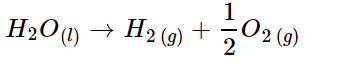
The ideal scenario is to produce green hydrogen via electrolysis where water (H2O) is split using electricity into hydrogen (H2) and oxygen (O2). This makes green hydrogen potentially completely green and clean if the process uses electricity from renewable sources. The overall chemical reaction is shown below: 

However, the use of water—a critical resource—as a feedstock for green hydrogen, especially in aviation, raises significant ethical concerns. Your customer’s management team is divided on the potential impact of this practice on global water scarcity, which has been exacerbated by climate change. You have been tasked with assessing the feasibility of using green hydrogen in aviation for your client. Your customer has chosen their London to New York route (3,500 nmi), one of their most popular, as a test-case. 


Despite its potential for green production, globally the majority of hydrogen is currently produced from fossil fuels – termed grey hydrogen. One of your team members has proposed using grey hydrogen as an interim solution to bridge the transition to green hydrogen, in order for the company to start developing the required hydrogen-related infrastructure at airports. They argue that carbon capture and storage technology could be used to reduce carbon emissions from grey hydrogen while still achieving the goal of decarbonisation. Hydrogen from fossil fuels with an additional carbon capture step is known as blue hydrogen. 

However, this suggestion has sparked a heated debate within the management team. While acknowledging the potential to address the immediate concerns of generating enough hydrogen to establish the necessary infrastructure and procedures, many team members argued that it would be a contradictory approach. They highlighted the inherent contradiction of utilising fossil fuels, the primary driver of climate change, to achieve decarbonisation. They emphasised the importance of remaining consistent with the ultimate goal of transitioning away from fossil fuels altogether and reducing overall carbon emissions. Your expertise is now sought to weigh these options and advise the board on the best course of action. 


Part three: Hydrogen storage 

Despite an impressive gravimetric energy density (the energy stored per unit mass of fuel) hydrogen has the lowest gas density and the second-lowest boiling point of all known chemical fuels. These unique properties pose challenges for storage and transportation, particularly in the constrained spaces of an aircraft.  


As the lead engineering consultant, you have been tasked with providing expert advice on viable hydrogen storage options for aviation. Your customer has again chosen their London to New York route (3,500 nmi) as a test-case because it is one of their most popular, transatlantic routes. They want to know if hydrogen storage can be effectively managed for this route as it could set a precedent for wider adoption for their other long-haul flights. The plane journey from London to New York is estimated to require around 15,000 kg of hydrogen (or use the quantity estimated previously estimated in Part 2 – see Appendix for example).  


Part four: Emissions and environmental impact 

In Part four, we delve deeper into the environmental implications of using hydrogen as a fuel in aviation with a focus on emissions and their impacts across the lifecycle of a hydrogen plane. Aircraft can be powered using either direct combustion of hydrogen in gas turbines or by reacting hydrogen in a fuel cell to produce electricity that drives a propeller. As the lead engineering consultant, your customer has asked you to choose between hydrogen combustion in gas turbines or the reaction of hydrogen in fuel cells. The management team is divided on the environmental impacts of both methods, with some emphasising the technological readiness and efficiency of combustion and others advocating for the cleaner process of fuel cell reaction.  


Both combustion of hydrogen in an engine and reaction of hydrogen in a fuel cell will produce water as a by-product. The management team are concerned over the effect of using hydrogen on the formation of contrails. Contrails are clouds of water vapour produced by aircraft that have a potential contribution to global warming but the extent of their impact is uncertain.  


So far we have considered each aspect of the hydrogen debate in isolation. However, it is important to consider the overall environmental impact of these stages as a whole. Choices made at each stage of the hydrogen cycle – generation, storage, usage – will collectively impact the overall environmental impact and sustainability of using hydrogen as an aviation fuel and demonstrates how interconnected our decisions can be.  


Part five: Hydrogen aviation stakeholders 

Hydrogen aviation is an area with multiple stakeholders with conflicting priorities. Understanding the perspectives of these key players is important when considering the feasibility of hydrogen in the aviation sector.   


Your consultancy firm is hosting a debate for the aviation industry in order to help them make a decision around hydrogen-based technologies. You have invited representatives from consumer groups, the UK government, Environmental NGOs, airlines, and aircraft manufacturers.  


Stakeholder Key priorities and considerations
Airline & Aerospace Manufacturer 
  • Cost efficiency (fuel, labour, fleet maintenance) – recovering from pandemic. 
  • Passenger experience (commercial & freight). 
  • Develop & maintain global supply chains. 
  • Safety, compliance and operational reliability. 
  • Financial responsibility to employees and investors. 
  • Need government assurances before making big capital investments. 
UK Government 
  • Achieve net zero targets by 2050 
  • Promote economic growth and job creation (still recovering from pandemic). 
  • Fund research and innovation to put their country’s technology ahead. 
  • Fund renewable infrastructure to encourage industry investment. 
Environmental NGOs 
  • Long-term employment for aviation sector. 
  • Demand a sustainable future for aviation to ensure this – right now, not in 50 years. 
  • Standards and targets for industry and government and accountability if not met. 
  • Some NGOs support drastic cuts to flying. 
  • Want to raise public awareness over sustainability of flying. 
Consumer 
  • Environmentally aware (understand the need to reduce carbon emissions). 
  • Also benefit greatly from flying (tourism, commercial shipping, etc.). 
  • Safety and reliability of aircraft & processes. 
  • Cost effectiveness – want affordable service

Appendix: Example calculations 

There are multiple methods for approaching these calculations. The steps shown below are just one example for illustrative purposes.  


Part two: Hydrogen production 

Challenge: Estimate the volume of water required for a hydrogen-powered aircraft.   

Assumptions around the hydrogen production process, aircraft, and fuel requirement can be given to students or researched as a separate task. In this example we assume: 


Example estimation: 

1. Estimate the energy requirement for a mid-size jet 

No current hydrogen-fuelled aircraft exists, so we can use a kerosene-fuelled analogue. Existing aircraft that meet the requirements include the Boeing 767 or 747. The energy requirement is then: 


2. Estimate the hydrogen requirement 

Assuming a hydrogen plane has the same fuel requirement:


3. Estimate the volume of water required 

Assuming all hydrogen is produced from the electrolysis of water: 

Electrolysis reaction:

For this reaction, we know one mole of water produces one mole of hydrogen. We need to calculate the moles for 20,000 kg of hydrogen: 


With a 1:1 molar ratio, we can then calculate the mass of water: 

This assumes an electrolyser efficiency of 100%. Typical efficiency values are under 80%, which would yield: 


Challenge: Is it feasible to power the UK aviation fleet with water? 


The total energy requirement for UK aviation can be given to students or set as a research task.  

Estimation can follow a similar procedure to the above. 

Multiple methods for validating and assessing the feasibility of this quantity of water. For example, the UK daily water consumption is 14 billion litres. The water requirement estimated above is < 1 % of this total daily water consumption, a finding supported by FlyZero.  


Part three: Hydrogen storage 

Challenge: Is it feasible to store 20,000 kg of hydrogen in an aircraft? 

There are multiple methods of determining the feasibility of storage volume. As example is given below. 


1. Determining the storage volume 

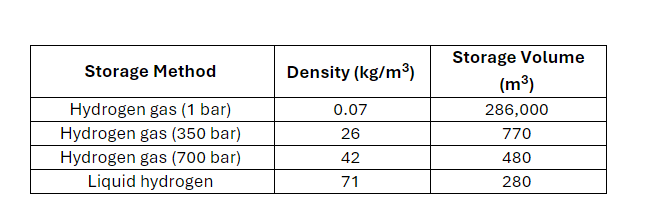
The storage volume is dependent on the storage method used. Density values associated with different storage techniques can be research or given to students (included in Table 2). The storage volume required can be calculated from the mass of hydrogen and density of storage method, example in Table 2.  

Table 2: Energy densities of various hydrogen storage methods 


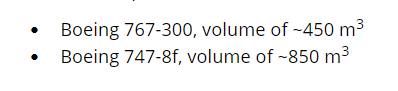
2. Determining available aircraft volume 

A straightforward method is to compare the available volume on an aircraft with the hydrogen storage volume required. Aircraft volumes can be given or researched by students. Examples: 

This assumes hydrogen tanks are integrated into an existing aircraft design. Liquid hydrogen can feasibly fit into an existing design, though actual volume will be larger due to space/constraint requirements and additional infrastructure (pipes, fittings, etc) for the tanks. Tank size can be compared to conventional kerosene tanks and a discussion encouraged over where in the plane hydrogen tanks would need to be (conventional liquid fuel storage is in the wings of aircraft, this is not possible for liquid storage tanks due to their shape and infrastructure storage is inside the fuselage). Another straightforward method for storage feasibility is modelling the hydrogen volume as a simple cylinder and comparing to the dimensions of a suitable aircraft.  


This work is licensed under a Creative Commons Attribution-ShareAlike 4.0 International License. 

Any views, thoughts, and opinions expressed herein are solely that of the author(s) and do not necessarily reflect the views, opinions, policies, or position of the Engineering Professors’ Council or the Toolkit sponsors and supporters. 
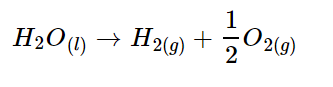
To view a plain text version of this resource, click here to download the PDF.

Author: Onyekachi Nwafor (CEO, KatexPower). 

Topic: Revealing links between ethics and sustainability by teaching with case studies. 

Tool type: Guidance. 

Relevant disciplines: Any. 

Keywords: Sustainability education; Engineering ethics; Environmental impact; Responsible design; Stakeholder engagement; AHEP; Sustainability; Higher education; Pedagogy; Renewable energy; Green energy; Climate change; Local community. 

Sustainability competency: Self-awareness; Normative.

AHEP mapping: This resource addresses two of the themes from the UK’s Accreditation of Higher Education Programmes fourth edition (AHEP4): The Engineer and Society (acknowledging that engineering activity can have a significant societal impact) and Engineering Practice (the practical application of engineering concepts, tools and professional skills). To map this resource to AHEP outcomes specific to a programme under these themes, access AHEP 4 here and navigate to pages 30-31 and 35-37.  

Related SDGs: SDG 4 (Quality education); SDG 13 (Climate action). 

Reimagined Degree Map Intervention: More real-world complexity; Active pedagogies and mindset development; Cross-disciplinarity.

Who is this article for? This article should be read by educators at all levels in higher education who are seeking to apply an approach of teaching with case studies in order to reveal the links between ethics and sustainability. Engaging with this topic will also help to prepare students with the soft skill sets that employers are looking for. 

Supporting resources: 


Premise: 

As environmental pressures mount, the world demands not just engineering solutions, but sustainable ones. This shift presents profound challenges and opportunities for engineering educators. How can we equip future engineers with the ethical frameworks and critical thinking skills needed to navigate the complex trade-offs inherent in green solutions? 

This article provides a guide for integrating ethical considerations into engineering education by using case studies. By fostering awareness of sustainability principles and promoting responsible decision-making through real-world examples, we can empower students to become stewards of a more equitable and resilient future. 


The interplay of ethics and sustainability: 

At its core, sustainability goes beyond environmental impact. It encompasses social responsibility, economic viability, and intergenerational equity. Ethical engineering aligns with these principles by: 


Integrating ethical considerations into engineering curricula presents several challenges: 


Learning from a case study:  

The sprawling Ivanpah Solar Electric Generating System in California’s Mojave Desert, initially celebrated as a beacon of clean energy, now casts a complex shadow on the region’s ecological landscape. While harnessing the sun’s power to electrify millions, its concentrated solar technology inadvertently unleashed unintended consequences. The intense heat generated by the mirrors tragically claimed thousands of birds, particularly desert tortoises, a threatened species. Drawn to the shimmering light, they would collide with the mirrors or structures, falling victim to a technological mirage. This stark reality challenged the “green” label of a project originally intended to combat climate change.  


Unforeseen costs of progress: 

Ivanpah’s case highlights the hidden costs of even well-intentioned renewable energy projects. It sparks critical questions for students to grapple with: 

Sustainability beyond carbon emissions: While reducing carbon footprint is crucial, broader ecosystem impacts must be considered. Can technological advancements mitigate harm to vulnerable species and habitats? 

Balancing energy needs with ecological needs: How can we find the sweet spot between harnessing renewable energy and preserving biodiversity? Can alternative technologies or site selection minimise ecological disruption? 

Engaging stakeholders in ethical decision-making: How can local communities and ecological experts be meaningfully included in planning and mitigation strategies to ensure equitable outcomes? 

By delving into the Ivanpah case (and others like it*), students can develop critical thinking skills to analyse the long-term implications of seemingly green solutions. They learn to consider diverse perspectives, advocate for responsible design practices, and prioritise environmental stewardship alongside energy production. 

*Relevant case studies: 


Empowering future engineers: 

As educators, we hold the power to shape the ethical compass of future engineers. By integrating ethical considerations into the fabric of our curriculum, we can equip them with the tools and knowledge necessary to: 


Conclusion: 

The pursuit of a sustainable future demands ethical engineers, engineers who can not only innovate, but also act with integrity and responsibility. By equipping students with the knowledge and skills necessary to grapple with complex ethical dilemmas, we can empower them to become transformative agents of change, shaping a world that thrives for generations to come. 


References: 

Delong, D. (2012). ‘Sustainable engineering: A comprehensive introduction’. John Wiley & Sons. 

Engineering ethics toolkit (2022) Engineering Professors Council. (Accessed: 05 February 2024). 

Engineers Without Borders. (n.d.). ‘Case studies on ethical dilemmas in sustainability’.(Accessed: October 20, 2023). 

The Hamilton Commission. (2019)  ‘On sustainable practices in Motorsport engineering’. (Accessed: October 20, 2023). 

MacKay, D.J.C. (2008). ‘Sustainable Energy – Without the Hot Air’. UIT Cambridge Ltd. 

Pritchard, M. S et al. (2013). ‘Engineering Ethics: Challenges and Opportunities’. Morgan & Claypool Publishers. 

Vallero, D. (2013). ‘The Ethics of Sustainable Engineering’. Princeton University Press. 


This work is licensed under a Creative Commons Attribution-ShareAlike 4.0 International License.  

Any views, thoughts, and opinions expressed herein are solely that of the author(s) and do not necessarily reflect the views, opinions, policies, or position of the Engineering Professors’ Council or the Toolkit sponsors and supporters.  

 

To view a plain text version of this resource, click here to download the PDF.

Authors: Dr Yujia Zhai (University of Hertfordshire); Associate Professor Scarlett Xiao (University of Hertfordshire). 

Topic: Data security of industrial robots.  

Disciplines: Robotics; Data; Internet of Things. 

Ethical issues: Safety; Health; Privacy; Transparency. 

Professional situations: Rigour; Informed consent; Misuse of data. 

Educational level: Intermediate. 

Educational aim: Gaining ethical knowledge. Knowing the sets of rules, theories, concepts, frameworks, and statements of duty, rights, or obligations that inform ethical attitudes, behaviours, and practices. 


Learning and teaching notes: 

This case study involves an engineer hired to develop and install an Industrial Internet of Things (IIoT) online machine monitoring system for a manufacturing company. The developments include designing the infrastructure of hardware and software, writing the operation manuals and setting policies. The project incorporates a variety of ethical components including law and policy, stakeholders, and risk analysis. 

This case study addresses three of the themes from the Accreditation of Higher Education Programmes fourth edition (AHEP4): Design and Innovation (significant technical and intellectual challenges commensurate the level of study), the Engineer and Society (acknowledging that engineering activity can have a significant societal impact) and Engineering Practice (the practical application of engineering concepts, tools, and professional skills). To map this case study to AHEP outcomes specific to a programme under these themes, access AHEP 4 here and navigate to pages 30-31 and 35-37. 

The dilemma in this case is presented in three parts. If desired, a teacher can use Part one in isolation, but Part two and Part three develop and complicate the concepts presented in Part one to provide for additional learning. The case study allows teachers the option to stop at multiple points for questions and/or activities as desired. 

Learners have the opportunity to: 

Teachers have the opportunity to:  


Learning and teaching resources: 

Professional organisations: 

Legal regulations: 

UN agency: 

Educational resource: 

Government sites: 

 Educational institutions: 


Summary: 

IIoT is a new technology that can provide accurate condition monitoring and predict component wear rates to optimise machine performance, thereby improving the machining precision of the workpiece and reducing the production cost.   

Oxconn is a company that produces auto parts. The robotic manipulators and other automation machines on the production line have been developed at considerable cost and investment, and regular production line maintenance is essential to ensure its effective operation. The current maintenance scheme is based on routine check tests which are not reliable and efficient. Therefore Oxconn has decided to install an IIoT-based machine condition monitoring system. To achieve fast responses to any machine operation issues, the machine condition data collected in real time will be transferred to a cloud server for analysis, decision making, and predictive maintenance in the future. 


Dilemma – Part one – Data protection on customers’ machines:

You are a leading engineer who has been hired by Oxconn to take charge of the project on the IIoT-based machine monitoring system, including designing the infrastructure of hardware and software, writing the operation manuals, setting policies, and getting the system up and running. With your background in robotic engineering and automation, you are expected to act as a technical advisor to Oxconn and liaise with the Facilities, Security, Operation, and Maintenance departments to ensure a smooth deployment. This is the first time you have worked on a project that involves real time data collection. So as part of your preparation for the project, you need to do some preliminary research as to what best practices, guidance, and regulations apply. 


Optional STOP for questions and activities: 

1. Discussion: What are the legal issues relating to machine condition monitoring? Machines’ real-time data allows for the identification of production status in a factory and is therefore considered as commercial data under GDPR and the Data Protection Act (2018). Are there rules specifically for IIoT, or are they the same no matter what technology is being used? Should IIoT regulations differ in any way? Why? 

2. Discussion: Sharing data is a legally and ethically complex field. Are there any stakeholders with which the data could be shared? For instance, is it acceptable to share the data with an artificial intelligence research group or with the public? Why, or why not? 

3. Discussion: Under GDPR, individuals must normally consent to their personal data being processed. For machine condition data, how should consent be handled in this case? 

4. Discussion: What ethical codes relate to data security and privacy in an IIoT scenario?  

5. Activity: Undertake a technical activity that relates to how IIoT-based machine monitoring systems are engineered. 

6. Discussion: Based on your understanding of how IIoT-based machine monitoring systems are engineered, consider what additional risks, and what kind of risks (such as financial or operational), Oxconn might incur if depending on an entirely cloud-based system. How might these risks be mitigated from a technical and non-technical perspective? 


Dilemma – Part two – Computer networks security issue brought by online monitoring systems:

The project has kicked off and a senior manager requests that a user interface (UI) be established specifically for the senior management team (SMT). Through this UI, the SMT members can have access to all the real-time data via their computers or mobiles and obtain the analysis result provided by artificial intelligence technology. You realise this has implications on the risk of accessing internal operating systems via the external information interface and networks. So as part of your preparation for the project, you need to investigate what platforms can be used and what risk analysis must be taken in implementation. 


Optional STOP for questions and activities: 

The following activities focus on macro-ethics. They address the wider ethical contexts of projects like the industrial data acquisition system. 

1. Activity: Explore different manufacturers and their approaches to safety for both machines and operators. 

2. Activity: Technical integration – Undertake a technical activity related to automation engineering and information engineering. 

3. Activity: Research what happens with the data collected by IIoT. Who can access this data and how can the data analysis module manipulate the data?  

4. Activity: Develop a risk management register, taking considerations of the findings from Activity 3 as well as the aspect of putting in place data security protocols and relevant training for SMT. 

5. Discussion/activity: Use information in the Ethical Risk Assessment guide to help students consider how ethical issues are related to the risks they have just identified. 

6. Discussion: In addition to cost-benefit analysis, how can the ethical factors be considered in designing the data analysis module? 

7. Activity: Debate the appropriateness of installing and using the system for the SMT. 

8. Discussion: What responsibilities do engineers have in developing these technologies? 


Dilemma – Part three – Security breach and legal responsibility: 

At the beginning of operation, the IIoT system with AI algorithms improved the efficiency of production lines by updating the parameters in robot operation and product recipes automatically. Recently, however, the efficiency degradation was observed, and after investigation, there were suspicions that the rules/data in AI algorithms have been subtly changed. Developers, contractors, operators, technicians and managers were all brought in to find out what’s going on. 


Optional STOP for questions and activities: 

1. Discussion: If there has been an illegal hack of the system, what might be the motive of cyber criminals?   

2. Discussion: What are the impacts on company business? How could the impact of cyber-attacks on businesses be minimised?

3. Discussion: How could threats that come from internal employees, vendors, contractors or partners be prevented?

4. Discussion: When a security breach happens, what are the legal responsibilities for developers, contractors, operators, technicians and managers? 


This work is licensed under a Creative Commons Attribution-ShareAlike 4.0 International License.

Any views, thoughts, and opinions expressed herein are solely that of the author(s) and do not necessarily reflect the views, opinions, policies, or position of the Engineering Professors’ Council or the Toolkit sponsors and supporters.

Author: Peter Beattie (Ultra Group). 

Topic: Dealing with contracts or subcontracts with potential slave or forced labour. 

Engineering disciplines: Manufacturing; Engineering business. 

Ethical issues: Social responsibility; Human rights; Risk. 

Professional situations: Legal implications; Company/organisational reputation; Conflicts with leadership/management. 

Educational level: Beginner. 

Educational aim: Practising Ethical Reasoning: the application of critical analysis to specific events in order to evaluate and respond to problems in a fair and responsible way. 


Learning and teaching notes: 

This case study puts students in the shoes of an engineer who is required to select a subcontractor to manufacture systems and parts. There are stipulations around who can be selected, among which are legal and ethical concerns around  suspicions of slavery or forced labour. The engineer must navigate communication with both their supervisors and their potential subcontractor, and ultimately justify their decision.  

This case study addresses two of the themes from the Accreditation of Higher Education Programmes fourth edition (AHEP4): The Engineer and Society (acknowledging that engineering activity can have a significant societal impact) and Engineering Practice (the practical application of engineering concepts, tools and professional skills). To map this case study to AHEP outcomes specific to a programme under these themes, access AHEP 4 here and navigate to pages 30-31 and 35-37. 

The case is presented in three parts. If desired, a teacher could use the Summary and Part one in isolation, but Parts two and three enable additional professional situations to be brought into consideration. The case study allows teachers the option to stop at multiple points for questions and/or activities as desired.  

Learners have the opportunity to: 

Teachers have the opportunity to: 


Learning and teaching resources: 

Professional organisations: 

Government sites: 

Global development institutions: 

NGOs: 

Educational institutions: 


Summary: 

Autonomous Vehicle Corporation (AVC) has recently been awarded a contract to provide a bespoke design unmanned air vehicle to India. AVC is a UK certified B Corp that prides itself on maintaining the highest standards of social and environmental performance, transparency, and accountability. 

A stipulation of the newly awarded contract is that at least 30% of the contract value is spent on the manufacture of sub-systems and parts from subcontractors based in India. AVC is responsible for identifying and contracting these suppliers. 

After many years working as a Systems Engineer for AVC, you have been selected as the Lead Engineer for the project, responsible for the selection of the Indian suppliers. You are aware from your initial research of reports regarding slave and forced labour in the region’s manufacturing industry and are concerned that this situation might affect the project and the company. Additionally, you would personally feel uncomfortable knowing that you might contract a supplier who engaged in those practices. 


Optional STOP for questions and activities: 

1. Activity: To consider how AVC might be impacted from engaging a supplier that utilises slave or forced labour, chart out the viewpoints of different stakeholders, such as customers, investors, other suppliers, communities, and employees. 

2. Discussion: Are there other factors besides ethical considerations that may influence your selection of supplier? What are these?  

3. Discussion: How would you weigh the importance of ethical considerations, such as the use of slave or forced labour, against the other factors identified in the previous question? What information or resources might you use in guiding your weighting of these considerations? 

4. Activity: Contrast the UK Engineering Council’s code of ethics with the Engineering Council of India’s Code of Ethics. How do the two differ? Which code should you be primarily guided by in this situation? Why? How might cultural expectations and norms influence what is seen as ethical?  


Dilemma – Part one: 

One supplier you are considering is Quality Electronics Manufacturing Pvt. Ltd. (QEM), a company based outside Naya Raipur in one of India’s poorest provinces. During a video call, QEM’s managing director assures you that they comply with a strict code of ethics and conduct all recruitment through a carefully selected list of brokers and agencies. He tells you that QEM sources raw materials from around the world, and none of their suppliers have ever been convicted of any offences relating to slavery. He invites you to tour their factory when you are in the country next month and will personally escort you to answer any questions you may have. 


Optional STOP for questions and activities: 

1. Activity: Does anything you have heard give you cause for concern regarding the risk of slave or forced labour at QEM in particular? Research this issue from the perspective of various sources, such as investigative journalism, academic papers, government reports, and industry publications. Do their conclusions align or differ in any significant ways? Are there any gaps in knowledge that these sources haven’t adequately covered?  

2. Discussion: QEM mentions that they source raw materials from around the world. The reality of modern supply chains is that they often involve multiple complex layers of subcontractors. Does AVC have an ethical duty to consider the whole supply chain? Would this be the same if AVC were further down the supply chain? If AVC were further down the supply chain, would they have to consider the upstream elements of the supply chain? What are the business implications of considering an entire supply chain? 

3. Activity: List possible contextual risk factors and potential indicators of slave and forced labour. Which are present in the case of QEM? 

4. Activity and discussion: Create a set of questions you wish to answer during your visit to QEM to help assess the risk that they are engaged in the use of slave or forced labour. How will you get this information? Who will you need to talk to? What evidence would you expect to see and collect? To practise business communication, students could draft a memo to their supervisor explaining the situation and outlining their proposed course of action.  


Dilemma – Part two: 

During your visit to QEM’s factory, you meet with workers at all levels and you review QEM’s policies and procedures. You identify some potential risk factors that could indicate QEM is using forced labour in its workforce. You raise this with QEM’s managing director, but he responds indignantly, “QEM creates good jobs for our workers and without us they would not be able to feed their families. Your contract would allow us to sustain those jobs and create many more for the local community.” 

You know that QEM is the lowest cost supplier for the work you want them to undertake, and you are under pressure to keep budgets down. You have no conclusive evidence that QEM uses forced labour. You also know that the alternative suppliers you could use are all based in regions with high employment, which means the risk of not being able to staff your work (resulting in schedule delays) is high.  

Upon your return to the UK, your project manager calls you into her office and tells you she needs your decision on whether to utilise QEM by the end of the week. 


Optional STOP for questions and activities: 

1. Activity: Conduct a risk analysis that identifies what might be the impact of not using QEM and what might be the impact of using QEM. 

2. Debate: Do you use QEM as one of your suppliers? Why, or why not? You may wish to consider your answer using the lens of uncertainty and risk. 

3. Discussion: What actions could you put in place with QEM to reduce the incidence/risk of slave or forced labour in its workforce? Which of these would you recommend, and which would you require, QEM to implement as part of contracting with them? How would you enforce them, and what evidence of them being successfully implemented would you need? 


Dilemma – Part three – Postscript:

If you chose to use QEM: It is now two years after you subcontracted QEM. An investigation by an NGO has uncovered the rampant use of slave and forced labour within the global electronics manufacturing industry by companies with B-Corp status. AVC is named as one of the perpetrators, and a story about workers at QEM is scheduled to run in a leading tabloid newspaper tomorrow morning. AVC has called an emergency press conference to give its side of the story.  

If you chose not to use QEM: The following week, your project manager calls you into her office again. She tells you that she has just stepped out of a meeting with the board, and they are deeply concerned about spiralling costs on your project. In particular, they are concerned that you rejected QEM’s proposal in favour of another supplier who is more than twice as expensive. You have been asked to present your reasoning to the board when they reconvene shortly.  


Optional STOP for activity:

1. Roleplay either the press conference or the board meeting and defend your decision. 


This work is licensed under a Creative Commons Attribution-ShareAlike 4.0 International License.

Any views, thoughts, and opinions expressed herein are solely that of the author(s) and do not necessarily reflect the views, opinions, policies, or position of the Engineering Professors’ Council or the Toolkit sponsors and supporters.
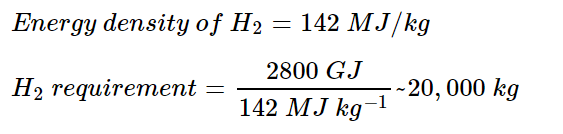
Let us know what you think of our website