Toolkit: Complex Systems Toolkit.

Author: Professor Nici Zimmermann (University College London).

Topic: Illuminating complex interactions in a system through participatory modelling methods.  

Title: Using a participatory modelling approach to urban regeneration.

Resource type: Teaching activity.

Relevant disciplines: Any; civil engineering.

Keywords: Available soon.

Licensing: This work is licensed under a Creative Commons Attribution-ShareAlike 4.0 International License. 

Related INCOSE Competencies: Toolkit resources are designed to be applicable to any engineering discipline, but educators might find it useful to understand their alignment to competencies outlined by the International Council on Systems Engineering (INCOSE). The INCOSE Competency Framework provides a set of 37 competencies for Systems Engineering within a tailorable framework that provides guidance for practitioners and stakeholders to identify knowledge, skills, abilities and behaviours crucial to Systems Engineering effectiveness.  A free spreadsheet version of the framework can be downloaded.

This resource relates to the Systems Thinking, Systems Modelling and Analysis and Critical Thinking INCOSE competencies. 

AHEP mapping: This resource addresses several of the themes from the UK’s Accreditation of Higher Education Programmes fourth edition (AHEP4):  Analytical Tools and Techniques (critical to the ability to model and solve problems), and Integrated / Systems Approach (essential to the solution of broadly-defined problems). In addition, this resource addresses the AHEP themes of Design and Practical and workshop skills. 

Educational level: Intermediate or advanced.


Learning and teaching notes: 

This activity is suitable for those having acquired some familiarity with complex systems and related concepts – especially causal loop diagrams, stock and flow diagrams, cognitive maps or participatory maps – who are looking for additional ideas for activities or who have a specific interest in participatory modelling. The activity is also useful at the point when students learn about interaction between different elements of a complex system or when they learn about the importance of human factors. 

Learners have the opportunity to:  

Teachers have the opportunity to: 


Downloads: 


Learning and teaching resources:


Overview:

This activity introduces students to a participatory systems thinking – or more specifically –  participatory modelling exercise. This is an approach used in group settings to explore complex issues and represent them via models. In this activity, students assume the roles of stakeholders involved in an urban regeneration project and take part in a group model-building workshop.  

It teaches students core principles of a participatory modelling method called group model-building or participatory system dynamics, but it can also be used to teach the underlying system structure of a specific phenomenon. This makes it well-suited for modules that contain elements of systems thinking and system dynamics (including causal loop diagramming and simulation modelling) or modules that contain an element on group facilitation and participatory methods.  

The activity is designed to run over 1.5 to 2.5 hours and is adaptable. While the current example focuses on the phenomenon of urban dynamics around the population development in a city, the activity can be reframed using a case and model from a project management, water management, energy or other sustainability-related context. 

The activity is directly aligned with systems thinking by immersing students in a participatory modelling process. It develops students’ awareness of system content and its interactions by teaching them qualitative modelling skills. It develops their skills in managing complexity and representing system elements with visual models consisting of items and their relationships depicted in causal loop diagrams and/or stock and flow diagrams. This serves to build students’ analysis skills and ability to apply systems approaches to problems. It also develops their practitioner, practical and workshop skills of collaborating with stakeholders. It does so by advancing their facilitation skills essential for collaborative systems work. This includes rules of conduct and techniques for managing a group discussion and group dynamics, making a broad range of ideas heard, prioritising them and mapping them visually. 


Materials or software required:

For in-person sessions, the following materials are recommended: 

If software or an online tool are used, these are used to collate concepts (variables suggested by students) and to build a diagram of their interactions. This will be projected to the in-person and/or online participants, replicating the participatory nature of in-person workshops. 


Detailed explanation of the activity:  

This activity introduces students to participatory modelling, an approach used in group settings to explore and understand complex issues and represent them via models. In this case, participatory modelling is introduced through a structured group model-building workshop, using a simplified version (Alfeld & Graham, 1976; Richardson, 2014) of Jay Forrester’s (1969) famous Urban Dynamics model, which sparked quite some debate because of its counter-intuitive insights. The session begins with a brief historical overview of urban growth and decline in major cities up to the 1980s (e.g. New York, Boston, London; see files under ‘Downloads’, above), before focusing on the London Docklands in London in 1981, as an example of an opportunity for urban redevelopment to counter the trend of population decline. Student groups are assigned stakeholder roles from that time, including the founder of the London Docklands Development Corporation (1–2 students), the Surrey Quays Housing Action Group (2–6 students), the London Chamber of Commerce (2–6 students) and the Greater London Council (2–6 students). Each student group receives a role sheet outlining their perspective and a small set of key variables relevant to their stakeholder position (see linked files). These variables are intentionally curated to align with the Urban Dynamics model and to ensure that collaboration is necessary to draw the interlinkages between the variables, i.e. the relevant system structure.  

A list of variables provided to the student groups via the role sheets is included below. Note that not all variables that are necessary to draw the model are included; students need to infer a few variables to train their thinking. 

Before the workshop begins, students are introduced to core concepts of participatory modelling (see linked slides), including facilitator roles (based on Richardson & Andersen, 1995) and common workshop scripts (e.g. hopes and fears, variable elicitation, voting, model building, policy option elicitation and system storytelling, as described in Scriptapedia and Andersen & Richardson, 1997). 

The workshop proceeds in three main phases: 

1. Variable elicitation: After a short introduction by the student playing the founder of the London Docklands Development Corporation into the setting and by the facilitator/teacher into the process, each group sketches behaviour-over-time graphs of their assigned variables (10 minutes). These are presented using a round-robin or nominal group technique, meaning one variable per group at a time only, and placed on a whiteboard/blackboard or digital canvas. The round-robin collection is a technique useful to foster inclusivity and avoid talking heads. Behaviour-over-time graphs rather than just variable names are useful because the final model is believed to explain a behavioural trend over time, linking model structure and dynamics. However, it is also possible to simplify by letting students just write the variable names on sheets of paper. 

2. Voting and prioritisation: To decide on a starting point for modelling, each student votes on which variables they consider to be the most important to include in the model, e.g. giving the students as many votes as there are variables on the board and freedom of how to distribute their votes. While all variables will be included in the model, the voting activity provides a basis for reflection on different priorities and students’ personal vs. their group’s perspective, after the modelling activity. 

3. Model building: The class collaboratively constructs a stock and flow diagram (see Figure 1). Stocks such as Housing Structures, Business Structures, and Population are identified, and their net rates of change are discussed. To connect the variables, some more variables need to be added such as the ratio of population to jobs, total land available, and land occupied. To help students identify these variables, the teacher can ask questions: “Population and housing are linked by a ratio. What concepts and respective variables could link the other stocks?”. Students are encouraged to identify feedback loops and classify them as reinforcing or balancing. 

It is useful to pay attention to uncovering less obvious relationships, such as the spatial competition between housing and business infrastructure. Once the diagram is complete, the facilitator reviews the model with the class, highlighting key feedback structures. 

After the modelling activity, students can be shown images of the Docklands after the redevelopment as well as urban population trends of London and other major cities until today, prompting discussion on the long-term impacts of different types of development and prioritisation of a business vs. housing focus. The session can conclude with a reflection on the participatory process and its relevance to real-world decision-making and the value of participatory modelling in complex policy environments. 

A more comprehensive version of this activity – including a more introductory group model-building exercise that teaches basic causal loop diagramming concepts and an alternative context using project management as an example – is available: https://discovery.ucl.ac.uk/id/eprint/10160261/   
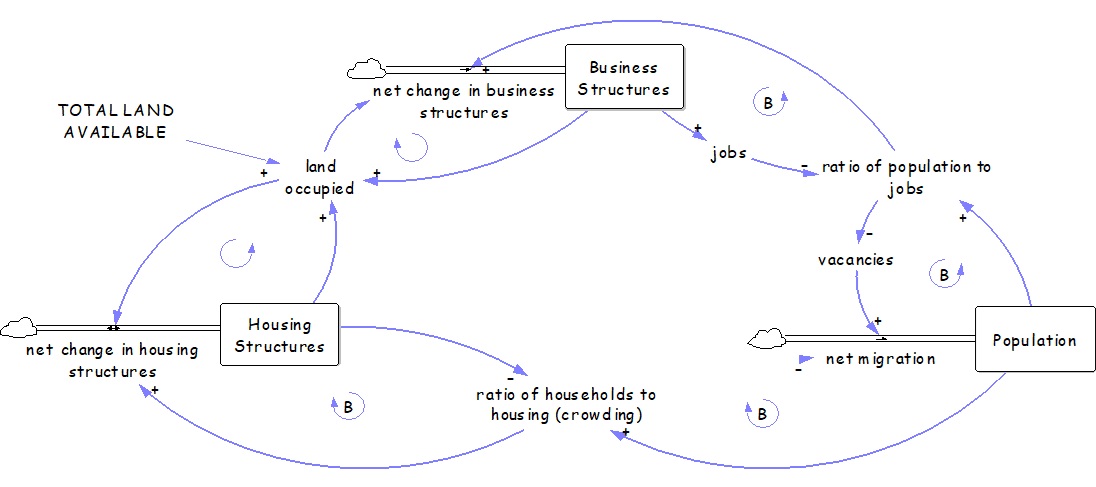
 

Figure 1: Stock and flow diagram of urban dynamics (produced with Vensim software). This figure is intended for educators and serves an illustrative purpose. It provides educators with a reference for how the model built during the activity is expected to look. 


Note: The author was originally inspired to focus on this case by the historical accounts found on the London Docklands Development Corporation (LDDC) History Pages (http://www.lddc-history.org.uk/index.html, now inactive).  


References:


Any views, thoughts, and opinions expressed herein are solely that of the author(s) and do not necessarily reflect the views, opinions, policies, or position of the Engineering Professors’ Council or the Toolkit sponsors and supporters.  

Toolkit: Complex Systems Toolkit.

Authors: Dr. Natalie Wint (University College London); Dr. Mohammad Hassannezhad (University College London); Dr. Manoj Ravi (University of Leeds).

Topic: Complex systems competencies.

Title: Understanding complex systems competencies required in engineering graduates. 

Resource type: Knowledge article.

Relevant disciplines: Any.

Keywords: Systems thinking; Problem-solving; Critical thinking; Digital literacy; Modelling and simulation; Design; Project management; Life cycle; Risk; Collaboration; Communication; Professional conduct; Social responsibility.

Licensing: This work is licensed under a Creative Commons Attribution-ShareAlike 4.0 International License. 

Downloads: A PDF of this resource will be available soon.

Learning and teaching resources:

Who is this article for?: This article should be read by educators at all levels in higher education who are seeking an overall perspective on teaching approaches for integrating complex systems in engineering education. 

Related INCOSE Competencies: Toolkit resources are designed to be applicable to any engineering discipline, but educators might find it useful to understand their alignment to competencies outlined by the International Council on Systems Engineering (INCOSE). The INCOSE Competency Framework provides a set of 37 competencies for Systems Engineering within a tailorable framework that provides guidance for practitioners and stakeholders to identify knowledge, skills, abilities and behaviours crucial to Systems Engineering effectiveness. A free spreadsheet version of the framework can be downloaded. 

AHEP mapping: This resource addresses several of the themes from the UK’s Accreditation of Higher Education Programmes fourth edition (AHEP4). 


Premise:

This article outlines the core competencies required for engineering students to effectively engage with complex systems. Such systems involve a range of technical and non-technical components that interact in non-linear and unpredictable ways. Working effectively with such complex systems requires collaboration across engineering disciplines, as well as other fields and stakeholder groups.  

Within AHEP4, complex problems are referred to as those which “have no obvious solution and may involve wide-ranging or conflicting technical issues and/or user needs that can be addressed through creativity and the resourceful application of engineering science” (p.26). The ability to work productively with complex systems is therefore essential for engineers and helps them address problems increasingly experienced in business and society, which have many interdependent components and lack clear or stable solutions.  

The aim of this article is to provide a foundational framework that integrates the knowledge, skills and attitudes necessary for undergraduate and graduate engineering students to navigate complexity. In so doing, it serves educators, curriculum designers, and students seeking to develop the mindset and skills required to tackle the challenges of the 21st century within an increasingly volatile, uncertain, complex, and ambiguous (VUCA) world (SEFI, 2025).  

This knowledge article, informed by the INCOSE Competency Framework for Systems Engineering (INCOSE, 2018), categorises complex systems competencies into eight core competencies. These competencies encompass mindset and foundations, technical methods and tools, management and delivery, and attributes and behaviours. The description of each competency references learning outcomes (LOs) outlined in AHEP4 (Engineering Council, 2025) and the International Engineering Alliance (IEA) Graduate Attributes (2021) to establish a common baseline for all engineering graduates (see Appendix for mapping).  


The eight core complex systems competencies:

1. Systems thinking and problem framing 

The ability to take a holistic approach, to consider a problem from multiple perspectives and to understand how a system’s parts interact to produce emergent behaviour.  

Students must be able to understand what makes a system ‘complex’ and move beyond narrow problem-solving to identify root causes. This involves understanding fundamental Systems thinking concepts including hierarchies and interfaces (structural dimension), holism and cause-effect (dynamic dimension), lifecycles (time dimension), and multiple perspectives (perception dimension).  

Systems thinking enables engineers to anticipate ripple effects, emergent behaviours, and trade-offs, designing solutions that remain robust under uncertainty. AHEP4 requires students to “formulate and analyse complex problems to reach substantiated conclusions” (LO2) and to “apply an integrated or systems approach to the solution of complex problems” (LO6).  

2. Critical thinking 

The ability to question assumptions, evaluate evidence, apply logical reasoning, and justify decisions based on reasoned arguments and evidence.  

Navigating complex systems involves working with a variety of (often conflicting) goals, information, and data types from across discipline and stakeholder groups. Critical thinking is thus necessary to enable engineers to identify biases, avoid oversimplification and flawed reasoning, and to make ethical, transparent and evidence-informed decisions with consideration for unintended consequences. AHEP4 requires graduates to “critically evaluate technical literature and other sources of information to solve complex problems” (LO4). 

3. Simulation, modelling and data literacy 

The ability to apply scientific, mathematical, and engineering principles to model, test, and improve complex systems.  

Working with complex systems involves a range of resources including people, data and information, tools and appropriate technologies. Students must be able to create, apply and validate system models (as physical, mathematical, or logical representation of systems) and demonstrate competence in simulation and data literacy to address uncertainty and complexity at scale. This may involve using models and data to justify assumptions, explore scenarios, predict the consequences of actions, solve difference equations, conduct sensitivity and stability analysis, and predict the probability of risk.  

This aligns with several AHEP4 outcomes: “apply mathematics, statistics, and engineering principles to solve complex problems” (LO1); “apply computational and analytical techniques while recognising limitations” (LO3); and “select and critically evaluate technical literature and other data sources” (LO4).  

4. Design for complexity and changeability 

The ability to design adaptable, robust, and resilient systems across their lifecycle.  

Changes (both planned and unplanned) are inherent in complex systems. Long-term success of a system therefore requires design for resilience to first hand/internal (by the system), second hand/external (to the system) or third hand (around the system) change. Design for complexity and changeability ensures systems can evolve and integrate new capabilities across their lifecycle.  

AHEP4 requires engineers to be able to innovatively “design solutions that meet a combination of societal, user, business and customer needs” (LO5). This may involve designing systems that deliver required functions over time, including evolution, adaptability, and integration across subsystems (capability engineering), and supports evaluation of alternatives, balance competing objectives, and justify transparent decisions (decision management).  

5. Project and lifecycle management 

The ability to plan and deliver engineering activities across the system lifecycle, ensuring outcomes are delivered on time, on cost, and with integrity.  

Complex systems involve many subsystems with various purposes and lifecycles. This necessitates effective coordination and delivery processes and a focus on early planning and lasting systemic impacts. Project and lifecycle management allows for concurrent engineering (parallelisation of tasks), and verification and validation of tasks in dynamic environments. Graduates must “apply knowledge of engineering management principles, commercial context, project and change management” (AHEP4, LO15).  

This aligns with the Engineering Attribute of Project Management and Teamwork and the INCOSE Framework competencies in Lifecycle Processes, Integration, and Project Management, emphasising coordinated delivery and long-term value creation across socio-technical systems. Lifecycle awareness prevents short-term optimisation and emphasises aspects such as maintainability, whole-life value delivery and total expenditure (TOTEX) thinking, all of which support efforts towards sustainability and net-zero.  

6. Risk and uncertainty management 

The ability to identify, assess, and manage technical, social, environmental, and ethical risks at multiple levels of complex systems.  

Complex systems are inherently uncertain, with cascading risks that must be anticipated and managed proactively. Risk management enables students to quantify source and impact of uncertainties where possible and apply precaution where uncertainty is irreducible, ensuring safety, sustainability, and governance.  

AHEP4 requires graduates to “use a structured risk management process to identify, evaluate and mitigate risks (the effects of uncertainty)” (LO9), ranging from project-specific challenges to systemic threats, which need to “adopt a holistic and proportionate approach to the mitigation of security risks” (LO10).  

7. Collaboration and communication 

The ability to work effectively across disciplines, boundaries, and cultures, while conveying complex insights clearly to technical and non-technical audiences. 

Complex systems challenges cannot be solved by individuals alone and include consideration for stakeholders across industry, policy and society. Such collaborative processes involve participatory problem-solving, learning from others, inclusive communication, and negotiation and persuasion strategies, all of which necessitate emotional intelligence.  

AHEP4 expects graduates to “function effectively as an individual, and as a member or leader of a team, being able to evaluate own and team performance” (LO16). They must be able to influence stakeholder decisions, foster alignment, and shape outcomes across industry, policy, and society (AHEP4, LO17).  

8. Professional responsibility 

The ability to apply professional and societal responsibilities in decision-making, with awareness of ethical implications and long-term impacts and unintended consequences of engineered systems.  

Engineers increasingly work on complex systems that shape lives, societies, and ecosystems. Ethical responsibility ensures that technical competence aligns with social good and involves consideration for trade-offs between factors including environmental impact, affordability and social acceptance. This aligns with AHEP4, IEA, and INCOSE principles on ethics, professionalism, and leadership, ensuring engineers act responsibly within complex systems and contribute positively to society and sustainability. AHEP4 requires graduates to “identify and analyse ethical concerns and make reasoned ethical choices informed by professional codes of conduct” (LO8) and “evaluate the environmental and societal impact of solutions to complex problems” (LO7).  


Conclusions:

This article defines a set of eight integrated competencies that prepare engineering graduates to navigate complex systems. Together, they combine knowledge (what graduates must know), skills (what they can do), and attitudes (how they behave and think). Embedding these competencies requires project-based learning, interdisciplinary collaboration, and reflective exercises, while assessment should include portfolios, teamwork, and scenario analysis. Employers and professional bodies can reinforce these competencies through mentoring, internships, and early career development. 

By aligning with INCOSE, AHEP4, and IEA GA frameworks (see Appendix for mapping), this guidance provides an internationally consistent foundation that can be adapted to local contexts, equipping engineering graduates to address complex, interdependent challenges of the 21st century with competence, integrity, and resilience.  


Appendix:  

Mapping between Eight Core Competencies and Standard frameworks 

Proposed Core Competency   INCOSE * AHEP4 ** IEA GA *** 
Systems Thinking & Problem Framing ST LO2, LO6 WA2
Critical Thinking   CT LO4 WA4, WA11 
Simulation, Modelling & Data Literacy  IM, SM  LO1, LO3, LO4  WA1, WA4, WA5
Design for Complexity & Changeability  CP, DM, DF LO5  WA3 
Project & Lifecycle Management   LC, PL, CE, CP  LO15  WA10 
Risk & Uncertainty Management  CE, PL, RO  LO9, LO10
Collaboration & Communication   CC, TD, TL, EI  LO16, LO17  WA8, WA9 
Professional Responsibility  EI, EP  LO7, LO8  WA6, WA7 


* INCOSE Competency Framework, 2nd edition (2018) 

** AHEP4 Learning Outcome (LO) (2025) 

*** International Engineering Alliance (IEA) Graduate Attributes (GA) (2021) 


CC = Communications 

CE = Concurrent Engineering  

CP = Capability Engineering 

CT = Critical Thinking 

DF = Design For … 

DM = Decision Management 

EI = Emotional Intelligence 

EP = Ethics and Professionalism 

IM = Information Management 

LC = Life Cycle 

LO = Learning Outcome 

PL = Planning 

RO = Risk and Opportunity Management 

TD = Team Dynamics 

TL = Technical Leadership 

SM = Systems Modelling and Analysis 

ST = Systems Thinking 

WA = Washington Accord 


References:


Any views, thoughts, and opinions expressed herein are solely that of the author(s) and do not necessarily reflect the views, opinions, policies, or position of the Engineering Professors’ Council or the Toolkit sponsors and supporters.  

Toolkit: Complex Systems Toolkit.

Author: Mariam Makramalla, PhD, FRSA (New Giza University).

Topic: Integrating complex systems learning outcomes in engineering curricula.

Title: How to scaffold complex systems learning outcomes across a curriculum.

Resource type: Guidance article.

Relevant disciplines: Any.

Keywords: Learning outcomes; Pedagogy; Curriculum; Curriculum map; Critical thinking; Problem-solving; Life cycle; Decision-making . 

Licensing: This work is licensed under a Creative Commons Attribution-ShareAlike 4.0 International License. 

Downloads:

Who is this article for?: This article should be read by educators at all levels of higher education looking to embed and integrate complex systems topics into curriculum, module, and / or programme design.   


Premise: 

Teaching and learning engineering carries with it a double layer of complexity. On the one hand, this complexity is connected to the growing interdisciplinary nature of engineering itself. On the other hand, the complexity is connected to the growing diversity of engineering students that are often present in one project team. This multifaceted complexity requires a re-envisioned understanding of the role and purpose of the engineering educator.  

With the growing trend of a global classroom reality, we often find that learners in the classroom are representing different cultures, which in turn are rooted in them unconsciously carrying historical and socio-cultural baggage relating to these cultures. Thus, it becomes crucial to unpack the challenge and potential that such a diverse collective intelligence can offer to an engineering learning experience.  

As our understanding of the engineering discipline gets more rooted and interconnected with the precarious reality that our world is witnessing today, it becomes essential that the engineering education community would take up a proactive role in actively contributing to the formation of engineering citizenship. In other words, every engineering student should be educated as a citizen that has mastered the engineering cross-cutting fields in such a way that they are free to create and solve problems of the present and the future.  

With this in mind, it becomes very clear that the one-size-fits all model of a single discipline engineering classroom can no longer sustain itself. It does not factor in the richness that a diverse student body can offer, and it dilutes the value and potential of an engineering learner to think clearly or solve problems. It is therefore imperative that engineering educators grasp the complex reality of an integrated engineering discipline and address it in a way that fosters scaffolding of diverse knowledge. Some students might specialise in one core technical discipline. Yet, future projections for most students showcase the need to have a wide level of exposure to broader competency development. Students need to learn to understand the field of engineering at large and to develop system thinking skills that enable them to exist, challenge and have an impact on the system that they are a part of.  


How to scaffold learning outcomes in a complex engineering curriculum:

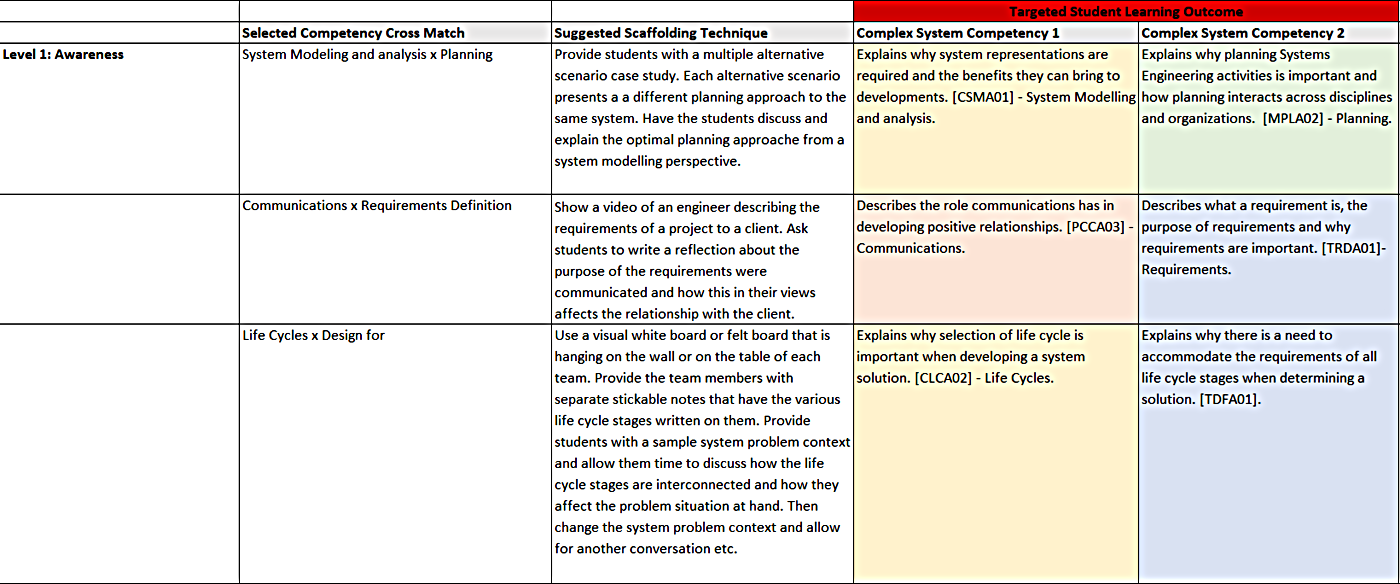
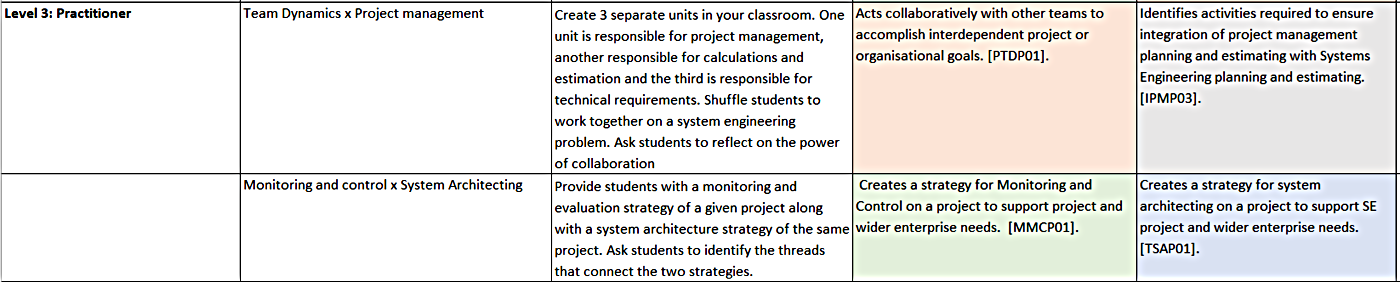
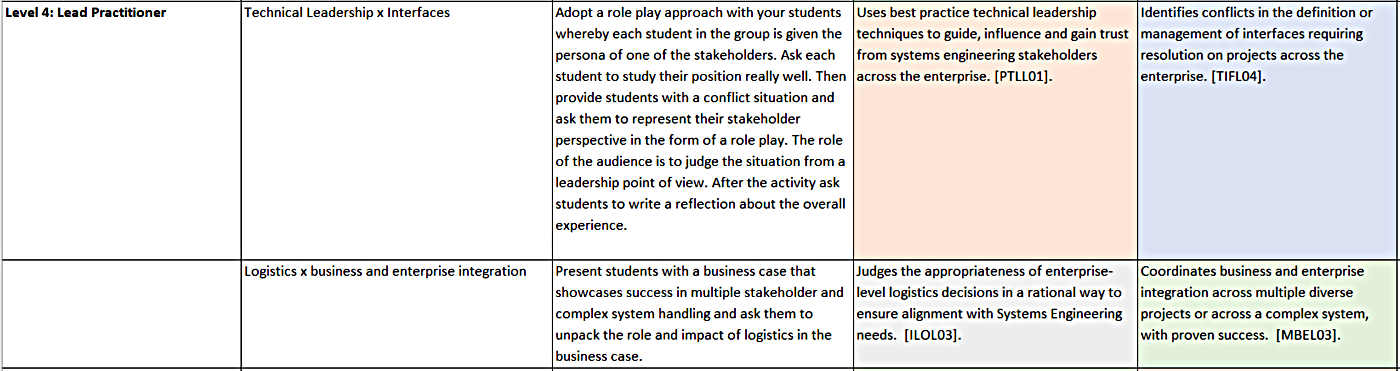
The below table has been designed for embedding Complex Systems Learning Outcomes across an engineering curriculum. It maps against competencies and suggests scaffolding techniques across educational levels. It is also important to note, that efforts need to be made to align to the relevant AHEP requirements or other accreditation standards. Table 1 presents the different strands of the Complex Systems Engineering Curriculum, colour coded in line with the INCOSE Competency Framework outline (INCOSE, 2025). Table 2 presents a practical guide for educators to scaffold Complex Systems learning outcomes across a curriculum. The intention is for the scaffolding framework to compare the trade-offs between different elements of the competency group. For example, system modelling and analysis as an element from the core competency and planning from the management competency. The table suggests activities that would integrate different competencies together in a scaffolded approach.  

Table 1. Competency Areas for Complex Systems (INCOSE, 2025).

Table 1 presents Competency Areas for Complex Systems. As mentioned, the skills range to include a wide variety of competencies, thereby enabling a solid and grounded systems thinking approach for students. As students approach their learning, they go through a series of development stages that gradually build up student level of expertise until they reach the stage of what the INCOSE competency framework refers to as a lead practitioner role. Building on the competencies of the complex system toolkit presented in Table 1, Table 2 presents a potential outline for a scaffolding framework that maps varying threads of the framework in a way that enables scaffolded activities at every developmental stage for learners. Depending on the learning context and educational level, educators can choose which level of attainment is appropriate to their curriculum.  

Table 2. Scaffolding Complex Systems Learning Outcomes across the curriculum 


Discussion and next steps:

As we are approaching the fuzzy front end to complexity in engineering pedagogy, as educators we need to be constantly toggling between devising frameworks, being informed by literature, contextualising ideas, validating these in our classrooms and repeating this cycle to continually fine-tune our complex teaching navigational complexity framework. The invitation is open for all educators who would like to connect as we continue to explore different ways of developing responsible engineers who leave a lasting and sustainable mark transforming their stationed realities.  


References:


Any views, thoughts, and opinions expressed herein are solely that of the author(s) and do not necessarily reflect the views, opinions, policies, or position of the Engineering Professors’ Council or the Toolkit sponsors and supporters.  


Toolkit: Complex Systems Toolkit.

Author: Dr. Rebecca Margetts (Nottingham Trent University).

Topic: The importance of teaching and learning about complex systems.

Title: The real world is a complex system.

Resource type: Knowledge article.

Relevant disciplines: Any.

Keywords: Problem solving; Feedback loops; Decision-making; VUCA; Optimisation; Public health and safety; Risk; Sustainability; Ethics; Responsible design; Life cycle; Societal impact; Enterprise and innovation.

Licensing: This work is licensed under a Creative Commons Attribution-ShareAlike 4.0 International License. 

Downloads: 

Learning and teaching resources:

Who is this article for?: This article should be read by educators at all levels in higher education who are seeking an overall perspective on teaching approaches for integrating complex systems in engineering education. 

Related INCOSE Competencies: Toolkit resources are designed to be applicable to any engineering discipline, but educators might find it useful to understand their alignment to competencies outlined by the International Council on Systems Engineering (INCOSE). The INCOSE Competency Framework provides a set of 37 competencies for Systems Engineering within a tailorable framework that provides guidance for practitioners and stakeholders to identify knowledge, skills, abilities and behaviours crucial to Systems Engineering effectiveness. A free spreadsheet version of the framework can be downloaded.

This resource relates to the Systems Thinking and Critical Thinking INCOSE competencies.

AHEP mapping: This resource addresses several of the themes from the UK’s Accreditation of Higher Education Programmes fourth edition (AHEP4):  Analytical Tools and Techniques (critical to the ability to model and solve problems), and Integrated / Systems Approach (essential to the solution of broadly-defined problems). 


Premise: 

We live in a complex world. Complexity is a key challenge, captured in leadership terms by the VUCA framework: volatile, uncertain, complex and ambiguous (Lanucha 2024). Engineers have the privilege of creating products and processes for humans to use in this landscape. Each of these likely has numerous parts which interact, as well as interacting with the environment, people, and needing to meet a host of safety, quality, sustainability, ethics, and financial obligations. Traditionally, engineers analyse problems by breaking them down into simple parts. This helps understanding and makes calculations feasible, but it’s easy to lose understanding of the whole system. Any change can easily create a problem elsewhere. From a technical viewpoint, engineers need to understand this interconnectedness in order for their creations to work. In a wider sense, ‘systems thinking’ is a skill central to engineering quality and management techniques, which seek to rationalise the complexity of entire organisations and their ever-changing market pressures.  


The case for understanding systems: 

Systems is perhaps one of the most misunderstood words in engineering. It is often found combined with mathematical modelling or control – topics often perceived as challenging – and is used in other fields like Computer Science, where tools and models are different. In all cases, the idea revolves around a group of interacting or interrelated elements which form a unified whole. Those elements can be physical or information, hardware or software, or any combination of mechanical, electrical, and other engineering domains. Thinking in terms of systems can therefore be thought of as a holistic approach.  

The Engineering Council UK’s AHEP criteria include a systems approach: C/M6 – “Apply an integrated or systems approach to the solution of complex problems.” Several other AHEP criteria also reference complexity and complex problems, which they define as having “no obvious solution and may involve wide-ranging or conflicting technical issues and/or user needs that can be addressed through creativity and the resourceful application of engineering science. The Systems Thinking Alliance (2025) gives a broader definition of complexity as referring to “the condition of systems, objects, phenomena, or concepts that are challenging to understand, explain, or manage due to their intricate and interconnected nature. It involves multiple elements or factors that interact in unpredictable ways, often requiring significant information, time, or coordinated efforts to address.” For these, there is no ‘one-size-fits-all solution’ (Ellis 2025). This is the reality that engineers need to manage by understanding the potential effects on all parts of the system. 

In order to analyse, engineers dissect complexity into manageable components, and educators teach these simple components before moving onto more complex systems. For example, students initially learn basic electrical components, simple beams, rigid bodies, etc. before bringing these together in case studies, and then moving onto topics like mechatronic systems. Historically, engineers specialised on graduation, perhaps becoming a stress engineer or fluid dynamicist in dedicated offices and functional teams.  A design decision by one team could have unintended consequences for another, as well as additional uncertainty. The advent of cross-functional project and ‘matrix’ organisations mitigated against this, and companies have moved towards attribute teams which can consider the balance of behaviour. Even so, some uncertainty remains in the form of assumptions in calculations, changes in material properties with temperature or stress, or small variations in composition and manufacturing tolerances, which can all accumulate. Any parts which are bought ‘off-the-shelf’ or made by other companies under license must be carefully specified. Relationships can be nonlinear – or even chaotic – and contain feedback loops which can amplify changes (Kastens et al 2009). This all increases the risk of a product’s comfort, performance, and safety being impacted in ways that weren’t anticipated. Any problem that doesn’t come to light until the testing phase – late in the design process – represents costly redesigns and delays. In the unlikely event that a problem isn’t captured during testing either, the outcome could be disastrous. 

Systems engineers will bring the product together and establish these complex behaviours through models and testing. Identifying potential problems early in the design phase can save significant money and facilitate better designs. This can be challenging, especially for systems using novel materials or operating in extreme environments, which aren’t accurately captured by standard calculations. Models may be linearised, neglect external forcing, or be derived for an assumed air density or ambient temperature which may not be valid. In recent decades, the engineering industry has moved towards model-based design and virtual prototyping, facilitated by advances in computer tools. These are increasingly sophisticated, but models still need to be built by engineers with an appreciation of complexity and the mechanisms by which a problem could arise. As humans develop new materials and technologies, and explore the limits of what is possible, engineering techniques and calculations need constant revision, and software tools are frequently updated to facilitate this.  

That holistic view of problems has benefits outside of designing engineering artefacts. The manufacturing process is itself a complex system with potentially long supply chains. As is the organisation, which is comprised of numerous people operating in a landscape of financial pressures, employment law, politics and culture. Quality guru William Deming’s 14 Points for Management (Deming 2018) can be viewed as a systems approach to handling this complexity, by breaking down barriers between departments and instigating continuous improvement. Once a product is produced, it exists in a wider world and continues to interact with it. From a sustainability viewpoint, this can be the user and surrounding community, the environmental impact over a product’s lifecycle, and the financial markets which dictate whether a product is viable. It can also be the social, political, and legal landscapes: these can place direct constraints in the forms of laws governing safety and emissions (such as the UK’s legally binding target of net zero by 2050), or through embargos, tariffs, and subsidies. Each country has its own regulations, which can necessitate multiple variations of a product: a good example is cars, which need to be produced in both left- and right-hand drive, satisfy varying safety and emissions regulations, and cater for differing personal and cultural preferences for size, noise, usage and driving styles. Even when not legislated, a company might choose to support fair trade, lead the way in sustainable practices, or refuse to do business with suppliers or regimes they find objectionable – potentially making this a key part of their brand.  

An engineer’s ability to appreciate and understand the wider social and business landscape is a reason why finance and management consultancy companies can often be seen recruiting engineers at student careers fairs. The Sainsbury Management Fellowship (SMF) scheme notably develops UK engineers as industry leaders, and fellows have made a major contribution to the UK’s economic prosperity (RAEng 2025). 


Conclusions:

Complex systems are the “real world” that engineers attempt to understand and design for. They are complicated, interconnected, changing, and uncertain. The well-known part of engineering is analysis: breaking systems into understandable parts. There needs to be a parallel operation where those parts are assembled or integrated into a whole, and that whole interacts with everything around it. This is where unforeseen problems can occur. Systems models and a holistic systems thinking approach can mitigate this risk. A systems approach and ability to manage complexity is a key skill for engineers, and positions them well for other fields like management.   


References:


Any views, thoughts, and opinions expressed herein are solely that of the author(s) and do not necessarily reflect the views, opinions, policies, or position of the Engineering Professors’ Council or the Toolkit sponsors and supporters.  

Authors: Dr. Kieran Higgins(Ulster University); Dr. Alison Calvert (Queen’s University Belfast).

Topic: Integrating Education for Sustainable Development (ESD) into higher education curricula.

Type: Guidance

Relevant disciplines: Any.

Keywords: Curriculum design; Global responsibility; Sustainability; SDGs; Course design; Higher education; Pedagogy;

Sustainability competency: Anticipatory; Integrated problem-solving; Strategic; Systems thinking.

Related SDGs: SDG 4 (Quality education); SDG 13 (Climate action).

Reimagined Degree Map Intervention: Adapt and repurpose learning outcomes; Authentic assessment; Active pedagogies and mindset development.

Who is this article for?:  This article should be read by educators at all levels of higher education looking to embed and integrate ESD into curriculum, module, and / or programme design.

Link to resource: AdvanceHE’s Education for Sustainable Development Curriculum Design Toolkit


Learning and Teaching Notes:
Supported by AdvanceHE, this Toolkit provides a structured approach to integrating Education for Sustainable Development (ESD) into higher education curricula. It uses the CRAFTS methodology and empowers educators to enhance their modules and programs with sustainability competencies aligned with UN Sustainable Development Goals.

Key Features:
• Five-Phase Process: Analyse stakeholder needs, map current provision, reflect on opportunities for development, redesign with an ESD focus, and create an action plan for continuous enhancement.
• Practical Tools: Includes templates for stakeholder analysis, module planning, active learning activities, and evaluation.
• Flexible Implementation: Designed for use at both module and programme level.
• Competency-Based: Focuses on developing authentic learning experiences across cognitive, socio-emotional, and behavioural domains.

Benefits
• Identify stakeholder sustainability needs
• Map existing ESD elements in your curriculum
• Reflect on opportunities to enhance ESD integration
• Redesign modules with active learning approaches of ESD
• Create actionable plans for implementation and evaluation

Click here to access the Toolkit.

Read more here.


Any views, thoughts, and opinions expressed herein are solely that of the author(s) and do not necessarily reflect the views, opinions, policies, or position of the Engineering Professors’ Council or the Toolkit sponsors and supporters. 

Case study example: Water wars: managing competing water rights

Activity: Assessment. This example demonstrates how the questions provided in Assessing ethics: Rubric can be used to assess the competencies stipulated at each level.

Authors: Dr. Natalie Wint (UCL); Dr. William Bennett (Swansea University).

Related content:


Water wars: managing competing water rights 

This example demonstrates how the questions provided in the accompanying rubric can be used to assess the competencies stipulated at each level. Although we have focused on ‘Water Wars’ here, the suggested assessment questions have been designed in such a way that they can be used in conjunction with the case studies available within the toolkit, or with another case study that has been created (by yourself or elsewhere) to outline an ethical dilemma. 

Year 1 

Personal values: What is your initial position on the issue? Do you see anything wrong with how DSS are using water? Why, or why not?

Professional responsibilities: What ethical principles and codes of conduct are relevant to this situation?

Ethical principles and codes of conduct can be used to guide our actions during an ethical dilemma. How does the guidance provided in this case align/differ with your personal views? (This is a question we had created in addition to those provided within the case study to meet the requirements stipulated in the accompanying rubric.)

What are the moral values involved in this case and why does it constitute an ethical dilemma? (This is a question we had created in addition to those provided within the case study to meet the requirements stipulated in the accompanying rubric.)

What role should an engineer play in influencing the outcome? What are the implications of not being involved? (This is a question we had created in addition to those provided within the case study to meet the requirements stipulated in the accompanying rubric.)

Year 2 

Formulate a moral problem statement which clearly states the problem, its moral nature and who needs to act. (This is a question we had created in addition to those provided within the case study to meet the requirements stipulated in the accompanying rubric.)

Stakeholder mapping: Who are all the stakeholders in the scenario? What are their positions, perspective and moral values?

Stakeholder  Perspectives/interests  Moral values 
Data Storage Solutions (DSS)  Increasing production in a profitable way; meeting legal requirements; good reputation to maintain/grow customer base.  Accountability; sustainability (primarily economic). 
Farmers’ union  Represent farmers who suffer from economic implications associated with costly irrigation.  Accountability; environmental sustainability; justice. 
Farm  The farm (presumably) benefits from DSS using the land.  Ownership and property; environmental sustainability; justice. 
Local Green Party  Represent views of those concerned about biodiversity. May be interested in opening of green battery plant.  Human welfare; environmental sustainability; justice. 
Local Council  Represent views of all stakeholders and would need to consider economic benefits of DSS (tax and employment), the need of the university and hospital, as well as the needs of local farmers and environmentalists. May be interested in opening of green battery plant.  Human welfare and public health; trust; accountability; environmental sustainability; justice. 
Member of the public  This may depend on their beliefs as an individual, their employment status and their use of services such as the hospital and university. Typically interested in low taxes/responsible spending of public money. May be interested in opening of green battery plant.  Human welfare; trust; accountability; environmental sustainability; justice. 
Stakeholders using DSS data storage  Reliable storage. They may also be interested in being part of an ethical supply chain.  Trust; privacy; accountability; autonomy. 
Non-human stakeholders  Environmental sustainability. 


What are some of the possible courses of action in the situation. What responsibilities do you have to the various stakeholders involved? What are some of the advantages and disadvantages associated with each? (Reworded from case study.)

What are the relevant facts in this scenario and what other information would you like to help inform your ethical decision making? (This is a question we had created in addition to those provided within the case study to meet the requirements stipulated in the accompanying rubric.)


Year 2/Year 3  

(At Year 2, students could provide options; at Year 3 they would evaluate and form a judgement.) 

Make use of ethical frameworks and/or professional codes to evaluate the options for DSS both short term and long term. How do the uncertainty and assumptions involved in this case impact decision making?

Option  Consequences  Intention  Action 
Keep using water  May lead to expansion and profit of DSS and thus tax revenue/employment and supply. 

Reputational damage of DSS may increase. Individual employee piece of mind may be at risk. 

Farmers still don’t have water and biodiversity still suffers which may have further impact long term. 

Intention behind action not consistent with that expected by an engineer, other than with respect to legality  Action follows legal norms but not social norms such as good will and concern for others. 
Keep using the water but limit further work  May limit expansion and profit of DSS and thus tax revenue/employment and supply. 

Farmers still don’t have water and biodiversity still suffers and may have further impact long term. This could still result in reputation damage. 

Intention behind action partially consistent with that expected by an engineer.  Action follows legal norms but only partially follow social norms such as good will and concern for others. 
Make use of other sources of water  Data storage continues. 

Potential for reputation to increase. 

Potential increase in cost of water resulting in less profit potentially less tax revenue/employment. 

Farmers have water and biodiversity may improve.

Alternative water sources may be associated with the same issues or worse. 

Intention behind action seems consistent with that expected by an engineer. However, this is dependent upon 

whether they chose to source sustainable water with less impact on biodiversity etc. 

This may be dependent on the degree to which DSS proactively source sustainable water. 
Reduce work levels or shut down  Impact on profit and thus tax revenue/employment and supply chain. Farmers have water and biodiversity may improve. 

May cause operational issues for those whose data is stored. 

Seems consistent with those expected of engineer. Raises questions more generally about viability and feasibility of data storage.  Action doesn’t follow social norms of responsibility to employees and shareholders. 
Investigate other cooling methods which don’t require as much water/don’t take on extra work until another method identified. 
May benefit whole sector. 

May cause interim loss of service. 


This follows expectations of the engineering profession in terms of evidence-based decision making and consideration for impact of engineering in society.  It follows social norms in terms of responsible decision making. 


Downloads:

Assessing ethics: Guidance

Assessing ethics: Rubric

Assessing ethics: Case study assessment example: Water Wars


This work is licensed under a Creative Commons Attribution-ShareAlike 4.0 International License.

Any views, thoughts, and opinions expressed herein are solely that of the author(s) and do not necessarily reflect the views, opinions, policies, or position of the Engineering Professors’ Council or the Toolkit sponsors and supporters.

Authors: Dr. Natalie Wint (UCL); Dr. William Bennett (Swansea University).

Keywords: Assessment; Accreditation, AHEP, Competencies; Curriculum design; Pedagogy.

Who is this article for?: This article should be read by educators at all levels in higher education who wish to integrate ethics into the engineering and design curriculum or module design.

Related content:


Guidance

Premise:

As engineering educators, it is uncommon that we were taught or assessed on ethical thinking within our own degree programmes. Although we may be able to think of plenty of ethical scenarios from our own experience, we may not necessarily be able to identify the best way to assess the ability of a student to engage in ethical thinking in a systematic and robust manner, something which is critical for both the evaluation of learning and teaching (as explained further here).

Furthermore, the complex, ill-structured nature of ethical dilemmas, which often involve a variety of diverse stakeholders, perspectives and cultural norms, necessitates an ability to navigate tensions and compromise. This results in situations in which multiple possible courses of action can be identified, meaning that there is not one single ‘good’ or ‘correct’ answer to ethical questions posed.

It is also necessary to evidence that students are able to meet the criteria outlined by accreditation bodies. Within the UK context, it is the Engineering Council (EC) that is responsible for providing the principal framework which guides engineering course content and sets accreditation threshold standards of competence through AHEP, the Accreditation of Higher Education Programs, as part of The UK Standard for Professional Engineering Competence (UKSPEC).

The knowledge, skills and attributes expected of engineering graduates constantly shifts, and since the advent of AHEP in 2004 there has been increased focus on strengthening design, and consideration for economic, ethical, environmental, legal, and social factors.

In-keeping with a need to assess engineering ethics in a robust manner, this article provides step-by-step considerations for designing assessment and is primarily intended to be used in conjunction with an existing ethics case study, such as those available through the EPC’s Engineering Ethics Toolkit (we later make use of the existing ‘Water Wars’ case study to exemplify the points made).

The guidance and accompanying rubric have been designed in a way that encourages students to grapple with the numerous tensions involved in ethical decision making, and the focus is thus on assessment of the decision-making process as opposed to the ‘answer’ given, the decision made or the outcome of the scenario.


Assessment purpose:

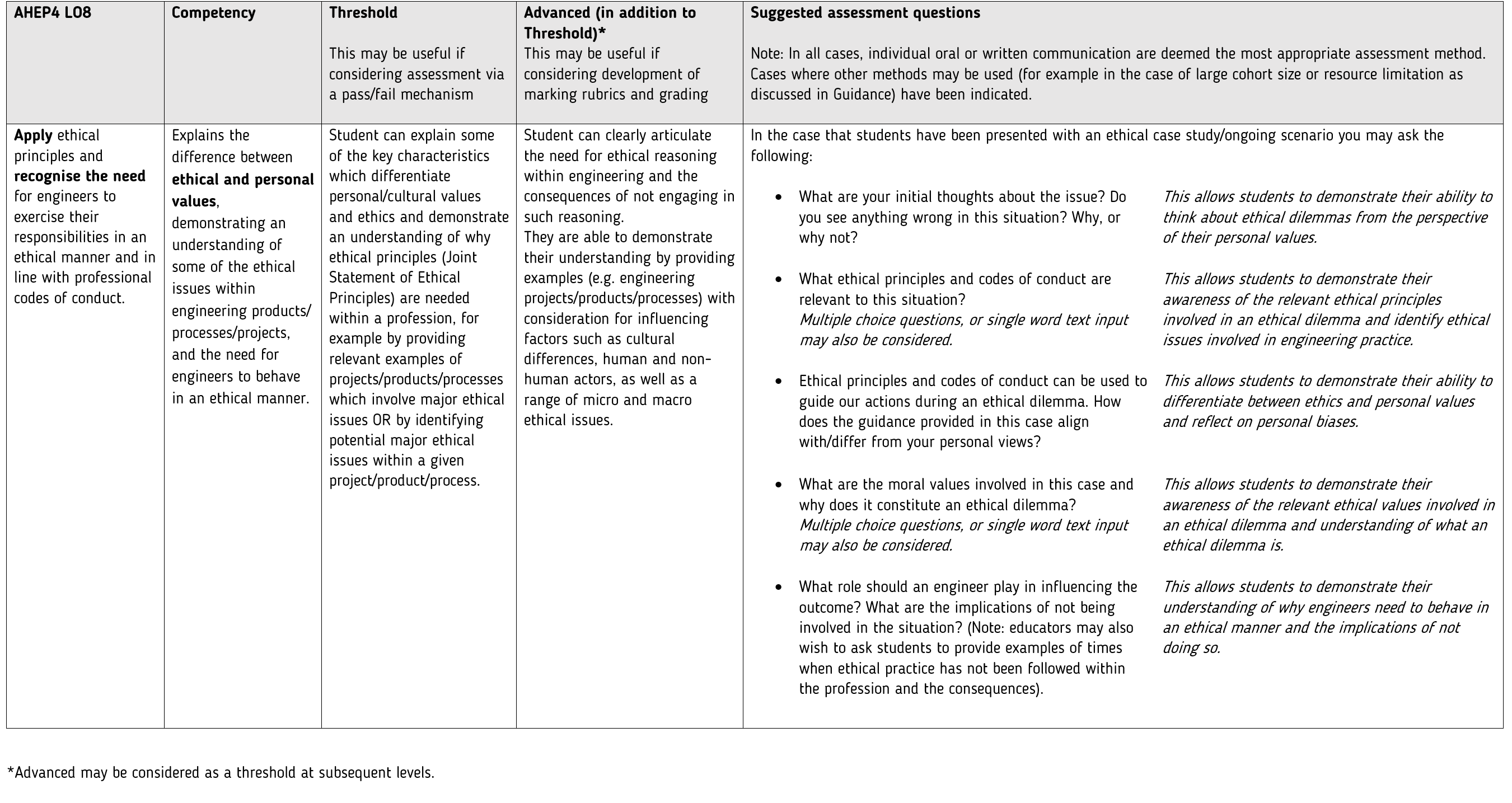
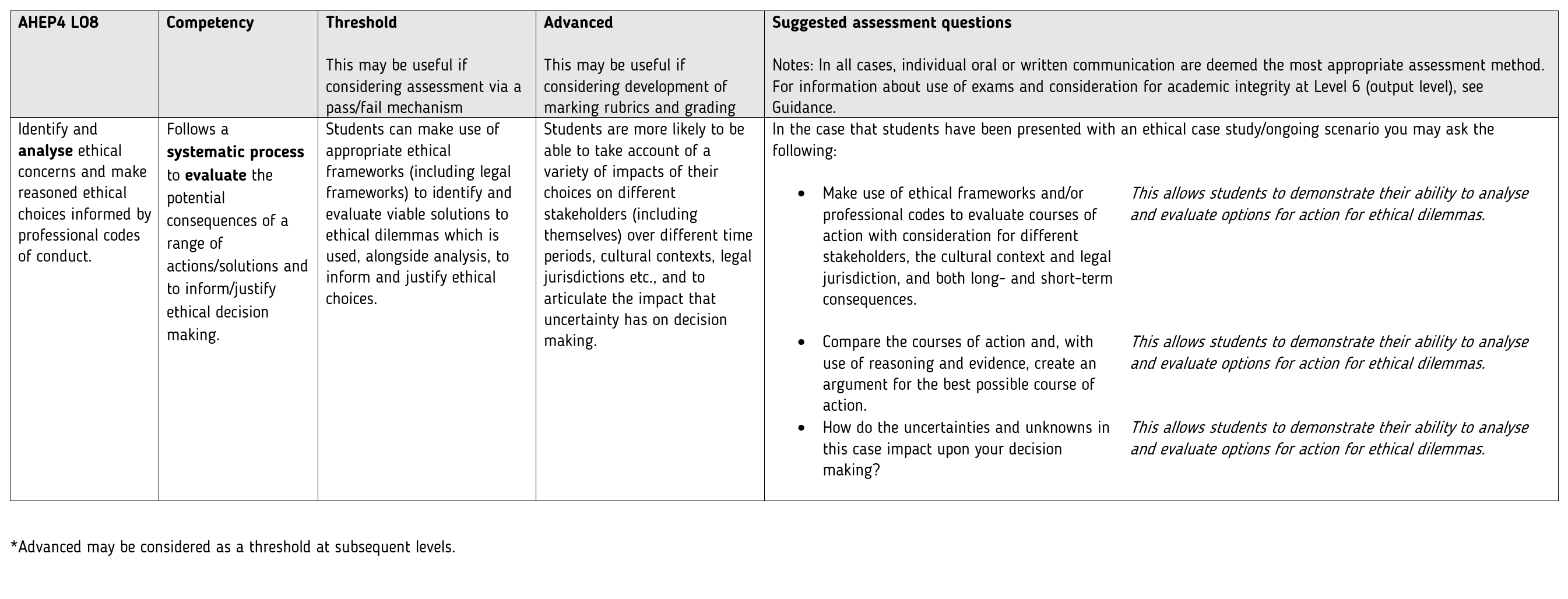
The first consideration is the year group you are assessing, and the competencies they have already acquired (for example in the case of Level 5 and Level 6 students). You may want to consider the (partial) learning outcome (LO) as defined by AHEP4 LO8 (Table 1). Whilst this shouldn’t act to limit what you choose to assess, it is a good place to start in terms of the level of ability your students should be demonstrating.

Note that the Engineering Council (EC) claim “This fourth edition of AHEP has reduced the total number of learning outcomes in order to focus attention on core areas, eliminate duplication and demonstrate progression between academic levels of study”. They are thus interested in the differences between level. You are recommended to make this explicit in module specification and associated assessment description. Key differentiations are shown in Table 1. For example, at Level 5 you may be more interested in students’ abilities to identify an ethical situation, whereas at Level 6 you may want them to be able to reason through options or make a judgement.

Table 1: AHEP4 Learning Outcomes

Year 1
(Level 4)
Year 2
(Level 5)
Year 3
(Level 6)
M Level
(Level 7)
LO8 Apply ethical principles and recognise the need for engineers to exercise their responsibilities in an ethical manner and in line with professional codes of conduct. Identify ethical concerns and make reasoned ethical choices informed by professional codes of conduct. Identify and analyse ethical concerns and make reasoned ethical choices informed by professional codes of conduct. Identify and analyse ethical concerns and make reasoned ethical choices informed by professional codes of conduct (MEng).
Interpretation Awareness of issues, obligations, and responsibilities; sensitising students to ethical issues. Ability to resolve practical problems; identify ethical issues and to examine opposing arguments. Ability to resolve practical problems; identify ethical issues and examine and evaluate/critique opposing arguments. Ability to resolve practical problems; identify ethical issues and examine and evaluate/critique opposing arguments.


The final row in Table 1 provides our interpretation of the LO, making use of language similar to that within the EPC’s Ethics Learning Landscape. We believe this is more accessible and more easily operationalised.

The following steps outline the process involved in designing your assessment. Throughout we make reference to an existing EPC case study (Water Wars) to exemplify the points made.

1.) The first consideration is how much time you have and how much of the case study you want to use. Many of the case studies have multiple stages and could be spread over several sessions depending on time constraints.

2.) Linked to this is deciding whether you want to assess any other LOs within the assessment. For example, many of the case studies have technical elements. Furthermore, when using reports, presentations, or debates as methods of assessment you may also want to assess communication skills. Whatever you decide you should be careful to design the assessment in such a way that assesses LO8 in a robust manner, whereby the student could not pass the element without demonstrating they have met the individual LO to the required level (this is a key requirement to meet AHEP4). For example, in an assessment piece where ethics is worth 50% of the grade, a student could still pass the element as a whole (with 40%) by achieving high scores in the other grading criteria without the need to demonstrate their ability to meet LO8.

3.) Once you are aware how much of a case study you have time for and have decided which LOs (other than LO8) you are assessing, you should start to determine which questions are aligned with the level of study you are considering and/or the ability of the students (for example you may query whether students at Level 5 have already developed the skills and competencies suggested for Level 4). At each level you can make use of the accompanying rubric to help you consider how the relevant attributes might be demonstrated by students. As an example, please refer to the accompanying document where we provide our thoughts about how we would assess Water Wars at Levels 4-6.

4.) Once you have selected questions you could look to add any complementary activities or tasks (that do not necessarily have to be assessed) to help the students broaden their understanding of the problem and ability to think through their response. For example, in the Water Wars case study, there are multiple activities (for example Part 1, Q3 and Part 2, Q3, Q4, Q6, Q7) aimed at helping students understand different perspectives which may help them to answer further ethical questions. There are also technical questions (for example Part 1, Q5) which help students understand the integrated nature of technical and social aspects and contextualise scenarios.

5.) Once you have selected your questions you will need to make a marking rubric which includes details of the weightings given for each component of the assessment. (This is where you will need to be careful in selecting whether other LOs are assessed e.g., communication, and whether a student can pass the assessment/module without hitting LO8). You can then make use of the guidance provided in terms of expectations at a threshold and advanced level, to write criteria for what is expected at each grade demarcation.

Although we have focused on ‘Water Wars’ here, the suggested assessment questions within the accompanying rubric have been designed in such a way that they can be used in conjunction with the case studies available within the toolkit, or with another case study that has been created (by yourself or elsewhere) to outline an ethical dilemma.


Other considerations:

As acknowledged elsewhere within the toolkit (see here), there are “practical limits on assessment” (Davis and Feinerman, 2012) of ethics, including demands on time, pressure from other instructors or administrators, and difficulty in connecting assessment of ethics with assessment of technical content. These are some other considerations you may wish to make when planning assessment.

Number of students and/or marking burden: With large student numbers you may be more inclined to choose a group assessment method (which may also be beneficial in allowing students to share perspectives and engage in debate), or a format which is relatively quick to mark/allows automated marking (e.g. a quiz). In the case of group work it is important to find a way in which to ensure that all students within each group meet the LO in a robust manner. Whilst assessment formats such as quizzes may be useful for assessing basic knowledge, they are limited in their ability to ensure that students have developed the higher-level competencies needed to meet the LO at output level.

Academic integrity: As with any LO there is a need to ensure academic integrity. This may be particularly difficult for large cohorts and group work. You may wish to have a range of case studies or ensure assessment takes place in a controlled environment (e.g. an essay/report under exam conditions). This is particularly important at output level where you may wish to provide individual assessment under exam conditions (although competencies may be developed in groups in class).

Logistics/resourcing: Many of the competencies associated with ethics are heavily linked to communication and argumentation, and answers tend to be highly individual in nature. Role play, debates, and presentations may therefore be considered the most suitable method of assessment. However, their use is often limited by staffing, room, and time constraints. Many of these methods could, instead, be used within class time to help students develop competencies prior to formal assessment. You may also choose to assess ethics in another assessment which is more heavily resourced (for example design projects or third year projects).

Staged assessment: The ethical reasoning process benefits from different perspectives. It may therefore be desirable to stage assessment in such a way that individuals form their own answer (e.g. a moral problem statement), before sharing within a group. In this way a group problem statement, which benefits from multiple perspectives and considerations, can be formed. Similarly, individuals may take the role of an individual stakeholder in an ethical dilemma before coming together as a group.

Use of exams: Whilst we see an increasing movement away from exams, we feel that a (closed book) exam is a suitable method of assessment of ethics based LOs in the situation that:

o There is a need to ensure academic integrity, and that each student meets the LO at output level.

o The exam is assessing competencies (e.g. ethical argumentation) as opposed to knowledge.

o All the relevant information needed is provided and there is limited content for students to learn in advance (aside from argumentation, justification, decision making skills etc developed in class).

Their use may therefore be limited to Level 6.


Rubric

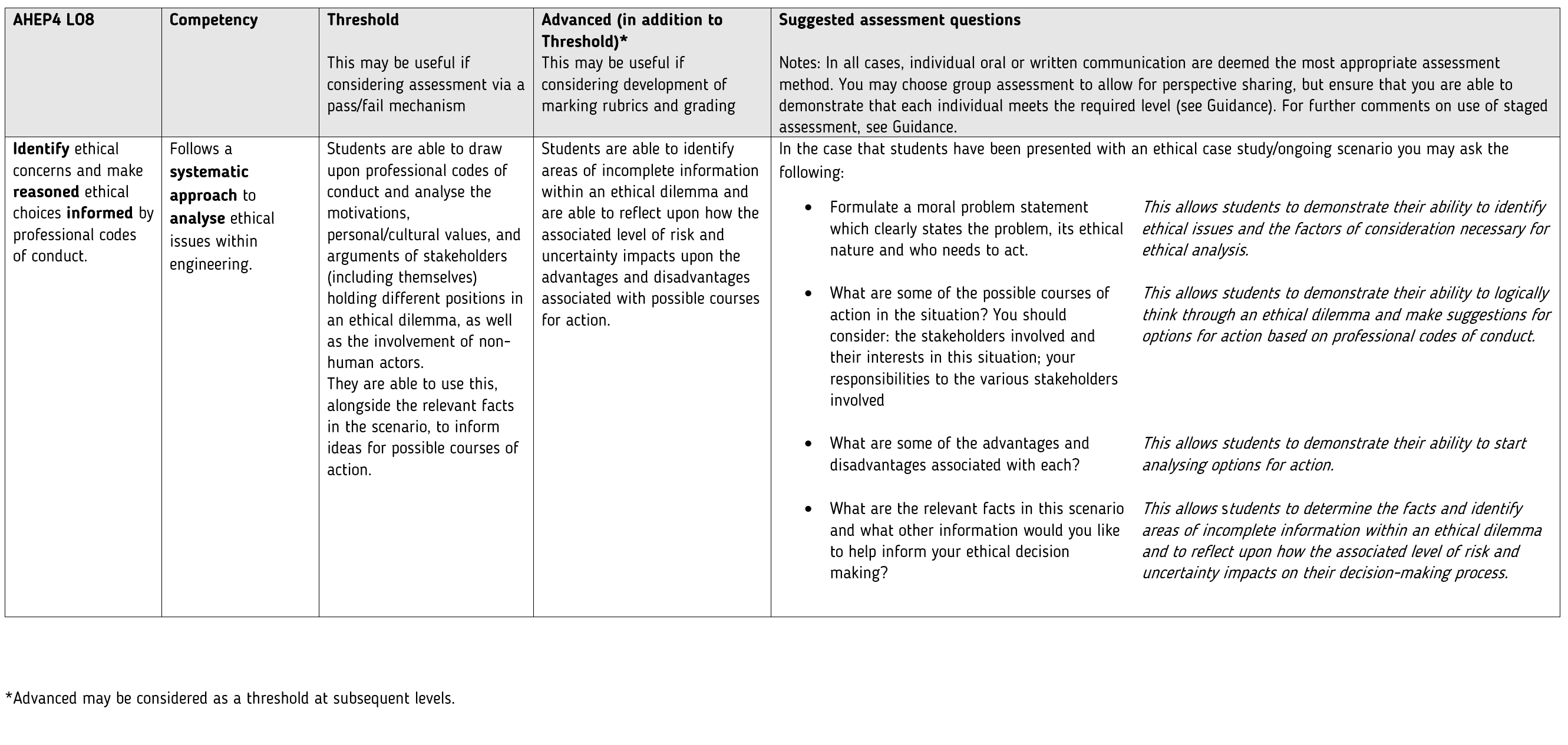
This document provides the partial AHEPLO8 at each level. The competences involved in meeting this LO have then been identified, along with what students would need to demonstrate to evidence meeting a threshold level, or advanced level. Example questions are given to show how students may demonstrate their competence at each level. For each question there is an explanation of how the question supports achievement of LO at that level. The rubrics should be used alongside the accompanying guidance document which offers practical suggestions and advice.

Year 1: This year focuses on developing awareness of issues, obligations, and responsibilities, and sensitising students to ethical issues.

Year 2: This year focuses on developing the ability to identify ethical issues and to examine opposing arguments, all of which is needed to examine, analyse, and evaluate ethical dilemmas in Year 3.

Year 3: This year focuses on ensuring that students can satisfy LO8 at an output level in a robust manner.


References:

Davis, M. and A. Feinerman. (2012). ‘Assessing graduate student progress in engineering ethics’, Science and Engineering Ethics, 18(2), pp. 351-367.


Downloads:

Assessing ethics: Guidance

Assessing ethics: Rubric

Assessing ethics: Case study assessment example: Water Wars


This work is licensed under a Creative Commons Attribution-ShareAlike 4.0 International License.

Any views, thoughts, and opinions expressed herein are solely that of the author(s) and do not necessarily reflect the views, opinions, policies, or position of the Engineering Professors’ Council or the Toolkit sponsors and supporters.

Authors: The Lemelson Foundation; Cynthia Anderson, Sarah Jayne Hitt and Jonathan Truslove (Eds.) 

Topic: Accreditation mapping for sustainability in engineering education. 

Tool type: Guidance. 

Engineering disciplines:  Any.

Keywords: Accreditation and standards; Learning outcomes; AHEP; Student support; Sustainability; Higher education; Students; Teaching or embedding sustainability.

Sustainability competency: Critical thinking; Systems thinking; Integrated problem-solving; Collaboration.

AHEP mapping: This resource addresses themes from the UK’s Accreditation of Higher Education Programmes fourth edition (AHEP4). See details about mapping within the guide. 

Related SDGs: SDG 12 (Responsible consumption and production). 

Reimagined Degree Map Intervention: Adapt and repurpose learning outcomes; More real-world complexity; Cross-disciplinarity.


Learning and teaching notes:

This guide, currently under review by the Engineering Council, maps the Engineering for One Planet (EOP) Framework to AHEP4. The EOP Framework is a practical tool for curricular supplementation and modification, comprising 93 sustainability focused learning outcomes in 9 topic areas. 

The Lemelson Foundation, VentureWell, and Alula Consulting stewarded the co-development of the EOP Framework with hundreds of individuals mostly situated in the United States. Now, in collaboration with the EPC and Engineers Without Borders UK, the EOP Framework’s student learning outcomes have been mapped to AHEP4 at the Chartered Engineer (CEng) level to ensure that UK educators can more easily align these outcomes and corresponding resources with learning activities, coursework, and assessments within their modules.  


Click here to access the guide


Supporting resources: 

EOP Comprehensive Teaching Guide 

EOP’s 13 Step-by-Step Ideas for Integrating Sustainability into Engineering Modules 

EOP Quickstart Activity Guide 


This work is licensed under a Creative Commons Attribution-ShareAlike 4.0 International License.  

Any views, thoughts, and opinions expressed herein are solely that of the author(s) and do not necessarily reflect the views, opinions, policies, or position of the Engineering Professors’ Council or the Toolkit sponsors and supporters. 
Authors: Dr Homeira Shayesteh (Senior Lecturer/Programme Leader for Architectural Technology, Design Engineering & Mathematics Department, Faculty of Science & Technology, Middlesex University), Professor Jarka Glassey (Director of Education, School of Engineering, Newcastle University). 

Topic: How to integrate the SDGs using a practical framework.   

Type: Guidance.  

Relevant disciplines: Any.  

Keywords: Accreditation and standards; Assessment; Global responsibility; Learning outcomes; Sustainability; AHEP; SDGs; Curriculum design; Course design; Higher education; Pedagogy. 

Sustainability competency: Anticipatory; Integrated problem-solving; Strategic.

AHEP mapping: This resource addresses two of the themes from the UK’s Accreditation of Higher Education Programmes fourth edition (AHEP4):The Engineer and Society(acknowledging that engineering activity can have a significant societal impact) andEngineering Practice(the practical application of engineering concepts, tools and professional skills). To map this resource to AHEP outcomes specific to a programme under these themes, access AHEP 4hereand navigate to pages 30-31 and 35-37. 

Related SDGs: SDG 4 (Quality education); SDG 13 (Climate action).  

Reimagined Degree Map Intervention: Adapt and repurpose learning outcomes; Authentic assessment; Active pedagogies and mindset development.

Who is this article for?  This article should be read by educators at all levels of higher education looking to embed and integrate sustainability into curriculum, module, and / or programme design.  


Premise: 

The critical role of engineers in developing sustainable solutions to grand societal challenges is undisputable. A wealth of literature and a range of initiatives supporting the embedding of sustainability into engineering curricula already exists. However, a practicing engineering educator responsible for achieving this embedding would be best supported by a practical framework providing a step-by-step guide with example resources for either programme or module/course-level embedding of sustainability into their practice. This practical framework illustrates a tested approach to programme wide as well as module alignment with SDGs, including further resources as well as examples of implementation for each step. This workflow diagram provides a visual illustration of the steps outlined below. The constructive alignment tool found in the Ethics Toolkit may also be adapted to a Sustainability context. 


For programme-wide alignment: 

 1. Look around. The outcome of this phase is a framework that identifies current and future requirements for programme graduates. 

a. Review guidelines and subject/discipline benchmark documents on sustainability. 

b. Review government targets and discipline-specific guidance. 

c. Review accreditation body requirements such as found in AHEP4 and guidance from professional bodies. For example, IChemE highlights the creation of a culture of sustainability, not just a process of embedding the topic. 

d. Review your university strategy relating to sustainability and education. For example, Middlesex University signed up to the UN Accord. 

e. Consider convening focus groups with employers in general and some employers of course alumni in particular. Carefully select attendees to represent a broad range of employers with a range of roles (recruiters, managers, strategy leaders, etc.). Conduct semi-structured focus groups, opening with broad themes identified from steps a through d. Identify any missing knowledge, skills, and competencies specific to particular employers, and prioritize those needed to be delivered by the programme together with the level of competency required (aware, competent, or expert). 


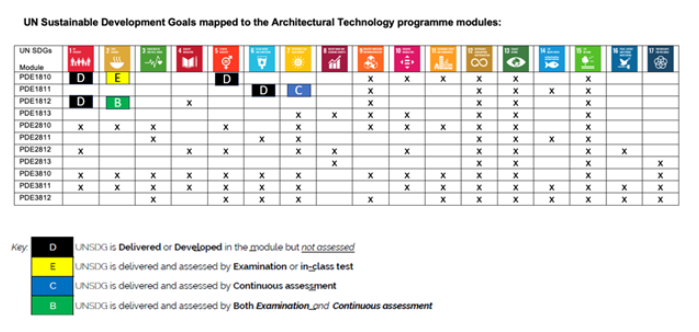
2. Look back. The outcome of this phase is a programme map (see appendix) of the SDGs that are currently delivered and highlighting gaps in provision.  

a. Engage in critical reflective analysis of the current programme as a whole and of individual modules.   

b. Conduct a SWOT analysis as a team, considering the strengths, weaknesses, opportunities, and threats of the programme from the perspective of sustainability and relevance/competitiveness. 

c. Convene an alumni focus group to identify gaps in current and previous provision, carefully selecting attendees to represent a broad range of possible employment sectors with a range of experiences (fresh graduates to mid-career). Conduct semi-structured discussions opening with broad themes identified from steps 1a-e. Identify any missing knowledge, skills, and competencies specific to particular sectors, and those missing or insufficiently delivered by the programme together with the level of competency required (aware, competent, or expert). 

d. Convene a focus group of current students from various stages of the programme. Conduct semi-structured discussions opening with broad themes identified from steps 1a-e and 2a-c. Identify student perceptions of knowledge, skills, and competencies missing from the course in light of the themes identified. 

e. Review external examiner feedback, considering any feedback specific to the sustainability content of the programme.  


 3. Look ahead. The goal of this phase is programme delivery that is aligned with the SDGs and can be evidenced as such. 

a. Create revised programme aims and graduate outcomes that reflect the SDGs. The Reimagined Degree Map and Global Responsibility Competency Compass can support this activity. 

b. Revise module descriptors so that there are clear linkages to sustainability competencies or the SDGs generally within the aims of the modules.  

c. Revise learning outcomes according to which SDGs relate to the module content, projects or activities. The Reimagined Degree Map and the Constructive Alignment Tool for Ethics provides guidance on revising module outcomes. An example that also references AHEP4 ILOS is: 

  1. “Apply comprehensive knowledge of mathematics, biology, and engineering principles to solve a complex bioprocess engineering challenge based on critical awareness of new developments in this area. This will be demonstrated by designing solutions appropriate within the health and safety, diversity, inclusion, cultural, societal, environmental, and commercial requirements and codes of practice to minimise adverse impacts (M1, M5, M7).” 

d. Align assessment criteria and rubrics to the revised ILOs.  

e. Create an implementation plan with clear timelines for module descriptor approvals and modification of delivery materials.  


For module-wide alignment: 

1. Look around. The outcome of this phase is a confirmed approach to embedding sustainability within a particular module or theme. 

a. Seek resources available on the SDGs and sustainability teaching in this discipline/theme. For instance, review these examples for Computing, Chemical Engineering and Robotics.  

b. Determine any specific guidelines, standards, and regulations for this theme within the discipline. 


2. Look back. The outcome of this phase is a module-level map of SDGs currently delivered, highlighting any gaps.  

a. Engage in critical reflective analysis of current modules, as both individual module instructors and leaders, and as a team.  

b. Conduct a SWOT analysis as a module team that considers the strengths, weaknesses, opportunities, and threats of the module from the perspective of sustainability and relevance of the module to contribute to programme-level delivery on sustainability and/or the SDGs. 

c. Review feedback from current students on the clarity of the modules links to the SDGs. 

d. Review feedback from external examiners on the sustainability content of the module. 


3. Look ahead.  

a. Create introduction slides for the modules that explicitly reference how sustainability topics will be integrated.  

b. Embed specific activities involving the SDGs in a given theme, and include students in identifying these. See below for suggestions, and visit the Teaching resources in this toolkit for more options.  


Appendix:

A. Outcome I.2 (programme level mapping)  


B. Outcome II.5 (module level mapping) – same as above, but instead of the modules in individual lines, themes delivered within the module can be used to make sure the themes are mapped directly to SDGs. 


 C. II.6.b – Specific activities 


This work is licensed under a Creative Commons Attribution-ShareAlike 4.0 International License. 

Any views, thoughts, and opinions expressed herein are solely that of the author(s) and do not necessarily reflect the views, opinions, policies, or position of the Engineering Professors’ Council or the Toolkit sponsors and supporters. 
To view a plain text version of this resource, click here to download the PDF.

Author: Mike Murray BSc (Hons) MSc PhD AMICE SFHEA (Senior Teaching Fellow in Construction Management, Department of Civil & Environmental Engineering, University of Strathclyde). 

Topic: Links between education for sustainable development (ESD) and intercultural competence. 

Tool type: Teaching. 

Engineering disciplines: Civil; Any. 

Keywords: AHEP; Sustainability; Student support; Local community; Higher education; Assessment; Pedagogy; Education for sustainable development; Internationalisation; Global reach; Global responsibility; EDI. 

Sustainability competency: Self-awareness; Collaboration; Critical thinking.

AHEP mapping: This resource addresses two of the themes from the UK’s Accreditation of Higher Education Programmes fourth edition (AHEP4): The Engineer and Society (acknowledging that engineering activity can have a significant societal impact) and Engineering Practice (the practical application of engineering concepts, tools and professional skills). To map this resource to AHEP outcomes specific to a programme under these themes, access AHEP 4 here and navigate to pages 30-31 and 35-37. 

Related SDGs: SDG 4 (Quality education); SDG 16 (Peace, justice, and strong institutions). 

Reimagined Degree Map Intervention: More real-world complexity; Active pedagogies and mindset development; Authentic assessment.

Educational level: Beginner. 


Learning and teaching notes: 

This resource describes a coursework aligned to three key pedagogical approaches of ESD. (1) It positions the students as autonomous learners (learner-centred); (2) who are engaged in action and reflect on their experiences (action-oriented); and (3) empowers and challenges learners to alter their worldviews (transformative learning). Specifically, it requires students to engage in collaborative peer learning (Einfalt, Alford, and Theobald 2022; UNESCO 2021). The coursework is an innovative Assessment for Learning” (AfL) (Sambell, McDowell, and Montgomery, 2013) internationalisation at home (Universities UK, 2021) group and individual assessment for first-year civil & environmental engineers enrolled on two programmes (BEng (Hons) / MEng Civil Engineering & BEng (Hons) / MEng Civil & Environmental Engineering). However, the coursework could easily be adapted to any other engineering discipline by shifting the theme of the example subjects. With a modification on the subjects, there is potential to consider engineering components / artifacts / structures, such as naval vessels / aeroplanes / cars, and a wide number of products and components that have particular significance to a country (i.e., Swiss Army Knife).

Learners have the opportunity to: 

Teachers have the opportunity to: 


Learning and teaching resources: 


Rationale: 

There have been several calls to educate the global engineer through imbedding people and planet issues in the engineering curriculum (Bourn and Neal, 2008; Grandin and Hirleman 2009). Students should be accepting of this practice given that prospective freshers are ‘positively attracted by the possibility of learning alongside people from the rest of the world’ (Higher Education Policy Unit, 2015:4). Correspondingly, ‘international students often report that an important reason in their decision to study abroad is a desire to learn about the host country and to meet people from other cultures’ (Scudamore, 2013:14). Michel (2010:358) defines this ‘cultural mobility’ as ‘sharing views (or life) with people from other cultures, for better understanding that the world is not based on a unique, linear thought’.  


Coursework brief summary extracted from the complete brief:

Civil Engineering is an expansive industry with projects across many subdisciplines (i.e. Bridges, Buildings, Coastal & Marine, Environmental, Geotechnical, Highways, Power including Renewables. In a group students are required to consult with an international mentor and investigate civil engineering (buildings & structures) in the mentor’s home country. Each student should select a different example. These can be historical projects, current projects or projects planned for the future, particularly those projects that are addressing the climate emergency. Students will then complete two tasks: 


Time frame and structure: 

1. Opening lecture covering:

a. Reasoning for coursework with reference to transnational engineering employers and examples of international engineering projects and work across national boundaries. 

b. Links between engineering, people, and planet through the example of biomimicry in civil engineering design (Hayes, Desha, & Baumeister, 2020) or nature-based solutions in the context of civil engineering technology (Cassina and Matthews ,2021). 

c. Existence of non-governmental organisations (NGOs) such as RedR UK (2023) Water Aid (2023) and Bridges to Prosperity (2023). 

d. The use of corporate social responsibility (CSR) to address problematic issues such as human rights abuses (Human Rights Watch, 2006) and bribery and corruption (Stansbury and Stansbury) in global engineering projects.  


2. Assign students to groups:

a. Identify international mentors. After checking the module registration list, identify international students and invite them to become a mentor to their peers.  Seek not to be coercive and explain that it is a voluntary role and to say no will have no impact on their studies. In our experience, less than a handful have turned down this opportunity. The peer international students are then used as foundation members to build each group of four first-year students. Additional international student mentors can be sourced from outside the module to assist each group. 

b. Establish team contracts and group work processes using the Carnegie Mellon Group Working Evaluation document


3. Allow for group work time throughout the module to complete the tasks (full description can be found in the complete brief). 


Assessment criteria: 

The coursework constitutes a 20% weighting of a 10-Credit elective module- Engineering & Society. The submission has two assessed components: Task 1) a group international poster with annotated sketches of buildings & structures (10% weighting); and Task 2) A short individual reflective writing report (10% weighting) that seeks to ascertain the students experience of engaging in a collaborative peer activity (process), and their views on their poster (product). Vogel et al, (2023, 45) note that the use of posters is ‘well-suited to demonstrating a range of sustainability learning outcomes’. Whilst introducing reflective writing in a first-year engineering course has its challenges, it is recognised that  reflective practice is an appropriate task for ESD- ‘The teaching approaches most associated with developing transformative sustainability values stimulate critical reflection and self-reflection’ (Vogel et al, 2023, 6). 

Each task has its own assessment criteria and process. Assessment details can be found in the complete coursework brief.  


Teaching reflection: 

The coursework has been undertaken by nine cohorts of first-year undergraduate civil engineers (N=738) over seven academic sessions between 2015-2024. To date this has involved (N=147) mentors, representing sixty nationalities. Between 2015-2024 the international mentors have been first-year peers (N=67); senior year undergraduate & post-graduate students undertaking studies in the department (N=58) and visiting ERASMUS & International students (N =22) enrolled on programmes within the department.  

Whilst the aim for the original coursework aligns with ESD (‘ESD is also an education in values, aiming to transform students’ worldviews, and build their capacity to alter wider society’ -Vogel et al ,2023:21) the reflective reports indicate that the students’ IC gain was at a perfunctory level. Whilst there were references to ‘a sense of belonging, ‘pride in representing my country’, ‘developing friendships’, ‘international mentors’ enthusiasm’ this narrative indicates a more generic learning gain that is known to help students acquire dispositions to stay and to succeed at university (Harding and Thompson, 2011). The coursework brief fell short of addressing the call ‘to transform engineering education curricula and learning approaches to meet the challenges of the SDGs’ (UNESCO,2021:125). Indeed, as a provocateur pedagogy, ‘ESD recognises that education in its current form is unsustainable and requires radical change’ (Vogel et al ,2023, 4).  

Given the above it is clear that the coursework requirement for peer collaboration and reflective practice aligns to three of the eight key competencies (collaboration, self-awareness, critical thinking) for sustainability (UNESCO, 2017:10). Scudamore (2013:26) notes the importance of these competencies when she refers to engaging home and international students in dialogue- ‘the inevitable misunderstandings, which demand patience and tolerance to overcome, form an essential part of the learning process for all involved’. Moreover, Beagon et al (2023) have acknowledged the importance of interpersonal competencies to prepare engineering graduates for the challenges of the SDG’s. Thus, the revised coursework brief prompts students to journey ‘through the mirror’ and to reflect on how gaining IC can assist their knowledge of, and actions towards the SDG’s. 


References: 

Beagon, U., Kövesi, K., Tabas, B., Nørgaard, B., Lehtinen, R., Bowe, B., Gillet, C & Claus Spliid, C.M .(2023). Preparing engineering students for the challenges of the SDGs: what competences are required? European Journal of Engineering Education, 48(1): 1-23 

Bourn, D and Neal, I. (2008). The Global Engineer: Incorporating Global Skills within the UK Higher Education of Engineers. Engineers against Poverty and Institute of Education. 

Einfalt, J., Alford, J & Theobald, M.(2022). Making talk work: using a dialogic approach to develop intercultural competence with students at an Australian university, Intercultural Education, 33(32):211-229 (Grandin and Hirleman 2009). 

Harding, J and  Thompson, J. (2011). Dispositions to stay and to succeed, Higher Education Academy, Final Report 

Higher Education Policy Unit .(2015). What do prospective students think about international students 

Human Rights Watch. (2006). Building Towers, Cheating Workers: Exploitation of Migrant Construction Workers in the United Arab Emirates  

Michel, J. (2010). Mobility of engineers; the European experience, In UNESCO, Engineering: Issues, Challenges and Opportunities for Development, pp 358-360 

Sambell, K, McDowell, L and Montgomery, C.(2013). Assessment for Learning in Higher Education. London: Routledge. 

Scudamore, R. (2013). Engaging home and international students: A guide for new lecturers, Advance HE 

Stansbury, C. and Stansbury, N. (2007) Anti-Corruption Training Manual: Infrastructure, Construction and Engineering Sectors, International Version, Transparency International UK. Online.  

UNESCO. (2021). Engineering for Sustainable Development, delivering on the sustainable development goals,  

Universities UK. (2021). Internationalisation at home – developing global citizens without travel: Showcasing Impactful Programmes, Benefits and Good Practice,   

Vogel, M., Parker, L., Porter, J., O’Hara, M., Tebbs, E., Gard, R., He, X and  Gallimore,J.B .(2023).  Education for Sustainable  Development: a review  of the literature 2015-2022, Advance HE 


This work is licensed under a Creative Commons Attribution-ShareAlike 4.0 International License. 

Any views, thoughts, and opinions expressed herein are solely that of the author(s) and do not necessarily reflect the views, opinions, policies, or position of the Engineering Professors’ Council or the Toolkit sponsors and supporters. 
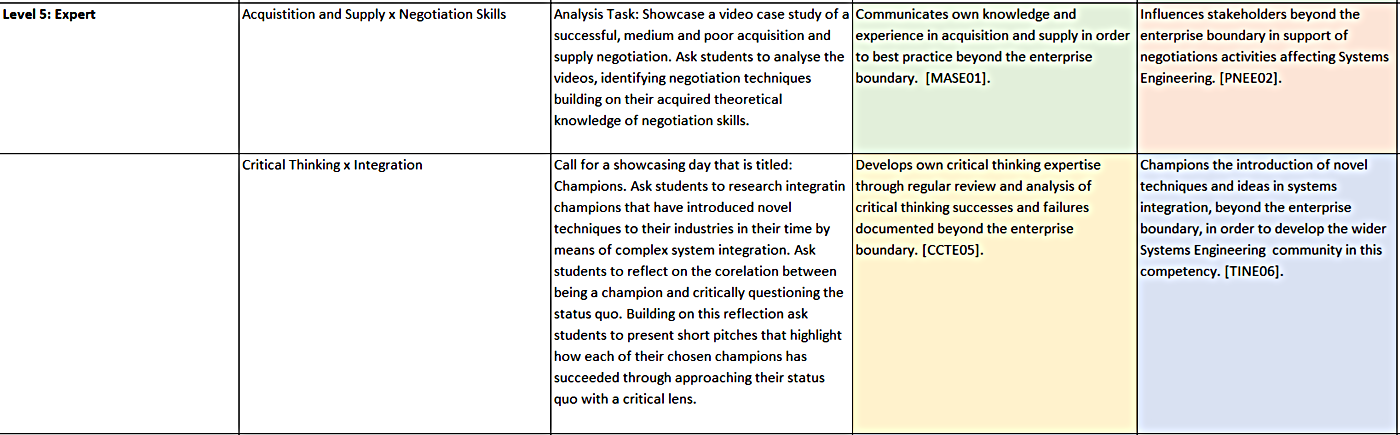
To view a plain text version of this resource, click here to download the PDF.

Let us know what you think of our website