Dr. Manoj Ravi, with the support of colleagues and students, reflects on the outcomes of a hackathon between students from the University of Leeds and NTU Singapore which explored solutions to sustainability challenges as well as fostering interdisciplinary and intercultural collaboration.
Experiential learning is vital for preparing engineers to tackle sustainability challenges that cannot be solved in isolation. By enabling engineering students to work in intercultural and interdisciplinary settings, we foster systems thinking skills, where working alongside peers from diverse disciplines help further understand the interconnections between the social, environmental, and economic dimensions of sustainability. Such collaboration reflects the reality that sustainable solutions must also bridge cultural perspectives across countries and local communities, emphasising the collaborative mindset and skills required to design solutions that are globally relevant, equitable and impactful.
How was it done?
Drawing inspiration from this idea, the University of Leeds (UoL) and Nanyang Technological University Singapore (NTU Singapore) organised a year-long student sustainability hackathon. We brought together 10 student teams, each with four members — two from UoL and two from NTU Singapore. The students were first- and second-year undergraduates, working in interdisciplinary groups that combined chemical engineering, bioengineering, and environmental sciences. They were asked to address open-ended problem statements focused on two critical themes for the context of Singapore and Leeds: sustainable transportation and retrofitting. Each problem statement was mapped onto the UN Sustainable Development Goals, ensuring the work aligns with global sustainability priorities while giving students experience in addressing real-world challenges.
The student-led solutions to these global challenges were developed in two phases. Phase 1 was the ideation or conceptualisation stage where students used system and design thinking approaches to brainstorm potential solutions through a mix of asynchronous (individual reflection and analytical thinking) and synchronous activities (online meetings, group brainstorming and planning). Each group then presented their ideas as elevator pitches to receive feedback from staff at both universities. In the second phase, students moved onto validating their idea and prototyping. The objective of this phase was for students to move from ‘an idea on paper’ to produce something more tangible by demonstrating feasibility in multiple dimensions including technical feasibility, economic viability and regulatory alignment. This challenged students to confront issues that might not have been envisioned during the ideation phase often requiring multiple iterations. Each group had flexibility in terms of how they wanted to present their final hackathon output. The solutions proposed included smart, low-cost retrofitting strategies such as LED lighting, daylight harvesting and motion sensors, alongside more experimental approaches involving recycled materials, including food waste-derived phase change materials and repurposed plastic panels. In all these cases, teams considered the applicability of their solutions from a socio-cultural lens reconciling differences in subsidy structures, urban densities, infrastructure constraints and public behaviour across the two countries. This necessitated students to think of sustainable solutions that bridge cultural perspectives across countries and local communities.
Student reflections
“My biggest learnings through the hackathon have been the extent to which the feasibility of an environmental solution being implemented is dependent on various local and national regulations, as well as how the economic sustainability (and hence scalability) of these solutions can differ in different locations depending on the focus of regional environmental subsidies. I should benefit from these learnings in the future in terms of being more acutely aware of how to design a change to a chemical plant, for example, in a legal and economically sustainable way.” – UoL Chemical Engineering Student
“I signed up for this hackathon because I wanted to push myself beyond my comfort zone and explore how far my creativity could take me in an open-ended environment. I have always enjoyed brainstorming ideas and thinking of alternative ways to solve problems, and this hackathon felt like a good opportunity to challenge myself to innovate in areas I was less familiar with. Reflecting on the experience, my biggest learning was understanding how important it is to balance creativity with feasibility. I learned that good ideas need to be refined, prioritised, and supported by clear reasoning in order to be impactful. Working closely with my team also taught me how to adapt quickly, manage differing viewpoints, and stay focused on the core problem despite constraints. These learnings will benefit me in the future by helping me approach complex problems more confidently, collaborate effectively across disciplines, and develop solutions that are not only innovative but also realistic and meaningful projects.” – NTU Singapore Chemical and Bioengineering student
“My thinking changed in two ways. First, brainstorming became more disciplined. Instead of chasing the most exciting idea, we compared options and asked early questions: what problem does this solve, what assumptions are we making, what would fail first, and what evidence would be needed to support it. This helped reduce ambition into something more realistic. Second, I became more focused on feasibility. Over time, I shifted from “this sounds strong/interesting” to “what is the first thing that proves this can work?”, and “what would fail first?” That meant focusing on clear steps, constraints, and what would be required for real approval and real use.” – UoL Geology student
Staff reflections
As staff involved in the design and delivery of this hackathon, we believe this international collaboration creates new pathways for collaborative curriculum development and empowering students to engage deeply with the complexity of global climate challenges. One of our key reflections from this hackathon is that challenge-based learning offers a truly unique environment for students to develop sustainability competencies. It allows for an authentic and holistic consideration of sustainability whereby core disciplinary knowledge is grounded in socio-cultural, economic, policy and environmental considerations.
We also observe that resilience and commitment are crucial for students to successfully engage in this exercise. Working across largely different time zones with fellow students who bring in different perspectives and skills requires a strong degree of commitment and being resilient in the face of challenges. Students who engaged in the hackathon also commented on how they had to pivot on ideas and make assumptions when faced with inadequate information or uncertainties in data. These are all vital skills for future engineers to thrive in an increasingly volatile, uncertain, complex and ambiguous (VUCA) world.
In future iterations, we aspire to focus on strengthening industry engagement and developing more structured mechanisms for evaluating student learning by embedding the activity within the programme or a module of study. More broadly, this work invites educators to consider how collaborative online international learning (COIL) might be adapted within their own institutional settings to better prepare students for the complexities of global engineering practice.
Authors
Dr Manoj Ravi, School of Chemical and Process Engineering, University of Leeds
Dr Vasiliki Kioupi, School of Earth and Environment, University of Leeds
Ericka Lionny, School of Chemistry, Chemical and Bioengineering, NTU Singapore
Samuel Edwards, School of Chemical and Process Engineering, University of Leeds
Abdulbari S Binafif, School of Earth and Environment, University of Leeds
Any views, thoughts, and opinions expressed herein are solely that of the author(s) and do not necessarily reflect the views, opinions, policies, or position of the Engineering Professors’ Council or the Toolkit sponsors and supporters.
Downloads: A PDF of this resource will be available soon.
Related INCOSE Competencies: Toolkit resources are designed to be applicable to any engineering discipline, but educators might find it useful to understand their alignment to competencies outlined by the International Council on Systems Engineering (INCOSE). The INCOSE Competency Framework provides a set of 37 competencies for Systems Engineering within a tailorable framework that provides guidance for practitioners and stakeholders to identify knowledge, skills, abilities and behaviours crucial to Systems Engineering effectiveness. A free spreadsheet version of the framework can be downloaded.
AHEP4 mapping:This resource addresses several of the themes from the UK’s Accreditation of Higher Education Programmes fourth edition (AHEP4): Analytical Tools and Techniques (critical to the ability to model and solve problems), and Integrated / Systems Approach (essential to the solution of broadly-defined problems).
Educational level: Intermediate; Advanced.
Learners have the opportunity to:
Apply systems engineering principles to understand interdependencies between design, manufacturing, and performance.
Use CAD software (e.g. Autodesk Fusion 360) to model and iterate heat sink designs for additive manufacturing.
Explore simulation tools such as Thermal Analysis (Fusion 360) for predicting performance before fabrication.
Engage in design–build–test cycles, fabricating prototypes using metal additive manufacturing and evaluating them experimentally.
Collect and analyse real-time data using LabVIEW and data acquisition systems, linking digital design to physical performance.
Develop collaborative and communication skills through team-based design projects and peer review sessions.
Reflect on sustainability considerations in advanced manufacturing processes.
Teachers have the opportunity to:
Introduce students to complex systems thinking through practical, problem-based, experiential learning activities.
Demonstrate the integration of digital tools and physical testing in a closed-loop design process.
Guide learners in using industry-standard software for design and simulation, reinforcing professional practice.
Facilitate iterative design processes, encouraging students to analyse trade-offs and optimise performance.
Incorporate structured prompts, rubrics, and feedback mechanisms to support critical thinking and design evaluation.
Promote reflection and uncertainty management as part of assessment, linking technical outcomes to systemic insights.
Align activities with INCOSE competencies and AHEP4 themes, ensuring relevance to accreditation and professional standards.
Foster peer learning and collaboration through group work and discussion-based sessions.
Materials and tools required:
This activity utilises both computational design tools and an experimental thermal testing facility to establish a complete system feedback loop:
CAD software (Autodesk Fusion 360) for 3D modelling and design iteration.
Additive manufacturing equipment (metal 3D printer) for prototype fabrication.
Thermal Analysis Tool (Fusion 360) or other CFD simulation software (optional – for design simulation).
Data acquisition system and testing equipment.
The experimental facility integrates the following components:
K-type thermocouples calibrated to ASTM E230 (0–100°C, ±1°C).
Data Acquisition System: NI USB-6210 with custom LabVIEW interface.
Thermal paste: DOWSIL 340 for improved thermal contact.
Computer interface for real-time data recording and analysis.
Learning and teaching resources:
Pre-reading includes literature on additive manufacturing, design for manufacture, and systems thinking in engineering. Students can review the references listed below to learn the fundamentals of heat sinks, guidance on heat sink design, and important considerations.
This teaching activity introduces students to complex systems thinking by having them design, fabricate, and experimentally evaluate additively manufactured heat sinks. It can form part of an advanced manufacturing module, in which learners apply systems engineering principles to understand the interdependencies among design, manufacturing, and performance. The activity demonstrates how complex systems principles—such as feedback, emergence, and uncertainty—manifest in physical engineering systems. Students are guided to see the design–test–evaluate cycle as an iterative, data-driven process that links digital design environments with real-world performance outcomes.
Activity description:
The experiential learning activity links digital design, manufacturing, and physical evaluation using a complex systems framework. Students iterate designs, fabricate prototypes, and measure thermal performance, reflecting on interdependencies and feedback loops.
Session 1: Introduction:
Students are introduced to complex systems and additive manufacturing principles. Variables affecting heat sink performance – geometry, material, surface finish – are identified. The session frames these variables as part of an interconnected thermal management system.
Notes for educators:
Discuss the role of thermal management in high-performance systems.
Provide resources (journal articles, books) for further reading.
Map out factors affecting heat sink efficiency and their systemic relationships, along with the limitations in additive manufacturing.
Introduce complex design thinking concepts, including feedback loops, trade-offs, and uncertainty.
Provide an overview of digital tools (e.g. CAD and simulation software) that support iterative design.
Session 2*: Design and manufacture:
Teams create CAD models in Fusion 360 and prepare designs for metal additive manufacturing. Students analyse trade-offs between thermal performance, printability, and material efficiency, applying complex design thinking to balance competing requirements. Feedback from earlier simulations informs iterative design refinement.
Notes for educators:
Prerequisite knowledge:
Students are expected to be familiar with additive manufacturing processes, including basic 3D printing principles and design-for-manufacture considerations. This ensures that the session focuses on systems thinking and optimisation rather than on manufacturing fundamentals.
Provide design constraints:
Clearly state the size limitations for the heat sink and the capacity of the metal 3D printer, including:
Maximum build volume (e.g. 100 mm × 100 mm × 50 mm).
Minimum wall thickness (e.g. 1.5 mm).
Minimum spacing between fins (e.g. 2 mm).
Provide a design prompt (e.g. “Optimise heat sink geometry for maximum heat dissipation under given constraints”).
Share an evaluation rubric that assesses the following: design rationale, manufacturability, thermal performance, and discussion/reflection, including consideration of environmental and societal impacts.
Encourage peer-review sessions in which teams critique one another’s designs before fabrication.
*Advanced option:
Academics may incorporate Thermal Analysis Tools within Fusion 360 or CFD simulations (e.g. ANSYS Fluent) to evaluate design performance and refine heat sink geometry for optimal efficiency.
Session 3: Experimental set-up and evaluation:
Each prototype is tested using the dedicated testing facility, as shown in Figure 1.
Figure 1: Schematic of the experimental facility for heat sink testing.
The experimental set-up used for evaluating the heat sink performance consists of a DC power supply (i.e. Velleman LABPS3003 30V, 3A), a polyimide-insulated flexible heater (i.e. OMEGA KHLVA-202/40), thermocouples (i.e. K type), a data acquisition system (i.e. NI USB-6210), and a computer for data recording, as shown schematically in Figure 1. A flexible heater is mounted beneath the heat sink, powered by a DC supply to simulate heat generation in microprocessors. Thermocouples are positioned at the heat sink base and calibrated to ASTM E230. A DOWSIL 340 thermal paste layer ensures optimal thermal contact. This enables accurate measurement of the thermal performance of fabricated heat sinks under controlled heat flux conditions.
Session 4: Data analysis and comparison:
A custom LabVIEW interface is developed to acquire, visualise, and log temperature and power data in real time, thereby providing a digital bridge between the physical test rig and the data analysis environment. Temperature and power data are acquired using LabVIEW with the NI USB-6210 DAQ card.
The evaluation and comparison of thermal performance among heat sink geometries designed by various student groups are conducted by recording the base temperature of each configuration as a function of time under a constant heat flux and identical ambient conditions. The transient temperature response, illustrated in Figure 2 (a), provides insight into the rate at which each design approaches steady state, whereas the steady-state base temperature indicates its overall heat dissipation capability. This procedure can be applied to any heat sink to assess and compare its thermal behaviour.
Figure 2: (a) Transient base temperature variation with time for the reference and three heat sink configurations. (b) Enhanced heat dissipation relative to the reference block, illustrating the method used to compare thermal performance across different designs.
Students compare results and interpret the impact of geometry on heat dissipation. They connect observed variations to systemic dependencies between design, manufacture, and experimental performance.
The computed enhancement values, shown in Figure 2 (b) allow direct comparison of heat dissipation efficiency among the different designs. By examining both the temperature–time response and the enhancement ratio, the effect of geometric modification on thermal performance can be quantitatively assessed within a unified experimental framework.
The experimental facility thus forms a closed digital loop connecting design, fabrication, and performance evaluation. The data acquired through LabVIEW and the DAQ system feed back into the design process, enabling iterative optimisation of heat-sink geometry and thermal-management strategies.
Session 5: Reflection:
Teams map out interdependencies between process variables, performance metrics, and uncertainties. They construct feedback diagrams (flowcharts) using Microsoft PowerPoint SmartArt, linking design iterations, measurements, and outcomes to identify emergent system behaviour.
Assessment and reflection:
The assessment can comprise a reflective report and a presentation.
Reports should include:
Interpretation of experimental data and comparison of thermal performance across designs.
Evaluation of system feedback mechanisms, showing how design decisions influenced outcomes.
Discussion of uncertainty management, including:
Identifying sources of uncertainty (e.g. measurement errors, material properties, environmental conditions).
Explaining how these uncertainties were considered during design iterations and testing.
Reflecting on strategies to mitigate uncertainty (e.g. calibration, repeated trials, simulation validation).
Considering the impact of uncertainty on decision-making and overall system performance.
Presentations should summarise:
The design evolution and rationale for changes.
System mapping to illustrate interdependencies and feedback loops.
Insights into complex systems behaviour, including how uncertainty shaped design choices.
Additional image:Heatsink fabricated using a metal 3D printer.
Any views, thoughts, and opinions expressed herein are solely that of the author(s) and do not necessarily reflect the views, opinions, policies, or position of the Engineering Professors’ Council or the Toolkit sponsors and supporters.
Engineering for One Planet (EOP) advances rapid innovation in engineering education, embedding sustainability and climate literacy to prepare engineers capable of solving today’s challenges without compromising tomorrow. For Earth Day on 22nd April, as part of our Sustainability Toolkit, we share details of their newest resources.
We know that engineering students are increasingly demanding the skills to address the climate crisis. We also know that educators’ syllabi are already packed, and finding the time to develop new, high-quality climate content can be a significant hurdle.
To bridge this gap, Engineering for One Planet (EOP) — in collaboration with 18 global organisations, including ABET, ASEE, ASME, and IEEE — is proud to release a new, open-access resource:
This guide is a practical companion to the EOP Framework. It provides a “menu” of flexible, vetted teaching activities designed to integrate seamlessly into existing courses. Whether you are teaching introductory, advanced, required, or elective engineering classes, this guide provides the modular tools you need to equip students with essential climate-related competencies.
Why use this guide?
Built for efficiency: You don’t need to overhaul your course. Pick a single activity that fits your current learning objectives and time constraints.
Peer-vetted: Co-created by a cross-sector community of engineers, climate experts, and teaching faculty.
Accreditation aligned: Activities have been mapped to AHEP4 and ABET Criteria 3 Student Outcomes (by educators, independently of ABET), Bloom’s Taxonomy, and the UN Sustainable Development Goals.
Multidisciplinary and flexible: While rooted in engineering, the activities are adaptable for any technical or non-engineering discipline and for K12 or industry applications.
Free and open access: Distributed under a Creative Commons license so you can use, share, and build upon the work freely.
Select a Topic Area: Browse the 9 EOP competency areas (Systems Thinking, Environmental Literacy, Responsible Business and Economy, Social Responsibility, Environmental Impact Assessment, Materials, Design, Critical Thinking,Communication & Teamwork).
Adapt & implement: Choose an activity level (introductory, intermediate, or advanced) that matches your student level and drop it into your next lesson plan.
As engineers and engineering educators, we have a moral and professional imperative to design, code, and build in ways that protect life on Earth. This guide is your “first step” in preparing the future workforce to lead that change.
We invite you to explore the guide and join the global community of educators making sustainability a core tenet of the engineering profession.
Any views, thoughts, and opinions expressed herein are solely that of the author(s) and do not necessarily reflect the views, opinions, policies, or position of the Engineering Professors’ Council or the Toolkit sponsors and supporters.
WHY
Engineering educators face a persistent challenge: how to teach standards effectively when the topic can seem abstract, process-heavy, and disconnected from the hands-on problem-solving that students expect. Without practical classroom materials, standards teaching risks becoming a tick-box exercise rather than a meaningful part of the curriculum. Teaching Resources exist because educators need ready-made, classroom-tested tools that bring standards to life ,turning what could be a dry regulatory topic into an engaging, interactive learning experience that prepares students for professional practice.
WHAT
This category provides ready-to-use classroom materials including slide decks, video tutorials, interactive games, free online courses, and direct access to standards documents. Highlights include ETSI’s comprehensive 380-slide teaching pack, the IEEE Mars Space Colony Standards Game (a role-play exercise in standards development), free W3C courses via edX on web standards and digital accessibility, and open-access ITU-T Recommendations. The collection also includes 3GPP-specific teaching materials, from introductory video walkthroughs to a full graduate-level university course on 5G NR standards.
HOW
Browse the resources below to find materials you can adopt or adapt for your teaching. Resources are drawn from SDOs, universities, and professional bodies, covering a range of formats and levels from introductory undergraduate to advanced postgraduate.
Any views, thoughts, and opinions expressed herein are solely that of the author(s) and do not necessarily reflect the views, opinions, policies, or position of the Engineering Professors’ Council or the Toolkit sponsors and supporters.
Related INCOSE Competencies: Toolkit resources are designed to be applicable to any engineering discipline, but educators might find it useful to understand their alignment to competencies outlined by the International Council on Systems Engineering (INCOSE). The INCOSE Competency Framework provides a set of 37 competencies for Systems Engineering within a tailorable framework that provides guidance for practitioners and stakeholders to identify knowledge, skills, abilities and behaviours crucial to Systems Engineering effectiveness. A free spreadsheet version of the framework can be downloaded.
This resource relates to the Systems Thinking, Systems Modelling and Analysis, Integration, and Technical Leadership INCOSE competencies.
AHEP4 mapping: This resource addresses several of the themes from the UK’s Accreditation of Higher Education Programmes fourth edition (AHEP4): Analytical Tools and Techniques (critical to the ability to model and solve problems), and Integrated / Systems Approach (essential to the solution of broadly-defined problems).
Educational level: Beginner; Intermediate.
Learning and teaching notes:
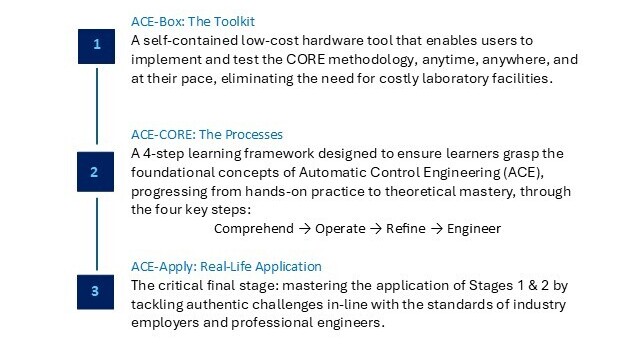
Modern engineering is increasingly digital, interconnected, and system oriented. To prepare students for this evolving landscape, the Automatic Control Engineering (ACE) Model offers a systems-driven, application-focused framework for practical control engineering education. Developed through a MathWorks-funded project launched in the summer of 2025, the ACE-Model unifies three complementary components that together cultivate systems thinking and model-based systems engineering competence:
ACE-Box: The Toolkit
ACE-CORE: The Processes
ACE-Apply: Real-World Application
Learners have the opportunity to:
Engage with the entire ACE-CORE (Comprehend – Operate – Refine – Engineer) framework.
Experience a welcoming and accessible introduction to ACE, without an early overemphasis on mathematics. This stands in contrast to the traditional approach, where topics such as Laplace transforms are introduced early on, often creating unnecessary barriers to engagement (Abou-Hayt and Dahl, 2023).
Develop systems awareness and motivation.
Develop confidence, engagement, and curiosity.
Gain the technical knowledge and systems integration mindset required to thrive in the complex, adaptive landscape of digital engineering.
Teachers have the opportunity to:
Introduce control theory topics in a way that addresses the concern of students finding it difficult to link abstract control theory with the world of control engineering practice(Rossiter, 2022; Badau, et al., 2024).
Introduce industry-standard systems processes such as the V-diagram and model-based design workflows.
Progressively link theory to practice.
Support AHEP4 expectations for developing graduates who can apply integrated systems approaches to solving complex problems and the INCOSE Systems Engineering Competency areas of systems thinking, integration, and technical leadership.
What does the ACE-Model consist of?:
Figure 1:The ACE-Model: Integrating the Toolkit (ACE-Box), with the Processes (ACE-CORE), to Lead to the Real-Life Application (ACE-Apply) to build a progressive mastery in Automatic Control Engineering (ACE).
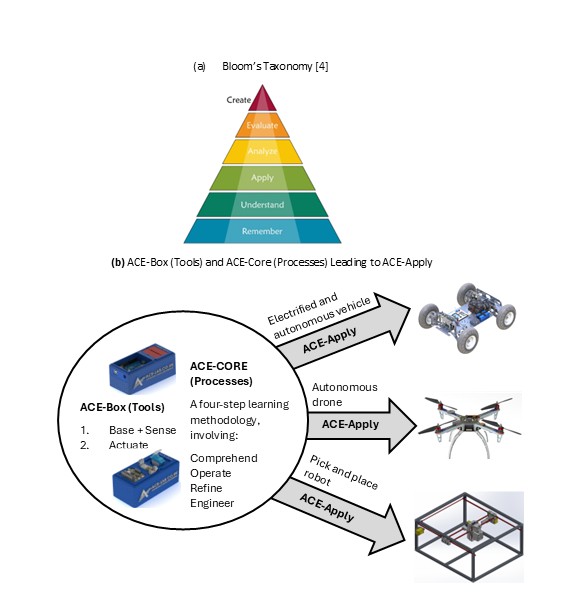
The ACE-Model is closely aligned with Bloom’s Taxonomy, see (Anderson and Krathwohl, 2001)and Figure 2(a) providing a structured pathway for students to progress through the cognitive hierarchy, while developing capabilities across multiple levels of system abstraction. Figure 2(b) offers a schematic view of the three stages of the ACE-Model, as introduced in Figure 1. An initial overview of the ACE-Model is presented here, with further details provided in the following sections.
The ACE-Box is a portable, self-contained hardware tool that brings ACE to life beyond the traditional costly, full-scale laboratories. All that is required is a laptop and the ACE-Box. Designed to support the ACE-CORE methodology, ACE-Box can be set up on a desk, in a classroom, or even at home. MATLAB and Simulink serve as the primary platforms for model-based design, enabling system modelling, control system development, and the deployment of control algorithms to physical hardware (e.g. Arduino Uno) through code generation tools.
ACE-CORE guides learners through successive levels of Bloom’s framework:
Comprehend aligns with Remember and Understand on the Bloom Taxonomy, enabling students to grasp the applications of control engineering before advancing.
Operate corresponds to Apply on the Bloom Taxonomy, as students engage directly with control systems, supported by Stage 2, making use of the ACE-Box (hardware or virtual).
Refine maps to both Analyse and Evaluate on the Bloom Taxonomy, where learners diagnose performance, compare outcomes, and adapt solutions to meet stakeholder requirements.
Engineer extends this process to system-level design and synthesis, making use of modelling and simulation tools such as MATLAB and Simulink. At this stage, students revisit the full cycle (Remember through to Evaluate), but at a higher level of integration with the use of control theory, again supported by the ACE-Box.
At each stage of CORE, learners move from recognising system components to synthesising complex interactions, mirroring the systems engineering lifecycle from requirement capture through verification and validation. This alignment supports AHEP4’s emphasis on analytical and problem-solving competence and INCOSE’s System Definition and Integration competencies.
Finally, learners progress to Create, the highest stage of Bloom’s Taxonomy, by applying their knowledge to design complete control systems for real-world applications such as drones, vehicles, and automation systems. In this way, the ACE-Model scaffolds learning in parallel with Bloom’s progression, from foundational comprehension to advanced problem-solving, design and innovation.
Together, these three pillars form a cohesive learning ecosystem: the toolkit, the process, and the application.
Figure 2:Bloom’s Taxonomy (Anderson and Krathwohl, 2001)(a) and the ACE-Model Three Stages (b).
Collaborative community:
The ACE-Model ‘sits’ within the ACE-Lab, a collaborative community of academics and industry professionals committed to developing, validating, and disseminating open-access systems education resources. The ACE-Lab approach embodies complex adaptive systems principles, where the community evolves through continuous feedback, iteration, and co-design. Membership to the ACE-Lab is open to anyone who shares our vision of advancing control engineering teaching tools and practices. Through this approach, the ACE-Model equips graduates with the knowledge and hands-on skills required to excel in modern ACE careers. Find out more about the ACE-Lab through the following website:www.ace-lab.co.uk
As an evolving community, ACE-Lab continually expands its open-access content through the active contributions of its members. New materials are regularly developed and shared, ensuring the resources remain current and relevant. Through this dynamic, collaborative approach, embodied in the ACE-Model, students not only gain technical knowledge but also develop the capacity to understand, navigate, and work effectively with complex, interconnected engineering systems.
ACE-Box: The toolkit:
The ACE-Box is based on the early development work of Control-Lab-in-a-Box(Pickering, 2023; 2025). CLB integrates sensors, actuators, and microcontroller to allow students to experience dynamic behaviour, and feedback control.
For now, two ACE-Box kits have been developed:
1. Base and sense
2. Actuate
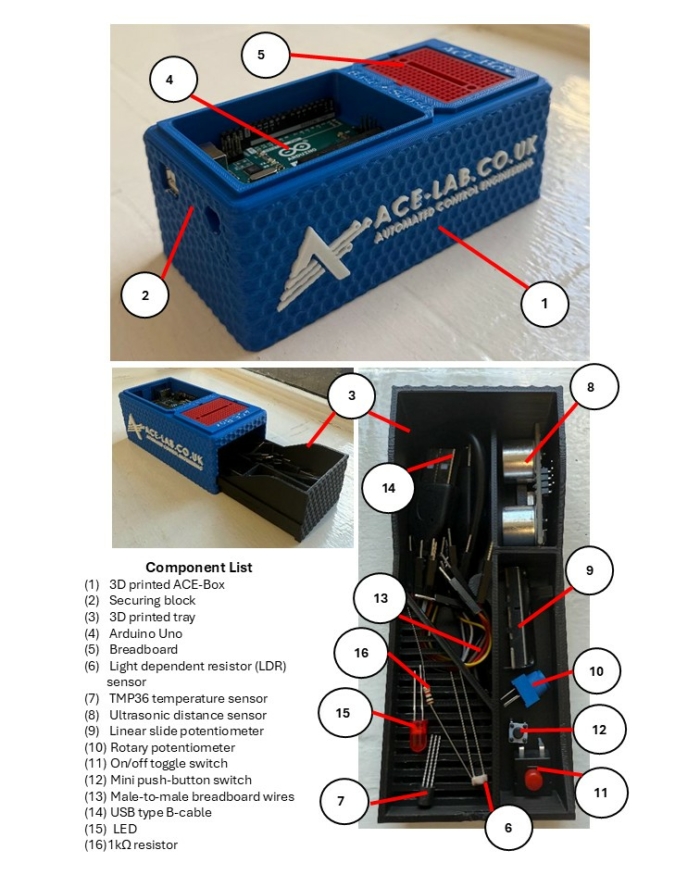
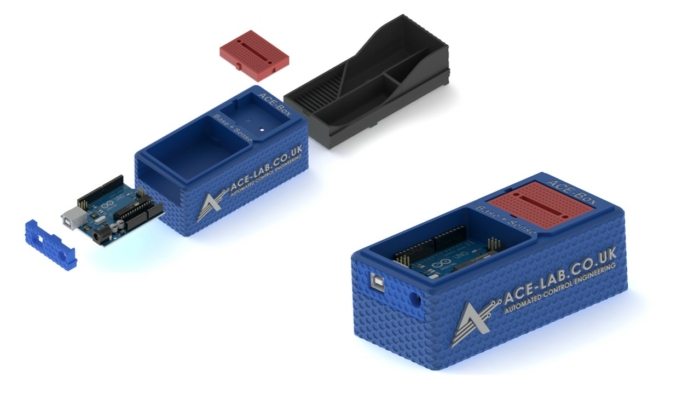
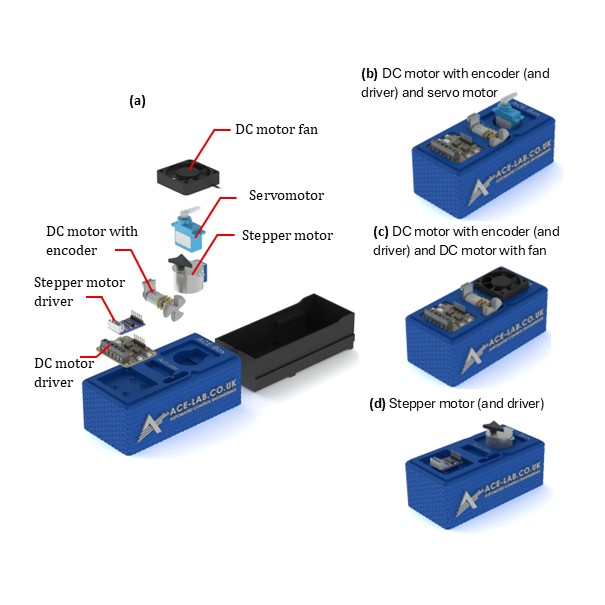
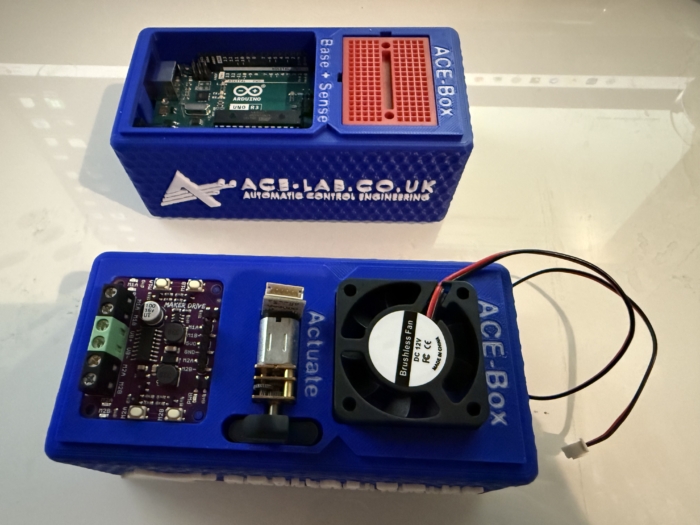
The ACE-Box (base and sense) is illustrated in Figure 3, with the 15 key components labelled, along with an exploded view of the main parts in Figure 4. The ACE-Boxesintegrate the essential microcontrollers, electronics, sensors, and actuators needed to design, implement, and test elements of digital control algorithm development, e.g. control algorithms in real time. It bridges the gap between theory and practice, allowing learners to see how abstract concepts behave in physical systems. The ACE-Box is also available as an open-access resource, with laboratory exercises included, with details provided later in this article. The ACE-Box (labelled (1) in Figure 3) and the tray (labelled (2) in Figure 3) are manufactured using 3D printing, with the necessary files available on the project website referenced above. A list of the required components and their sources is also provided on the project website, corresponding to labels (3) to (15) in Figure 3. Due to the open-source design of ACE-Lab, the library of exercises will continue to expand, supported by contributions from both academia and industry. The ACE-Box (Actuate) is illustrated in Figure 5, with the key actuator components detailed in (a), along with some typical lab set-ups (b, c and d). Figure 6 illustrates both the ACE-Box (Base + Sense) and also ACE-Box (Actuate).
Figure 3:The ACE-Box (Base and Sense).
Figure 4: Assemble of the 3D Printed ACE-Box (Base and Sense).
Figure 5:The ACE-Box (Actuate).
Figure 6:ACE-Box (Actuate) Alongside the ACE-Box (Base + Sense).
ACE-CORE: The methodology:
ACE-CORE is a four-step framework designed to scaffold learning from components to system-of-systems understanding:
Comprehend: Recognise the interdependencies between components within a feedback control system.
Operate: Discover how to operate a control system from understanding system requirements to testing and validation.
Refine: Diagnose, analyse, and optimise performance using feedback principles; students apply system verification and validation approaches.
Engineer: Apply mathematics and modelling to synthesise control algorithms and architectures that achieve desired system behaviours.
The methodology explicitly develops systems thinking, and integrationcompetencies, core to both AHEP4 and INCOSE frameworks.
ACE-CORE is intentionally designed to offer a scaffolded learning experience, allowing students to build confidence step by step as they deepen their understanding. Due to its flexible structure, students can also follow a completely practical route, i.e. avoiding the modelling and simulation. The emphasis is not on rote memorisation of theory, but on progression through understanding the fundamentals of control engineering, e.g. the components that form a feedback control system.These routes enable learners to apply concepts in practical control engineering contexts and develop genuine competence.
ACE-Apply: Real-world application:
ACE-Apply is the project stage, where the skills and knowledge gained from ACE-Box and ACE-CORE are consolidated by tackling authentic challenges aligned with the expectations of industry and professional engineers, see Figure 2(b). At this stage, learners prove their mastery by addressing engineering application problems that reflect the standards of industry practice. The focus is on:
Applying the ACE-CORE methodology to practical control application challenges across domains such as robotics, automotive systems, drones, and industrial automation.
Bridging theory, simulation, and hardware with confidence and agility using industry standard tools and processes.
This stage reinforces AHEP4 Themes 3 and 5, particularly:
Applying integrated systems approaches to complex, real-world problems.
Managing system lifecycle activities including requirements capture, design, testing, and validation.
It also strengthens INCOSE competencies in System Realisation, Integration, and Technical Project Management, encouraging students to act as systems integrators capable of managing interfaces and dependencies across mechanical, electrical, and software domains.
By bridging theory, simulation, and hardware using industry-standard digital tools, ACE-Apply nurtures the ability to navigate complex adaptive systems, anticipate emergent behaviour, and work collaboratively within multidisciplinary engineering ecosystems.
ACE-Box activities:
Upon visiting the ACE-Lab website (www.ace-lab.co.uk), under the tab ‘ACE-Box’, the following tabs exist (with the links provided):
The “What is the ACE-Box?” page introduces educators and students to the ACE-Box platform, outlining its purpose, key features, and practical considerations such as sourcing components and 3D-printing enclosure parts.
The “Prior Exercises” page provides essential onboarding material designed to help users become familiar with MATLAB and Simulink. This includes links to the relevant OnRamp courses, guidance on installing the required software packages, and short tutorial videos that introduce the MATLAB and Simulink graphical user interfaces (GUIs).
The “Base + Sense” section contains a set of introductory tutorial exercises that use the ACE-Box (Base + Sense configuration). These activities help users get started with Simulink code generation for the Arduino Uno, while working with a range of basic sensors and electronic components.
Finally, the “Base + Sense + Actuate” section builds on the previous material by introducing actuation hardware. Using both the Base + Sense and Actuate modules, students and educators learn how to interface with and control devices such as DC motors, servomotors, and stepper motors. This section is designed to familiarise users with actuator integration and reinforce practical control engineering workflows.
Example use of ACE-Box (Base + Sense):
To demonstrate the use of the ACE-Box (Base + Sense), an introductory activity is provided, i.e. the on-off blinking of an LED. Prior to this activity, through ACE-CORE, students should receive a short introduction to microcontrollers covering key concepts such as digital input/output pins, analogue pins, and pulse-width modulation (PWM). Once students are familiar with these fundamentals, they progress to the initial exercise detailed here, which is aligned with defined learning outcomes.
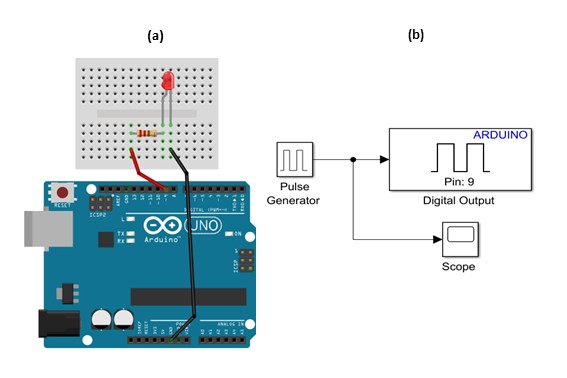
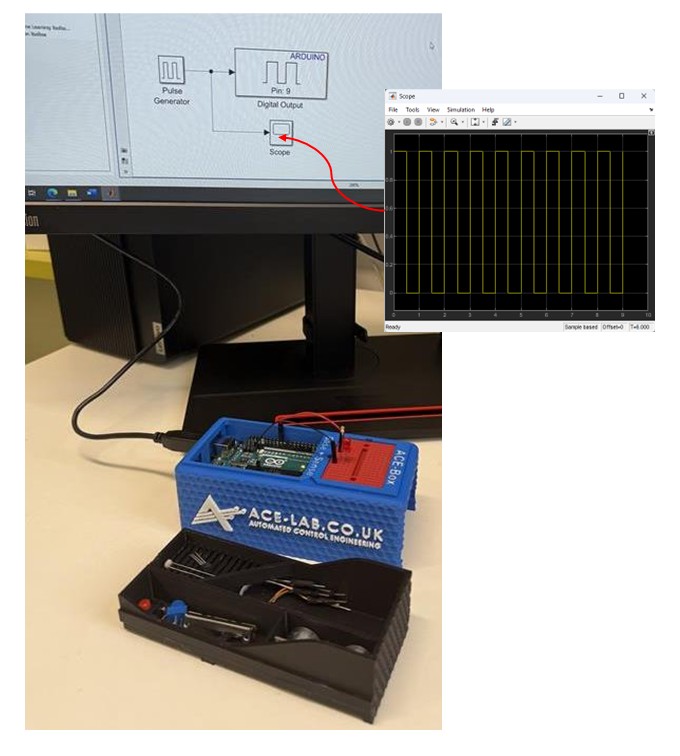
Since MATLAB and Simulink are the primary software tools used with the ACE-Box, students are first guided through installing the Simulink Support Package for Arduino Hardware. After the hardware and software setup is complete, they assemble a simple circuit, see Figure 7(a), and configure a Simulink model for the first exercise, see Figure 6(b). This initial activity requires students to control the state of a digital output pin on the Arduino, switching it on and off. The Simulink model, provided in Figure 7(b), enables students to quickly build the exercise using a visual programming approach. To run the activity, they follow a sequence of steps that includes code generation, which compiles the Simulink model into embedded C code and deploys it onto the Arduino Uno microcontroller. Once completed, the LED connected to the circuit blinks on and off according to the settings of the Simulink pulse generator. A visual of the complete set-up for this initial exercise can be found in Figure 8. At this stage, students are encouraged to experiment with the pulse generator parameters in real-time, observing how changes to the signal properties immediately affect the LED’s behaviour. Scopes can also be used (see Figure 7(b)) to visualise the pulse generator’s square-wave output, including its amplitude, period, and pulse width. This hands-on interaction reinforces the link between the initial set-up and hardware implementation while deepening their understanding of microcontrollers.
Figure 7:LED Simple Circuit (a) and Simulink for Code Generation for the on-off Blinking of an LED.
Figure 8:LED Simple Circuit Set-Up using Simulink for Code Generation for on-off Blinking of an LED.
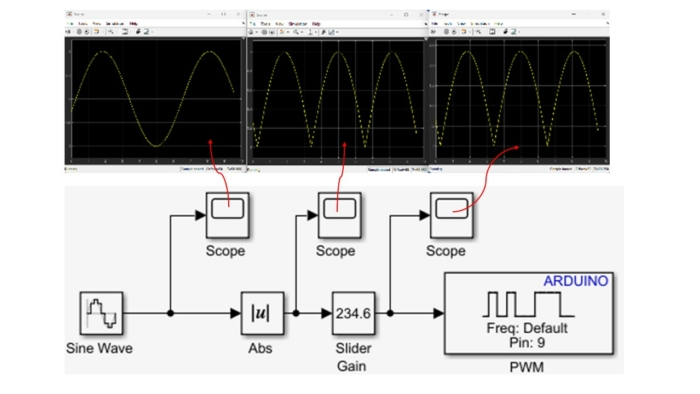
The initial exercise is designed to familiarise students with the ACE-Box and the use of Simulink’s code generation tools. This type of activity is typical for introducing students to a new software and hardware environment. The next exercise involves using pulse width modulation (PWM) to vary the brightness of the LED. This exercise involves using additional blocks in Simulink, see Figure 8, where multiple scopes are used to visualise the signals in real-time. Once students understand the fundamental building blocks of Simulink, they can quickly progress to developing feedback control systems that meet a variety of application requirements. In the authors’ view, student familiarity with Simulink makes it a more accessible platform for designing advanced control algorithms, particularly when working with sub-systems.
Figure 9:LED Simple Circuit Set-Up using Simulink for Code Generation Varying Brightness of an LED using Pulse Width Modulation (PWM).
Building on this foundation, a wide range of laboratory exercises can be developed using the electronic components involved in ACE-Box (Base + Sense), as illustrated in Figure 3, with the option to expand further by incorporating additional components. Examples of extended exercises include:
Analogue sensing and calibration with a temperature sensor
LDR characterisation and linearisation using a voltage divider
Analogue sensing and calibration with a potentiometer sensor
Digital sensing using an ultrasonic sensor
Distance-reactive LED control with proportional feedback (human-in-the-loop plant)
Closed-loop brightness control using LDR feedback and LED PWM
LED–LDR plant control experiments
In addition to sensing activities, the ACE-Box (Actuate) provides four actuators: a servomotor, a DC motor with encoder, a stepper motor, and a DC motor fan. This unit can be used independently or in combination with the Base and Sense ACE-Box to enable more advanced control experiments, such as DC motor speed control or motor control based on light intensity measurements from an LDR.
The flexibility of the ACE-Box system ensures that the number of possible exercises is effectively unlimited, as new experiments can be designed by combining existing sensors and actuators or by integrating additional measurement devices. This also allows unique coursework assignments to be created.
Summary:
The ACE-Model provides a systemic and holistic framework for practical control engineering education that:
Fosters systems thinking and model-based design literacy aligned with INCOSE and AHEP4 competencies.
Connects abstract control theory to complex, real-world systems through accessible hands-on experiences.
Encourages progression from component-level comprehension to system integration.
Builds confidence and motivation through authentic engagement with digital and physical systems, preparing graduates for engineering practice in a complex, interconnected world.
Acknowledgements:
Dr James E. Pickering gratefully acknowledges the support from MathWorks, whose funding made this project possible. He also extends his sincere thanks to Hari Sudeskkumar for his exceptional engineering design contributions and 3D-printing work. The authors would like to thank the Project Advisory Group (PAG) for their valuable guidance throughout the development of this work.
References:
Abou-Hayt, I. and Dahl, B., 2023. A Critical Look at the Laplace Transform Method in Engineering Education. IEEE Transactions on Education, 67(4), pp.542-549.
Anderson, L.W. and Krathwohl, D.R., 2001. A taxonomy for learning, teaching, and assessing: A revision of Bloom’s taxonomy of educational objectives: complete edition. Addison Wesley Longman, Inc..
Badau, N.E., Popescu, T.M., Mihai, M., Dulf, E.H. and Muresan, C.I., 2024. Bridging the gap between control theory and practice: From simple controller design to a practical microcontroller implementation. IFAC-PapersOnLine, 58(26), pp.124-129.
Pickering, J.E., 2023. Control-Lab-in-a-Box: Bridging the Gap between Control Theory and Engineering Practice. In UK and Ireland Engineering Education Research Network Conference Proceedings 2023.
Pickering, J.E., 2025. Leveraging Control-Lab-in-Box (CLB) to Teach Control Engineering on Future Vehicle Technologies MSc. IFAC-PapersOnLine, 59(7), pp.31-35.
Rossiter, J.A., 2022. Future trends for a first course in control engineering. Frontiers in Control Engineering, 3, p.956665.
Any views, thoughts, and opinions expressed herein are solely that of the author(s) and do not necessarily reflect the views, opinions, policies, or position of the Engineering Professors’ Council or the Toolkit sponsors and supporters.
Downloads: A PDF of this resource will be available soon.
Related INCOSE Competencies: Toolkit resources are designed to be applicable to any engineering discipline, but educators might find it useful to understand their alignment to competencies outlined by the International Council on Systems Engineering (INCOSE). The INCOSE Competency Framework provides a set of 37 competencies for Systems Engineering within a tailorable framework that provides guidance for practitioners and stakeholders to identify knowledge, skills, abilities and behaviours crucial to Systems Engineering effectiveness. A free spreadsheet version of the framework can be downloaded.
This resource relates to the Systems Thinking, Systems Modelling and Analysis, Configuration Management, Requirements Definition, Communication, Verification, and Validation INCOSE Competencies.
AHEP4 mapping: This resource addresses several of the themes from the UK’s Accreditation of Higher Education Programmes fourth edition (AHEP4):Analytical Tools and Techniques (critical to the ability to model and solve problems), and Integrated / Systems Approach (essential to the solution of broadly-defined problems). In addition, this resource addresses the themes of Sustainability and Communication.
Educational level: Advanced.
Learning and teaching notes:
Overview:
This multi-part case study guides students through the complex systems challenges of Prince Edward Island, Canada’s ambitious 100% renewable energy transition by 2030. Students will experience how technical, social, and economic factors interact through emergence, feedback loops, and multi-scale dynamics that traditional engineering analysis alone cannot capture.
Learners have the opportunity to:
Identify complex systems characteristics (emergence, feedback loops, nonlinearity) in real energy systems.
Apply multiple modelling approaches (ABM, system dynamics, network analysis) to analyse system behaviour.
Evaluate how technical decisions create emergent social and economic consequences.
Synthesise insights from different modelling approaches to inform policy recommendations.
Communicate complex systems concepts and uncertainties to non-technical stakeholders.
Teachers have the opportunity to:
Demonstrate complex systems concepts through hands-on modelling.
Facilitate discussions on emergence and system-level behaviours.
Evaluate learners’ ability to apply systems thinking to engineering problems.
Connect technical modelling to real-world policy and social implications.
Overview: Energy transition as a complex systems challenge:
Prince Edward Island (PEI), Canada’s smallest province, aims to achieve 100% renewable electricity by 2030. Its small grid, dependence on imported power, and growing renewable infrastructure make it a natural laboratory for systems thinking in energy transitions.
This case invites students to explore how technical, social, and policy decisions interact to shape renewable integration outcomes. Using complexity-science tools, they will uncover how local actions produce emergent system behaviour, and why traditional linear models often fail to predict real-world dynamics.
The complex challenge: Traditional engineering approaches often treat energy systems as predictable and linear, optimising components like generation, transmission, or storage in isolation. However, energy transitions are complex socio-technical systems, characterised by feedback loops, interdependencies, and emergent behaviours.
In PEI’s case, replacing stable baseload imports with variable wind and solar generation creates cascading effects on grid stability, pricing, storage demand, and social acceptance. The island’s bounded geography magnifies these interactions, making it an ideal context to observe emergence and system-level behaviour arising from local interactions.
PEI currently imports about 75% of its electricity via two 180 MW submarine cables, while 25% is produced locally through onshore wind farms (204 MW). Plans for offshore wind, community solar, and hydrogen projects have triggered debates around stability, affordability, and social acceptance.
Taking on the role of an engineer at TechnoGrid Consulting, students are tasked to advise Maritime Electric, the island’s utility, on modelling strategies to guide $2.5 billion in renewable investments.
Competing goals:
Maintain grid reliability while replacing fossil baseloads.
Achieve policy targets without increasing public resistance.
Balance economic cost, environmental benefit, and technological feasibility.
Discussion prompt:
In systems terms, where do you see tensions between policy, technology, and society? How might feedback loops amplify or mitigate these tensions?
While Maritime Electric’s engineering team insists the project scope should stay strictly technical, limited to grid hardware, generation, and storage, policy advisors argue that social behaviour, market pricing, and community engagement are part of the system’s real dynamics.
Expanding boundaries makes the model richer but harder to manage; narrowing them simplifies computation but risks missing the very factors that determine success.
Temporal boundaries: timescales from milliseconds (grid response) to decades (infrastructure).
Organisational boundaries: stakeholders, regulations, and markets.
Discuss how including or excluding elements (e.g., electric-vehicle uptake, community cooperatives, carbon policy) changes the model’s focus and meaning.
Learning insight:
Complex systems cannot be fully understood in isolation; boundaries are analytical choices that shape both perception and leverage. Every inclusion or exclusion reflects an assumption about what matters and that assumption determines which complexities emerge, and which stay hidden.
Part three: Modelling the system: Multiple lenses of complexity:
(a) Agent-Based Modelling (ABM) with NetLogo:
Students construct simplified models of households, businesses, and grid operators:
Household agents: decide to adopt rooftop solar based on payback time and neighbour influence.
Technology providers: adjust prices in response to market demand.
Grid operator: balances reliability and cost.
Emergent patterns such as adoption S-curves or network clustering illustrate how simple local rules generate complex collective dynamics.
(b) System Dynamics (SD) with Vensim:
Students then develop causal loop diagrams capturing key feedbacks:
Adoption–Learning Loop: installations ↓ costs ↓ encourage more adoption.
Cost–Acceptance Loop: higher bills ↓ public support ↓ investment capacity.
This provides a macroscopic view of feedback, delay, and leverage points.
(c) Network Analysis with Python (NetworkX):
Students model actor interdependencies: how households, utilities, industries, and regulators interact. Network metrics (centrality, clustering, connectivity) reveal where resilience or vulnerability is concentrated.
Reflection prompt:
Which modelling approach offered the most insight into system-level behaviour? What were the trade-offs in complexity and interpretability?
Part four: Scenario exploration: Pathways to 2030:
Students explore three transition scenarios, each with distinct emergent behaviours:
A. Distributed Solar + Community Storage
300 MW solar, 150 MWh batteries
Decentralised coordination challenges and social clustering effects.
B. Offshore Wind + Grid Enhancement
400 MW offshore wind, new 300 MW interconnection
Weather-dependent reliability and cross-border dependency.
Any views, thoughts, and opinions expressed herein are solely that of the author(s) and do not necessarily reflect the views, opinions, policies, or position of the Engineering Professors’ Council or the Toolkit sponsors and supporters.
Keywords: Systems thinking; System dynamics; Built environment; Causal loop diagrams; Participatory modelling; Modelling or simulation; Health or wellbeing; Cognitive map.
Related INCOSE Competencies: Toolkit resources are designed to be applicable to any engineering discipline, but educators might find it useful to understand their alignment to competencies outlined by the International Council on Systems Engineering (INCOSE). The INCOSE Competency Framework provides a set of 37 competencies for Systems Engineering within a tailorable framework that provides guidance for practitioners and stakeholders to identify knowledge, skills, abilities and behaviours crucial to Systems Engineering effectiveness. A free spreadsheet version of the framework can be downloaded.
This resource relates to the Systems Thinking, Systems Modelling and Analysis and Critical Thinking INCOSE competencies.
AHEP mapping: This resource addresses several of the themes from the UK’s Accreditation of Higher Education Programmes fourth edition (AHEP4): Analytical Tools and Techniques (critical to the ability to model and solve problems), and Integrated / Systems Approach (essential to the solution of broadly-defined problems). In addition, this resource addresses the AHEP themes of Design and Practical and workshop skills.
Educational level: Intermediate; Advanced.
Learning and teaching notes:
This activity is suitable for those having acquired some familiarity with complex systems and related concepts – especially causal loop diagrams, stock and flow diagrams, cognitive maps or participatory maps – who are looking for additional ideas for activities or who have a specific interest in participatory modelling. The activity is also useful at the point when students learn about interaction between different elements of a complex system or when they learn about the importance of human factors.
Learners have the opportunity to:
Deepen their understanding of systems thinking.
Engage with participatory modelling.
Enjoy a fun group activity.
Teachers have the opportunity to:
Introduce students to participatory modelling (i.e. more specifically to participatory system dynamics / group model-building).
Develop students’ understanding of stock-and-flow modelling in the tradition of system dynamics.
Support students’ understanding of complex interactions around urban dynamics, and if adapted also around other contexts.
This activity introduces students to a participatory systems thinking – or more specifically – participatory modelling exercise. This is an approach used in group settings to explore complex issues and represent them via models. In this activity, students assume the roles of stakeholders involved in an urban regeneration project and take part in a group model-building workshop.
It teaches students core principles of a participatory modelling method called group model-building or participatory system dynamics, but it can also be used to teach the underlying system structure of a specific phenomenon. This makes it well-suited for modules that contain elements of systems thinking and system dynamics (including causal loop diagramming and simulation modelling) or modules that contain an element on group facilitation and participatory methods.
The activity is designed to run over 1.5 to 2.5 hours and is adaptable. While the current example focuses on the phenomenon of urban dynamics around the population development in a city, the activity can be reframed using a case and model from a project management, water management, energy or other sustainability-related context.
The activity is directly aligned with systems thinking by immersing students in a participatory modelling process. It develops students’ awareness of system content and its interactions by teaching them qualitative modelling skills. It develops their skills in managing complexity and representing system elements with visual models consisting of items and their relationships depicted in causal loop diagrams and/or stock and flow diagrams. This serves to build students’ analysis skills and ability to apply systems approaches to problems. It also develops their practitioner, practical and workshop skills of collaborating with stakeholders. It does so by advancing their facilitation skills essential for collaborative systems work. This includes rules of conduct and techniques for managing a group discussion and group dynamics, making a broad range of ideas heard, prioritising them and mapping them visually.
Miro (free version available with up to three active boards)
MURAL or similar platforms (depending on institutional access)
If software or an online tool are used, these are used to collate concepts (variables suggested by students) and to build a diagram of their interactions. This will be projected to the in-person and/or online participants, replicating the participatory nature of in-person workshops.
Detailed explanation of the activity:
This activity introduces students to participatory modelling, an approach used in group settings to explore and understand complex issues and represent them via models. In this case, participatory modelling is introduced through a structured group model-building workshop, using a simplified version (Alfeld & Graham, 1976; Richardson, 2014) of Jay Forrester’s (1969) famous Urban Dynamics model, which sparked quite some debate because of its counter-intuitive insights. The session begins with a brief historical overview of urban growth and decline in major cities up to the 1980s (e.g. New York, Boston, London; see files under ‘Downloads’, above), before focusing on the London Docklands in London in 1981, as an example of an opportunity for urban redevelopment to counter the trend of population decline. Student groups are assigned stakeholder roles from that time, including the founder of the London Docklands Development Corporation (1–2 students), the Surrey Quays Housing Action Group (2–6 students), the London Chamber of Commerce (2–6 students) and the Greater London Council (2–6 students). Each student group receives a role sheet outlining their perspective and a small set of key variables relevant to their stakeholder position (see linked files). These variables are intentionally curated to align with the Urban Dynamics model and to ensure that collaboration is necessary to draw the interlinkages between the variables, i.e. the relevant system structure.
A list of variables provided to the student groups via the role sheets is included below. Note that not all variables that are necessary to draw the model are included; students need to infer a few variables to train their thinking.
London Docklands Development Corporation
Population (This is the total number of people living in the city. As the variable represents the sum of all people, it is an integral. Specific pictogram language can highlight this. In the tradition of system dynamics modelling, one would therefore put a rectangle around it, which the teacher can do after the variable has been placed on the board.)
Surrey Quays Housing Action Group
Housing Structures (Indicates the number of dwellings. Housing is important for urban development. As the variable represents the sum of all dwellings, it is also an integral, which would be depicted by a rectangle.)
Ratio of households to housing (This variable is an indicator of crowding. Ideally, there is one household per housing structure. A number above one means that some people need to live in shared places. A number below one means that there is vacant housing.)
London Chamber of Commerce
Business structures (Indicates the number of business units. Businesses are important to urban development. As the variable represents the sum of all business units, it is also an integral, which would be depicted by a rectangle.)
Jobs (Total number of jobs available in the city (whether filled or unfilled).
Greater London Council
Population (Repeated variable to be able to compare between groups.)
Net migration (Change in population. The simple model excludes population changes by births and deaths because of the relative larger changes by national and international migration.)
Jobs (Repeated variable to be able to compare between groups.)
Before the workshop begins, students are introduced to core concepts of participatory modelling (see linked slides), including facilitator roles (based on Richardson & Andersen, 1995) and common workshop scripts (e.g. hopes and fears, variable elicitation, voting, model building, policy option elicitation and system storytelling, as described in Scriptapedia and Andersen & Richardson, 1997).
The workshop proceeds in three main phases:
1. Variable elicitation: After a short introduction by the student playing the founder of the London Docklands Development Corporation into the setting and by the facilitator/teacher into the process, each group sketches behaviour-over-time graphs of their assigned variables (10 minutes). These are presented using a round-robin or nominal group technique, meaning one variable per group at a time only, and placed on a whiteboard/blackboard or digital canvas. The round-robin collection is a technique useful to foster inclusivity and avoid talking heads. Behaviour-over-time graphs rather than just variable names are useful because the final model is believed to explain a behavioural trend over time, linking model structure and dynamics. However, it is also possible to simplify by letting students just write the variable names on sheets of paper.
2. Voting and prioritisation: To decide on a starting point for modelling, each student votes on which variables they consider to be the most important to include in the model, e.g. giving the students as many votes as there are variables on the board and freedom of how to distribute their votes. While all variables will be included in the model, the voting activity provides a basis for reflection on different priorities and students’ personal vs. their group’s perspective, after the modelling activity.
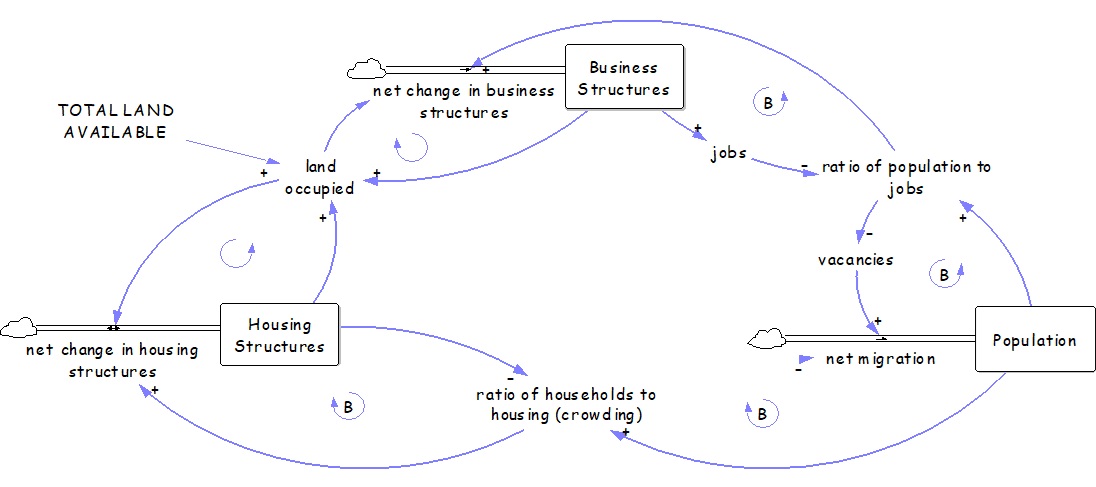
3. Model building: The class collaboratively constructs a stock and flow diagram (see Figure 1). Stocks such as Housing Structures, Business Structures, and Population are identified, and their net rates of change are discussed. To connect the variables, some more variables need to be added such as the ratio of population to jobs, total land available, and land occupied. To help students identify these variables, the teacher can ask questions: “Population and housing are linked by a ratio. What concepts and respective variables could link the other stocks?”. Students are encouraged to identify feedback loops and classify them as reinforcing or balancing.
It is useful to pay attention to uncovering less obvious relationships, such as the spatial competition between housing and business infrastructure. Once the diagram is complete, the facilitator reviews the model with the class, highlighting key feedback structures.
After the modelling activity, students can be shown images of the Docklands after the redevelopment as well as urban population trends of London and other major cities until today, prompting discussion on the long-term impacts of different types of development and prioritisation of a business vs. housing focus. The session can conclude with a reflection on the participatory process and its relevance to real-world decision-making and the value of participatory modelling in complex policy environments.
A more comprehensive version of this activity – including a more introductory group model-building exercise that teaches basic causal loop diagramming concepts and an alternative context using project management as an example – is available: https://discovery.ucl.ac.uk/id/eprint/10160261/
Figure 1: Stock and flow diagram of urban dynamics (produced with Vensim software). This figure is intended for educators and serves an illustrative purpose. It provides educators with a reference for how the model built during the activity is expected to look.
Note: The author was originally inspiredto focus on this case by the historical accounts found on the London Docklands Development Corporation (LDDC) History Pages (http://www.lddc-history.org.uk/index.html, nowinactive).
References:
Alfeld LE, & Graham AK. 1976. Introduction to Urban Dynamics. Cambridge, MA: Productivity Press.
Andersen DF, & Richardson GP. 1997. Scripts for group model building. System Dynamics Review 13(2): 107–129.
Antunes P, Stave K, Videira N, & Santos R. 2015. Using participatory system dynamics in environmental and sustainability dialogues. In M. Ruth (Ed.), Handbook of Research methods and Applications in Environmental Studies. Edward Elgar Publishing: Cheltenham, UK: 346–374.
Deaton M, & MacDonald R. 2025. System Dynamics Learning Guide. Harrisonburg, VA: James Madison University Libraries.
Zimmermann, N. 2026 (forthcoming). Weaving participatory modelling into teaching: Purposes and practices from system dynamics education. Systems Dynamics Review.
Any views, thoughts, and opinions expressed herein are solely that of the author(s) and do not necessarily reflect the views, opinions, policies, or position of the Engineering Professors’ Council or the Toolkit sponsors and supporters.
Licensing:This work is licensed under a Creative Commons Attribution-ShareAlike 4.0 International License. It is based upon the author’s 2025 article “A Simulation Tool for Pinch Analysis and Heat Exchanger/Heat Pump Integration in Industrial Processes: Development and Application in Challenge-based Learning”. Education for Chemical Engineers 52, 141–150.
Related INCOSE Competencies: Toolkit resources are designed to be applicable to any engineering discipline, but educators might find it useful to understand their alignment to competencies outlined by the International Council on Systems Engineering (INCOSE). The INCOSE Competency Framework provides a set of 37 competencies for Systems Engineering within a tailorable framework that provides guidance for practitioners and stakeholders to identify knowledge, skills, abilities and behaviours crucial to Systems Engineering effectiveness. A free spreadsheet version of the framework can be downloaded.
This resource relates to the Systems Thinking, Systems Modelling and Analysis and Critical Thinking INCOSE competencies.
AHEP mapping: This resource addresses several of the themes from the UK’s Accreditation of Higher Education Programmes fourth edition (AHEP4): Analytical Tools and Techniques (critical to the ability to model and solve problems), and Integrated / Systems Approach (essential to the solution of broadly-defined problems). In addition, this resource addresses the themes of Science, mathematics and engineering principles; Problem analysis; and Design.
Educational level: Intermediate.
Educational aim:To equip learners with the ability to model, analyse, and optimise pathways for industrial decarbonisation through a complex-systems lens – integrating technical, economic, and policy dimensions – while linking factory-level design decisions to wider value-chain dynamics, multi-stakeholder trade-offs, and long-term sustainability impacts.
Learning and teaching notes:
This teaching activity explores heat integration for the decarbonisation of industrial processes through the lens of complex systems thinking, combining simulation, systems-level modelling, and reflective scenario analysis. It is especially useful in modules related to energy systems, process systems, or sustainability.
Learners analyse a manufacturing site’s energy system using a custom-built simulation tool to explore the energy, cost and carbon-emission trade-offs of different heat-integration strategies. They also reflect on system feedback, stakeholder interests and real-world resilience using causal loop diagrams and role-played decision frameworks.
This activity frames industrial heat integration as a complex adaptive system, with interdependent subsystems such as process material streams, utilities, technology investments and deployments, capital costs, emissions, and operating constraints.
Learners run the simulation tool to generate outputs to explore different systems integration strategies: pinch-based heat recovery by heat exchangers, with and without heat pump-based waste heat upgrade. Screenshots of the tool graphical user interface are attached as separate files:
The learning is delivered in part, through active engagement with the simulation tool. Learners interpret the composite and grand composite curves and process tables, to explore how system-level outcomes change across various scenarios. Learners explore, using their generated simulation outputs, how subsystems (e.g. hot and cold process streams, utilities) interact nonlinearly and with feedback effects (e.g., heat recovery impacts), shaping global system behaviour and revealing leverage points and emergent effects in economics, emissions and feasibility.
Using these outputs as a baseline, and exploring other systems modelling options, learners evaluate trade-offs between heat recovery, capital expenditure (CAPEX), operating costs (OPEX), and carbon emissions, helping them develop systems-level thinking under constraints.
The activity embeds scenario analysis, including causal loop diagrams, what-if disruption modelling, and stakeholder role-play, using multi-criteria decision analysis (MCDA) to develop strategic analysis and systems mapping skills. Interdisciplinary reasoning is encouraged across thermodynamics, economics, optimisation, engineering ethics, and climate policy, culminating in reflective thinking on system boundary definitions, trade-offs, sustainability transitions and resilience in industrial systems.
Learners have the opportunity to:
Analyse non-linear interactions in thermodynamic systems.
Reconcile conflicting demands (e.g. energy savings vs costs vs emissions vs technical feasibility) using data generated from real system simulation.
Model and interpret feedback-driven process systems using pinch analysis, heat recovery via heat exchangers, and heat upgrade via heat pump integration.
Explore emergent behaviour, trade-offs, and interdisciplinary constraints.
Navigate system uncertainties by simulation data analysis and scenario thinking.
Understand the principles of heat integration using pinch analysis, heat exchanger networks, and heat pump systems, framed within complex industrial systems with interdependent subsystems.
Evaluate decarbonisation strategies and their performances in terms of energy savings, CAPEX/OPEX, carbon reduction, and operational risks, highlighting system-level trade-offs and nonlinear effects
Develop data-driven decision-making, navigating assumptions, parameter sensitivity, and model limitations, reflecting uncertainty and systems adaptation.
Explore ethical, sustainability, and resilience dimensions of engineering design, recognising how small changes or policy shifts may act on leverage points and produce emergent behaviours.
Analyse stakeholder dynamics, policy impacts, and uncertainty as part of the broader system environment influencing energy transition pathways.
Construct and interpret causal loop diagrams (CLDs), explore what-if scenarios, and apply multi-criteria decision analysis (MCDA), building competencies in feedback loops, system boundaries, and systems mapping.
Teachers have the opportunity to:
Embed systems thinking and complex systems pedagogy into energy and process engineering, using real-world simulations and data-rich problem-solving.
Introduce modelling and scenario-based reasoning, helping students understand how interactions between process units, energy streams, and external factors affect industrial decarbonisation.
Facilitate exploration of design trade-offs, encouraging learners to consider technical feasibility, economic sustainability, and environmental constraints within dynamic system contexts.
Support students in identifying leverage points, feedback loops, and emergent behaviours, using tools like CLDs, composite curves, and stakeholder role play.
Assess complex problem-solving capacity, including students’ ability to model, critique and adapt industrial systems under conflicting constraints and uncertain futures.
Proprietary Simulator for Pinch Analysis & Heat Integration. Freely available for educational use and can be accessed online through a secure link provided by the author on request (james.atuonwu@nmite.ac.uk or james.atuonwu@gmail.com). No installation or special setup is required; users can access it directly in a web browser.
About the simulation tool (access and alternatives):
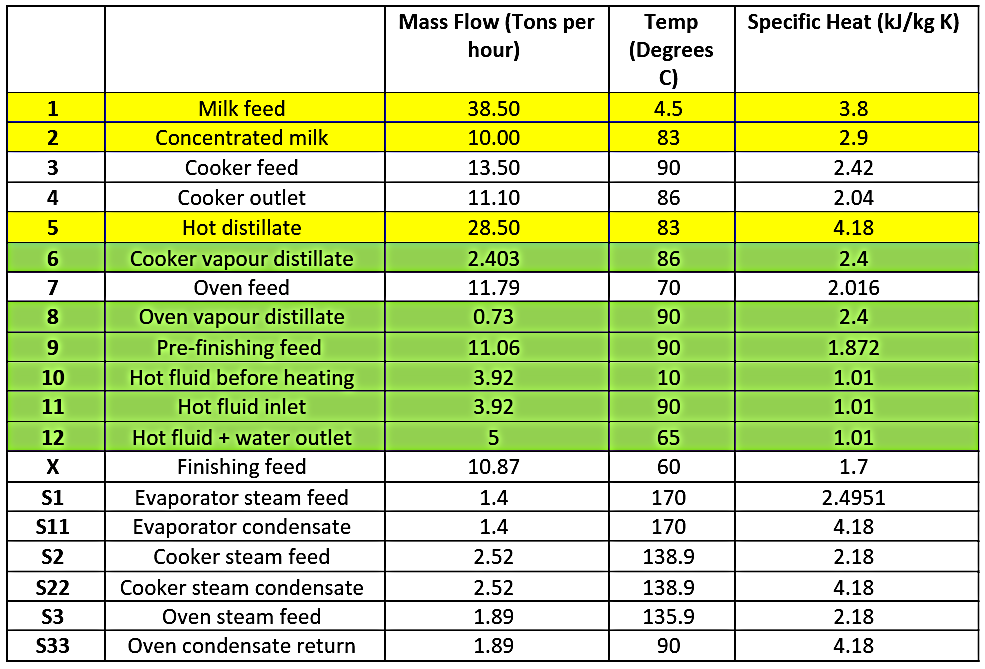
This activity uses a Streamlit-based simulation tool, supported with process data (Appendix A, Table 1, or an educator’s equivalent). The tool is freely available for educational use and can be accessed online through a secure link provided by the author on request (james.atuonwu@nmite.ac.uk or james.atuonwu@gmail.com). No installation or special setup is required; users can access it directly in a web browser.The activity can also be replicated using open-source or online pinch analysis tools such as OpenPinch, PyPinchPinCH, TLK-Energy Pinch Analysis Online. SankeyMATIC can be used for visualising energy balances and Sankey diagrams.
Pinch Analysis, a systematic method for identifying heat recovery opportunities by analysing process energy flows, forms the backbone of the simulation. A brief explainer and further reading are provided in the resources section. Learners are assumed to have prior or guided exposure to its core principles. A key tunable parameter in Pinch Analysis, ΔTmin, represents the minimum temperature difference allowed between hot and cold process streams. It determines the required heat exchanger area, associated capital cost, controllability, and overall system performance. The teaching activity helps students explore these relationships dynamically through guided variation of ΔTmin in simulation, reflection, and trade-off analysis, as outlined below.
Introducing and prioritising ΔTmin trade-offs:
ΔTmin is introduced early in the activity as a critical decision variable that balances heat recovery potential against capital cost, controllability, and safety. Students are guided to vary ΔTmin within the simulation tool to observe how small parameter shifts affect utility demands, exchanger area, and overall system efficiency. This provides immediate visual feedback through the composite and grand composite curves, helping them connect technical choices to system performance.
Educators facilitate short debriefs using the discussion prompts in Part 1 and simulation-based sensitivity analysis in Part 2. Students compare low and high ΔTmin scenarios, reasoning about implications for process economics, operability, and energy resilience.
This experiential sequence allows learners to prioritise competing factors (technical, economic, and operational), while recognising that small changes can create non-linear, system-wide effects. It reinforces complex systems principles such as feedback loops and leverage points that govern industrial energy behaviour.
Data for decisions:
The simulator’s sidebar includes some default values for energy prices (e.g. gas and electricity tariffs) and emission factors (e.g. grid carbon intensity), which users can edit to reflect their own local or regional conditions. For those replicating the activity with other software tools, equivalent calculations of total energy costs, carbon emissions and all savings due to heat recovery investments can be performed manually using locally relevant tariffs and emission factors.
The Part 1–3 tasks, prompts, and assessment suggestions below remain fully valid regardless of the chosen platform, ensuring flexibility and accessibility across different teaching contexts.
Educator support and implementation notes:
The activity is designed to be delivered across 3 sessions (6–7.5 hours total), with flexibility to adapt based on depth of exploration, simulation familiarity, or group size. Each part can be run as a standalone module or integrated sequentially in a capstone-style format.
Part 1: System mapping: (Time: 2 to 2.5 hours) – Ideal for a classroom session with blended instruction and group collaboration:
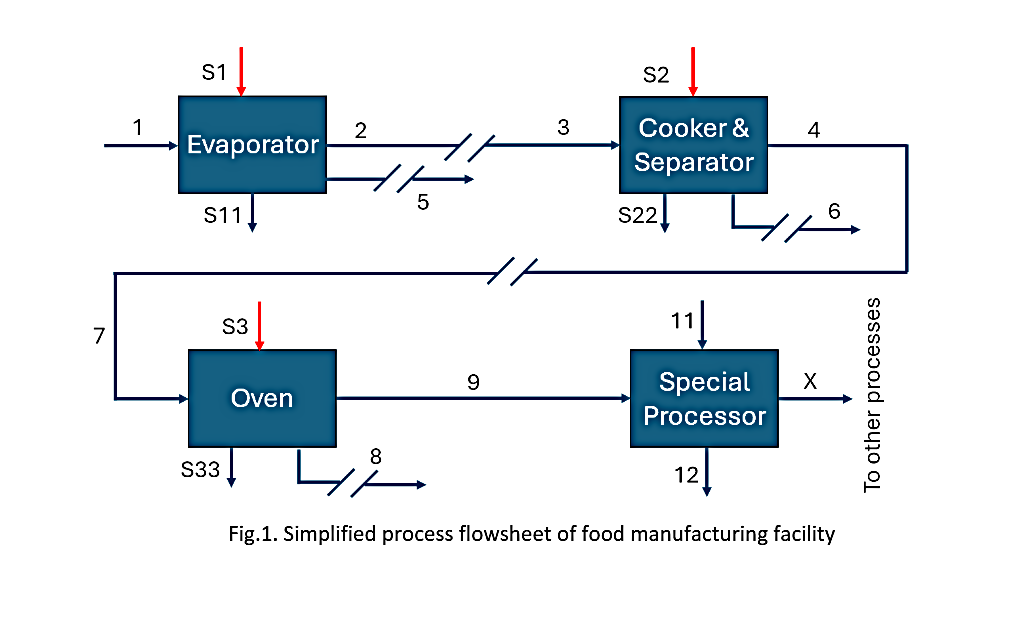
This stage introduces students to the foundational step of any heat integration analysis: system mapping. The aim is to identify and represent energy-carrying streams in a process plant, laying the groundwork for further system analysis. Educators may use the Process Flow Diagram of Fig. 1, Appendix A (from a real industrial setting: a food processing plant) or another Process Diagram, real or fictional. Students shall extract and identify thermal energy streams (hot/cold) within the system boundary and map energy balances before engaging with software to produce required simulation outputs.
Key activities and concepts include:
Defining system boundaries: Focus solely on thermal energy streams, ignoring non-thermal operations. The boundary is drawn from heat sources (hot streams) to heat sinks (cold streams).
Identifying hot and cold streams: Students classify process material streams based on whether they release or require heat. Each stream is defined by its inlet and target temperatures and its heat capacity flow rate (CP).
Building the stream table: Students compile a simple table of hot/cold streams (name, supply temperature, target temperature and heat capacity flow CP).
Constructing energy balances and Sankey Diagrams: Students manually calculate energy balances across each subsystem in the defined system boundary, identifying energy inputs, useful heat recovery, and losses. Using this information, they construct Sankey diagrams to visualise the magnitude and direction of energy flows, strengthening their grasp of system-wide energy performance before optimisation.
Pinch Concept introduction: Students are introduced to the concept of “the Pinch”, including the minimum heat exchanger temperature difference (ΔTmin) and how it affects heat recovery targets (QREC), as well as overall heating and cooling utility demands (QHU & QCU, respectively).
Assumptions: All analysis is conducted under steady-state conditions with constant CP and no heat losses.
Discussion prompts:
What insights does the Sankey diagram reveal about energy use, waste and recovery potential in the system? How might these visual insights shape optimisation decisions?
Why might certain streams be excluded from the analysis?
How does the choice of ΔTmin influence the heat recovery potential and cost?
What trade-offs are involved in system simplification during mapping?
How can assumptions (like steady-state vs. transient) impact integration outcomes?
Student deliverables:
A labelled system map showing the thermal process boundaries, hot and cold streams.
A structured stream data table.
Justification for selected ΔTmin values based on process safety, economics, or practical design and operational considerations.
A basic Sankey diagram representing the energy flows in the mapped system, based on calculated heat duties of each stream.
Part 2: Running and interpreting process system simulation results (Time: 2 to 2.5 hours) – Suitable for lab or flipped delivery;only standard computer access is needed to run the tool (optional instructor demo can extend depth):
Students use the simulation tool to generate their own results.The process scenario of Fig. 1, Appendix A, with the associated stream data (Table 1) can be used as a baseline.
Tool-generated outputs:
Curves: Composite and Grand Composite (pinch location, recovery potential).
Scenario summary: QREC, QHU, QCU; COP (where applicable); CAPEX/OPEX/CO₂; payback period for various values of system levers (e.g., ΔTmin levels, tariffs, emission factors).
Heat Pump (HP) tables: Feasible pairs, Top-N heat pump selections (where N = 0, 1, or 2); QEVAP, QCOND, QCOMP, COP. All notations are designated in the simulator’s help/README section.
Learning tasks:
1. Scenario sweeps Run different scenarios (e.g., different ΔTmin levels, tariffs, emission factors, and Top-N HP selections). Prompts: How do QREC, QHU/QCU, HX area, and CAPEX/OPEX/CO₂ shift across scenarios? Which lever moves the needle most?
2. Group contrast (cases A vs B: see time-phased operations A & B in Appendix A) Assign groups different cases; each reports system behaviours and trade-offs. Prompts: Where do you see CAPEX vs. energy-recovery tension? Which case is more HP-friendly and why?
3. Curve reading Use the Composite & Grand Composite Curves to identify pinch points and bottlenecks; link features on the curves to the tabulated results. Prompts: Where is the pinch? How does ΔTmin change the heat-recovery target and utility demands?
4. Downstream implications Trace how curve-level insights show up in HX sizing/costs and HP options. Prompts: When does adding HP reduce utilities vs. just shifting costs? Where do stream temperatures/CP constrain integration?
5. Systems lens: feedback and leverage Map short causal chains from the results (e.g., tariffs → HP use → electricity cost → OPEX; grid-carbon → HP emissions → net CO₂). Prompts: Which levers (ΔTmin, tariffs, EFs, Top-N) create reinforcing or balancing effects?
Outcome:
Students will be able to generate and interpret industrial simulation outputs, linking technical findings to economic and emissions consequences through a systems-thinking lens. They begin by tracing simple cause–effect chains from the simulation data and progressively translate these into causal loop diagrams (CLDs) that visualise reinforcing and balancing feedback. Through this, learners develop the ability to explain how system structure drives performance both within the plant and across its broader industrial and policy environment.
Optional extension: Educators may provide 2–3 predefined subsystem options (e.g., low-CAPEX HX network, high-COP HP integration, hybrid retrofit) for comparison. Students can use a decision matrix to justify their chosen configuration against CAPEX, OPEX, emissions, and controllability trade-offs.
Part 3: Systems thinking through scenario analysis (Time: 2 to 2.5 hours) – Benefits from larger-group facilitation, a whiteboard or Miro board (optional), and open discussion. It is rich in systems pedagogy:
Having completed simulation-based pinch analysis and heat recovery planning, learners now shift focus to strategic implementation challenges faced in real-world industrial settings. In this part, students apply systems thinking to explore the broader implications of their heat integration simulation output scenarios, moving beyond process optimisation to consider real-world dynamics, trade-offs, and stakeholder interactions. The goal is to encourage students to interrogate the interconnectedness of decisions, feedback loops, and unintended consequences in process energy systems including but not limited to operational complexity, resilience to disruptions, and alignment with long-term sustainability goals.
Activity: Stakeholder role play / Multi-Criteria Decision Analysis Students take on stakeholder roles and debate which design variant or operating strategy should be prioritised. They then conduct a Multi-Criteria Decision Analysis (MCDA), evaluating each option based on criteria such as CAPEX, OPEX savings, emissions reductions, risk, and operational ease.
Stakeholders include:
Operations managers, focused on ease of control and process stability.
Investors and finance teams, focused on return on investment.
Environmental officers, concerned with emissions and policy compliance.
Engineers, responsible for design and retrofitting.
Community members, advocating for sustainable industry practices.
Government reps responsible for regulations and policy formulation, e.g. taxes and subsides.
The team must present a strategic analysis showing how the heat recovery system behaves as a complex adaptive system, and how its implementation can be optimised to balance technical, financial, environmental, and human considerations.
Optional STOP for questions and activities:
Before constructing causal loop diagrams (CLDs), learners revisit key results from their simulation — such as ΔTmin, tariffs, emission factors, and system costs — and trace how these parameters interact to influence overall system performance. Educators guide this transition, helping students abstract quantitative outputs (e.g., changes in QREC, OPEX, or CO₂) into qualitative feedback relationships that reveal cause-and-effect chains. This scaffolding helps bridge the gap between process simulation and systems-thinking representation, supporting discovery of reinforcing and balancing feedback structures.
Activity: Construct a causal loop diagram (CLD) Students identify at least five variables that interact dynamically in the implementation of a heat integration system (e.g. energy cost, investment risk, emissions savings, system complexity, staff training). They must map reinforcing and balancing feedback loops that illustrate trade-offs or virtuous cycles.
Where could policy or process changes trigger leverage points?
How could delays in response (e.g. slow staff adaptation to new technologies) affect outcomes?
How might design choices affect local energy equity, air quality, or community outcomes?
What policy incentives or ethical trade-offs might reinforce or hinder your proposed solution?
Instructor debrief (engineering context with simulation linkage): After students share their CLDs, the educator facilitates a short discussion linking their identified reinforcing and balancing loops to common dynamic patterns observable in the simulation results. For instance:
Limits to growth: As ΔTmin decreases, heat recovery (QREC) initially improves, but exchanger area, CAPEX, and controllability demands grow disproportionately — diminishing overall economic benefit.
Shifting the burden: Installing a heat pump may appear to improve carbon performance, but if low process efficiency remains unaddressed, electricity use and OPEX rise — creating a new dependency that shifts rather than solves the problem.
Tragedy of the commons: Competing units or stakeholders optimising locally (e.g. for their own OPEX or production uptime) can undermine total system efficiency or resilience.
Success to the successful: Design options with early financial or policy support (e.g. high-COP heat pumps) attract more investment and attention, reinforcing a positive but unequal feedback loop.
This reflection connects quantitative model outputs (e.g. QREC, OPEX, CAPEX, emissions) to qualitative system behaviours, helping learners recognise leverage points and understand how design choices interact across technical, economic, and social dimensions of decarbonisation.
Activity: Explore “What if?” scenarios
Working in groups, students choose one scenario to explore using a systems lens:
What if gas prices fluctuate drastically?
What if capital funding is delayed by 6 months?
What if a heat exchanger fouls during peak season?
What if CO₂ emissions policy tightens?
What if current electricity grid decarbonisation trends suffer an unexpected setback?
What if government policies now encourage onsite renewable electricity generation?
Each group evaluates the resilience and flexibility of the proposed integration design. They consider:
System bottlenecks and fragilities.
Leverage points for intervention.
Need for redundancy or modular design.
Educators may add advanced scenarios (e.g. carbon tax introduction, supplier failure, or project delay) to challenge students’ resilience modelling and stakeholder negotiation skills.
Stakeholder impact reflection:
To extend systems reasoning beyond the technical domain, students assess how their chosen design scenarios (e.g., low vs. high ΔTmin, with or without heat pump integration) affect each stakeholder group. For instance:
Operations managers assess control complexity, downtime risk, and maintenance implications.
Finance teams evaluate CAPEX/OPEX trade-offs and payback periods.
Environmental officers examine lifecycle emissions and regulatory compliance.
Engineers reflect on reliability, retrofit feasibility, and process safety.
Community members or regulators consider social and policy outcomes, such as visible sustainability impact or energy equity.
Each team member rates perceived benefits, risks, or compromises under each design case, and the results are summarised in a stakeholder impact matrix or discussion table. This exercise links quantitative system metrics (energy recovery, emissions, cost) to qualitative stakeholder outcomes, reinforcing the “multi-layered feedback” perspective central to complex systems analysis.
Learning Outcomes (Part 3):
By the end of this part, students will be able to:
Identify systemic interdependencies in industrial energy systems.
Analyse how feedback loops and delays influence system behaviour.
Assess the resilience of energy integration solutions under different future scenarios.
Balance multiple stakeholder objectives in complex engineering contexts.
Apply systems thinking tools to communicate complex technical scenarios to diverse stakeholder audiences.
Use systems diagrams and decision tools to support strategic analysis.
Instructor Note – Guiding CLD and archetype exploration:
Moving from numerical heat-exchange and cost data to CLD archetypes can be conceptually challenging. Instructors are encouraged to model this process by identifying at least one reinforcing loop (e.g. “energy savings → lower OPEX → more investment in recovery → further savings”) and one balancing loop (e.g. “higher capital cost → reduced investment → lower heat recovery”). Relating these loops to common system archetypes such as “Limits to Growth” or “Balancing with Delay” helps students connect engineering data to broader system dynamics and locate potential leverage points. The activity concludes with students synthesising their findings from simulation, systems mapping, and stakeholder analysis into a coherent reflection on complex system behaviour and sustainable design trade-offs.
Assessment guidance:
This assessment builds directly on the simulation and systems-thinking activities completed by students. Learners generate and interpret their own simulation outputs (or equivalent open-source pinch analysis results), using these to justify engineering and strategic decisions under uncertainty.
Assessment focuses on students’ ability to integrate quantitative analysis (energy, cost, carbon) with qualitative reasoning (feedbacks, trade-offs, stakeholder dynamics), demonstrating holistic systems understanding.
Deliverables (portfolio; individual or group):
1. Reading and interpretation of simulation outputs
Use the outputs you generate (composite & grand composite curves: HX match/area/cost tables; HP pairing/ranking; summary sheets of QHU, QCU, QREC, COP, CAPEX, OPEX, CO₂, paybacks) for a different industrial process (from the one used in the main learning activity) to:
Identify the pinch point(s) and explain what the curves imply for recovery potential and bottlenecks.
Comment on QHU/QCU/QREC and how they change across the scenarios you run (e.g., ΔTmin, tariffs, emission factors, Top-N HP selection).
Interpret trade-offs among energy, CAPEX, OPEX, emissions, using numbers reported by the simulator. No calculations beyond light arithmetic/annotation.
2. Systems mapping and scenario reasoning
A concise system boundary sketch and a simple stream table.
A Causal Loop Diagram (CLD) highlighting key feedbacks (e.g., tariffs ↔ HP use ↔ grid carbon intensity ↔ emissions/cost).
A short MCDA (transparent criteria/weights) comparing the scenario variants you test; include a brief stakeholder reflection.
3. Decision memo (max 2 pages)
Your recommended integration option under stated assumptions, with one “what-if” sensitivity (e.g., +20% electricity price, tighter CO₂ factor).
State uncertainties/assumptions and any implementation risks (operations, fouling, timing of capital).
Students should include a short reflective note addressing assumptions, feedback insights, and how their stakeholder perspective shaped their recommendation.
Appendix A: Example process scenario for teaching activity:
Sample narrative: Large-scale food processing plant with time-sliced operations
The following process scenario explains the industrial context behind the main teaching activity simulations. A large-scale food processing plant operates a milk product manufacturing line. The process, part of which is shown in Fig. 1, involves the following:
Thermal evaporation of milk feed.
Cooking operations after other ingredient mixing and formulation upstream.
Oven heating to drive off moisture and stimulate critical product attributes.
Pre-finishing operations as the product approaches packaging.
In real operations, the evaporation subprocessoccurs at different times from the cooking/separation, oven and pre-finishing operations. This means that their hot and cold process streams are not simultaneously available for direct heat exchange. For a realistic industrial pinch analysis, the process is thus split into two time slices:
Time Slice A (used for scenario Case A): Evaporation streams only.
Time Slice B (Case B): Cooking/separation, oven and pre-finishing streams only.
Separate pinch analyses are performed for each slice, using the yellow-highlighted sections of Table 1 as stream data for time slice A, and the green-highlighted sections as stream data for time slice B. Any heat recovery between slices would require thermal storage (e.g., a hot-water tank) to bridge the time gap.
Fig.1. Simplified process flowsheet of food manufacturing facility.
Note on storage and system boundaries:
Because the two sub-processes occur at different times, direct process-to-process heat exchange between their streams is not possible without thermal storage. If storage is introduced:
Production surplus heat at time slice A can be stored at high temperature (e.g., 80 °C) and later discharged to preheat time slice B cold streams.
The size of the tank depends on the portion of hot utility demand of sub-process B to be offset, the temperature swing, and the duration of the sub-process B.
Table 1. Process stream data corresponding to flowsheet of Fig. 1. Yellow-highlighted sections represent processes available at time slice A, while green-highlighted sections are processes available at time slice B.
Appendix B: Suggested marking rubric (Editable):
Adopter note: The rubric below is a suggested template. Instructors may adjust criteria language, weightings and band thresholds to align with local policies and learning outcomes. No marks depend on running software.
1) Interpretation of Simulation Outputs — 25%
A (Excellent): Reads curves/tables correctly; uses QHU/QCU/QREC, COP, CAPEX/OPEX/CO₂, payback figures accurately; draws clear, defensible trade-offs.
B (Good): Mostly accurate; links numbers to decisions with some insight.
C (Adequate): Mixed accuracy; limited or generic trade-off discussion.
D/F (Weak): Frequent misreads; cherry-picks or contradicts generated data.
2) Systems Thinking & Scenario Analysis — 30%
A: Clear CLD with at least one reinforcing and one balancing loop; leverage points identified; scenarios coherent; MCDA with explicit criteria, weights, and justified ranking; uncertainty acknowledged.
B: Reasonable CLD; scenarios sound; MCDA present with partial justification.
C: Superficial CLD; scenarios/MCDA incomplete or weakly reasoned.
D/F: Little or no systems view; scenarios/MCDA absent or not meaningful.
Atuonwu, J.C. (2025). A Simulation Tool for Pinch Analysis and Heat Exchanger/Heat Pump Integration in Industrial Processes: Development and Application in Challenge-based Learning. Education for Chemical Engineers 52, 141-150.
Oh, X.B., Rozali, N.E.M., Liew, P.Y., Klemes, J.J. (2021). Design of integrated energy- water systems using Pinch Analysis: a nexus study of energy-water-carbon emissions. Journal of Cleaner Production 322, 129092.
Rosenow, J., Arpagaus, C., Lechtenböhmer, S.,Oxenaar, S., Pusceddu, E. (2025). The heat is on: Policy solutions for industrial electrification. Energy Research & Social Science 127, 104227.
Bale, C.S.E., Varga, L., Foxon, T.J. (2015). Energy and complexity: New ways forward. Applied Energy 138, 150-159.
Atuonwu, J.C. (2025). Proprietary Simulator for Pinch Analysis & Heat Integration. Private reviewer access available on request (demo video or temporary login).
Any views, thoughts, and opinions expressed herein are solely that of the author(s) and do not necessarily reflect the views, opinions, policies, or position of the Engineering Professors’ Council or the Toolkit sponsors and supporters.
Keywords: Climate change; Policy; Carbon emissions; Built environment; Energy production; Renewable energy; Sustainability; Simulation.
Licensing:This work is licensed under a Creative Commons Attribution-ShareAlike 4.0 International License. It was originally developed as part of the Strathclyde Climate Ambassadors Networks (StrathCAN) at Strathclyde in collaboration with the Centre for Sustainable Development.
Related INCOSE Competencies: Toolkit resources are designed to be applicable to any engineering discipline, but educators might find it useful to understand their alignment to competencies outlined by the International Council on Systems Engineering (INCOSE). The INCOSE Competency Framework provides a set of 37 competencies for Systems Engineering within a tailorable framework that provides guidance for practitioners and stakeholders to identify knowledge, skills, abilities and behaviours crucial to Systems Engineering effectiveness. A free spreadsheet version of the framework can be downloaded.
This resource relates to the Systems Thinking, and Critical Thinking INCOSE Competencies.
AHEP mapping: This resource addresses several of the themes from the UK’s Accreditation of Higher Education Programmes fourth edition (AHEP4):Integrated / Systems Approach (essential to the solution of broadly-defined problems), Problem analysis, Sustainability, and Science, mathematics, and engineering principles.
Educational level: Beginner.
Learning and teaching notes:
The two complementary workshops, Climate Fresk and En-ROADS, are introduced to situate Renewable Energy Technologies within the wider context of the Net Zero transition. Their purpose is first to deepen students’ understanding of the climate science that underpins climate change as the driver of technical innovation, and then to broaden awareness of the social, economic, political, and environmental factors that shape global decarbonisation pathways. Building on this foundation, the workshops shift focus to the policy levers required to enable systems change – highlighting, often with surprising insights, their relative effectiveness in reducing emissions and limiting temperature rise. Together, they provide the context for a Renewable Energy Technologies module, where attention turns to the role of renewables and other low-carbon technologies as climate solutions. The central takeaway is that there is no single “silver bullet” solution; instead, a coordinated “silver buckshot” approach is essential.
Learners do not require any prior learning in the area of climate change or climate solutions for these workshops. The workshops are the perfect introduction to these. Climate Fresk facilitator training begins with attending a workshop as a participant, followed by a session on facilitation. Staff can train via local workshops, the CF MOOC and peer-to-peer practice, or through official training, enabling institutions to build a self-sustaining community of facilitators at minimal cost.
Learners have the opportunity to:
Learn about the climate science that underpins the IPCC assessment reports.
Develop an understanding of systems thinking by applying it to climate science and the impacts of climate change, while also exploring the policy solutions needed to drive systems-level change.
Be Introduced to the En-Roads Climate Simulator tool and the possibility of becoming trained Climate Fresk Facilitators themselves.
Teachers have the opportunity to:
Actively engage the students in taking a systems thinking approach to their understanding of ‘the problem’ of climate change, and exploring ‘the solutions’ to it.
Use these workshops as stand-alone activities (for outreach) or embed within the curriculum.
Collaborate with other teachers and students, by training them as facilitators to support future workshops.
Engage students with different competencies such as systems thinking, critical thinking, and anticipatory thinking and highlight to students how these are relevant and applied.
Downloads: A PDF of this resource will be available soon.
This activity utilises off-the-shelf educational tools in the form of the Climate Fresk workshop and the En-Roads Climate Simulator tool. These are used in two separate (but connected) workshops adapted from the guided assignment that is presented in the resources above. These are not intended to be run back-to-back. In fact, some gap (of days) in between is desirable as together, this would be too exhausting, and also give time for reflection in between.
The Climate Fresk workshop is designed to build a solid understanding of cause-and-effect in climate systems. This develops baseline systems thinking without overloading students.
En-ROADS, is designed to engage students with the types of sectors that we need to decarbonise and get them thinking about the need for system wide policies to achieve system wide decarbonisation of our energy system.
Figure 1. Using Climate Fresk and En-ROADS as complementary workshops focusing on ‘the climate problem’ and ‘climate solutions’.
A key aspect of both workshops is highlighting the need for systems thinking in both understanding the problem of, and exploring the solutions to, climate change. This involves introducing students to the cause and effects of climate change, feedback loops and the concept of tipping points – both in terms of climate tipping points (BBC Sounds – The Climate Tipping Points, no date) that can potentially trigger irreversible changes in the climate system, as well as positive, social tipping points (TEDx Talks 2023) that once crossed can shift social norms, and how policies can affect this. It allows discussions around leverage points in the context of climate solutions and policies, which Donella Meadows describes as where “a small shift in one thing can produce big changes in everything”.
Part one: Climate Fresk workshop:Understanding the problem of climate change (or the ‘science piece’):
Overview:
Climate Fresk is a 2-2.5 hour facilitator-led gamified workshop based on the latest IPCC report, where participants work in groups to build a causal-loop diagram (or fresk) of the Earth’s climate system using specially designed cards. The activity encourages discussion, challenges assumptions, and develops systems thinking by illustrating the interconnections, feedback loops, and tipping points of climate change. In doing so, it supports UNESCO Education for Sustainable Development competencies in anticipatory and systems thinking, helping participants understand the potential impacts of climate dynamics on ecological, social, and economic systems in a way that is accessible.
Scalability and setup:
The Climate Fresk workshop can be delivered to almost any number of participants, limited only by the size of the space, the number of trained facilitators available, and the number of card decks. Participants are usually divided into groups of 8 (10 at a push), each working around a table roughly 2m x 1m in size. Each group (table) requires a dedicated facilitator to guide the process.
Facilitation and training:
Facilitators must be trained before running the activity. Training can be undertaken through official Climate Fresk courses (see resources) or, once enough experience has been built, in-house peer-to-peer training supported by staff development units. Facilitators use a “crib sheet” containing guiding questions and timings to help keep groups on track.
Workshop materials:
The Fresk uses a deck of 42 cards, each representing a cause, effect, or impact within the climate system-ranging from fossil fuel use across industry, buildings, transport and agriculture, to wider impacts on society, biodiversity, and ecosystems. Each card has a graphic on one side and explanatory text on the other, which participants use to determine its role in the system.
Learning process:
Over the session, participants collaboratively arrange the cards on a large sheet of paper to construct a causal-loop diagram of the climate system. In doing so, they identify drivers of carbon emissions, critical carbon sinks, feedback loops, and potential tipping points. The activity encourages discussion, challenges assumptions, and introduces key climate science terminology, while making visible the complex interdependencies of Earth systems.
Reflection and discussion:
After constructing the Fresk, participants are encouraged to reflect on how the process made them feel (normative competency) and what insights they gained. This is followed by open discussion on mitigation strategies and possible solutions. In a standard Climate Fresk workshop, around 45 minutes is devoted to this. However, when combined with the En-Roads simulator, this discussion naturally transitions from the “problem space” of the Fresk workshop to the “solutions space” of the subsequent En-Roads workshop, where participants explore the realistic impacts of different climate solutions, their co-benefits, and the equity issues they raise – engaging participants in deeper systems-level thinking.
Part two: En-ROADS workshop:‘Exploring the solutions’ to climate change (or the ‘policy piece’):
Overview:
This En-ROADS workshop can be run from one to two hours, and can follow a role-play format, where participants are asked to take on the role of policymakers, exploring different policy options to limit global temperatures to 1.5oC (or 2oC). They are introduced to the workshop by telling them “you are policymakers tasked with limiting global heating”. En-Roads is a climate change simulator developed by Climate Interactive and MIT that uses roleplay to explore global policy interventions for limiting temperature rise. It enables participants—from students to policymakers—to test combinations of climate solutions, examine trade-offs and unintended consequences, and understand that no single “silver bullet” exists. The workshop develops UNESCO Education for Sustainable Development competencies in anticipatory, systems, critical, and strategic thinking, while highlighting the challenges of achieving policy consensus across diverse stakeholders.
Preparation:
1. Participants
Suitable for classes split into small groups.
Works well in groups of 3–5 for discussions.
2. Facilitators
1 facilitator to introduce the tool and guide reflection.
Teaching assistants can circulate during group tasks to prompt discussion.
Handouts: list of possible climate “levers” (policy actions) – See resources – En-Roads Control Panel
Online polling software (e.g. Mentimeter)
Step-by-step instructions for 60-minute workshop (but can be expanded to 2 hours involving more discussion and more interaction with En-Roads simulator):
1. Introduction (5 mins)
Introduce EN-ROADS as an interactive simulator for testing climate solutions.
Explain the goal: Can we keep global heating below 1.5 °C?
Use causal loop diagram below to demonstrate how mitigating actions effect positive change.
Figure 2. Causal loop diagram showing how increasing GHG emissions drive climate action and emissions reduction.
2. Initial actions brainstorm (5 mins)
Ask cohort to use an online polling system, asking them to vote for their Topaction (from the list of mitigating actions – see resources – En-Roads Control Panel) that that they think will have the greatest impact on reducing emissions and temperature.
Figure 3. Example of a Menti poll to capture learners’ understanding of climate solution impacts.
Don’t show this yet – keep this for later, when you will ask them to vote again and can then compare how their views have changed from beginning to end of session.
Ask participants to self-sort into groups of 3–4, and now ask them to discuss what their Top 3 actions would be – they must agree on these.
3.Using EN-ROADS (15 mins)
As facilitator, ask one group to volunteer their top action. Demonstrate their action using the simulator with an example (e.g. applying a coal phase-out or carbon tax).
IMPORTANT: Before you implement the action – ask the group (and others) what they expect to happen to emissions and temperature.
Apply their action and ask if it is what they expected. Then discuss why it is, or is not, what they expected to see.
Highlight unintended consequences (e.g. rising energy prices and discussion on the real-world impacts this can have on local communities or households, land-use impacts).
This does require the facilitator to be familiar with the simulator and what these impacts might be and how to use the simulator to show these (there is a Climate Interactive course available (Training, no date), which is free, and there are also many resources available for individuals to work through at their own pace).
Can repeat this with other groups volunteering their top action. Ask for a group who has a different top action, or ask a group for their second top action to ensure you cover different levers.
4. Group simulation (15 mins)
Ask groups to now use En-Roads to consider other levers to get temperature as close to 1.5oC as possible, to determine whether their initial top 5 ranking has changed.
They should record how much each action reduces emissions and temperature rise.
Take the poll again.
Show both polls and look at differences – have they changed their views on certain actions – ask them why.
Discuss: Which actions had the biggest effect? Which had less than expected? Why?
5. Achieving 1.5 °C (10 mins)
Ask who reached 1.5oC
Ask them to show their combined actions.
Open up for discussion on how feasible these actions look – what are the implementation challenges associated with them. Are there risks of unintended consequences such as GDP, equity, biodiversity, etc?
6. Reflection and debrief (5 mins)
Discuss key takeaways:
The importance of combining multiple actions (“silver buckshot” rather than a silver bullet).
Trade-offs and co-benefits (e.g. health, equity, biodiversity).
The role (and challenge) of collaboration and consensus in policy decisions.
7. Post Workshop – optional
Challenge groups to adjust policies and combinations of levers to approach the IEA’s Net Zero 2050 (1.5 °C) pathway, and compare their pathways with this. Gives them a sense of how challenging/possible the net-zero pathway will be.
Any views, thoughts, and opinions expressed herein are solely that of the author(s) and do not necessarily reflect the views, opinions, policies, or position of the Engineering Professors’ Council or the Toolkit sponsors and supporters.
Related INCOSE Competencies: Toolkit resources are designed to be applicable to any engineering discipline, but educators might find it useful to understand their alignment to competencies outlined by the International Council on Systems Engineering (INCOSE). The INCOSE Competency Framework provides a set of 37 competencies for Systems Engineering within a tailorable framework that provides guidance for practitioners and stakeholders to identify knowledge, skills, abilities and behaviours crucial to Systems Engineering effectiveness. A free spreadsheet version of the framework can be downloaded.
This resource relates to the Systems Thinking, Requirements Definition, Communication, Design For, and Critical Thinking INCOSE Competencies.
AHEP4 mapping: This resource addresses several of the themes from the UK’s Accreditation of Higher Education Programmes fourth edition (AHEP4): Analytical Tools and Techniques (critical to the ability to model and solve problems), and Integrated / Systems Approach (essential to the solution of broadly-defined problems). In addition, this resource addresses the themes of Sustainability and Communication.
Educational level: Beginner; intermediate.
Acknowledgement:
The case study underpinning this teaching activity was developed by Prof. Kristen MacAskill (University of Cambridge). The Module was first developed and implemented in teaching by TEDI- London, led by a team of learning technologists, Ellie Bates, Laurence Chater, Pratishtha Poudel, and academic member, Rhythima Shinde. This work was carried out in collaboration with the Royal Academy of Engineering through its Engineering X programme — a global partnership that supports safer, more sustainable engineering education and practice worldwide. With critical support from Professor Kristen MacAskill and involvement of Ana Andrade and Hazel Ingham, Aisha Seif Salim. This was a collective effort involving many individuals across TEDI-London and RAEng (advisors and reviewers), and while we cannot name everyone here, we are deeply grateful for all the contributions that made this module possible.
Learning and teaching notes:
This case study introduces a structured, systems-thinking–based teaching resource. It provides educators with tools and frameworks—such as the Cynefin framework and stakeholder mapping—to analyse and interpret complex socio-technical challenges. By exploring the case of the Queensland, Australia floods, it demonstrates how engineering decisions evolve within interconnected technical and social systems, helping students link theory with practice.
The Cynefin framework (Nachbagauer, 2021; Snowden, 2002), helps decision-makers distinguish between different types of problem contexts—simple, complicated, complex, chaotic, and disordered. In an engineering context, this framework guides learners to recognise when traditional linear methods work (for simple or complicated problems) and when adaptive, experimental approaches are required (for complex or chaotic systems).
Within this teaching activity, Cynefin is used to help students understand how resilience strategies evolve when facing uncertainty, incomplete information, and changing stakeholder dynamics. By mapping case study events to the Cynefin domains, learners gain a structured way to navigate uncertainty and identify appropriate modes of action.
This case study activity assumes basic familiarity with systems concepts and builds on this foundation with deeper application to real-world socio-technical challenges.
Summary of context:
The activity focuses on a case study of 2010–2011 floods in Queensland, Australia, which caused extensive damage to urban infrastructure. The Queensland Reconstruction Authority (QRA) initially directed resources to short-term asset repairs but subsequently shifted towards long-term resilience planning, hazard management, and community-centred approaches.
The case resonates with global engineering challenges, such as flood, fire, and storm resilience, and can be easily adapted to local contexts. This case therefore connects systems thinking theory directly to engineering and governance decisions, illustrating how frameworks like Cynefin can support engineers in navigating uncertainty across technical and institutional domains.
Learning objectives:
Aligned with AHEP4 (Engineering Council, 2020) – Outcomes 6, 10, and 16 on systems approaches, sustainability, and risk – this activity emphasises systems thinking, stakeholder engagement, problem definition, and decision-making under uncertainty.
This teaching activity introduces learners to the principles and practice of systems thinking by embedding a real-world case study into engineering education (Godfrey et al., 2014; Monat et al.,2022). The objectives are to:
Enable students to recognise interconnections, interdependencies, and evolving behaviours of stakeholders within socio-technical systems.
Support learners in applying systems frameworks —particularly the Cynefin framework and stakeholder mapping—to analyse complexity, uncertainty, and decision-making in climate resilience and disaster mitigation contexts.
Apply systems thinking tools and frameworks to real-world challenges, such as climate resilience and disaster mitigation.
Strengthen confidence in addressing uncertainty and complexity in engineering problem-solving.
Collaborate effectively across diverse teams, appreciating multiple stakeholder perspectives.
Reflect critically on trade-offs and decision-making in engineering practice.
Equip students to transfer systems insights from case-based scenarios to broader projects in their curriculum and future professional practice.
Teachers have the opportunity to:
Introduce students to complex systems concepts through engaging, real-world case studies.
Facilitate interactive, blended learning using narrative-driven tools, explainer animations, and role-play exercises.
Assess learners’ baseline and improved understanding of systems thinking through pre- and post-module surveys.
Guide students in navigating multiple systems frameworks while managing cognitive load.
Encourage interdisciplinary collaboration and stakeholder-focused analysis within classroom or project-based settings.
Adapt and scale the teaching activity for different educational levels, contexts, and case study themes (e.g., floods, wildfires, extreme heat).
This dedicated platform hosts the interactive modules designed for this teaching activity. Students progress through three modules — Context, Analysis and Insights, and Discussion and Transferable Learning. Each module includes animations, narrative-driven content, scenario prompts, and interactive tasks. The platform ensures flexibility: it can be used in fully online, hybrid, or face-to-face settings. All necessary digital assets (readings, maps, videos, and quizzes) are embedded, so learners have a “one-stop” environment.
The core teaching narrative is anchored in this Engineering X case study. It documents the evolution of the Queensland Reconstruction Authority (QRA) from a short-term flood recovery body to a long-term resilience institution. This resource provides students with authentic socio-technical detail — including stakeholder conflicts, institutional learning, and systemic barriers — which they then interrogate using systems thinking frameworks.
This resource provides a suggested delivery schedule for facilitators. It maps when live sessions, asynchronous tasks, and group discussions should occur, ensuring students remain engaged over the course. It also indicates where key reflective points and assessments (both formative and summative) can be integrated.
5. Pre- and post-module assessment form: (Appendix C)
This tool evaluates students’ systems thinking learning outcomes. It includes:
Baseline survey: assesses initial understanding of systems thinking, approaches to complex problems, and confidence in collaboration.
Scenario-based survey: applies systems thinking questions to a specific context (e.g. extreme monsoon rains and flooding in the case of Sakura Cove – as per the group assignment in module 1).
Post-module survey: measures changes in understanding, confidence, and skills, while also capturing qualitative reflections on learning.
The form provides both quantitative data (Likert scales) and qualitative insights (open-ended reflections), enabling robust evaluation of teaching impact.
Assessment:
Formative: Pre- and post-module surveys assess changes in learners’ self-reported understanding of systems thinking (Appendix A). Facilitators may adapt reflective prompts and scenario-based activities as part of coursework.
Summative (optional): Students can integrate insights into ongoing design projects (e.g. climate resilience in urban redevelopment), with assessment based on problem analysis, stakeholder engagement, and solution development.
Narrative of the case:
Learners are introduced to the case via a fictional guide, “Bernice,” who frames the scenario and supports navigation through the material. Students work through three stages that progressively apply the Cynefin framework and other systems tools to understand how resilience emerges through evolving governance and engineering responses:
1. Context module:
Initial Mandate: Students explore how the QRA was first tasked with rapid technical recovery—fixing roads after flood damage.
Narrative Depth: They study the Queensland floods of 2010–11 not just as a physical shock, but as a systemic stress test on multiple layers: infrastructure, governance, and community systems.
2. Analysis & insights module:
Framework Application: Learners apply systems frameworks (e.g., Cynefin, stakeholder maps) to see how QRA’s remit expanded over time—from asset restoration to hazard anticipation and community resilience.
Knowledge Types: Students distinguish between explicit knowledge (e.g., rebuild standards, hydrology data) and tacit knowledge (e.g., local inter-agency trust, relational coordination).
Governance Layers: Activities explore how resilience depends on multi-level governance, local-state-federal coordination, and overcoming systemic barriers like funding cycles or short-lived institutional mandates.
3. Discussion & transfer learning module:
Reflective Debate: Students weigh whether engineering alone can deliver resilience, or whether social relationships and institutions are equally critical.
Barrier Identification: They debate typical constraints—political, funding, institutional—and propose ways systems thinking can mitigate them.
Transfer Lab: Learners apply the evolved QRA model to other scenarios—e.g., urban heat adaptation or wildfires—considering both technical measures and governance dynamics.
Interactive learning design:
The teaching activity integrates multiple interactive elements to immerse students in systems thinking:
Role-play simulations: Learners take on the role of Queensland Reconstruction Authority (QRA) decision-makers, negotiating trade-offs between immediate engineering fixes and long-term institutional resilience. This requires balancing technical priorities with building trust, relationships, and governance capacity.
Scenario challenges: Students are presented with governance disruptions (e.g. funding cuts, loss of stakeholder trust, leadership turnover). They must reframe solutions using systems approaches, moving from reactive technical patchworks towards adaptive, capacity-building strategies.
Interactive digital tools: The online platform provides hotspot maps for exploring interdependencies, drag-and-drop activities for categorising frameworks, explainer animations, and AI-driven chatbot negotiations with sceptical stakeholders. These exercises develop critical and applied problem-solving skills.
Collaborative reflection: Group discussions and peer-to-peer feedback allow learners to surface diverse perspectives, debate trade-offs, and integrate insights into ongoing project briefs.
Why this approach adds value:
Although rooted in social-technical interactions, the activity explicitly connects systems thinking to core engineering design competencies—problem framing, stakeholder analysis, and iterative solution development under uncertainty
Holistic understanding of resilience: Students experience resilience as more than just technical recovery. They engage with a dynamic system that includes knowledge creation, governance evolution, and social relationships.
Adaptive systems thinking in action: The evolving narrative demonstrates how system boundaries shift over time, and how sustainable outcomes require not only engineering but institutional and cultural change.
Direct relevance to real-world engineering: The case mirrors global infrastructure challenges where effective disaster response and resilience planning depend on the interplay between technical solutions, governance capacity, and community engagement.
Guided questions and activities:
Facilitators can use these prompts to stimulate inquiry and structured reflection:
Who are the key stakeholders in the QRA flood response, and where do their priorities align or conflict?
How do feedback loops and interdependencies influence resilience planning?
What trade-offs exist between rapid repair and long-term resilience?
How can systems frameworks such as the Cynefin model or stakeholder mapping guide decision-making under uncertainty?
In role-play: how would you convince a sceptical funder (AI chatbot) to invest in resilience measures?
How could lessons from flood mitigation be applied to other contexts such as wildfire or urban heat resilience?
Opportunities for extension:
In addition to the Queensland floods and Sakura Cove examples, educators may draw parallels with urban heat planning in London, wildfire adaptation in Australia, or storm resilience in the Netherlands. These comparative cases allow learners to generalise systems insights beyond one event or geography.
The activity is designed to be scalable and adaptable:
Broader case study base: Educators can expand beyond flood resilience to include wildfire, storm, or extreme heat events.
Integration with larger modules: The activity can be embedded into project-based learning modules (e.g. urban redevelopment, transport network resilience).
Advanced complexity: For higher-level learners, facilitators can introduce additional frameworks (e.g. agent-based modelling, system dynamics) to deepen analysis.
This flexibility allows educators to tailor the activity to their students’ level of expertise, institutional context, and disciplinary focus.
References:
Design Council. (2021). Beyond Net Zero: A systemic design approach. Design Council.
Godfrey, P., Crick, R. D., & Huang, S. (2014). Systems thinking, systems design and learning power in engineering education. International Journal of Engineering Education.
Monat, J., Gannon, T., & Amissah, M. (2022). The case for systems thinking in undergraduate engineering education. International Journal of Engineering Pedagogy, 12(3), 50–88.
Nachbagauer, A. (2021). Managing complexity in projects: Extending the Cynefin framework. Project Leadership and Society, 2, 100017.
Snowden, D. (2002). Complex acts of knowing: paradox and descriptive self‐awareness. Journal of knowledge management, 6(2), 100-111.
Any views, thoughts, and opinions expressed herein are solely that of the author(s) and do not necessarily reflect the views, opinions, policies, or position of the Engineering Professors’ Council or the Toolkit sponsors and supporters.
 Toolkit: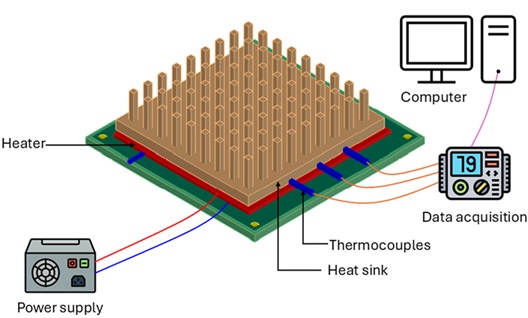
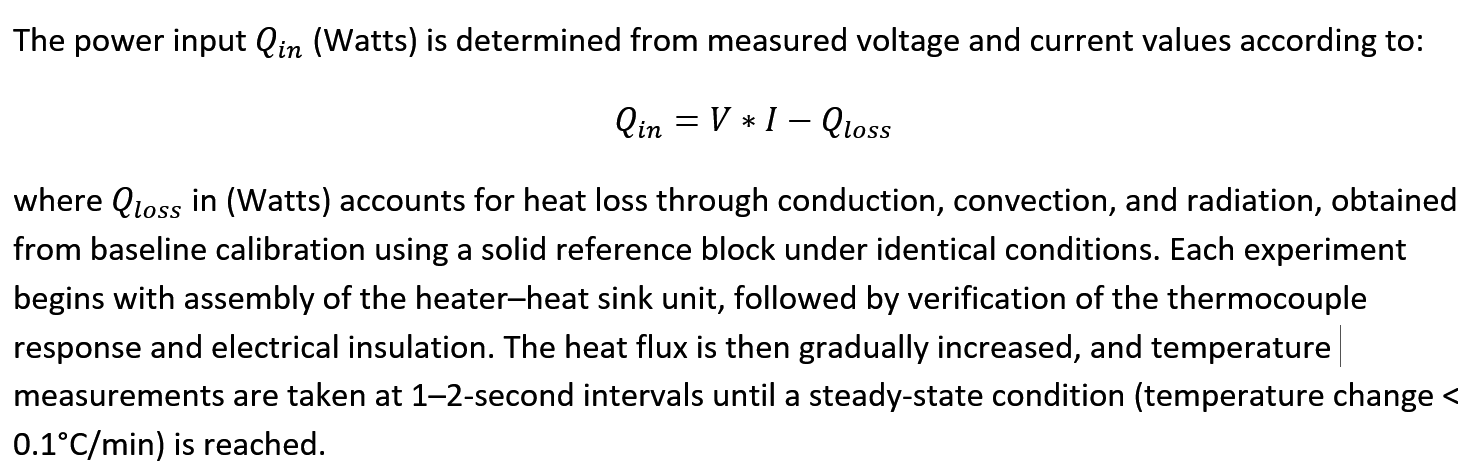
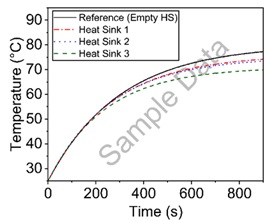
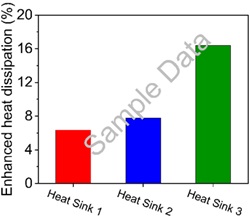
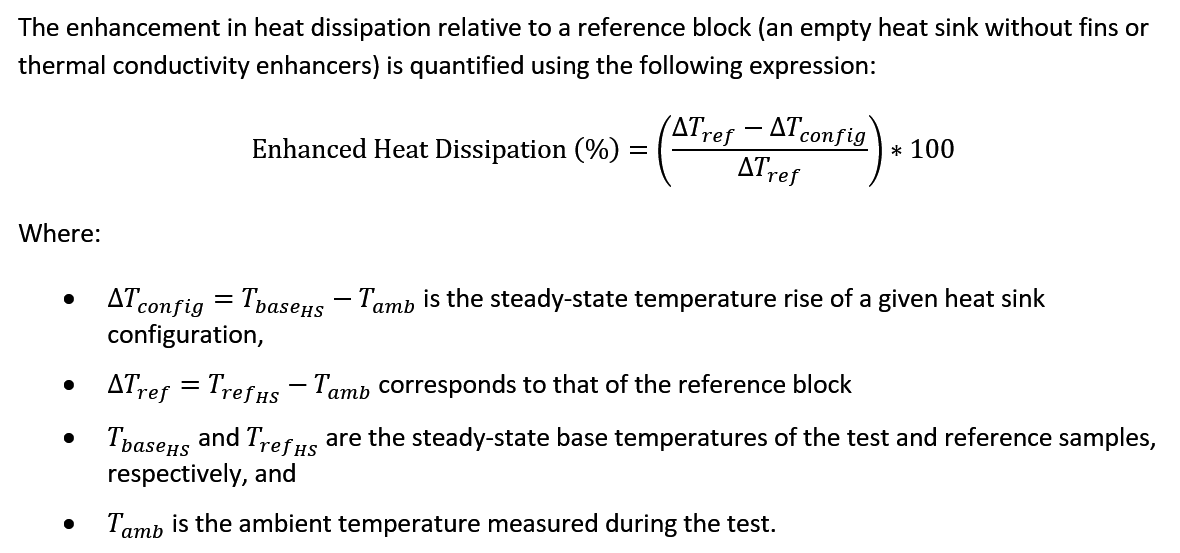
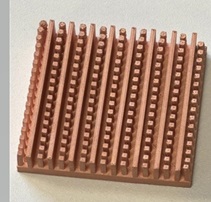
 WHY
WHY