Toolkit: Complex Systems Toolkit.

Authors: Dr. Natalie Wint (University College London); Dr. Mohammad Hassannezhad (University College London); Dr. Manoj Ravi (University of Leeds).

Topic: Complex systems competencies.

Title: Understanding complex systems competencies required in engineering graduates. 

Resource type: Knowledge article.

Relevant disciplines: Any.

Keywords: Systems thinking; Problem-solving; Critical thinking; Digital literacy; Modelling and simulation; Design; Project management; Life cycle; Risk; Collaboration; Communication; Professional conduct; Social responsibility.

Licensing: This work is licensed under a Creative Commons Attribution-ShareAlike 4.0 International License. 

Downloads: A PDF of this resource will be available soon.

Learning and teaching resources:

Who is this article for?: This article should be read by educators at all levels in higher education who are seeking an overall perspective on teaching approaches for integrating complex systems in engineering education. 

Related INCOSE Competencies: Toolkit resources are designed to be applicable to any engineering discipline, but educators might find it useful to understand their alignment to competencies outlined by the International Council on Systems Engineering (INCOSE). The INCOSE Competency Framework provides a set of 37 competencies for Systems Engineering within a tailorable framework that provides guidance for practitioners and stakeholders to identify knowledge, skills, abilities and behaviours crucial to Systems Engineering effectiveness. A free spreadsheet version of the framework can be downloaded. 

AHEP mapping: This resource addresses several of the themes from the UK’s Accreditation of Higher Education Programmes fourth edition (AHEP4). 


Premise:

This article outlines the core competencies required for engineering students to effectively engage with complex systems. Such systems involve a range of technical and non-technical components that interact in non-linear and unpredictable ways. Working effectively with such complex systems requires collaboration across engineering disciplines, as well as other fields and stakeholder groups.  

Within AHEP4, complex problems are referred to as those which “have no obvious solution and may involve wide-ranging or conflicting technical issues and/or user needs that can be addressed through creativity and the resourceful application of engineering science” (p.26). The ability to work productively with complex systems is therefore essential for engineers and helps them address problems increasingly experienced in business and society, which have many interdependent components and lack clear or stable solutions.  

The aim of this article is to provide a foundational framework that integrates the knowledge, skills and attitudes necessary for undergraduate and graduate engineering students to navigate complexity. In so doing, it serves educators, curriculum designers, and students seeking to develop the mindset and skills required to tackle the challenges of the 21st century within an increasingly volatile, uncertain, complex, and ambiguous (VUCA) world (SEFI, 2025).  

This knowledge article, informed by the INCOSE Competency Framework for Systems Engineering (INCOSE, 2018), categorises complex systems competencies into eight core competencies. These competencies encompass mindset and foundations, technical methods and tools, management and delivery, and attributes and behaviours. The description of each competency references learning outcomes (LOs) outlined in AHEP4 (Engineering Council, 2025) and the International Engineering Alliance (IEA) Graduate Attributes (2021) to establish a common baseline for all engineering graduates (see Appendix for mapping).  


The eight core complex systems competencies:

1. Systems thinking and problem framing 

The ability to take a holistic approach, to consider a problem from multiple perspectives and to understand how a system’s parts interact to produce emergent behaviour.  

Students must be able to understand what makes a system ‘complex’ and move beyond narrow problem-solving to identify root causes. This involves understanding fundamental Systems thinking concepts including hierarchies and interfaces (structural dimension), holism and cause-effect (dynamic dimension), lifecycles (time dimension), and multiple perspectives (perception dimension).  

Systems thinking enables engineers to anticipate ripple effects, emergent behaviours, and trade-offs, designing solutions that remain robust under uncertainty. AHEP4 requires students to “formulate and analyse complex problems to reach substantiated conclusions” (LO2) and to “apply an integrated or systems approach to the solution of complex problems” (LO6).  

2. Critical thinking 

The ability to question assumptions, evaluate evidence, apply logical reasoning, and justify decisions based on reasoned arguments and evidence.  

Navigating complex systems involves working with a variety of (often conflicting) goals, information, and data types from across discipline and stakeholder groups. Critical thinking is thus necessary to enable engineers to identify biases, avoid oversimplification and flawed reasoning, and to make ethical, transparent and evidence-informed decisions with consideration for unintended consequences. AHEP4 requires graduates to “critically evaluate technical literature and other sources of information to solve complex problems” (LO4). 

3. Simulation, modelling and data literacy 

The ability to apply scientific, mathematical, and engineering principles to model, test, and improve complex systems.  

Working with complex systems involves a range of resources including people, data and information, tools and appropriate technologies. Students must be able to create, apply and validate system models (as physical, mathematical, or logical representation of systems) and demonstrate competence in simulation and data literacy to address uncertainty and complexity at scale. This may involve using models and data to justify assumptions, explore scenarios, predict the consequences of actions, solve difference equations, conduct sensitivity and stability analysis, and predict the probability of risk.  

This aligns with several AHEP4 outcomes: “apply mathematics, statistics, and engineering principles to solve complex problems” (LO1); “apply computational and analytical techniques while recognising limitations” (LO3); and “select and critically evaluate technical literature and other data sources” (LO4).  

4. Design for complexity and changeability 

The ability to design adaptable, robust, and resilient systems across their lifecycle.  

Changes (both planned and unplanned) are inherent in complex systems. Long-term success of a system therefore requires design for resilience to first hand/internal (by the system), second hand/external (to the system) or third hand (around the system) change. Design for complexity and changeability ensures systems can evolve and integrate new capabilities across their lifecycle.  

AHEP4 requires engineers to be able to innovatively “design solutions that meet a combination of societal, user, business and customer needs” (LO5). This may involve designing systems that deliver required functions over time, including evolution, adaptability, and integration across subsystems (capability engineering), and supports evaluation of alternatives, balance competing objectives, and justify transparent decisions (decision management).  

5. Project and lifecycle management 

The ability to plan and deliver engineering activities across the system lifecycle, ensuring outcomes are delivered on time, on cost, and with integrity.  

Complex systems involve many subsystems with various purposes and lifecycles. This necessitates effective coordination and delivery processes and a focus on early planning and lasting systemic impacts. Project and lifecycle management allows for concurrent engineering (parallelisation of tasks), and verification and validation of tasks in dynamic environments. Graduates must “apply knowledge of engineering management principles, commercial context, project and change management” (AHEP4, LO15).  

This aligns with the Engineering Attribute of Project Management and Teamwork and the INCOSE Framework competencies in Lifecycle Processes, Integration, and Project Management, emphasising coordinated delivery and long-term value creation across socio-technical systems. Lifecycle awareness prevents short-term optimisation and emphasises aspects such as maintainability, whole-life value delivery and total expenditure (TOTEX) thinking, all of which support efforts towards sustainability and net-zero.  

6. Risk and uncertainty management 

The ability to identify, assess, and manage technical, social, environmental, and ethical risks at multiple levels of complex systems.  

Complex systems are inherently uncertain, with cascading risks that must be anticipated and managed proactively. Risk management enables students to quantify source and impact of uncertainties where possible and apply precaution where uncertainty is irreducible, ensuring safety, sustainability, and governance.  

AHEP4 requires graduates to “use a structured risk management process to identify, evaluate and mitigate risks (the effects of uncertainty)” (LO9), ranging from project-specific challenges to systemic threats, which need to “adopt a holistic and proportionate approach to the mitigation of security risks” (LO10).  

7. Collaboration and communication 

The ability to work effectively across disciplines, boundaries, and cultures, while conveying complex insights clearly to technical and non-technical audiences. 

Complex systems challenges cannot be solved by individuals alone and include consideration for stakeholders across industry, policy and society. Such collaborative processes involve participatory problem-solving, learning from others, inclusive communication, and negotiation and persuasion strategies, all of which necessitate emotional intelligence.  

AHEP4 expects graduates to “function effectively as an individual, and as a member or leader of a team, being able to evaluate own and team performance” (LO16). They must be able to influence stakeholder decisions, foster alignment, and shape outcomes across industry, policy, and society (AHEP4, LO17).  

8. Professional responsibility 

The ability to apply professional and societal responsibilities in decision-making, with awareness of ethical implications and long-term impacts and unintended consequences of engineered systems.  

Engineers increasingly work on complex systems that shape lives, societies, and ecosystems. Ethical responsibility ensures that technical competence aligns with social good and involves consideration for trade-offs between factors including environmental impact, affordability and social acceptance. This aligns with AHEP4, IEA, and INCOSE principles on ethics, professionalism, and leadership, ensuring engineers act responsibly within complex systems and contribute positively to society and sustainability. AHEP4 requires graduates to “identify and analyse ethical concerns and make reasoned ethical choices informed by professional codes of conduct” (LO8) and “evaluate the environmental and societal impact of solutions to complex problems” (LO7).  


Conclusions:

This article defines a set of eight integrated competencies that prepare engineering graduates to navigate complex systems. Together, they combine knowledge (what graduates must know), skills (what they can do), and attitudes (how they behave and think). Embedding these competencies requires project-based learning, interdisciplinary collaboration, and reflective exercises, while assessment should include portfolios, teamwork, and scenario analysis. Employers and professional bodies can reinforce these competencies through mentoring, internships, and early career development. 

By aligning with INCOSE, AHEP4, and IEA GA frameworks (see Appendix for mapping), this guidance provides an internationally consistent foundation that can be adapted to local contexts, equipping engineering graduates to address complex, interdependent challenges of the 21st century with competence, integrity, and resilience.  


Appendix:  

Mapping between Eight Core Competencies and Standard frameworks 

Proposed Core Competency   INCOSE * AHEP4 ** IEA GA *** 
Systems Thinking & Problem Framing ST LO2, LO6 WA2
Critical Thinking   CT LO4 WA4, WA11 
Simulation, Modelling & Data Literacy  IM, SM  LO1, LO3, LO4  WA1, WA4, WA5
Design for Complexity & Changeability  CP, DM, DF LO5  WA3 
Project & Lifecycle Management   LC, PL, CE, CP  LO15  WA10 
Risk & Uncertainty Management  CE, PL, RO  LO9, LO10
Collaboration & Communication   CC, TD, TL, EI  LO16, LO17  WA8, WA9 
Professional Responsibility  EI, EP  LO7, LO8  WA6, WA7 


* INCOSE Competency Framework, 2nd edition (2018) 

** AHEP4 Learning Outcome (LO) (2025) 

*** International Engineering Alliance (IEA) Graduate Attributes (GA) (2021) 


CC = Communications 

CE = Concurrent Engineering  

CP = Capability Engineering 

CT = Critical Thinking 

DF = Design For … 

DM = Decision Management 

EI = Emotional Intelligence 

EP = Ethics and Professionalism 

IM = Information Management 

LC = Life Cycle 

LO = Learning Outcome 

PL = Planning 

RO = Risk and Opportunity Management 

TD = Team Dynamics 

TL = Technical Leadership 

SM = Systems Modelling and Analysis 

ST = Systems Thinking 

WA = Washington Accord 


References:


Any views, thoughts, and opinions expressed herein are solely that of the author(s) and do not necessarily reflect the views, opinions, policies, or position of the Engineering Professors’ Council or the Toolkit sponsors and supporters.  

Toolkit: Complex Systems Toolkit.

Author: Milan Liu, Ph.D. Candidate (Cranfield University); Dr. Lampros Litos (Cranfield University). 

Topic: Towards circular economy: development of systems-based interventions in complex systems.

Title: Improving metal recycling and recycled content intake.

Resource type: Guidance article.

Relevant disciplines: Any; Production and manufacturing engineering.

Keywords: Recycled materials; Circular economy; Socio-technical systems; Waste management; Life cycle; Sustainability.

Licensing: This work is licensed under a Creative Commons Attribution-ShareAlike 4.0 International License. 

Downloads: A PDF of this resource will be available soon.


Who is this article for?: This article should be read by educators at all levels of higher education looking to highlight the connection between complex systems and sustainability within engineering learning. 

Related INCOSE Competencies: Toolkit resources are designed to be applicable to any engineering discipline, but educators might find it useful to understand their alignment to competencies outlined by the International Council on Systems Engineering (INCOSE). The INCOSE Competency Framework provides a set of 37 competencies for Systems Engineering within a tailorable framework that provides guidance for practitioners and stakeholders to identify knowledge, skills, abilities and behaviours crucial to Systems Engineering effectiveness.  A free spreadsheet version of the framework can be downloaded.

This resource relates to the Systems Thinking, Life Cycles, Capability Engineering, Systems Modelling and Analysis, and Design INCOSE competencies.

AHEP mapping: This resource addresses several of the themes from the UK’s Accreditation of Higher Education Programmes fourth edition (AHEP4): Analytical Tools and Techniques (critical to the ability to model and solve problems), and Integrated / Systems Approach (essential to the solution of broadly-defined problems). In addition, this resource addresses AHEP themes of Materials, equipment, technologies and processes, and Sustainability.  


Learning and teaching resources:

Resource  Type  Best for  Quick classroom use  URL 
Insight Maker  Web-based modelling tool  Building stock-and-flow models and simple simulations  Convert the aluminium CLD into stocks/flows and run a scenario  https://insightmaker.com 
Loopy  Interactive causal-loop diagram app  Fast, visual CLDs and in-class demonstration of loop behaviour  Live demo of reinforcing vs balancing loops; students toggle link polarities  https://ncase.me/loopy 
Vensim PLE  Free desktop system-dynamics software  Introductory quantitative modelling and sensitivity runs  Short lab: implement simplified aluminium-recycling model and compare policy scenarios  https://vensim.com/free-download/ 
Leverage Points (Meadows)  Concept primer on leverage points  Framing where to intervene in systems  Assign as required reading; students map which leverage points the CLD targets  https://donellameadows.org/archives/leverages-points-places-to-intervene-in-a-system/ 
MIT  System Dynamics materials  Course notes and lecture videos  Structured curriculum and worked examples for deeper study  Use selected lectures and problem sets for follow-up or flipped classroom  https://ocw.mit.edu/courses/15-871-introduction-to-system-dynamics-fall-2013/  


Premise:

Several sustainability challenges, such as transitioning to a circular economy, are embedded in complex socio-technical systems. A circular economy is an economic model that replaces the linear take-make-dispose pattern with systems that keep materials and products in use for longer through designing for durability, reuse, remanufacturing, and recycling, while minimising waste and regenerating natural systems (Rizos, Tuokko, and Behrens, 2017).   

Complex systems like these exhibit feedback loops, delays, non-linear change, path dependence and emergent behaviour (Sterman, 2000; Meadows, 2008). This article introduces the idea of systems-based interventions using the example of aluminium recycling systems. It is designed for engineering educators who plan to provide learners with a baseline understanding of complexity and practical entry points for designing and developing and evaluating interventions that can move a system towards sustainability. 


Complexity of aluminium recycling systems:

Aluminium is infinitely recyclable, yet achieving truly closed material loops at scale remains a challenge. Most of today’s recycling occurs in situations where post-consumer scrap is collected from a wide variety of end-of-life products and the boundaries of the recycling system are difficult to define and control. This creates high variability in both the composition and the quality of recovered aluminium, since different products contain different alloys and levels of contamination (IRT M2P, 2023). At the same time, the volume of available scrap is difficult to predict, as it depends on product lifespans and consumer behaviour. These fluctuations make it harder for producers to plan and optimise secondary aluminium output, particularly when industries rely on consistent standards or just-in-time manufacturing. 

The recycling system is also shaped by broader economic and regulatory forces. On the one hand, demand for low-carbon materials and the cost advantage of recycled over primary aluminium are powerful drivers of growth. On the other hand, the system faces constraints from volatile scrap prices and shifting global trade dynamics, such as U.S. tariffs on aluminium imports. Meanwhile, new policy instruments are adding further complexity. The EU’s Carbon Border Adjustment Mechanism (CBAM) is set to reshape trade flows and investment patterns, while the forthcoming Digital Product Passport (DPP) will transform how information is shared across the value chain. Together, these forces influence technologies, markets and business models, underscoring the dynamic and interconnected nature of aluminium recycling. 

These interconnected factors highlight aluminium recycling as a complex socio-technical system, in which technological capabilities, market incentives, policy frameworks, and global trade are deeply interconnected. For educators, this makes aluminium an effective example for teaching students how multiple forces interact to create both opportunities and challenges for sustainable engineering. 


Intervention from systems perspective:

System Dynamics (SD), first formalised by Forrester (1968), has proven to be a highly valuable approach for understanding and managing complex resource and recovery systems. SD is an interdisciplinary approach, drawing on insights from psychology, organisational theory, economics, and related fields (Sterman, 2000). More supporting information about SD pedagogical tools and techniques can be found through the System Dynamics Society and Insight Maker. 

From a systems perspective, interventions are not isolated events but strategic effort to influence system behaviour by targeting its structure and dynamics. A key concept here is leverage points – places within a complex system where small changes can lead to significant, systemic effects (Meadows, 1999). Meadows identified twelve types of leverage points, ranging from adjusting parameters to transforming the system’s underlying goals and paradigms, proving a conceptual framework for identifying impactful intervention. 

Figure 1. Donella Meadows’ leverage points (Source: based on Meadows (1999); credit: UNDP/Carlotta Cataldi; reproduced from Bovarnick and Cooper (2021)) 


Exploration of potential leverage points: 

System Dynamics (SD) tools such as Causal Loop Diagrams (CLDs) can help explore leverage points. CLDs can help visualise main components of a system and their interdependencies, making complex dynamics easier to understand. Besides, the process of building a CLD or more computational SD model encourages practitioners to clarify system boundaries, relationships, and drivers, laying the foundation for identifying leverage points. 

For example, a CLD of aluminium recycling might capture how classification and sorting processes influence scrap quality, which then affects remelting efficiency and ultimately market uptake of recycled alloys (see Figure 2 below). 


Figure 2. The causal loop diagram for auto aluminium recycling (Liu et al., 2025) 

By tracing these circular cause-and-effect relationships, learners can see where interventions may ripple through the system. Highlighting reinforcing loops, balancing loops, and delays also shows why some interventions produce limited short-term results but more substantial long-term effects. 

Leverage points can also be examined through the lens of information, rules, and goals. Improved information flows, such as those enabled by the Digital Product Passport, could reshape how scrap is sorted and valued. Rules, such as alloy specifications or trade tariffs, determine what types of recycled material can enter the market. At a deeper level, the goals of the system, whether to maximise throughput or to retain material value, fundamentally shape behaviour. Here too, CLDs are valuable because they allow users to visualise how changes to information, rules, or goals can shift system dynamics, providing a clearer picture of where interventions might be most effective. 


Implication for educators: 

This article equips educators with a focused, practical pathway to teach systems thinking through the example of aluminium recycling. Students can gain both conceptual understanding and hands-on skills to map feedback loops, identify delays, and design interventions that account for short-term trade-offs and long-term system behaviour. Teaching a single clear CLD followed by one modelling or scenario activity produces measurable learning gains while keeping the task accessible for beginners. 


Educational approach: 


Potential related learning outcomes within this topic: 


Further resources: 


References 


Any views, thoughts, and opinions expressed herein are solely that of the author(s) and do not necessarily reflect the views, opinions, policies, or position of the Engineering Professors’ Council or the Toolkit sponsors and supporters. 

Toolkit: Complex Systems Toolkit.

Authors: Dr Neil Carhart, University of Bristol; Dr. Francesco Ciriello, King’s College London; Richard Beasley, RB Systems.

Topic: Definitions of key terms relevant to Engineered Complex Systems.

Title: Engineering complex systems glossary. 

Resource type: Knowledge article.

Relevant disciplines: Any.

Keywords: Definitions; Emergence; Systems.

Licensing: This work is licensed under a Creative Commons Attribution-ShareAlike 4.0 International License. 

Downloads: 

Who is this article for?: This article should be read by educators at all levels in higher education who are seeking an overall perspective on teaching approaches for integrating complex systems in engineering education. 

Related INCOSE Competencies: Toolkit resources are designed to be applicable to any engineering discipline, but educators might find it useful to understand their alignment to competencies outlined by the International Council on Systems Engineering (INCOSE). The INCOSE Competency Framework provides a set of 37 competencies for Systems Engineering within a tailorable framework that provides guidance for practitioners and stakeholders to identify knowledge, skills, abilities and behaviours crucial to Systems Engineering effectiveness. A free spreadsheet version of the framework can be downloaded. 

This resource relates to the Systems Thinking and Critical Thinking INCOSE competencies. 

AHEP mapping: This resource addresses several of the themes from the UK’s Accreditation of Higher Education Programmes fourth edition (AHEP4): Analytical Tools and Techniques (critical to the ability to model and solve problems), and Integrated / Systems Approach (essential to the solution of broadly-defined problems).  


Premise: 

This document aims to provide definitions of key terms regarding engineered complex systems.  

There are many existing relevant glossaries (for example, the Systems Engineering Body of Knowledge or SEBoK) so we have implemented a process to select a curated list of 14 common terms that are fundamental when considering the idea of complexity in engineered solutions, and therefore of importance to educators in this space. Rather than adding new definitions for each term we offer appropriate and accessible definitions from the literature, together with commentary exploring wider context and consideration where relevant.  


Approach: 

Some care is needed when using any definition around terms relating to complexity – because complexity itself is complex. There are multiple valid perspectives and so any one definition is unlikely to capture the totality of nuance and satisfy the variety of viewpoints. The process for selecting these terms involved collating an initial long list for potential inclusion, along with the ways in which each has been previously defined. These are provided as a supplementary annex to the main glossary. The method is further described in the following sub-section.  

An initial list of potential terms to define was generated by cross-referencing existing glossaries. Terms that occurred in multiple glossaries were included in the long list. The definitions of these terms were extracted from these existing glossaries and are cited in the references. In addition, the relationship to the INCOSE Competencies is shown. The range of potential terms, and the variety of definitions that already exist, illustrate the complexity of describing complexity!  

The authors used three categorisations of the definitions to help further group and classify the terms. The following categories are tagged to relevant terms in the glossary: 

1. Property – whether or not the term describes a property applied to systems; 

2. Principle – whether or not the term represents a principle that should be used when engineering complex situations or systems; 

3. Approach – whether or not the term represents an approach, or element of an approach that should / could be used when engineering complex situations or systems. 

Finally, explanatory commentary was added to most definitions to more specifically address an engineering education context.  


Glossary:


Architecture 

Definition: “an abstract description of the entities of a system and the relationship between those entities.” Crawley et al. (2016) System Architecture: Strategy & Product Development for Complex Systems


Boundary 

#Property #Principle 

Definition: “Define the system to be addressed. A description of the boundary of the system can include the following: definition of internal and external elements/items involved in realizing the system purpose as well as the system boundaries in terms of space, time, physical, and operational. Also, identification of what initiates the transitions of the system to operational status and what initiates its disposal is important.” NASA (2007) NASA Systems Engineering Handbook, p304 

Commentary: The boundary defines the scope of the system being considered, and by implication, what sits outside of the system. As such, it is critically important to define the boundary of the system-of-interest. When dealing with complex systems this can be a challenging task and may even benefit from acknowledging multiple boundaries (e.g. physical, spatial, functional, logical etc.). For example, the boundary of the physical elements of a system could be considered within a wider boundary of the problem space.  


Complexity 

#Property 

Definition: “A complex system is a system in which there are non-trivial relationships between cause and effect: each effect may be due to multiple causes; each cause may contribute to multiple effects; causes and effects may be related as feedback loops, both positive and negative; and cause-effect chains are cyclic and highly entangled rather than linear and separable.” INCOSE (2019) INCOSE Systems Engineering and Systems Definitions 

Commentary: Early conceptions of complexity emphasised the difficulty in understanding, predicting or verifying the behaviours of a system. A key distinction arising from this is the complicated and complex are not synonymous.  This concept of the difficulty in predicting behaviours is reflected in the definitions of the NASA Systems Engineering Handbook, SEBoK and ISO 24765. This is the key resultant consideration but does not describe the underlying property which causes this difficulty. While this definition relates more to complex systems than complexity, it is chosen for the way in which it goes beyond the consequences of complexity.  


Coupling 

#Property #Principle 

Definition: “Coupling […] means to fasten together, or simply to connect things […] Coupling suggests a relationship between connected entities. If they are coupled, in some way they can affect each other […] For the system to be useful, its components have to be connected – coupled – so that they can work together. That said, putting them together arbitrarily won’t do the trick. The components have to be coupled in a way that achieves the goals of the system. Not only is coupling the glue that holds a system together, but it also makes the value of the system higher than the sum of its parts.” Khononov (2024) Balancing Coupling in Software Design: Universal Design Principles for Architecting Modular Software Systems, Ch1 

Commentary: Coupling is a very important concept. It is the interconnection and interdependence that makes the system more (or less) than the sum of its parts. Standard Systems architecture advice is to minimise coupling between system elements (or between the systems in a system-of-systems). This is because high coupling correlates to higher structural complexity, reduced resilience and flexibility in the system, and introduces challenges for modularity in the system design. Lower or looser coupling means changes in one part of the system (in design or operation) are less likely to induce or require changes in another part. However, this lower coupling is not always possible and may be necessary to improve system performance (for example communication through intermediate layers in a system to reduce coupling can introduce unacceptable amounts of overhead and latency in the system). In design terms, high coupling between system elements means that those elements cannot be designed independently.  


Emergence 

#Principle 

Definition: “As the entities of a system are brought together, their interaction will cause function, behaviour, performance and other intrinsic (anticipated and unanticipated) properties to emerge… Emergence refers to what appears, materializes, or surfaces when a system operates.” Crawley et al. (2016) System Architecture: Strategy & Product Development for Complex Systems 

Commentary: It is worth noting that Crawley et al. (2014) go on to add “As a consequence of emergence, change propagates in unpredictable ways. System success occurs when anticipated emergence occurs, while system failure occurs when anticipated emergent properties fail to appear or when unanticipated undesirable emergent properties appear.” This emergence that gives rise to the difficulty in understanding, predicting or verifying the behaviours of a system (see Complexity).


Form 

#Property 

Definition: “The shape, size, dimensions, mass, weight, and other measurable parameters which uniquely characterize an item.” SAE International (2019) ANSI/EIA-649C 


Function 

#Principle #Approach 

Definition: “A function is defined as the transformation of input flows, with defined performance targets for how well the function is performed in different conditions. A function usually has logical pre-conditions that trigger its operation. ”Systems Engineering Body of Knowledge v2.12 (2025)  

Commentary: In general usage it is common to hear reference to ‘Form and Function’ in tandem, but it is the distinction between them and their relationship to one another that is important to engineering complex systems. Thinking in terms of functionality is a good way of abstracting the system to define what it does (or is needed to do) rather than what it is (and therefore by extension its form).  Functions are normally allocated to single sub-elements of the system.  Complexity arises at functional interfaces, or when different elements perform the same function. Thinking in terms of functionality encourages creativity as designers consider all the different ways in which the function could be performed – and then apply requirement constraints to choose the best/most feasible option.  Thinking in terms of “objects” first constrains design by presupposing the solutions.  Equally, when the solution goes wrong, thinking in terms of what function is failing and why, rather than focusing on a failed part allows identification of the true root cause. Organisations also have functions (such as Engineering, Human Resources, etc.) as a group of roles that perform a specific set of activities. This is important for considering the organisation/System that creates the engineered solution (which is itself a complex system, but secondary to the main application of the idea of function). 


Iteration 

#Approach 

Definition: “Iteration is used as a generic term for successive application of a systems approach to the same problem situation, learning from each application, in order to progress towards greater stakeholder satisfaction.” Systems Engineering Body of Knowledge v2.12 (2025)  


Lifecycle  

#Property #Principle #Approach 

Definition: “The evolution of a system, product, service, project or other human-made entity from conception through retirement.” ISO (2024) ISO/IEC/IEEE 24748-1:2024 

Commentary: Understanding the lifecycle of an engineered artefact is very important. Issues arising in later stages (e.g. production, support/maintenance, upgrade and disposal) must be considered during the system’s initial development. In a system-of-systems or a capability system a significant source of complexity is the fact that different system elements have different lifecycles, and so may change or be changed independently of other elements with which they may interact or interdepend.  


Model 

#Approach 

Definition: “An abstraction of a system, aimed at understanding, communicating, explaining, or designing aspects of interest of that system” Dori, D. (2003) Conceptual modelling and system architecting, p286 

Commentary: An abstraction is a simplification. The selection of what to exclude, what to include, and at what level of granularity to depict it, is informed by the purpose of the model and the point of view from which it is created. Models do not have to be quantitative, nor is their purpose exclusively analytical. 


Stakeholder 

Definition: “A group or individual who is affected by or has an interest or stake in a program or project.” NASA (2019) NASA Systems Engineering Handbook SP-2016-6105 (Rev. 2) 

Commentary: It is worth noting the potential difference between a stakeholder of the project that develops the system, and a stakeholder of the system that is developed.  


System 

#Principle #Approach 

Definition: “A system is an arrangement of parts or elements that together exhibit behaviour or meaning that the individual constituents do not.” INCOSE (2019) INCOSE Fellows Briefing to INCOSE Board of Directors, January 2019 

Commentary: There are many similar definitions of a system, each may offer a slightly different phrasing which can resonate better with different individuals. The origins of this definition is explained in the Systems Engineering Body of Knowledge. In assessing complexity in engineered system, the concept of “systems” is of course of key value.  There are two important aspects two consider: 

1) Many schools of Systems Science argue that systems do not actually exist (apart from perhaps the complete universe) – they are defined for the convenience of consideration, and so the definition of the boundary of the “system of interest” is both important and somewhat arbitrary. As such, the system-of-interest can have multiple useful boundaries.  While it might be possible to identify and articulate the physical boundary of an engineered artefact (and it should be acknowledged), it might not be the most useful boundary to consider.  

2) The point of defining a “system of interest” includes being able to consider it as a system and so use the properties seen in systems (boundary, interface with outside, affected by/affecting environment, made up of parts, part of something larger, has a lifecycle, seen differently by different people (with different perspectives), are dynamic, exhibit emergence etc.) as a “framework for curiosity” (as the INCOSE SE competency framework defines systems thinking).

In engineered systems (rather than natural systems) it is important to distinguish between purpose (what those engineering or creating it want it do) and emergence (what it actually does). 


Systems Engineering 

#Principle #Approach 

Definition: “Systems Engineering is a transdisciplinary and integrative approach to enable the successful realization, use, and retirement of engineered systems, using systems principles and concepts, and scientific, technological, and management methods.” INCOSE (2019) INCOSE Systems Engineering and Systems Definitions 


Systems Thinking 

#Approach 

Definition: “Systems thinking is thinking about a question, circumstance, or problem explicitly as a system – a set of interrelated entities.” Crawley et al. (2016) System Architecture: Strategy & Product Development for Complex Systems 

Commentary: Crawley et al (2016) go on to add “This means identifying the system, its form and function, by identifying its entities and their interrelationships, its system boundary and context, and the emergent properties of the system based on the function of the entities, and their functional interactions.”  


References:


Any views, thoughts, and opinions expressed herein are solely that of the author(s) and do not necessarily reflect the views, opinions, policies, or position of the Engineering Professors’ Council or the Toolkit sponsors and supporters.  

Toolkit: Complex Systems Toolkit.

Author: Mariam Makramalla, PhD, FRSA (New Giza University).

Topic: Integrating complex systems learning outcomes in engineering curricula.

Title: How to scaffold complex systems learning outcomes across a curriculum.

Resource type: Guidance article.

Relevant disciplines: Any.

Keywords: Learning outcomes; Pedagogy; Curriculum; Curriculum map; Critical thinking; Problem-solving; Life cycle; Decision-making . 

Licensing: This work is licensed under a Creative Commons Attribution-ShareAlike 4.0 International License. 

Downloads:

Who is this article for?: This article should be read by educators at all levels of higher education looking to embed and integrate complex systems topics into curriculum, module, and / or programme design.   


Premise: 

Teaching and learning engineering carries with it a double layer of complexity. On the one hand, this complexity is connected to the growing interdisciplinary nature of engineering itself. On the other hand, the complexity is connected to the growing diversity of engineering students that are often present in one project team. This multifaceted complexity requires a re-envisioned understanding of the role and purpose of the engineering educator.  

With the growing trend of a global classroom reality, we often find that learners in the classroom are representing different cultures, which in turn are rooted in them unconsciously carrying historical and socio-cultural baggage relating to these cultures. Thus, it becomes crucial to unpack the challenge and potential that such a diverse collective intelligence can offer to an engineering learning experience.  

As our understanding of the engineering discipline gets more rooted and interconnected with the precarious reality that our world is witnessing today, it becomes essential that the engineering education community would take up a proactive role in actively contributing to the formation of engineering citizenship. In other words, every engineering student should be educated as a citizen that has mastered the engineering cross-cutting fields in such a way that they are free to create and solve problems of the present and the future.  

With this in mind, it becomes very clear that the one-size-fits all model of a single discipline engineering classroom can no longer sustain itself. It does not factor in the richness that a diverse student body can offer, and it dilutes the value and potential of an engineering learner to think clearly or solve problems. It is therefore imperative that engineering educators grasp the complex reality of an integrated engineering discipline and address it in a way that fosters scaffolding of diverse knowledge. Some students might specialise in one core technical discipline. Yet, future projections for most students showcase the need to have a wide level of exposure to broader competency development. Students need to learn to understand the field of engineering at large and to develop system thinking skills that enable them to exist, challenge and have an impact on the system that they are a part of.  


How to scaffold learning outcomes in a complex engineering curriculum:

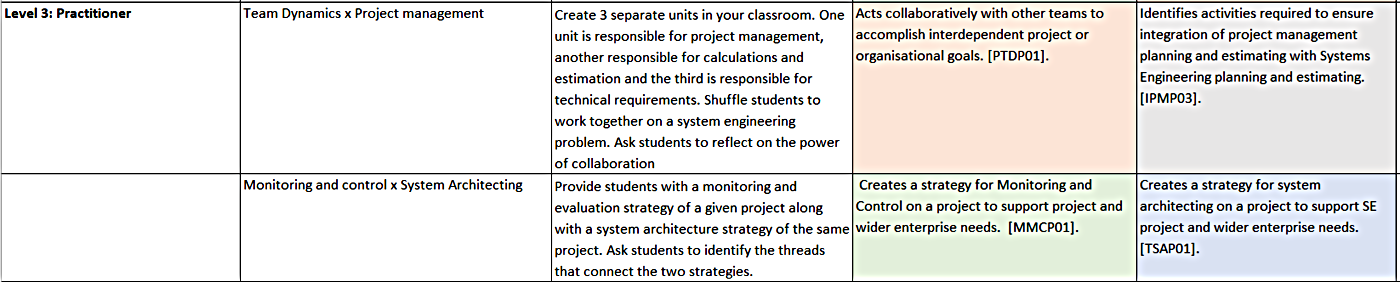
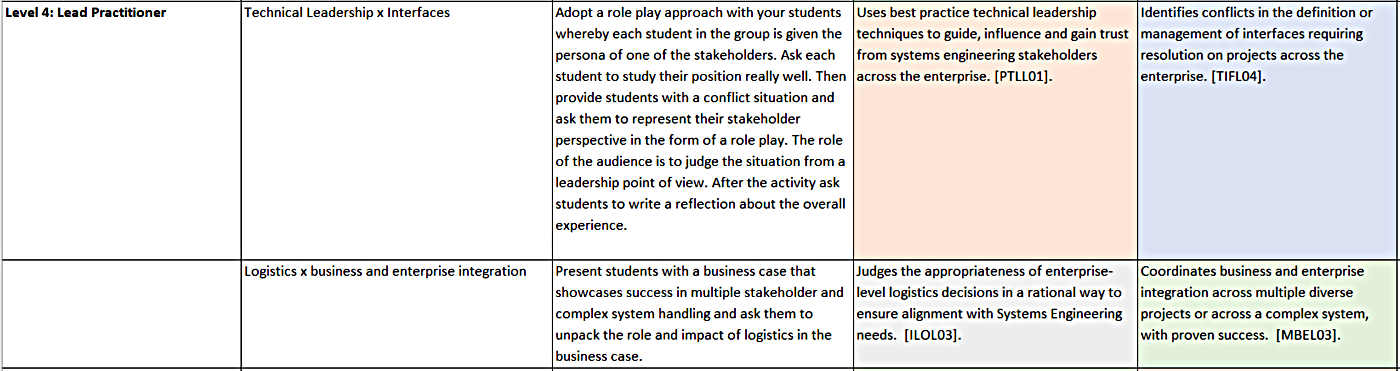
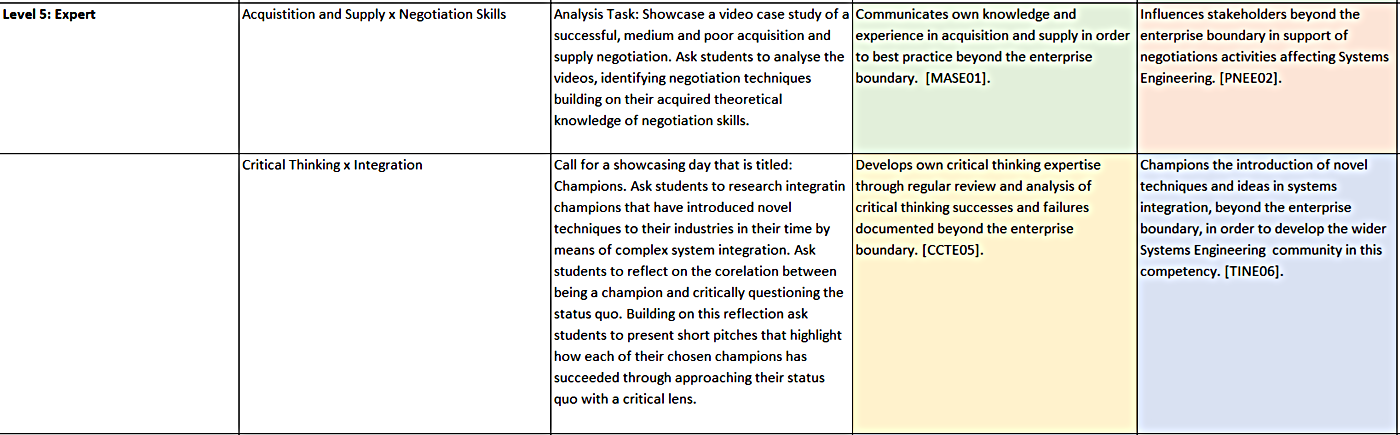
The below table has been designed for embedding Complex Systems Learning Outcomes across an engineering curriculum. It maps against competencies and suggests scaffolding techniques across educational levels. It is also important to note, that efforts need to be made to align to the relevant AHEP requirements or other accreditation standards. Table 1 presents the different strands of the Complex Systems Engineering Curriculum, colour coded in line with the INCOSE Competency Framework outline (INCOSE, 2025). Table 2 presents a practical guide for educators to scaffold Complex Systems learning outcomes across a curriculum. The intention is for the scaffolding framework to compare the trade-offs between different elements of the competency group. For example, system modelling and analysis as an element from the core competency and planning from the management competency. The table suggests activities that would integrate different competencies together in a scaffolded approach.  

Table 1. Competency Areas for Complex Systems (INCOSE, 2025).

Table 1 presents Competency Areas for Complex Systems. As mentioned, the skills range to include a wide variety of competencies, thereby enabling a solid and grounded systems thinking approach for students. As students approach their learning, they go through a series of development stages that gradually build up student level of expertise until they reach the stage of what the INCOSE competency framework refers to as a lead practitioner role. Building on the competencies of the complex system toolkit presented in Table 1, Table 2 presents a potential outline for a scaffolding framework that maps varying threads of the framework in a way that enables scaffolded activities at every developmental stage for learners. Depending on the learning context and educational level, educators can choose which level of attainment is appropriate to their curriculum.  

Table 2. Scaffolding Complex Systems Learning Outcomes across the curriculum 


Discussion and next steps:

As we are approaching the fuzzy front end to complexity in engineering pedagogy, as educators we need to be constantly toggling between devising frameworks, being informed by literature, contextualising ideas, validating these in our classrooms and repeating this cycle to continually fine-tune our complex teaching navigational complexity framework. The invitation is open for all educators who would like to connect as we continue to explore different ways of developing responsible engineers who leave a lasting and sustainable mark transforming their stationed realities.  


References:


Any views, thoughts, and opinions expressed herein are solely that of the author(s) and do not necessarily reflect the views, opinions, policies, or position of the Engineering Professors’ Council or the Toolkit sponsors and supporters.  


Toolkit: Complex Systems Toolkit.

Author: Dr. Rebecca Margetts (Nottingham Trent University).

Topic: The importance of teaching and learning about complex systems.

Title: The real world is a complex system.

Resource type: Knowledge article.

Relevant disciplines: Any.

Keywords: Problem solving; Feedback loops; Decision-making; VUCA; Optimisation; Public health and safety; Risk; Sustainability; Ethics; Responsible design; Life cycle; Societal impact; Enterprise and innovation.

Licensing: This work is licensed under a Creative Commons Attribution-ShareAlike 4.0 International License. 

Downloads: 

Learning and teaching resources:

Who is this article for?: This article should be read by educators at all levels in higher education who are seeking an overall perspective on teaching approaches for integrating complex systems in engineering education. 

Related INCOSE Competencies: Toolkit resources are designed to be applicable to any engineering discipline, but educators might find it useful to understand their alignment to competencies outlined by the International Council on Systems Engineering (INCOSE). The INCOSE Competency Framework provides a set of 37 competencies for Systems Engineering within a tailorable framework that provides guidance for practitioners and stakeholders to identify knowledge, skills, abilities and behaviours crucial to Systems Engineering effectiveness. A free spreadsheet version of the framework can be downloaded.

This resource relates to the Systems Thinking and Critical Thinking INCOSE competencies.

AHEP mapping: This resource addresses several of the themes from the UK’s Accreditation of Higher Education Programmes fourth edition (AHEP4):  Analytical Tools and Techniques (critical to the ability to model and solve problems), and Integrated / Systems Approach (essential to the solution of broadly-defined problems). 


Premise: 

We live in a complex world. Complexity is a key challenge, captured in leadership terms by the VUCA framework: volatile, uncertain, complex and ambiguous (Lanucha 2024). Engineers have the privilege of creating products and processes for humans to use in this landscape. Each of these likely has numerous parts which interact, as well as interacting with the environment, people, and needing to meet a host of safety, quality, sustainability, ethics, and financial obligations. Traditionally, engineers analyse problems by breaking them down into simple parts. This helps understanding and makes calculations feasible, but it’s easy to lose understanding of the whole system. Any change can easily create a problem elsewhere. From a technical viewpoint, engineers need to understand this interconnectedness in order for their creations to work. In a wider sense, ‘systems thinking’ is a skill central to engineering quality and management techniques, which seek to rationalise the complexity of entire organisations and their ever-changing market pressures.  


The case for understanding systems: 

Systems is perhaps one of the most misunderstood words in engineering. It is often found combined with mathematical modelling or control – topics often perceived as challenging – and is used in other fields like Computer Science, where tools and models are different. In all cases, the idea revolves around a group of interacting or interrelated elements which form a unified whole. Those elements can be physical or information, hardware or software, or any combination of mechanical, electrical, and other engineering domains. Thinking in terms of systems can therefore be thought of as a holistic approach.  

The Engineering Council UK’s AHEP criteria include a systems approach: C/M6 – “Apply an integrated or systems approach to the solution of complex problems.” Several other AHEP criteria also reference complexity and complex problems, which they define as having “no obvious solution and may involve wide-ranging or conflicting technical issues and/or user needs that can be addressed through creativity and the resourceful application of engineering science. The Systems Thinking Alliance (2025) gives a broader definition of complexity as referring to “the condition of systems, objects, phenomena, or concepts that are challenging to understand, explain, or manage due to their intricate and interconnected nature. It involves multiple elements or factors that interact in unpredictable ways, often requiring significant information, time, or coordinated efforts to address.” For these, there is no ‘one-size-fits-all solution’ (Ellis 2025). This is the reality that engineers need to manage by understanding the potential effects on all parts of the system. 

In order to analyse, engineers dissect complexity into manageable components, and educators teach these simple components before moving onto more complex systems. For example, students initially learn basic electrical components, simple beams, rigid bodies, etc. before bringing these together in case studies, and then moving onto topics like mechatronic systems. Historically, engineers specialised on graduation, perhaps becoming a stress engineer or fluid dynamicist in dedicated offices and functional teams.  A design decision by one team could have unintended consequences for another, as well as additional uncertainty. The advent of cross-functional project and ‘matrix’ organisations mitigated against this, and companies have moved towards attribute teams which can consider the balance of behaviour. Even so, some uncertainty remains in the form of assumptions in calculations, changes in material properties with temperature or stress, or small variations in composition and manufacturing tolerances, which can all accumulate. Any parts which are bought ‘off-the-shelf’ or made by other companies under license must be carefully specified. Relationships can be nonlinear – or even chaotic – and contain feedback loops which can amplify changes (Kastens et al 2009). This all increases the risk of a product’s comfort, performance, and safety being impacted in ways that weren’t anticipated. Any problem that doesn’t come to light until the testing phase – late in the design process – represents costly redesigns and delays. In the unlikely event that a problem isn’t captured during testing either, the outcome could be disastrous. 

Systems engineers will bring the product together and establish these complex behaviours through models and testing. Identifying potential problems early in the design phase can save significant money and facilitate better designs. This can be challenging, especially for systems using novel materials or operating in extreme environments, which aren’t accurately captured by standard calculations. Models may be linearised, neglect external forcing, or be derived for an assumed air density or ambient temperature which may not be valid. In recent decades, the engineering industry has moved towards model-based design and virtual prototyping, facilitated by advances in computer tools. These are increasingly sophisticated, but models still need to be built by engineers with an appreciation of complexity and the mechanisms by which a problem could arise. As humans develop new materials and technologies, and explore the limits of what is possible, engineering techniques and calculations need constant revision, and software tools are frequently updated to facilitate this.  

That holistic view of problems has benefits outside of designing engineering artefacts. The manufacturing process is itself a complex system with potentially long supply chains. As is the organisation, which is comprised of numerous people operating in a landscape of financial pressures, employment law, politics and culture. Quality guru William Deming’s 14 Points for Management (Deming 2018) can be viewed as a systems approach to handling this complexity, by breaking down barriers between departments and instigating continuous improvement. Once a product is produced, it exists in a wider world and continues to interact with it. From a sustainability viewpoint, this can be the user and surrounding community, the environmental impact over a product’s lifecycle, and the financial markets which dictate whether a product is viable. It can also be the social, political, and legal landscapes: these can place direct constraints in the forms of laws governing safety and emissions (such as the UK’s legally binding target of net zero by 2050), or through embargos, tariffs, and subsidies. Each country has its own regulations, which can necessitate multiple variations of a product: a good example is cars, which need to be produced in both left- and right-hand drive, satisfy varying safety and emissions regulations, and cater for differing personal and cultural preferences for size, noise, usage and driving styles. Even when not legislated, a company might choose to support fair trade, lead the way in sustainable practices, or refuse to do business with suppliers or regimes they find objectionable – potentially making this a key part of their brand.  

An engineer’s ability to appreciate and understand the wider social and business landscape is a reason why finance and management consultancy companies can often be seen recruiting engineers at student careers fairs. The Sainsbury Management Fellowship (SMF) scheme notably develops UK engineers as industry leaders, and fellows have made a major contribution to the UK’s economic prosperity (RAEng 2025). 


Conclusions:

Complex systems are the “real world” that engineers attempt to understand and design for. They are complicated, interconnected, changing, and uncertain. The well-known part of engineering is analysis: breaking systems into understandable parts. There needs to be a parallel operation where those parts are assembled or integrated into a whole, and that whole interacts with everything around it. This is where unforeseen problems can occur. Systems models and a holistic systems thinking approach can mitigate this risk. A systems approach and ability to manage complexity is a key skill for engineers, and positions them well for other fields like management.   


References:


Any views, thoughts, and opinions expressed herein are solely that of the author(s) and do not necessarily reflect the views, opinions, policies, or position of the Engineering Professors’ Council or the Toolkit sponsors and supporters.  

Authors: Dr Gilbert Tang; Dr Rebecca Raper (Cranfield University). 

Topic: Considering the SDGs at all stages of new robot creation. 

Tool type: Guidance. 

Relevant disciplines: Computing; Robotics; Electrical; Computer science; Information technology; Software engineering; Artificial Intelligence; Mechatronics; Manufacturing engineering; Materials engineering; Mechanical engineering; Data. 

Keywords: SDGs; AHEP; Sustainability; Design; Life cycle; Local community; Environment; Circular economy; Recycling or recycled materials; Student support; Higher education; Learning outcomes. 

Sustainability competency: Systems thinking; Anticipatory; Critical thinking.

AHEP mapping: This resource addresses two of the themes from the UK’s Accreditation of Higher Education Programmes fourth edition (AHEP4): The Engineer and Society (acknowledging that engineering activity can have a significant societal impact) and Engineering Practice (the practical application of engineering concepts, tools and professional skills). To map this resource to AHEP outcomes specific to a programme under these themes, access AHEP 4 here  and navigate to pages 30-31 and 35-37.  

Related SDGs: SDG 9 (Industry, innovation, and infrastructure); SDG 12 (Responsible consumption and production). 

Reimagined Degree Map Intervention: Adapt and repurpose learning outcomes; More real-world complexity.

Who is this article for? This article is for educators working at all levels of higher education who wish to integrate Sustainability into their robotics engineering and design curriculum or module design. It is also for students and professionals who want to seek practical guidance on how to integrate Sustainability considerations into their robotics engineering. 


Premise:  

There is an urgent global need to address the social and economic challenges relating to our world and the environment (Raper et al., 2022). The United Nations Sustainable Development Goals (SDGs) provide a framework for individuals, policy-makers and industries to work to address some of these challenges (Gutierrez-Bucheli et al., 2022). These 17 goals encompass areas such as clean energy, responsible consumption, climate action, and social equity. Engineers play a pivotal role in achieving these goals by developing innovative solutions that promote sustainability and they can use these goals to work to address broader sustainability objectives. 

Part of the strategy to ensure that engineers incorporate sustainability into their solution development is to ensure that engineering students are educated on these topics and taught how to incorporate considerations at all stages in the engineering process (Eidenskog et al., 2022). For instance, students need not only to have a broad awareness of topics such as the SDGs, but they also need lessons on how to ensure their engineering incorporates sustainable practice. Despite the increased effort that has been demonstrated in engineering generally, there are some challenges when the sustainability paradigm needs to be integrated into robotics study programs or modules (Leifler and Dahlin, 2020). This article details one approach to incorporate considerations of the SDGs at all stages of new robot creation: including considerations prior to design, during creation and manufacturing and post-deployment. 


1. During research and problem definition:

Sustainability considerations should start from the beginning of the engineering cycle for robotic systems. During this phase it is important to consider what the problem statement is for the new system, and whether the proposed solution satisfies this in a sustainable way, using Key Performance Indicators (KPIs) linked to the SDGs (United Nations, 2018), such as carbon emissions, energy efficiency and social equity (Hristov and Chirico, 2019). For instance, will the energy expended to create the robot solution be offset by the robot once it is in use? Are there long-term consequences of using a robot as a solution? It is important to begin engagement with stakeholders, such as end-users, local communities, and subject matter experts to gain insight into these types of questions and any initial concerns. Educators can provide students with opportunities to engage in the research and development of robotics technology that can solve locally relevant problems and benefit the local community. These types of research projects allow students to gain valuable research experience and explore robotics innovations through solving problems that are relatable to the students. There are some successful examples across the globe as discussed in Dias et al., 2005. 


2. At design and conceptualisation:

Once it is decided that a robot works as an appropriate solution, Sustainability should be integrated into the robot system’s concept and design. Considerations can include incorporating eco-design principles that prioritise resource efficiency, waste reduction, and using low-impact materials. The design should use materials with relatively low environmental footprints, assessing their complete life cycles, including extraction, production, transportation, and disposal. Powered systems should prioritise energy-efficient designs and technologies to reduce operational energy consumption, fostering sustainability from the outset. 


3. During creation and manufacturing:

The robotic system should be manufactured to prioritise methods that minimise, mitigate or offset waste, energy consumption, and emissions. Lean manufacturing practices can be used to optimise resource utilisation where possible. Engineers should be aware of the importance of considering sustainability in supply chain management to select suppliers with consideration of their sustainability practices, including ethical labour standards and environmentally responsible sourcing. Robotic systems should be designed in a way that is easy to assemble and disassemble, thus enabling robots to be easily recycled, or repurposed at the end of their life cycle, promoting circularity and resource conservation. 


4. Deployment:

Many robotic systems are designed to run constantly day and night in working environments such as manufacturing plants and warehouses. Thus energy-efficient operation is crucial to ensure users operate the product or system efficiently, utilising energy-saving features to reduce operational impacts. Guidance and resources should be provided to users to encourage sustainable practices during the operational phase. System designers should also implement systems for continuous monitoring of performance and data collection to identify opportunities for improvement throughout the operational life. 


5. Disposal:

Industrial robots have an average service life of 6-7 years. It is important to consider their end-of-life and plan for responsible disposal or recycling of product components. Designs should be prioritised that facilitate disassembly and recycling (Karastoyanov and Karastanev, 2018). Engineers should identify and safely manage hazardous materials to comply with regulations and prevent environmental harm. Designers can also explore options for product take-back and recycling as part of a circular economy strategy. There are various ways of achieving that. Designers can adopt modular design methodologies to enable upgrades and repairs, extending their useful life. Robot system manufacturers should be encouraged to develop strategies for refurbishing and reselling products, promoting reuse over disposal. 


Conclusion: 

Sustainability is not just an option but an imperative within the realm of engineering. Engineers must find solutions that not only meet technical and economic requirements but also align with environmental, social, and economic sustainability goals. As well as educating students on the broader topics and issues relating to Sustainability, there is a need for teaching considerations at different stages in the robot development lifecycle. Understanding the multifaceted connections between sustainability and engineering disciplines, as well as their impact across various stages of the engineering process, is essential for engineers to meet the challenges of the 21st century responsibly.  


References: 

Dias, M. B., Mills-Tettey, G. A., & Nanayakkara, T. (2005, April). Robotics, education, and sustainable development. In Proceedings of the 2005 IEEE International Conference on Robotics and Automation (pp. 4248-4253). IEEE. 

Eidenskog, M., Leifler, O., Sefyrin, J., Johnson, E., & Asplund, M. (2023). Changing the world one engineer at a time–unmaking the traditional engineering education when introducing sustainability subjects. International Journal of Sustainability in Higher Education, 24(9), 70-84.  

Gutierrez-Bucheli, L., Kidman, G., & Reid, A. (2022). Sustainability in engineering education: A review of learning outcomes. Journal of Cleaner Production, 330, 129734. 

Hristov, I., & Chirico, A. (2019). The role of sustainability key performance indicators (KPIs) in implementing sustainable strategies. Sustainability, 11(20), 5742. 

Karastoyanov, D., & Karastanev, S. (2018). Reuse of Industrial Robots. IFAC-PapersOnLine, 51(30), 44-47. 

Leifler, O., & Dahlin, J. E. (2020). Curriculum integration of sustainability in engineering education–a national study of programme director perspectives. International Journal of Sustainability in Higher Education, 21(5), 877-894. 

Raper, R., Boeddinghaus, J., Coeckelbergh, M., Gross, W., Campigotto, P., & Lincoln, C. N. (2022). Sustainability budgets: A practical management and governance method for achieving goal 13 of the sustainable development goals for AI development. Sustainability, 14(7), 4019. 

SDG Indicators — SDG Indicators (2018) United Nations (Accessed: 19 February 2024) 


This work is licensed under a Creative Commons Attribution-ShareAlike 4.0 International License.  

Any views, thoughts, and opinions expressed herein are solely that of the author(s) and do not necessarily reflect the views, opinions, policies, or position of the Engineering Professors’ Council or the Toolkit sponsors and supporters. 


To view a plain text version of this resource, click here to download the PDF.

Author: Dr Irene Josa (University College London). The author would like to acknowledge Colin Church (IOM3) who provided valuable feedback during the development of this case.

Topic: Materials sourcing and circularity.

Engineering disciplines: Materials engineering; Manufacturing; Environmental engineering; Construction.

Ethical issues: Respect for the environment; Risk.

Professional situations: Conflicts of interest; Public health and safety; Legal implications; Whistleblowing; Power; Corporate social responsibility.

Educational level: Intermediate.

Educational aim: Gaining ethical knowledge. Knowing the sets of rules, theories, concepts, frameworks, and statements of duty, rights, or obligations that inform ethical attitudes, behaviours, and practices.


Learning and teaching notes:

This case involves an engineer responsible for verifying the source of recycled construction material to ensure it is not contaminated. The case is presented in three parts. Part one focuses on the environmental, professional, and social contexts and may be used in isolation to allow students to explore both micro-ethical and macro-ethical concerns. Parts two and three bring in a dilemma about public information and communication and allows students to consider their positions and potential responses. The case allows teachers the option to stop at multiple points for questions and / or activities as desired.

This case study addresses two of AHEP 4’s themes: The Engineer and Society (acknowledging that engineering activity can have a significant societal impact) and Engineering Practice (the practical application of engineering concepts, tools and professional skills). To map this case study to AHEP outcomes specific to a programme under these themes, access AHEP 4 here and navigate to pages 30-31 and 35-37.

Learners have the opportunity to:

Teachers have the opportunity to:


Learning and teaching resources:

NGOs:

Government site:

Business:

Journal articles:

Professional organisations:


Dilemma – Part one:

Charlie is a junior environmental engineer who started working at Circle Mat after graduating. Circle Mat is a construction products company that takes pride in using recycled materials from waste in their products, such as mortars and concretes. In fact, Circle Mat was recently nominated by the National Sustainability Association in the prize for the most innovative and sustainable production chains.

Charlie’s role is to ensure that the quality standards of the recycled waste used in the products are met. She is sent a report every two weeks from the factories receiving the waste and she checks the properties of this waste. While she is also supposed to visit all the factories once a month, her direct supervisor, Sam, advised her to visit only those factories where data shows that there are problems with the quality. While it is Charlie’s responsibility to verify the quality and to create the factory visit plan, she trusts her line manager as to how best approach her work.

Among all the factories with which they are working, the factory in Barretton has always had the highest quality standards, and since it is very far from where Charlie is based, she has postponed for months her visit to that factory.


Optional STOP for questions and activities:

1. Discussion: Charlie is responsible for checking the quality from the data she receives, but what about the quality/reliability of the data? Where does her responsibility begin and end? What ethical guidance, codes, or frameworks can help her decide?

2. Activity: Research the issue of asbestos, including current science, potential risks, and legal implications.

3. Discussion: Macroethical context – What is circularity, and how does it relate to climate goals or environmental practice?


Dilemma: Part two:

After several months, she finally goes to the town where the factory is located. Before getting to the factory, she stops for a coffee at the town’s café. There, she enquires of the waiter about the impacts of the factory on the town. The waiter expresses his satisfaction and explains that since Circle Mat started operations there, the town has become much more prosperous.

When Charlie reaches the factory, she notices a pile of waste that, she assumes, is the one that is being used as recycled aggregate in concrete. Having a closer look, she sees that it is waste from demolition of a building, with some insulation walls, concrete slabs and old pipes. At that moment, the head of the factory arrives and kindly shows Charlie around.

At the end of the visit, Charlie asks about the pile, and the head says that it is indeed demolition waste from an old industrial building. By the description, Charlie remembers that there are some buildings in the region that still contain asbestos, so asks whether the demolition material could potentially have asbestos. To Charlie’s surprise, the head reacts aggressively and says that the visit is over.


Optional STOP for questions and activities:

1. Activity: Use an environmental and social Life Cycle Assessment tool to assess the environmental and social impacts that the decision that Charlie makes might have.

2. Discussion: Map possible courses of action regarding the approach that Charlie could adopt when the factory head tries to shut down the visit. Discuss which is the best approach and why. Some starting questions would be: What should Charlie do? What feels wrong about this situation?

3. Discussion: if she reports her suspicions to her manager, what data or evidence can she present? Should she say anything at all at this point?


Dilemma – Part three:

In the end, Charlie decides not to mention anything, and after writing her report she leaves Barretton. A few days later, Circle Mat is announced to be the winner of the prize by the National Sustainability Association. Circle Mat organises a celebration event to be carried out in Barretton. During the event, Charlie discovers that Circle Mat’s CEO is a relative of the mayor of Barretton.

She is not sure if there really is asbestos in the waste, and also she does not know if other factories might be behaving in the same way. Nonetheless, other junior engineers are responsible for the other factories, so she doesn’t have access to the information.

Some days after the event, she receives a call from a journalist who says that they have discovered that the company is using waste from buildings that contain asbestos. The journalist is preparing an article to uncover the secret and wants to interview her. They ensure that, if she wants, her identity will be kept anonymous. They also mention that, if she refuses to participate, they will collect information from other sources in the company.


Optional STOP for questions and activities:

1. Activity: Technical integration related to measuring contaminants in waste products used for construction materials.

2. Discussion: What ethical issues can be identified in this scenario? Check how ethical principles of the construction sector inform the ethical issues that may be present, and the solutions that might be possible.

3. Discussion: What interpersonal and workplace dynamics might affect the approach taken to resolve this situation? 

4. Discussion: Would you and could you take the interview with the journalist? Should Charlie? Why or why not?

5. Activity: In the case of deciding to take the interview, prepare the notes you would take to the interview.


This work is licensed under a Creative Commons Attribution-ShareAlike 4.0 International License.

Any views, thoughts, and opinions expressed herein are solely that of the author(s) and do not necessarily reflect the views, opinions, policies, or position of the Engineering Professors’ Council or the Toolkit sponsors and supporters.

Case enhancement: Developing an internet constellation

Activity: Anatomy of an internet satellite.

Author: Sarah Jayne Hitt, Ph.D. SFHEA (NMITE, Edinburgh Napier University).


Overview:

This enhancement is for an activity found in the Dilemma Part two section. It is based on the work done by Kate Crawford and Vladan Joler and published by the SHARE Lab of the SHARE Foundation and the AI Now Institute of New York University, which investigates the “anatomy” of an Amazon Echo device in order to “understand and govern the technical infrastructures” of complex devices. Educators should review the Anatomy of an AI website to see the map and the complementary discussion in order to prepare and to get further ideas. This activity is fundamentally focused on developing systems thinking, a competency viewed as essential in sustainability that also has many ethical implications. Systems thinking is also an AHEP outcome (area 6). The activity could also be given a supply chain emphasis.

This could work as either an in-class activity that would likely take an entire hour or more, or it could be a homework assignment or a combination of the two. It could easily be integrated with technical learning. The activity is presented in parts; educators can choose which parts to use or focus on.


1. What are the components needed to make an internet satellite functional?:

First, students can be asked to brainstorm what they think the various components of an internet satellite are without using the internet to help them. This can include electrical, mechanical, and computing parts.

Next, students can be asked to brainstorm what resources are needed for a satellite to be launched into orbit. This could include everything from human resources to rocket fuel to the concrete that paves the launch pad. Each of those resources also has inputs, from chemical processing facilities to electricity generation and so forth.

Next, students can be asked to brainstorm what systems are required to keep the internet satellite operational throughout its time in orbit. This can include systems related to the internet itself, but also things like power and maintenance.

Finally, students can be asked to brainstorm what resources will be needed to manage the satellite’s end of life.

Small groups of students could each be given a whiteboard to make a tether diagram showing how all these components connect, and to try to determine the path dependencies between all of them.

To emphasise ethics explicitly, educators could ask students to imagine where within the tether diagram there could be ethical conflicts or dilemmas and why. Additionally, students could reflect on how changing one part of the system in the satellite would affect other parts of the system.


2. How and where are those components made?:

In this portion of the activity, students can research where all the parts of those components and systems come from – including metals, plastics, glass, etc. They should also research how and where the elements making up those parts are made – mines, factories, chemical plants, etc. – and how they are then shipped to where they are assembled and the corresponding inputs/outputs of that process.

Students could make a physical map of the globe to show where the raw materials come from and where they “travel” on their path to becoming a part of the internet satellite system.

To emphasise ethics explicitly, educators could ask students to imagine where within the resources map there could be ethical conflicts or dilemmas and why, and what the sustainability implications are of materials sourcing.


3. The anatomy of data:

In this portion of the activity, students can research how the internet provides access to and stores data, and the physical infrastructures required to do so. This includes data centres, fibre optic cables, energy, and human labour. Whereas internet service is often quite localised (for instance, students may be able to see 5G masts or the service vans of their internet service provider), in the case of internet satellites it is very distant and therefore often “invisible”.

To emphasise ethics explicitly, educators could ask students to debate the equity and fairness of spreading the supply and delivery of these systems beyond the area in which they are used. In the case of internet satellites specifically, this includes space and the notion of space as a common resource for all. This relates to other questions and activities presented in the case study.


This work is licensed under a Creative Commons Attribution-ShareAlike 4.0 International License.

Any views, thoughts, and opinions expressed herein are solely that of the author(s) and do not necessarily reflect the views, opinions, policies, or position of the Engineering Professors’ Council or the Toolkit sponsors and supporters.

Theme: Collaborating with industry for teaching and learning

Authors: Prof Lucy Rogers (RAEng Visiting Professor at Brunel University, London and freelance engineering consultant) and Petra Gratton (Associate Dean of Professional Development and Graduate Outcomes in the College of Engineering, Design and Physical Science at Brunel University London, and Lecturer in the Department of Mechanical and Aerospace Engineering)

Keywords: Industry, Interview, Video, Real Life, Engineers

Abstract: A number of short videos that can be re-used in teaching undergraduate modules in Engineering Business, instead of inviting guest presentations. The interview technique got each individual to talk about their life experiences and topics in engineering business that are often considered mundane (or challenging) for engineers, such as ethics, risks and regulation, project management, innovation, intellectual property, life-cycle assessment, finance and creativity. They also drew attention to their professional development.


Project outcomes

The outcomes of this project are a number of short videos that were used, and can be re-used, in teaching delivery of an undergraduate module in Engineering Business in the Department of Mechanical and Aerospace Engineering at Brunel University London instead of having guest presentations from invited speakers.  Lucy’s interview technique got the individuals featured in each film to talk about their life experiences and topics in engineering business that are often considered mundane (or challenging) for engineers, such as ethics, risks and regulation, project management, innovation, intellectual property, life-cycle assessment and finance; and drew attention to their professional development. 

The shorter videos were inspirational for students to make videos of themselves as part of the assessment of the module, which required them to carry out a personal professional reflection exercise and report upon what they had learned from the exercise in a simple 90-second video using their smartphone or laptop. 

Having used the videos with Brunel students, Lucy has made them available on her YouTube channel: Dr Lucy Rogers – YouTube. Each of the videos are listed in the following table:


Topic Who Video Link
Creativity in Engineering: Your CV Reid Derby https://youtu.be/qQILO4uXJ24
Creativity in Engineering: Your CV Leigh-Ann Russell https://youtu.be/LJLG2SH0CwM
Creativity in Engineering: Your CV Richard Hopkins https://youtu.be/tLQ7lZ3nlvg
Corporate Social Responsibility Alexandra Knight
(Amey Strategic Consulting)
https://youtu.be/N7ojL6id_BI
Ethics and Diversity Alexandra Knight
(Amey Strategic Consulting)
https://youtu.be/Q4MhkLQqWuI
Project Management and Engineers Fiona Neads (Rolls Royce) https://youtu.be/-TZlwk6HuUI
Project Management – Life Cycle Paul Kahn
(Aerospace and Defence Industry)
https://youtu.be/1Z4ZXMLRPt4
Ethics at Work Emily Harford (UKAEA) https://youtu.be/gmBq9FIX6ek
Communication Skills at Work Emily Harford (UKAEA) https://youtu.be/kmgAlyz7OhI
Client Brief Andy Stanford-Clark (IBM) https://youtu.be/WNYhDA317wE
Intellectual Property from Artist’s Point of View Dave Corney
(Artist and Designer)
https://youtu.be/t4pLkletXIs
Intellectual Property Andy Stanford-Clark (IBM) https://youtu.be/L5bO0IdxKyI
Project Management Fiona Neads – Rolls Royce https://youtu.be/XzgS5SJhiA0


Lessons learned and reflections

We learned that students generally engaged with the videos that were used.  Depending which virtual learning environment (VLE) was being used, using pre-recorded videos in synchronous online lectures presents various challenges.  To avoid any unplanned glitches, in future we know to use the pre-recorded videos as part of the teaching-delivery preparation (e.g. in a flipped classroom mode). 

As part of her legacy, Lucy is going to prepare a set of simple instructions on producing video interviews that can be carried out by both staff and students in future.


Any views, thoughts, and opinions expressed herein are solely that of the author(s) and do not necessarily reflect the views, opinions, policies, or position of the Engineering Professors’ Council or the Toolkit sponsors and supporters.
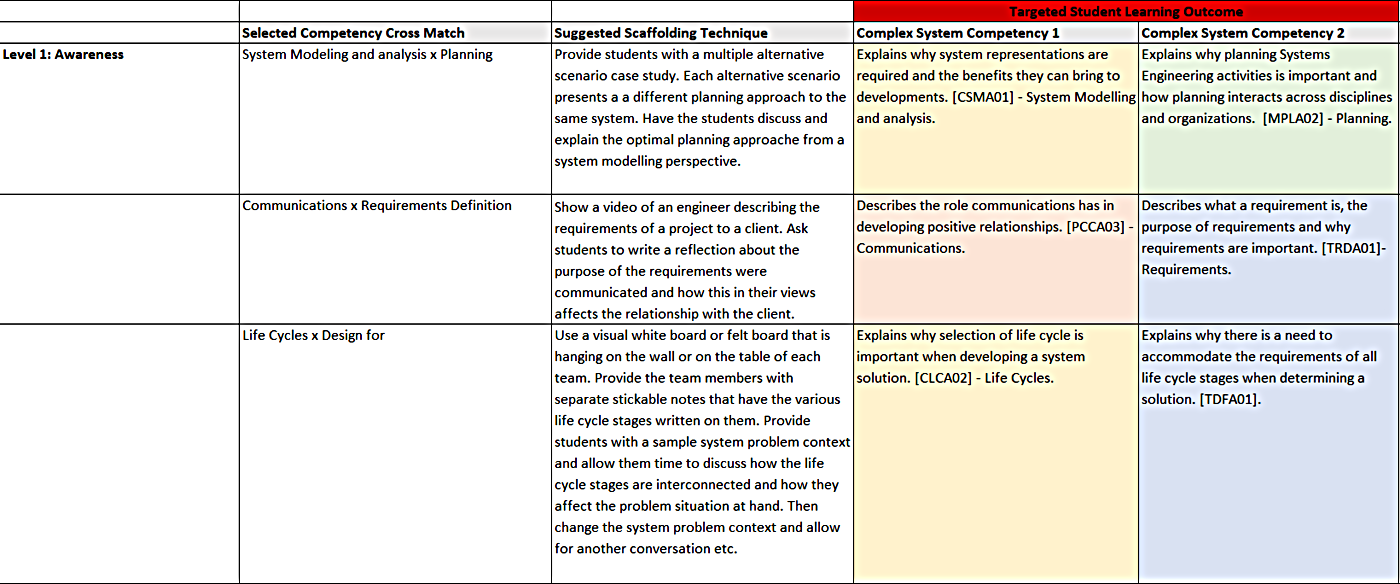
Authors:  Dr Nik Whitehead (University of Wales Trinity Saint David); Dr Sarah Jayne Hitt SFHEA (NMITE); Professor Thomas Lennerfors (Uppsala University); Claire Donovan (Royal Academy of Engineering); Professor Raffaella Ocone OBE FREng FRSE (Heriot Watt University); Isobel Grimley (Engineering Professors’ Council).

Topic: Low earth orbit satellites for internet provision. 

Engineering disciplines: Electronics, Mechanical engineering.

Ethical issues: Respect for environment, Public good, Future generations.

Professional situations: Communication, Management, Working cultures.

Educational level: Intermediate.

Educational aim: Practise ethical analysis. Ethical analysis is a process by which ethical issues are defined, affected parties and consequences are identified, so that relevant moral principles can be applied to a situation in order to determine possible courses of action. 


Learning and teaching notes:

This case is about an experienced engineer leading a team at a tech start-up. The company has been awarded a contract to produce an innovative satellite that will be used in an internet constellation. While the team was initially excited about their work, some members are now concerned about the impact of the internet constellation. While mainly focused on environmental ethics, effects on human communities are also raised in this case study.

This case study addresses two of AHEP 4’s themes: The Engineer and Society (acknowledging that engineering activity can have a significant societal impact) and Engineering Practice (the practical application of engineering concepts, tools and professional skills). To map this case study to AHEP outcomes specific to a programme under these themes, access AHEP 4 here and navigate to pages 30-31 and 35-37.

The dilemma in this case is presented in two parts. If desired, a teacher can use Part one in isolation, this section enables students to practise different types of analysis and to introduce aspects of environmental ethics. It highlights the challenges of making ethical decisions with global consequences, in scenarios where policy isn’t clear. Part two develops and complicates the concepts presented in Part one to provide for additional learning by focusing on the course of actions taken by an individual engineer based on the dilemma presented in Part one. The Challenge of Environmental Ethics linked below is recommended, though not required, for students engaging with this case. Additionally, throughout the case, there is the option to stop at multiple points for questions and / or activities as desired.

Learners have the opportunity to:

Teachers have the opportunity to:


Learning and teaching resources: 


Summary: 

After years of working your way up the corporate ladder, you are now Head of Engineering for a tech start-up. The company has won a contract connected to a project creating a constellation of thousands of low Earth orbit satellites. This constellation has the potential to create a reliable system of internet access for areas of the world that are hard to reach by conventional infrastructure. Your company is one of those chosen to develop and build a low-cost, lightweight, efficient satellite that can be produced at scale. This is a huge accomplishment for you, as well as for your company. 


Dilemma – Part one:

A conference that brings together various project partners is met by protesters whose message is that the internet constellation has several potential negative impacts for nature and human communities. Disparaging comments have been made about your company’s participation in the project on social media. Some members of your team seem quite rattled by the protests, and you convene at a coffee shop to discuss. 


Optional STOP for questions and activities:

1. Discussion: Technical analysis – Undertake a technical activity in the areas of electronic and / or mechanical engineering related to internet constellations.

2. Activity: Position analysis – Divide students into three groups—constellation project managers; satellite engineers and protestors. Imagine how their positions are related to the internet constellation. What values might inform their positions? What knowledge might inform their position that the other groups do not have access to or understanding of?

3. Discussion: Environmental analysis – While nature cannot speak for itself, if it could, what might be its position on the internet constellation? What aspects of the natural world might be affected by this technology in both the short- and long-term? For example, are there any direct or indirect effects on the health of humans and the ecosystems around them? Should the natural world of space be treated the same way as the natural world on earth?

4. Discussion: Policy analysis – Who should make decisions about projects that affect nature on a global scale? What laws or regulations exist that govern internet constellations?

5. Discussion and Activity: Moral analysis – Use environmental ethics principles such as intrinsic value and anthropocentrism to debate the project. Beyond environmental concerns, how might other ethical approaches, such as consequentialism or justice, inform positions on the issue?


Dilemma – Part two:

You remind and explain to your team members that they, and the company, have a duty to the client. Everyone has been hired to deliver a specific project and been excited about overcoming the technical challenges to ensure the project’s success. The team agrees, but also expresses concern about aspects that aren’t in the project remit, such as how the satellite will be maintained and what will happen to it at the end of its life. They demand that you pause your work until an ethical review is conducted. 

You report all of this to the CEO, who reacts with disappointment and unhappiness at your team’s actions. She argues that the only thing your company is doing is building the satellite: it’s not your responsibility what happens to it afterwards. She feels that it’s your job to get your team back in line and on task. How do you approach this situation? 


Optional STOP for questions and activities:

1. Discussion and Activity: How do you respond to this situation? What responsibilities do you have to your team, your boss, and the client? How will you balance these? Are the team’s engineers right to be concerned about the impact of their satellite within the wider constellation, or is it beyond their scope? Role-play an interaction between you and the engineering team, or between you and your boss.

2. Activity: Life cycle analysis – Research life cycles of satellites and their environmental impact.

3. Discussion and Activity: Debate if, and how, we have obligations to future generations. Is it possible to have a moral contract with a person that may never be born? How do we know that people in the future, will value the same things we do now? Both creating the internet constellation and preventing its implementation seem to potentially benefit future generations. How do we balance these ‘goods’ and make a decision on how to proceed? Who gets to decide?

4. Activity: Anatomy of an internet satellite – use the Anatomy of an AI case study as an example of a tether map, showing the inputs and outputs of a device. Create a tether map showing the anatomy of an internet satellite.


Enhancements:

An enhancement for this case study can be found here.


This work is licensed under a Creative Commons Attribution-ShareAlike 4.0 International License.

Any views, thoughts, and opinions expressed herein are solely that of the author(s) and do not necessarily reflect the views, opinions, policies, or position of the Engineering Professors’ Council or the Toolkit sponsors and supporters.

 

Let us know what you think of our website