Sustainability competency: Systems-thinking; Collaboration; Integrated problem-solving.UNESCO has developed eight key competencies for sustainability that are aimed at learners of all ages worldwide. Many versions of these exist, as are linked here*. In the UK, these have been adapted within higher education by AdvanceHE and the QAA with appropriate learning outcomes. The full list of competencies and learning outcome alignment can be found in the Education for Sustainable Development Guidance*. *Click the pink ''Sustainability competency'' text to learn more.
AHEP mapping: This resource addresses two of the themes from the UK’s Accreditation of Higher Education Programmes fourth edition (AHEP4): The Engineer and Society (acknowledging that engineering activity can have a significant societal impact) and Engineering Practice (the practical application of engineering concepts, tools and professional skills). To map this resource to AHEP outcomes specific to a programme under these themes, access AHEP 4 here and navigate to pages 30-31 and 35-37.
Related SDGs: SDG 2 (Zero hunger); SDG 3 (Good health and well-being); SDG 4 (Quality education); SDG 12 (Responsible consumption and production); SDG 13 (Climate action).
Reimagined Degree Map Intervention: Active pedagogies and mindset development; Authentic assessment; More real-world complexity.The Reimagined Degree Map is a guide to help engineering departments navigate the decisions that are urgently required to ensure degrees prepare students for 21st century challenges. Click the pink ''Reimagined Degree Map Intervention'' text to learn more.
Who is this article for? This article should be read by Chemical Engineering educators in higher education who are seeking to integrate sustainability in their project modules. Engaging with this topic will also help to prepare students with the soft skill sets that employers are looking for.
Premise:
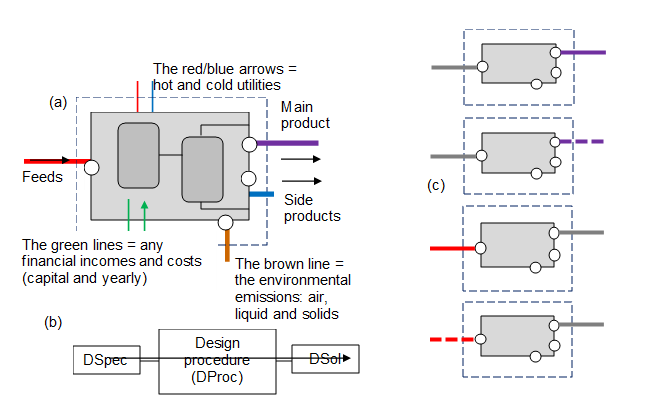
The design project (DP) is considered to be the major focus of the CE curriculum, where students work in groups to design a complete chemical process – feeds, products process routes, energy requirements, financial aspects and emissions. It is considered challenging for various reasons including the following: the requirement to recall and combine knowledge covered previously in taught classes (some of which may have been forgotten), dealing with a huge corpus of data (unavailability, uncertainty, some being in conflict and some being superfluous) and all the design decisions that need to be made from many options. This is a major contrast with standard taught modules where all the data required is normally provided in advance. Just making decisions is not enough – they need to be timely and justified otherwise the project may be rushed and may not complete by the deadline. This is why the DP is valued by employers. Furthermore, if Education for Sustainable Development (ESD) is embedded in the design project, it is more likely that students will take forward sustainability into the workplace. Figure 1 illustrates Chemical processes and the design project.
1.Subject (CE) and DP pictorial representations:
Part (a) is a generic representation of a chemical process and shows the input-output nature of chemical processes. A chemical process takes a feed and converts it to useful products (the process shown has two equipment units and four streams). Part (b) is a representation of the design project, where the specification (or brief) is provided to groups at the start (DSpec) and the final submission (or solution) is the information in part (a). Part (c) shows that specifications can be product-based (the top two) or feed-based (the bottom two). The dashed lines indicate specifications where the flowrate and composition of the feed/product is subject to design choice – a typical factor that will extend the design procedure and require more decision-making.
2. Inclusion of sustainability in the project topic and communication with students:
This is fairly straightforward in CE design projects, because of the circular economy and the associated waste minimisation. So, from Figure 1, a feed-based (rather than product-based) specification can be employed. Topics that have been used at Strathclyde in recent years have been the utilisation of coffee grounds, food waste and (in 2024) green and garden waste. It is helpful that such topics can be linked to many of the UN SDGs. Furthermore, waste products are often complex with many components, and one of the characteristics of chemical engineering is the various separation techniques. These two factors should be communicated to students to improve engagement.
3. Inclusion of sustainability as an ESD activity to be carried out by groups:
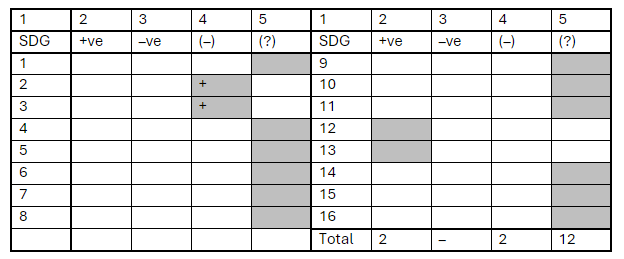
One of the complicating factors about the UN SDGs is that there are so many, meaning that there is the possibility of a chemical process having both positive and negative impacts on different SDGs. This means that groups really need to consider all of the SDGs. This might be conveniently demonstrated as per Table 1. Certainly, it would be hoped that there are more ticks in column 2 than in column 3. Column 4 corresponds to minimal change, and column 5 where there is not enough information to determine any impact.
Table 1: Sustainability rating form for design project submissions
As an example, consider a design project which is based on better utilisation of green waste. Let us say that this results in less greenhouse gas emissions, as well as there being less need to plant and harvest plants. This will result in positive outcomes for SDG12 and SDG13. There are also positive effects because more land can be used for crops, and there will be higher plant coverage during the year. It could be argued then that there are minor positive effects om SDG2 and SDG3. The subsequent SDG profile in Table 1 shows two major impacts and two minor impacts – this might be typical for DPs.
4. Assessment of sustainability in the design project:
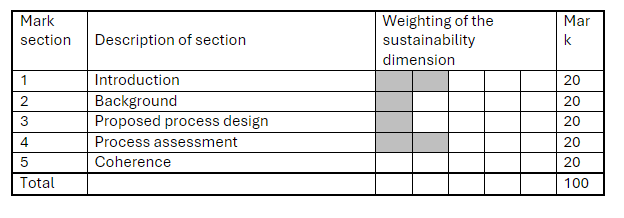
Table 2 shows the typical sections in a DP submission. For convenience these are shown as having equal 20-mark contributions. One way of determining marks is to divide these sections into a number of dimensions, for example: use of the literature, technical knowledge, creativity/innovation and style/layout. Sustainability could then be included as a fifth dimension. It is then a case of determining the sustainability dimension for each of the marking sections. It could be argued that sustainability is particularly important at the start of the project (when feeds and amounts are being decided) and at the end (when the final process is being assessed). This explains the larger weightings in Table 2. Coherence refers to how well the submission reads in terms of order and consistency and is thus independent of sustainability. The weightings are subject to debate, but they do at least give the potential for consistent (and traceable) grading between different assessors.
Table 2: Design project assessment now including ESD
Feijoo, G., Moreira, M.T. (2020) “Fostering environmental awareness towards responsible food consumption and reduced food waste in chemical engineering students”, Education for Chemical Engineers 33, pp. 27–35
IChemE (2021), “Accreditation of chemical engineering programmes: a guide for education providers and assessors”
Any views, thoughts, and opinions expressed herein are solely that of the author(s) and do not necessarily reflect the views, opinions, policies, or position of the Engineering Professors’ Council or the Toolkit sponsors and supporters.
Keywords: SDGs; AHEP; Sustainability; Design; Life cycle; Local community; Environment; Circular economy; Recycling or recycled materials; Student support; Higher education; Learning outcomes.
Sustainability competency: Systems thinking; Anticipatory; Critical thinking.UNESCO has developed eight key competencies for sustainability that are aimed at learners of all ages worldwide. Many versions of these exist, as are linked here*. In the UK, these have been adapted within higher education by AdvanceHE and the QAA with appropriate learning outcomes. The full list of competencies and learning outcome alignment can be found in the Education for Sustainable Development Guidance*. *Click the pink ''Sustainability competency'' text to learn more.
AHEP mapping: This resource addresses two of the themes from the UK’s Accreditation of Higher Education Programmes fourth edition (AHEP4): The Engineer and Society (acknowledging that engineering activity can have a significant societal impact) and Engineering Practice (the practical application of engineering concepts, tools and professional skills). To map this resource to AHEP outcomes specific to a programme under these themes, access AHEP 4 here and navigate to pages 30-31 and 35-37.
Related SDGs: SDG 9 (Industry, innovation, and infrastructure); SDG 12 (Responsible consumption and production).
Reimagined Degree Map Intervention: Adapt and repurpose learning outcomes; More real-world complexity.The Reimagined Degree Map is a guide to help engineering departments navigate the decisions that are urgently required to ensure degrees prepare students for 21st century challenges. Click the pink ''Reimagined Degree Map Intervention'' text to learn more.
Who is this article for? This article is for educators working at all levels of higher education who wish to integrate Sustainability into their robotics engineering and design curriculum or module design. It is also for students and professionals who want to seek practical guidance on how to integrate Sustainability considerations into their robotics engineering.
Part of the strategy to ensure that engineers incorporate sustainability into their solution development is to ensure that engineering students are educated on these topics and taught how to incorporate considerations at all stages in the engineering process (Eidenskog et al., 2022). For instance, students need not only to have a broad awareness of topics such as the SDGs, but they also need lessons on how to ensure their engineering incorporates sustainable practice. Despite the increased effort that has been demonstrated in engineering generally, there are some challenges when the sustainability paradigm needs to be integrated into robotics study programs or modules (Leifler and Dahlin, 2020). This article details one approach to incorporate considerations of the SDGs at all stages of new robot creation: including considerations prior to design, during creation and manufacturing and post-deployment.
1. During research and problem definition:
Sustainability considerations should start from the beginning of the engineering cycle for robotic systems. During this phase it is important to consider what the problem statement is for the new system, and whether the proposed solution satisfies this in a sustainable way, using Key Performance Indicators (KPIs) linked to the SDGs (United Nations, 2018), such as carbon emissions, energy efficiency and social equity (Hristov and Chirico, 2019). For instance, will the energy expended to create the robot solution be offset by the robot once it is in use? Are there long-term consequences of using a robot as a solution? It is important to begin engagement with stakeholders, such as end-users, local communities, and subject matter experts to gain insight into these types of questions and any initial concerns. Educators can provide students with opportunities to engage in the research and development of robotics technology that can solve locally relevant problems and benefit the local community. These types of research projects allow students to gain valuable research experience and explore robotics innovations through solving problems that are relatable to the students. There are some successful examples across the globe as discussed in Dias et al., 2005.
2. At design and conceptualisation:
Once it is decided that a robot works as an appropriate solution, Sustainability should be integrated into the robot system’s concept and design. Considerations can include incorporating eco-design principles that prioritise resource efficiency, waste reduction, and using low-impact materials. The design should use materials with relatively low environmental footprints, assessing their complete life cycles, including extraction, production, transportation, and disposal. Powered systems should prioritise energy-efficient designs and technologies to reduce operational energy consumption, fostering sustainability from the outset.
3.During creation and manufacturing:
The robotic system should be manufactured to prioritise methods that minimise, mitigate or offset waste, energy consumption, and emissions. Lean manufacturing practices can be used to optimise resource utilisation where possible. Engineers should be aware of the importance of considering sustainability in supply chain management to select suppliers with consideration of their sustainability practices, including ethical labour standards and environmentally responsible sourcing. Robotic systems should be designed in a way that is easy to assemble and disassemble, thus enabling robots to be easily recycled, or repurposed at the end of their life cycle, promoting circularity and resource conservation.
4. Deployment:
Many robotic systems are designed to run constantly day and night in working environments such as manufacturing plants and warehouses. Thus energy-efficient operation is crucial to ensure users operate the product or system efficiently, utilising energy-saving features to reduce operational impacts. Guidance and resources should be provided to users to encourage sustainable practices during the operational phase. System designers should also implement systems for continuous monitoring of performance and data collection to identify opportunities for improvement throughout the operational life.
5.Disposal:
Industrial robots have an average service life of 6-7 years. It is important to consider their end-of-life and plan for responsible disposal or recycling of product components. Designs should be prioritised that facilitate disassembly and recycling (Karastoyanov and Karastanev, 2018). Engineers should identify and safely manage hazardous materials to comply with regulations and prevent environmental harm. Designers can also explore options for product take-back and recycling as part of a circular economy strategy. There are various ways of achieving that. Designers can adopt modular design methodologies to enable upgrades and repairs, extending their useful life. Robot system manufacturers should be encouraged to develop strategies for refurbishing and reselling products, promoting reuse over disposal.
Conclusion:
Sustainability is not just an option but an imperative within the realm of engineering. Engineers must find solutions that not only meet technical and economic requirements but also align with environmental, social, and economic sustainability goals. As well as educating students on the broader topics and issues relating to Sustainability, there is a need for teaching considerations at different stages in the robot development lifecycle. Understanding the multifaceted connections between sustainability and engineering disciplines, as well as their impact across various stages of the engineering process, is essential for engineers to meet the challenges of the 21st century responsibly.
Any views, thoughts, and opinions expressed herein are solely that of the author(s) and do not necessarily reflect the views, opinions, policies, or position of the Engineering Professors’ Council or the Toolkit sponsors and supporters.
Sustainability competency: Collaboration; Integrated problem-solving.UNESCO has developed eight key competencies for sustainability that are aimed at learners of all ages worldwide. Many versions of these exist, as are linked here*. In the UK, these have been adapted within higher education by AdvanceHE and the QAA with appropriate learning outcomes. The full list of competencies and learning outcome alignment can be found in the Education for Sustainable Development Guidance*. *Click the pink ''Sustainability competency'' text to learn more.
AHEP mapping: This resource addresses two of the themes from the UK’s Accreditation of Higher Education Programmes fourth edition (AHEP4): The Engineer and Society (acknowledging that engineering activity can have a significant societal impact) and Engineering Practice (the practical application of engineering concepts, tools and professional skills). To map this resource to AHEP outcomes specific to a programme under these themes, access AHEP 4 here and navigate to pages 30-31 and 35-37.
Related SDGs: All 17; see specific examples below for SDG 2 (Zero Hunger); SDG 13 (Climate Action).
Reimagined Degree Map Intervention: Adapt and repurpose learning outcomes; Active pedagogies and mindset development; Authentic assessment.The Reimagined Degree Map is a guide to help engineering departments navigate the decisions that are urgently required to ensure degrees prepare students for 21st century challenges. Click the pink ''Reimagined Degree Map Intervention'' text to learn more.
Who is this article for? This article should be read by educators at all levels in Higher Education who wish to embed sustainable development goals into computing projects.
Education for Sustainable Development (ESD) is defined by UNESCO (2021) as: “the process of equipping students with the knowledge and understanding, skills and attributes needed to work and live in a way that safeguards environmental, social and economic wellbeing, in the present and for future generations.” All disciplines have something to offer ESD, and all can contribute to a sustainable future. This guide presents how to embed the Sustainable Development Goals (SDGs) into undergraduate computing projects, using problem-based learning and teamwork as the main pedagogical tools (Mishra & Mishra, 2020).
Embedding Sustainable Development Goals (SDGs) into computing group projects:
Typically, the aim of the undergraduate Computing Group Project is to:
start preparing students for a professional career in the computing industry.
familiarise the students with working in software development teams.
give them the experience of delivering a non-trivial software system.
This type of project provides students with an opportunity to integrate various skills, including design, software development, project management, and effective communication.
In this project setting, the students can be asked to select a project theme based on the SDGs. The module team then can support student learning in three key ways:
1. Lectures, labs, and regular formative assessments can build on lab activities to walk the project groups through a sustainability journey that starts from a project pitch, continues with design, implementation, and project progress reporting, and ends with delivering a final demo.
2. Blending large classroom teaching with small group teaching, where each group is assigned a tutor, to ensure timely support and feedback on formative assessments.
3. A summative assessment based on a well-structured project portfolio template, guiding students to present and reflect on their individual contribution to the group effort. This portfolio may form the only graded element of their work, giving the students the opportunity to learn from their mistakes in formative assessments and present their best work at the end of the module.
Mapping the learning outcomes to the eight UNESCO key competencies for sustainability (Advance HE, 2021), the students will have the opportunity to experience the following:
Group work: The students plan, manage, and track a substantial group activity, understanding and applying the principles of professional and ethical behaviour in a group context. They “recognise that a collective effort is not just a simple sum of each individual’s effort but is likely to be more complex and have multiple drivers that may be personal, political or communal” (Advance HE, 2021, p. 24).
Open-ended problem: The groups take an open-ended problem, collect, and analyse relevant information and define the requirements. They will “identify the tensions between the 17 SDGs and recognise their interconnections” (Advance HE, 2021, p. 24) and work towards “creating their visions for the future” (Advance HE, 2021, p. 25).
Non-trivial software development: The students will independently and systematically design, develop, and evaluate a piece of software that is data-driven and has non-trivial functionality. This way, they will “develop and implement innovative actions that further sustainable development at the local level and beyond” (Advance HE, 2021, p. 27).
Alternative solutions: They will analyse complex systems and compare and evaluate alternative problem solutions according to given criteria, including from a technical perspective.
Communication: They will effectively present ideas and solutions, recognising the importance of “verbal and non-verbal communication skills and their role in group cohesion” (Advance HE, 2021, p. 28).
More specifically, sustainable development can be embedded following a lecture-lab-formative assessment-summative assessment path:
1. Introduction lecture: Introduce the SDGs and give real-life examples of software that contribute to SDGs (examples include: for SDG 2 – Zero Hunger, the World Food Programme’s Hunger Map; SDG 13 – Climate Action, Climate Mind ). The students then can be instructed to do their own research on SDGs.
2. Apply design thinking to project ideation: In a lecture, students are introduced to design thinking and the double-diamond of design to use a diverge-converge strategy to first “design the right thing” and second “design things right.” In a practical session, with teaching team support, the students can meet their groups for a brainstorming activity. It is essential to inform students about setting ground rules for discussion, ensuring all voices are heard. Encourage students to apply design thinking to decide which SDG-based problem they would like to work on to develop a software solution. Here, giving students an example of this process based on a selected SDG will be useful.
3. Formative assessment – project pitch deliverable: The next step is to channel students’ output of the design thinking practical to a formative assessment. Students can mould their discussion into a project pitch for their tutors. Their presentation should explain how their project works towards one or more of the 17 SDGs.
4. Summative assessment – a dedicated section in project portfolio: Finally, dedicating a section in a project portfolio template on ideation ensures students reflect further on the SDGs. In the portfolio, students can be asked to reflect on how individual ideas were discussed and feedback from different group members was captured. They should also reflect on how they ensured the chosen problem fits one or more SDGs, describe the selection process of the final software solution, and what alternative solutions for the chosen SDG they have discussed, elaborating on the reasons for the final choice.
Conclusion:
Computing projects provide an excellent opportunity to align teaching, learning, and assessment activities to meet key Sustainable Development competencies and learning outcomes. The projects can provide transformational experiences for students to hear alternative viewpoints, reflect on experiences, and address real-world challenges.
Lewrick, M., Link, P., Leifer, L.J. & Langensand, N. (2018). The design thinking playbook: mindful digital transformation of teams, products, services, businesses, and ecosystems. New Jersey: John Wiley & Sons, Inc, Hoboken.
Any views, thoughts, and opinions expressed herein are solely that of the author(s) and do not necessarily reflect the views, opinions, policies, or position of the Engineering Professors’ Council or the Toolkit sponsors and supporters.
Authors: Peter Mylon MEng PhD CEng FIMechE PFHEA NTF and SJ Cooper-Knock PhD (The University of Sheffield).
Topic: Maker Communities and ESD.
Tool type: Knowledge.
Relevant disciplines: Any.
Keywords: Interdisciplinary; Education for sustainable development; Makerspaces, Recycling or recycled materials; Employability and skills; Inclusive learning; Local community; Climate change; Student engagement; Responsible consumption; Energy efficiency; Design; Water and sanitation; AHEP; Sustainability; Higher education; Pedagogy.
Sustainability competency: Collaboration; Integrated problem-solving.UNESCO has developed eight key competencies for sustainability that are aimed at learners of all ages worldwide. Many versions of these exist, as are linked here*. In the UK, these have been adapted within higher education by AdvanceHE and the QAA with appropriate learning outcomes. The full list of competencies and learning outcome alignment can be found in the Education for Sustainable Development Guidance*. *Click the pink ''Sustainability competency'' text to learn more.
AHEP mapping: This resource addresses two of the themes from the UK’s Accreditation of Higher Education Programmes fourth edition (AHEP4): The Engineer and Society (acknowledging that engineering activity can have a significant societal impact) and Engineering Practice (the practical application of engineering concepts, tools and professional skills). To map this resource to AHEP outcomes specific to a programme under these themes, access AHEP 4 here and navigate to pages 30-31 and 35-37.
Related SDGs: SDG 4 (Quality education); SDG 6 (Clean water and sanitation); SDG 11 (Sustainable cities and communities); SDG 12 (Responsible consumption and production); SDG 13 (Climate action).
Reimagined Degree Map Intervention: Active pedagogies and mindset development; Cross-disciplinarity.The Reimagined Degree Map is a guide to help engineering departments navigate the decisions that are urgently required to ensure degrees prepare students for 21st century challenges. Click the pink ''Reimagined Degree Map Intervention'' text to learn more.
Who is this article for? This article should be read by educators at all levels in higher education who are curious about how maker spaces and communities can contribute to sustainability efforts in engineering education. Engaging with this topic will also help to prepare students with the soft skill sets that employers are looking for.
Premise:
Makerspaces can play a valuable role in Education for Sustainable Development (ESD). In this article, we highlight three specific contributions they can make to ESD in Engineering: Makerspaces enable engineering in real-world contexts; they build cross-disciplinary connections and inclusive learning; and they promote responsible consumption.
A brief introduction to makerspaces:
In recent years, a ‘makerspace’ movement has emerged in Higher Education institutions. While most prevalent in the US, there are now a number of university-based makerspaces in the UK, including the iForge at the University of Sheffield, the Institute of Making at UCL, and the Makerspace at King’s College London. So what is a makerspace, and what do they have to do with Education for Sustainable Development (ESD)?
Makerspaces are part of a larger “maker movement” that includes maker fairs, clubs and magazines. Within universities, they are “facilities and cultures that afford unstructured student-centric environments for design, invention, and prototyping.” (Forest et al., 2016). Successful and inclusive makerspaces are student led. Student ownership of makerspace initiatives deepens student motivation, promotes learning, and encourages peer-to-peer collaboration. Successful makerspaces produce thriving learning communities, through which projects can emerge organically, outside of curriculum structures and discipline boundaries.
In terms of Education for Sustainable Development (ESD), this means that students can bring their passion to make a difference, and can meet other students with similar interests but complementary skill sets. With support from the University, they can then be given opportunities to put their passion and skills into practice. Below, we focus on three concrete contributions that makerspaces can make to ESD: Opportunities for applied learning; expanded potential for cross-disciplinary learning, and the chance to deepen engaged learning on sustainable consumption.
1. Maker communities enable engineering in real world contexts:
1.1 ESD rationale
ESD enables students to think critically about possible solutions to global challenges. It encourages students to consider the social, economic, and political context in which change takes place. ESD also spurs students to engage, where possible, with those beyond the university.
It may be tempting to think of engineering as simply a technical exercise: one in which scientific and mathematical knowledge is taken and applied to the world around us. In practice, like all other professions, engineers do not simply apply knowledge, they create it. In order to do their work, engineers build, hold, and share ideas about how the world works: how users will behave; how materials will function; how they can be repaired or disposed of; what risks are acceptable, and why. These ideas about what is reasonable, rational, and probable are, in turn, shaped by the broader social, political, and economic context in which they work. This context shapes everything from what data is available, to what projects are prioritised, and how risk assessments are made. Rather than trying to ignore or remove these subjective and context-based elements of engineering, we need to understand them. In other words, rather than ask whether an engineering process is impacted by social, political, and economic factors we need to ask how this impact happens and the consequences that it holds. ESD encourages students to think about these issues.
1.2 The contribution of makerspaces
The availability of both equipment and expertise, and the potential for practical solutions, means that makerspaces often attract projects from outside the university. These provide opportunities to practise engineering in real-world contexts, where there is the possibility for participatory design. All such projects will require some consideration of social, political, or economic factors, which are at the heart of the Sustainable Development Goals.
One example of this is SheffHEPP, a hydroelectric power project at the University of Sheffield. In response to requests for help from local communities, students are designing and building small-scale hydroelectric power installations in a number of locations. This multidisciplinary project requires an understanding of water engineering, electrical power generation, battery storage and mechanical power transmission, as well as taking into consideration the legal, financial, and environmental constraints of such an undertaking. But it also requires Making – students have made scale models and tested them in the lab, and are now looking to implement their designs in situ. Such combinations of practical engineering and real-world problems that require consideration of the wider context provide powerful educational experiences that expose students to the realities of sustainable development.
There are a number of national and international organisations for students that promote SDGs through competitions and design challenges. These include:
Engineers Without Borders – an international organisation with branches at many UK universities, which runs, amongst other things, the ‘Engineering for People Design Challenge’
Shell EcoMarathon – a vehicle design competition focused on energy optimisation
Cybathlon– a platform that challenges teams globally to develop assistive technologies suitable for everyday use, with and for people with disabilities
Student engagement with such activities is growing exponentially, and makerspaces can benefit students who are prototyping ideas for the competitions. At Sheffield, there are over 20 co-curricular student-led projects in engineering, involving around 700 students, many of which engage with the SDGs. In addition to SheffHEPP and teams entering all of the above competitions, these include teams designing solutions for rainwater harvesting, vaccine storage, cyclone-proof shelters for refugees, plastics recycling, and retrofitting buildings to reduce energy consumption. As well as the employability benefits of such activities, students are looking for ways to use engineering to create a better future, with awareness of issues around climate change and sustainability increasing year on year. And none of these activities would be possible without access to maker facilities to build prototypes.
Linked to the makerspace movement is the concept of hackathons – short sprints where teams of students compete to design and prototype the best solution to a challenge. At Sheffield, these have included:
Hackcessible – an assistive technology hackathon where students work with disabled members of the community to design bespoke solutions to problems that fall outside of the scope of healthcare provision;
The Biodigester Hackathon – finding the best way to convert waste from the University’s Diamond building into energy;
The Rice Seeder Design Challenge – working with a social enterprise in Cambodia to improve the design of traditional rice seeders in order to increase productivity.
In summary, Makerspaces enable students to access multiple initiatives through which they can engage in learning that is potentially participatory and applied. These forms of learning are critical to ESD and have the potential to address multiple Sustainable Development Goals.
2. Maker communities build cross-disciplinary connections and encourage inclusive learning:
2.1 ESD rationale
Global complex challenges cannot be resolved by engineers alone. ESD encourages students to value different forms of knowledge, from within and beyond academia. Within academia, makerspaces can provide opportunities for students to collaborate with peers from other disciplines. Cross-disciplinary knowledge can play a crucial role in understanding the complex challenges that face our world today. Makerspaces also offer an opportunity for students to engage with other forms of knowledge – such as the knowledge that is formed through lived experience – and appreciate the role that this plays in effective practices of design and creation. Finally, makerspaces can help students to communicate their knowledge in ways that are understandable to non-specialist audiences. This inclusive approach to knowledge creation and knowledge sharing enables students to think innovatively about sustainable solutions for the future.
2.2 The contribution of makerspaces
Cross-disciplinary spaces
Student-led makerspaces encourage students to lead in the creation of cross-disciplinary connections. For example, at the University of Sheffield, the makerspace has primarily been used by engineering students. Currently, however, the students are working hard to create events that will actively draw in students from across the university. This provides students with a co-created space for cross-disciplinary exchange as students train each other on different machines, learning alongside each other in the space. At other times, staff from different disciplines can come together to create shared opportunities for learning.
The cross-disciplinary nature of makerspaces and the universality of the desire to create encourages a diverse community to develop, with inclusivity as a core tenet. They can often provide opportunities for marginalised communities. Makerspaces such as the ‘Made in Za’atari’ space in Za’atari refugee camp have been used to give women in the camp a space in which they can utilise, share, and develop their skills both to improve wellbeing and create livelihoods. Meanwhile, projects such as Ambessa Play have provided opportunities for young people in refugee camps across the world to learn about kinetic energy and electronic components by creating a wind-up flashlight.
Spaces of inclusive learning
Maker projects also allow students to engage with their local communities, whether creating renewable energy installations, restoring community assets or educating the next generation of makers. Such projects raise the profile of sustainable development in the wider public and give students the opportunity to contribute to sustainable development in their neighbourhoods.
ESD does not just influence what we teach and how we teach; it also shapes who we are. A central tenet of ESD is that it helps to shape students, staff, and educational communities. When this happens, they are – in turn – better able to play their part in shaping the world around them.
3.2 The contribution of makerspaces
Even before the concept was popularised by the BBC’s ‘The Repair Shop’, repair cafes had begun to spring up across the country. Such facilities promote an ethos of repair and recycling by sharing of expertise amongst a community, a concept which aligns very closely with the maker movement. Items repaired might include furniture, electrical appliances, and ornaments. Related organisations like iFixit have also helped to promote responsible consumption and production through advocacy against built-in obsolescence and for the ‘Right to Repair’.
The same principles apply to Making in textiles – sustainable fashion is a topic that excites many students both within and outside engineering, and makerspaces offer the opportunity for upcycling, garment repair and clothes shares. Students can learn simple techniques that will allow them to make better use of their existing wardrobes or of used clothing and in the process begin to change the consumption culture around them. At the University of Sheffield, our making community is currently planning an upcycled runway day, in which students will bring clothing that is in need of refresh or repair from their own wardrobes or from local charity shops. Our team of peer-instructors and sewing specialists will be on hand to help students to customise, fit, and mend their clothes. In doing so, we hope to build an awareness of sustainable fashion amongst our students, enabling an upcycling fashion culture at the university.
Conclusion:
Education for Sustainable Development plays a vital role in enabling students to expand the knowledge and skills that they hold so that they can play their part in creating a sustainable future. Makerspaces offer a valuable route through which engineering students can engage with Education for Sustainable Development, including opportunities for applied learning, cross disciplinary connections, and responsible consumption.
Any views, thoughts, and opinions expressed herein are solely that of the author(s) and do not necessarily reflect the views, opinions, policies, or position of the Engineering Professors’ Council or the Toolkit sponsors and supporters.
Author: Professor Manuela Rosa (Algarve University).
Keywords: Societal impact; Equity; Equality, diversity and inclusion (EDI); Design; Justice; Equity; Communication; Global responsibility.
Who is this article for?: This article should be read by educators at all levels in higher education who wish to integrate social sustainability, EDI, and ethics into the engineering and design curriculum or module design. It will also help to prepare students with the integrated skill sets that employers are looking for.
Premise:
The Declaration on the Rights of Disabled Persons, adopted by the General Assembly of United Nations on 9 December 1975, stipulated protection of the rights of people with disabilities. The United Nations 2030 Agenda for Sustainable Development, a plan of action for people, planet, and prosperity, demands that all stakeholders, acting in collaborative partnership, must recognise that the dignity of the human person is fundamental and so the development of the 17 Sustainable Development Goals must meet all segments of society in a way that “no one will be left behind”.
In relation to engineering, the Statement of Ethical Principles published by the Engineering Council and the Royal Academy of Engineering in 2005 and revised in 2017, articulates one of its strategic challenges to be positioning engineering at the heart of society, enhancing its wellbeing, improving the quality of the built environment, and promoting EDI. To uphold these principles, engineering professionals are required to promote social equity, guaranteeing equal opportunities to access the built environment and transportation systems, enabling the active participation of all citizens in society, including vulnerable groups. The universal design approach is one method that engineers can use to ensure social sustainability.
The challenges of universal and inclusive design:
Every citizen must have the same equality of opportunities in using spaces because the existence of an accessible built environment is fundamental to guarantee vitality, safety, and sociability. These ethical values associated with the technical decision-making process were considered by the American architect Ronald Lawrence Mace (1941-1998) who defined the universal design concept as “designing all products, buildings and exterior spaces to be usable by all people to the greatest extent possible” (Mace et al., 1991), thus contributing to social inclusion.
Universal accessibility according to this universal design approach is “the characteristic of an environment or object which enables everybody to enter into a relationship with, and make use of, that object or environment in a friendly, respectful and safe way” (Aragall et al., 2003). It focuses on people with reduced mobility, such as people with disabilities (mobility, vision, hearing and cognitive dimensions), children and elderly people. Built environment and transport systems must be designed considering this equity attribute which is associated with social sustainability and inclusion.
The Center for Universal Design of the North Carolina State University developed seven principles of universal design (Connell et al., 1997):
1. Equitable use
2. Flexibility in use
3. Simple and intuitive use
4. Perceptible information
5. Tolerance for error
6. Low physical effort
7. Size and space for approach and use.
These principles must always be incorporated in the conception of products and physical environments, so as to create a ‘fair built’ environment, where all have the right to use it, in the same independent and natural way. This justice design must guarantee autonomy in the use of spaces and transport vehicles, contributing to the self-determination of citizens.
The perceptions of the space users are fundamental to be considered in the design process to achieve the usability of the built environment and transport systems. Pedestrian infrastructure design and modal interfaces demand user-centred approaches and therefore processes of co-design and co-creation with communities, where people are effectively involved as collaborators and participants.
Achieving an inclusive society is a great challenge because there are situations where the needs of users are divergent: technical solutions created for a specific group of people are inadequate for others. For example, wheelchair users and elderly people need smooth surfaces and, on the contrary, blind people need tactile surfaces.
Consequently, in the process of universal design, some people can feel excluded because they need other technical solutions. It is then necessary to consider precise inclusive design when projecting urban spaces for all.
Universal design is linked with designing one-space-suits-almost-all, and inclusive design focuses on one-space-suits-one, for example design a space for everyone (collective perspective) versus design a space for one specific group (particular perspective). As the built environment must be understandable to and usable by all people, both are important for social sustainability. Universal design contributes to social inclusion, but added inclusive design is needed, matching the excluded users to the object or space design.
In order to promote social inclusion and quality of life, to which everyone is entitled, universal and inclusive co-design of the built environment and the transportation systems demands specific approaches that have to be integrated in engineering education:
Universal and inclusive co-design aims at considering human diversity and that “it is normal to be different”.
Universal and inclusive co-design requires strong collaborative approaches, through surveys, face to face interviews, walking with people with disabilities, elderly people, and other vulnerable groups.
Universal and inclusive co-design must consider different components of the built environment and transportation systems, and requires connectivity and a strategic value chain approach.
Universal and inclusive co-design demands cross-sectorial and interdisciplinary work, in transdisciplinary approaches.
Universal and inclusive co-design benefits all the population.
Universal and inclusive co-design is a fundamental tool for sustainable design.
Conclusion:
Universal and inclusive co-design of the built environment and transportation systems must be seen as an ethical act in engineering. Co-design for social sustainability can be strengthened through engineering acts. Ethical responsibility must be assumed to create inclusive solutions considering human diversity, empowering engineers to act and design justice.
There is a strong need for engineers to possess a set of skills and competencies related to the ability to work with other professionals (for example from the social sciences), users, or collaborators. In the 21st century, beyond the use of technical knowledge to solve problems, engineers need communication skills to achieve the sustainable development goals, requiring networking, cooperating in teams, and working with communities.
Engineering education must consider transdisciplinary approaches which make clear progress in tackling urban challenges and finding human-centred solutions. Universal and inclusive co-design must be incorporated routinely into the practice of engineers and assumed in Engineering Ethics Codes.
References:
Aragall, F. and EuCAN members, (2003) European Concept for Accessibility: Technical Assistance Manual. Luxemburg: EuCAN – European Concept for Accessibility Network.
Connell, B. R., Jones, M., Mace, R., Mueller, J., Mullick, A., Ostroff, E., Sanford, J., Steinfeld, E., Story, M. and Vanderheiden, G. (1997) The Principles of Universal Design, Version 2.0. Raleigh: North Carolina State University, The Center for Universal Design. USA.
Mace, R. L., Hardie G. J. and Place, J. P. (1991) ‘Accessible environments: Toward universal design,’in W.E. Preiser, J.C. Vischer, E.T. White (Eds.). Design Intervention: Toward a More Human Architecture. New York: Van Nostrand Reinhold, pp. 155-180.
Declaration on the Rights of Disabled Persons. (1975). Proclaimed by G/A/RES 3447 of 9 December 1975.
United Nations. (2015). Transforming Our World: The 2030 Agenda for Sustainable Development. Resolution adopted by the United Nations General Assembly on 25 September 2015, New York.
Any views, thoughts, and opinions expressed herein are solely that of the author(s) and do not necessarily reflect the views, opinions, policies, or position of the Engineering Professors’ Council or the Toolkit sponsors and supporters.
Authors: Dr Gareth Thomson (Aston University, Birmingham), Dr Jakub Sacharkzuk (Aston University, Birmingham) and Paul Gretton (Aston University, Birmingham)
Abstract: This paper describes the work done within the Mechanical, Biomedical and Design Engineering group at Aston University to develop an Industry Club with the aim to enhance and strategically organise industry involvement in the taught programmes within the department. A subscription based model has been developed to allow the hiring of a part-time associate to manage the relationship with industry, academic and student partners and explore ways to develop provision. This paper describes the approach and some of the activities and outcomes achieved by the initiative.
Introduction
Industry is a key stakeholder in the education of engineers and the involvement of commercial engineering in taught programmes is seen as important within degrees but may not always be particularly optimised or strategically implemented.
Nonetheless, awareness of industry trends and professional practice is seen as vital to add currency and authenticity to the learning experience [1,2]. This industry involvement can take various forms including direct involvement with students in the classroom or in a more advisory role such as industrial advisory or steering boards [3] designed to support the teaching team in their development of the curriculum.
Direct input into the curriculum from industry normally involves engagement in dissertations, final year ‘capstone’ project exercises [4], visits [5], guest lectures [6,7], internships [8,9] or design projects [10,11]. These are very commonly linked to design type modules [12,13] or projects where the applied nature of the subject makes industrial engagement easier and are more commonly centred toward later years when students are perceived to have accrued the underpinning skills and intellectual maturity needed to cope with the challenges posed.
These approaches can however be ad hoc and piecemeal. Industry contacts used to directly support teaching are often tied into specific personal relationships through previous research or consultancy or through roles such as the staff involved also being careers or placement tutors. This means that there is often a lack of strategic thinking or sharing of contacts to give a joined up approach – an academic with research in fluid dynamics may not have an easy way to access industrial support or guidance if allocated a manufacturing based module to teach.
This lack of integration often gives rise to fractured and unconnected industrial involvement (Figure 1) with lack of overall visibility of the extent of industrial involvement in a group and lack of clarity on where gaps exist or opportunities present themselves.
Figure 1 : Industry involvement in degrees is often not as joined up as might be hoped.
As part of professional body accreditation it is also generally expected that Industrial Advisory Boards are set-up and meet regularly to help steer curriculum planning. Day to day pressures however often mean that these do not necessarily operate as effectively as they could and changes or suggestions proposed by these can be slow to implement.
Industry Club
To try to consolidate and develop engagement with industry a number of institutions have developed Industry Clubs [14,15] as a way of structuring and strategically developing industrial engagement in industry.
For companies, such a scheme offers a low risk, low cost involvement with the University, access to students to undertake projects and can also help to raise awareness in the students minds of companies and sectors which may not have the profile of the wider jobs market beyond the big players in the automotive, aerospace or energy sectors. At Aston University industry clubs have been running for several years in Mechanical Engineering, Chemical Engineering and Computer Science.
The focus in this report is the setting up and development of the industry club in the Mechanical, Biomedical and Design Engineering (MBDE) department.
Recruitment of companies was via consolidation of existing contacts from within the MBDE department and engagement with the wider range of potential partners through the University’s ‘Research and Knowledge Exchange’ unit.
The industry focus within the club has been on securing SME partners. This is a sector which has been found to be very responsive. Feedback from these partners has indicated that often getting access to University is seen as ‘not for them’ but when an easy route in is offered, it becomes a viable proposition. By definition SMEs do not have the visibility of multi-nationals and so they can struggle to attract good graduates so the ability to raise brand awareness is seen as positive. From the perspective of academics, the very flat and localised management structure also makes for a responsive partner able to make decisions relatively quickly. Longer term this opens up options to explore more expansive relationships such as KTPs or other research projects and also sets up a network of different but compatible companies able to share knowledge among themselves.
Within MBDE the industry club initially focussed on placing industrially linked projects for final year dissertation students. This was considered relatively ‘low hanging fruit’ with a simple proposition for companies, academics and students.
The companies get the opportunity to access the physical and student resource of the university
The students get a more contextualised and live project offering added practical and commercial concerns of a commercial project thereby enhancing their experience and employability
The academics are able to enhance the curriculum and build industrial contacts who can support both teaching and research going forward.
While this proposal is straightforward it is not entirely without difficulty with matching of academics to projects, expectation management and practical logistics of diary mapping between partners all needing attention.
To support this, an Industry Club Associate was recruited to help manage the initiative, funding for this being drawn from industry partner subscriptions and underwritten by the department.
This has allowed the Industry Club to move beyond its initial basis of final year projects to have a much wider remit to oversee much of the involvement of industry in both the teaching programmes directly and in their advising and steering of the curriculum.
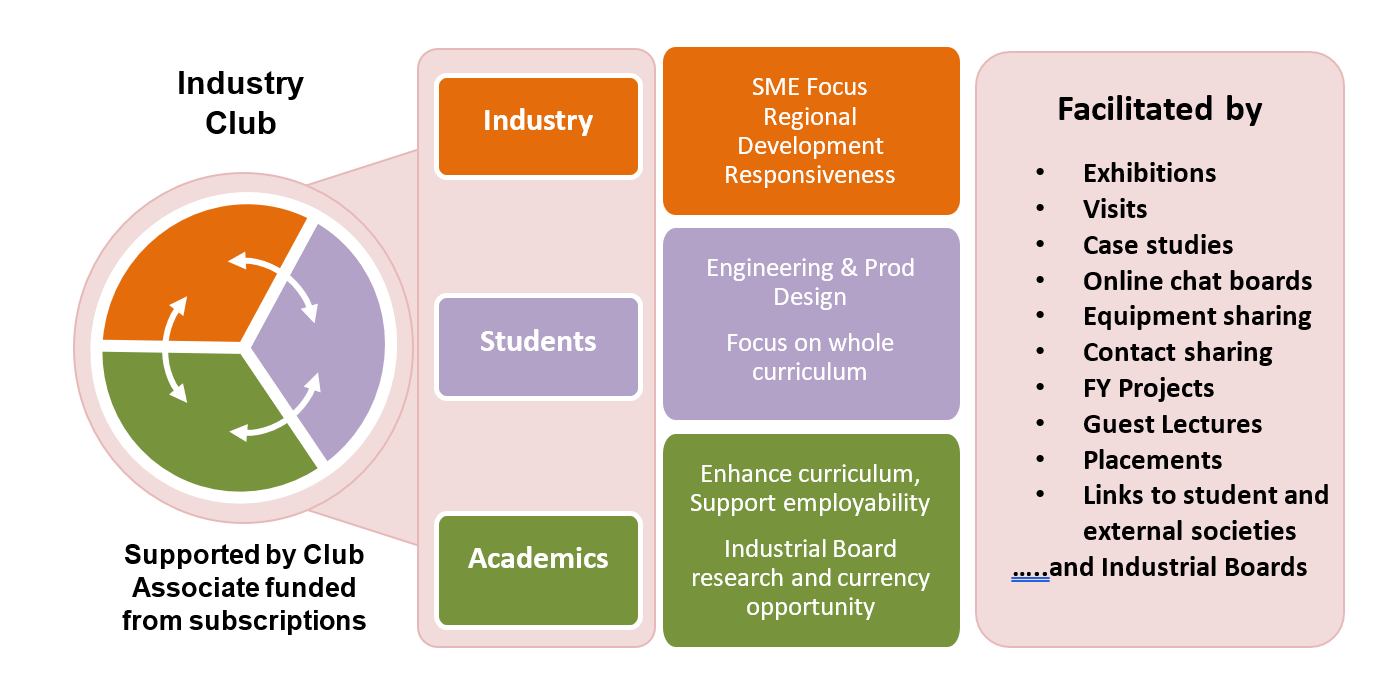
Figure 2 shows schematically the role and activities of the industry club within the group.
Impact Beyond Projects
The use of the Industry Club to co-ordinate and bolster other industry activity within the department has gone beyond final year projects. These can be seen in Figure 2.
The Industrial Advisory Board has now become linked to the Industry Club and so with partners now involved in the wider activities of the club involvement is now not exclusively limited to twice yearly meeting but is an active ongoing partnership using the projects, other learning and teaching activity and a LinkedIn group to create a more dynamic and responsive consultation body. A subset of the IAB is now also made up entirely of recent alumni to act as a bridge between the students and practising industry to help spot immediate gaps and opportunities to support students in this important transition.
Figure 2 : Industry Club set-up and Activity
The club has also developed a range of other industrially linked activities in support of teaching and learning.
While industrial involvement is relatively easy to embed in project or design type modules this is not so easy in traditional underpinning engineering science type activity.
To address the lack of industrial content in traditional engineering science modules a pilot interactive online case studies be developed to help show how fundamental engineering science can be applied in authentic industrial problems. A small team consisting of an academic, the industry club associate and an industrialist was assembled.
This team developed an online pump selection tool which combined interactive masterclasses and activities, introduced and explained by the industrialist to show how the classic classroom theory could be used and adapted in real world scenarios (Figure 3). This has been well-received by students, added authenticity to the curriculum and raised awareness in student minds of the perhaps unfashionable but important and rewarding water services sector.
Figure 3 : Online Interactive Activity developed as part of industry club activity
Further interactions developed by the Industry Club, and part of its remit to embed industrial links at all stages of the degree, include the involvement of an Industrial Partner on a major wind turbine design, build and test project engaged in as group exercises by all students in year one. Here the industrialist, a wind energy professional, contextualises work while his role is augmented by a recent alumni member of the Industrial board who is currently working as a graduate engineer on offshore wind and who completed the same module as the students four years or so previously.
Conclusion
While the development of the Industry Club and its associated activity can not be considered a panacea, it has significantly developed the level of industry involvement within programmes. More crucially it moves away from an opaque and piecemeal approach to industry engagement and offers a more transparent framework and structure on which to hang industry involvement to support academics and industry in developing and maximising the competencies of graduates.
References
Pantzos, P.,Gumaelius L.,Buckley J. and Pears A., “On the role of industry contact on the motivation and professional development of engineering students,” 2019 IEEE Frontiers in Education Conference (FIE), 2019, pp. 1-8, doi: 10.1109/FIE43999.2019.9028621.
Male, S.A., King, R. (2019). Enhancing learning outcomes from industry engagement in Australian engineering education. Journal of Teaching and Learning for Graduate Employability, 10(1), 101–117.
Genheimer SR, Shehab R. The effective industry advisory board in engineering education – a model and case study. 2007 37th Annual Frontiers In Education Conference – Global Engineering: Knowledge Without Borders, Opportunities Without Passports, 2007 FIE ’07 37th Annual. October 2007. doi:10.1109/FIE.2007.4418027
Surgenor B, Mechefske C, Wyss U, Pelow J,(2005) Capstone Design – Experience with Industry Based Projects, 1st Annual CDIO Conference Queen’s University Kingston, Ontario, Canada June 7 to 8, 2005
Carbone A, Rayner GM, Ye J, Durandet Y (2020) Connecting curricula content with career context: the value of engineering industry site visits to students, academics and industry, European Journal of Engineering Education, 45:6, 971-984, DOI: 10.1080/03043797.2020.1806787
Fang N, Mcneill L, Spall R, Barr P (2019) Impacts of Industry Seminars and a Student Design Competition in an Engineering Education Scholarship Program International Journal of Engineering Education Vol. 35, No. 2, pp. 674–684, 2019
Ringwood JV(2013) Integrating industrial seminars within a graduate engineering programme, European Journal of Engineering Education, 38:2, 141-148, DOI: 10.1080/03043797.2012.755497
Magnell M, Geschwind L, Kolmos A (2017) Faculty perspectives on the inclusion of work-related learning in engineering curricula, European Journal of Engineering Education, 42:6, 1038-1047, DOI: 10.1080/03043797.2016.1250067
Tennant S, Murray M, Gilmour B, Brown L. Industrial Work Placement in Higher Education: A Study of Civil Engineering Student Engagement. Industry and Higher Education. 2018;32(2):108-118. Accessed April 30, 2021.
Mejtoft T, (2015) Industry Based Projects And Cases: A CDIO Approach To Students’ Learning, Proc. of the 11th International CDIO Conference, Chengdu University of Information Technology, Chengdu, Sichuan, P.R. China, June 8-11, 2015.
Lima RM, Dinis-Carvalhoa J, Sousaa RM, Arezesa P, Mesquita D, (2017), Production, Development of competences while solving real industrial interdisciplinary problems: a successful cooperation with industry, 27(spe), e20162300, 2017 | DOI: 10.1590/0103-6513.230016
Seidel R, Shahbazpour M, Walker D, Shekar A, Chambers C, (2011), An Innovative Approach To Develop Students’ Industrial Problem Solving SkillsProc. of the 7th International CDIO Conference, Technical University of Denmark, Copenhagen, June 20 – 23, 2011
Thomson G, Prince M, McLening C, Evans C, (2012) A Comparison Between Different Approaches To Industrially Supported Projects, Proc. of the 8th International CDIO Conference, Queensland University of Technology, Brisbane, July 1 – 4, 2012
University of Canterbury, (2021), Collaborate – College of Engineering
Aston University (2021), Computer Science Industry Club Brochure
Any views, thoughts, and opinions expressed herein are solely that of the author(s) and do not necessarily reflect the views, opinions, policies, or position of the Engineering Professors’ Council or the Toolkit sponsors and supporters.
Authors: Prof Simon Barrans (University of Huddersfield), Harvey Kangley (Associated Utility Supplies Ltd), Greg Jones (University of Huddersfield) and Mark Newton (Associated Utility Supplies Ltd)
Keywords: Knowledge Transfer Partnership, Design and Innovation, Student Projects, Railway Infrastructure
Abstract: A six year collaboration between the University of Huddersfield and Associated Utility Supplies Ltd has resulted in one completed and one ongoing KTP project, two successfully completed First of a Kind projects for the rail industry and the development of a new design department in the company. Benefits to the University include, graduate and placement student employment, industrially relevant final year and masters projects and the application of University research. Continued collaboration will generate a case study for the next REF. In this paper we explore the various mechanisms that have been used to facilitate this work.
The opportunity
Network Rail felt that their current supply chain was vulnerable with many parts being single source, some from overseas. They addressed this issue by engaging with SMEs who could develop alternative products. A local company, AUS, believed they could tackle this challenge but needed to develop their design and analysis capability. Their collaboration with the University of Huddersfield enabled this.
Seed funded taster projects
In 2016 AUS approached regional development staff at the 3M Buckley Innovation Centre, the University‘s business and innovation centre, with two immediate needs. These were: an explanation as to why a cast iron ball swivel clamp had failed in service, and a feasibility study to determine if a cast iron cable clamp could be replaced with an aluminium equivalent. Both these small projects were funded using the University’s Collaborative Venture Fund, an internal funding scheme to deliver short feasibility projects for industry. This incentivises staff to only engage in collaborations where there is a high expectation of significant external future funding, and which are low risk to an industry partner.
Knowledge Transfer Partnership (KTP) Projects
KTPs are managed by Innovate UK and are one of the few Innovate UK grants that are designed to have a university as the lead organisation. They are particularly attractive to SMEs as Innovate UK funds 67% of the project cost. The costs cover: the employment costs for a graduate, known as the Associate, who typically works full time at the company; an academic supervisor who meets with the Associate for half a day a week; and administrative support. The key measure of success of a KTP project is that it leaves the company generating more profit and hence, paying more tax. Increased employment is also desirable.
The first, three-year KTP project, applied for in January 2017 and started in June 2017, aimed to provide the company with a design and analysis capability. A Mechanical Engineering graduate from Huddersfield was recruited as the Associate and the Solidworks package was introduced to the company. A product development procedure was put in place and a number of new products brought to market. The Associate’s outstanding performance was recognised in the KTP Best of the Best Awards 2020 and he has stayed with the company to lead the Product Innovation team.
The second, two-year KTP project started in November 2020 with the aim of expanding the company’s capability to use FRP materials. Whilst the company had some prior product experience in this area, they were not carrying out structural analysis of the products. FRP is seen as an attractive material for OLE structures as it is non-conductive (hence removing the need for insulators) and reduces mass (compared to steel) which reduces the size of foundations needed.
First of a kind (FOAK) projects
The Innovate UK FOAK scheme provides 100% funding to develop products at a high technology readiness level and bring them to market. They are targeted at particular industry areas and funding calls are opened a month to two months before they close. It is important therefore to be prepared to generate a bid before the call is made. FOAKs can and have been led by universities. In the cases here, the company was the lead as they could assemble the supply chain and route to market. The entire grant went to the company with the university engaged as a sub-contractor.
The first FAOK to support development of a new span-wire clamp was initially applied for in 2019 and was unsuccessful but judged to be fundable. A grant writing agency was employed to rewrite the bid and it was successful the following year. Comparing the two bids, re-emphasis of important points between sections of the application form and emphasising where the bid met the call requirements, appeared to be the biggest change.
The span-wire clamp is part of the head-span shown in figure 1. The proposal was to replace the existing cast iron, 30 component assembly with an aluminium bronze, 14 component equivalent, as shown in figure 2. The FOAK project was successful with the new clamp now approved for deployment by Network Rail.
The University contributed to the project by testing the load capacity of the clamps, assessing geometric tolerances in the cast parts and determining the impact that the new clamp would have on the pantograph-contact wire interface. This latter analysis used previous research work carried out by the University and will be an example to include in a future REF case study.
The second FOAK applied for in 2020 was for the development of a railway footbridge fabricated from pultruded FRP sections. This bid was developed jointly by the University and the company, alongside the resubmission of the span-wire FOAK bid. This bid was successful and the two projects were run in parallel. The footbridge was demonstrated at RailLive 2021.
Additional benefits to University of Huddersfield
In addition to the funding attracted, the collaboration has provided material for two MSc module assignments, six MSc individual projects and 12 undergraduate projects. The country of origin of students undertaking these projects include India, Sudan, Bangladesh, Egypt, Syria and Qatar. A number of these students intend to stay in the UK and their projects should put them in a good position to seek employment in the rail industry. A number of journal and conference papers based on the work are currently being prepared.
Figure 1. Head-span showing span-wires and span-wire clamp.
Figure 2. Old (left) and new (right) span-wire clamps.
Any views, thoughts, and opinions expressed herein are solely that of the author(s) and do not necessarily reflect the views, opinions, policies, or position of the Engineering Professors’ Council or the Toolkit sponsors and supporters.
Abstract: The case study is interesting as it combines the engaging topics of smart materials and sports engineering, and showcases the release of a sports product. The work is underpinned by academic papers, include a teaching focus one detailing how materials have influenced tennis rackets dating back to the origins of the game. Effect of materials and design on the bending stiffness of tennis rackets: https://doi.org/10.1088/1361-6404/ac1146. Review of auxetic materials for sports applications: Expanding options in comfort and protection: https://doi.org/10.3390/app8060941.
This case study is about the application of auxetic materials to sports equipment. Particularly, it is about the development of the first ever tennis racket to feature auxetic fibre-polymer composites [1]. In our work, we aim to combine the exciting fields of sport and advanced materials to engage people with science, technology, engineering, and maths (STEM). Indeed, our work is multi-disciplinary. Dr Mohr is the R&D Manager for PreDevelopement at HEAD and brings expertise in tennis racket engineering, Dr Allen and Professor Alderson are academics and bring respective expertise in sports engineering and smart materials.
Dr Allen has been researching the mechanics of sports equipment for many years, with a focus on tennis rackets [2]. One project involved characterising the properties of over 500 diverse rackets dating back to the origins of the game in the 1870s to the present day. The rackets were from various collections, including the Wimbledon Lawn Tennis Museum in London, and HEAD in Kennelbach Austria, where Dr Mohr works. The museum houses particularly old and rare rackets, whereas the collection at HEAD has a broad range of more modern designs. Initial work involved developing techniques for efficiently characterising many rackets [3]. Subsequent publications describe how a shift in construction materials – from wood to fibre-polymer composites – around the 1970s and 1980s led to lighter and stiffer rackets, with shorter handles and larger heads [4], [5]. Indeed, the application of new materials has driven the development of tennis rackets, and further advances are likely to come from developments in materials and manufacturing techniques.
Professor Alderson has been researching smart materials and structures for many years, with a focus on auxetic materials [6]. Auxetic materials have a negative Poisson’s ratio, which means that they fatten when stretched and become thinner when compressed. A negative Poisson’s ratio can enhance other properties, including vibration damping. Dr Allen and Professor Alderson have been working together to apply auxetic materials to sports equipment [7]. Dr Allen discussed this work on auxetic materials with Dr Mohr, and this led to the collaboration between the three parties that resulted in the new racket design [1].
Auxetic fibre-polymer composites were particularly appealing to Dr Mohr for application in tennis rackets, as they can be made using conventional fibres and resins, by simply arranging the fibres in specific orientations [8]. Following a visit to HEAD, where he was able to see the prototyping facilities, Professor Alderson developed various auxetic fibre-polymer composites, using the materials already being used by HEAD to make rackets. HEAD then developed prototype rackets incorporating these auxetic fibre-polymer composites at their research and development facility in Kennelbach. The racket designs were further developed and refined through testing, both in the laboratory and on the tennis court with players providing feedback.
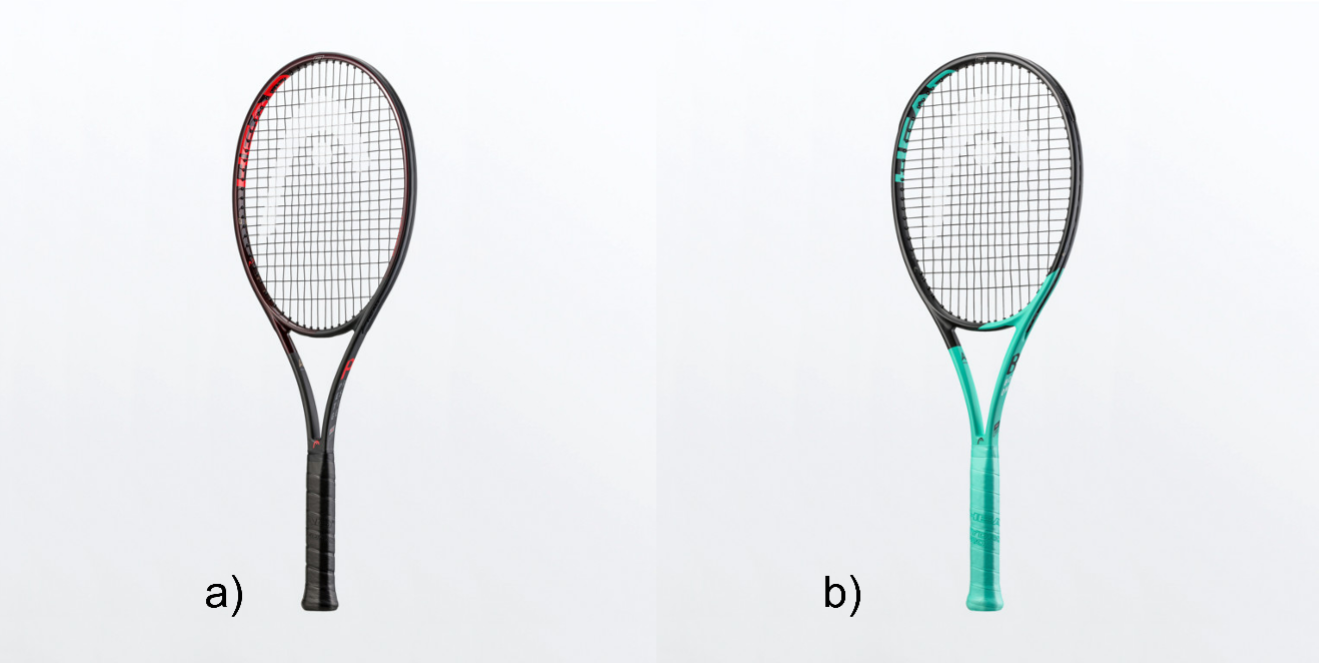
The first tennis racket with auxetic fibre composites was released in late 2021, in the form of the HEAD Prestige (Figure 1a). The Prestige was followed by the release of a new racket silo (collection) in early 2022 in the form of the Boom (Figure 1b). Drs Mohr and Allen and Professor Alderson are now exploring options for further applying auxetic materials to tennis rackets. Dr Allen’s teaching case study on the historical development of the tennis racket [4] has been enriched by including the story behind the development of the new auxetic fibre-polymer composite rackets [1]. He also includes discussion of emerging topics in the case study that could be applied to tennis rackets, such as more automated manufacturing techniques like additive manufacturing, and more environmentally friendly materials, like natural fibres and resins [5]. We hope that the new tennis rackets will raise awareness of auxetic materials amongst the public, and the case study will help inspire others to use topics like sports engineering and advanced materials to support their STEM teaching and public engagement.
Figure 1 Examples of HEAD rackets featuring auxetic fibre-polymer composites, a) Prestige Pro and b) Boom Prom.
References
[1] HEAD Sports, “Auxetic – The Science Behind the Sensational Feel,” 2021. https://www.head.com/en_GB/tennis/all-about-tennis/auxetic-the-science-behind-the-sensational-feel (accessed Feb. 05, 2022).
[2] T. Allen, S. Choppin, and D. Knudson, “A review of tennis racket performance parameters,” Sport. Eng., vol. 19, no. 1, Mar. 2016, doi: 10.1007/s12283-014-0167-x.
[3] L. Taraborrelli et al., “Recommendations for estimating the moments of inertia of a tennis racket,” Sport. Eng., vol. 22, no. 1, 2019, doi: 10.1007/s12283-019-0303-8.
[4] L. Taraborrelli, S. Choppin, S. Haake, S. Mohr, and T. Allen, “Effect of materials and design on the bending stiffness of tennis rackets,” Eur. J. Phys., vol. 42, no. 6, 2021, doi: 10.1088/1361-6404/ac1146.
[5] L. Taraborrelli et al., “Materials Have Driven the Historical Development of the Tennis Racket,” Appl. Sci., vol. 9, no. 20, Oct. 2019, doi: 10.3390/app9204352.
[6] K. E. Evans and A. Alderson, “Auxetic materials: Functional materials and structures from lateral thinking!,” Adv. Mater., vol. 12, no. 9, 2000, doi: 10.1002/(SICI)1521-4095(200005)12:9<617::AID-ADMA617>3.0.CO;2-3.
[7] O. Duncan et al., “Review of auxetic materials for sports applications: Expanding options in comfort and protection,” Applied Sciences (Switzerland), vol. 8, no. 6. 2018, doi: 10.3390/app8060941.
[8] K. L. Alderson, V. R. Simkins, V. L. Coenen, P. J. Davies, A. Alderson, and K. E. Evans, “How to make auxetic fibre reinforced composites,” Phys. Status Solidi Basic Res., vol. 242, no. 3, 2005, doi: 10.1002/pssb.200460371.
Any views, thoughts, and opinions expressed herein are solely that of the author(s) and do not necessarily reflect the views, opinions, policies, or position of the Engineering Professors’ Council or the Toolkit sponsors and supporters.
Abstract: A project, developed jointly by UCL and engineers from ARUP, allowed students to work on redesigning the fire damaged roof of the Notre Dame Cathedral. Industry expertise complemented academic experience in civil engineering design to create a topical, relevant and creative project for students. The project combined technical learning in timber design with broader considerations such as costs, health and safety, buildability and environmental impacts. Final presentations being made to engineering teams at ARUP offices also developed wider professional skills.
Background
Following the 2019 fire in the Notre Dame Cathedral, Civil Engineering Students at University College London (UCL) were tasked with designing a replacement. The project was delivered, in collaboration with engineers from ARUP, within a Design module in Year 2 of the programme. The project was run as a design competition with teams competing against one another. The project built on learning and design project experience built up during years 1 and 2 of the course.
The collaboration with ARUP is a long-standing partnership. UCL academics and ARUP engineers have worked on several design projects for students across all years of the Civil Engineering Programme.
The Brief
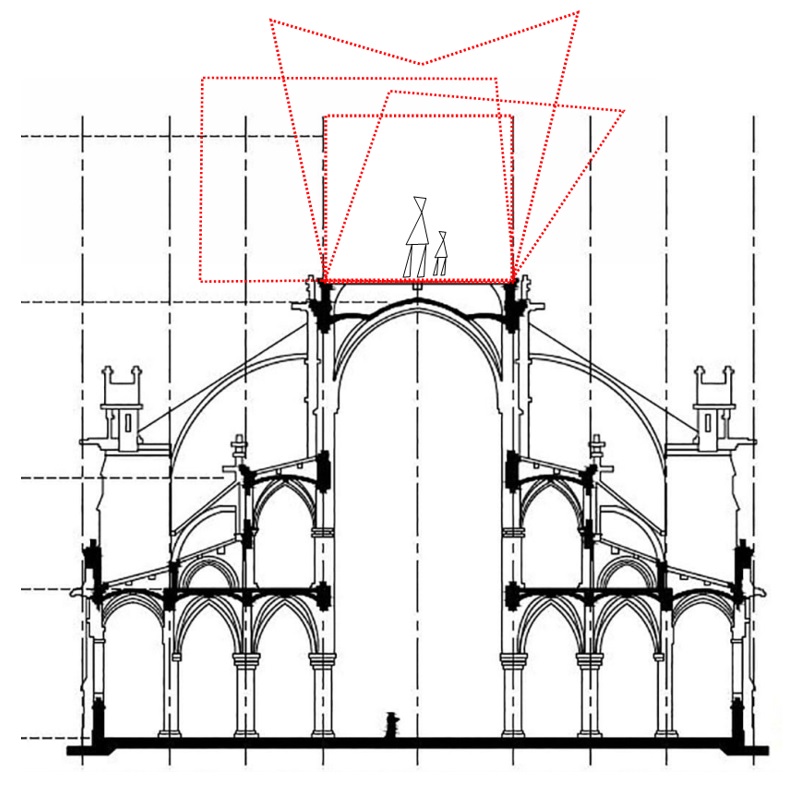
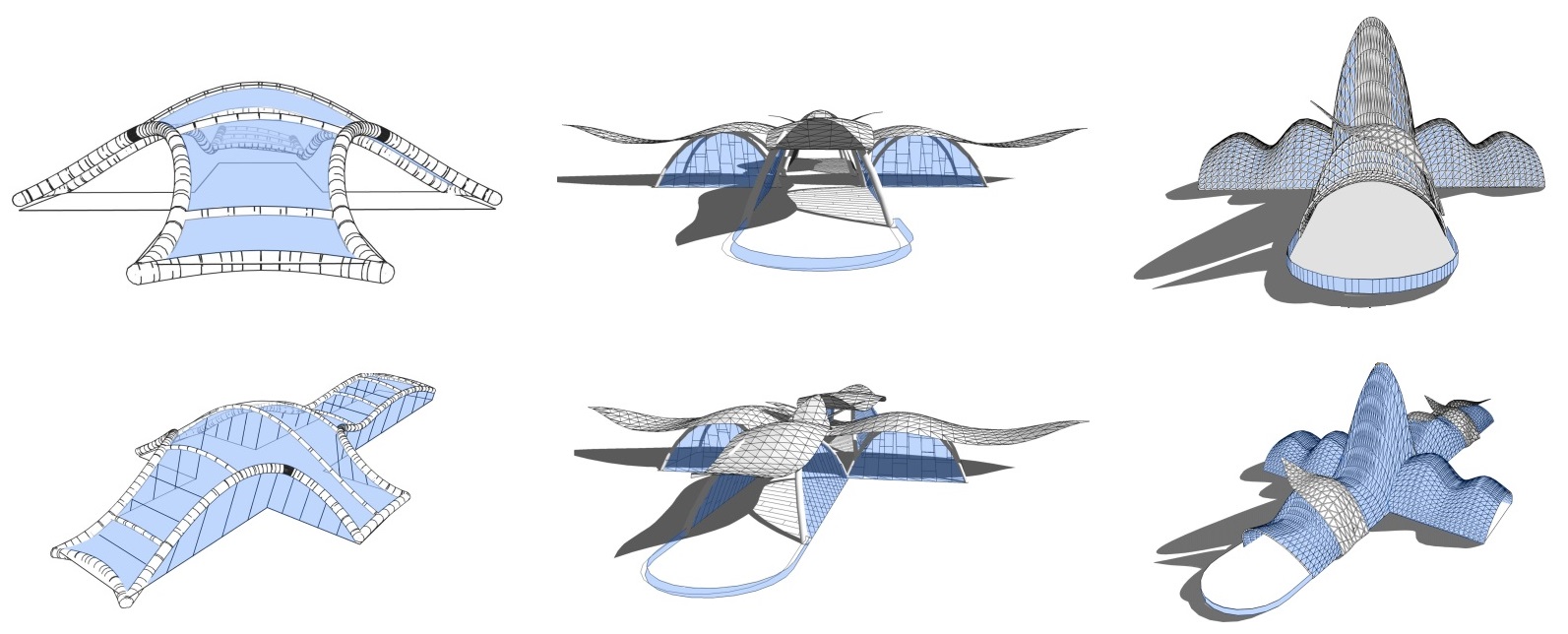
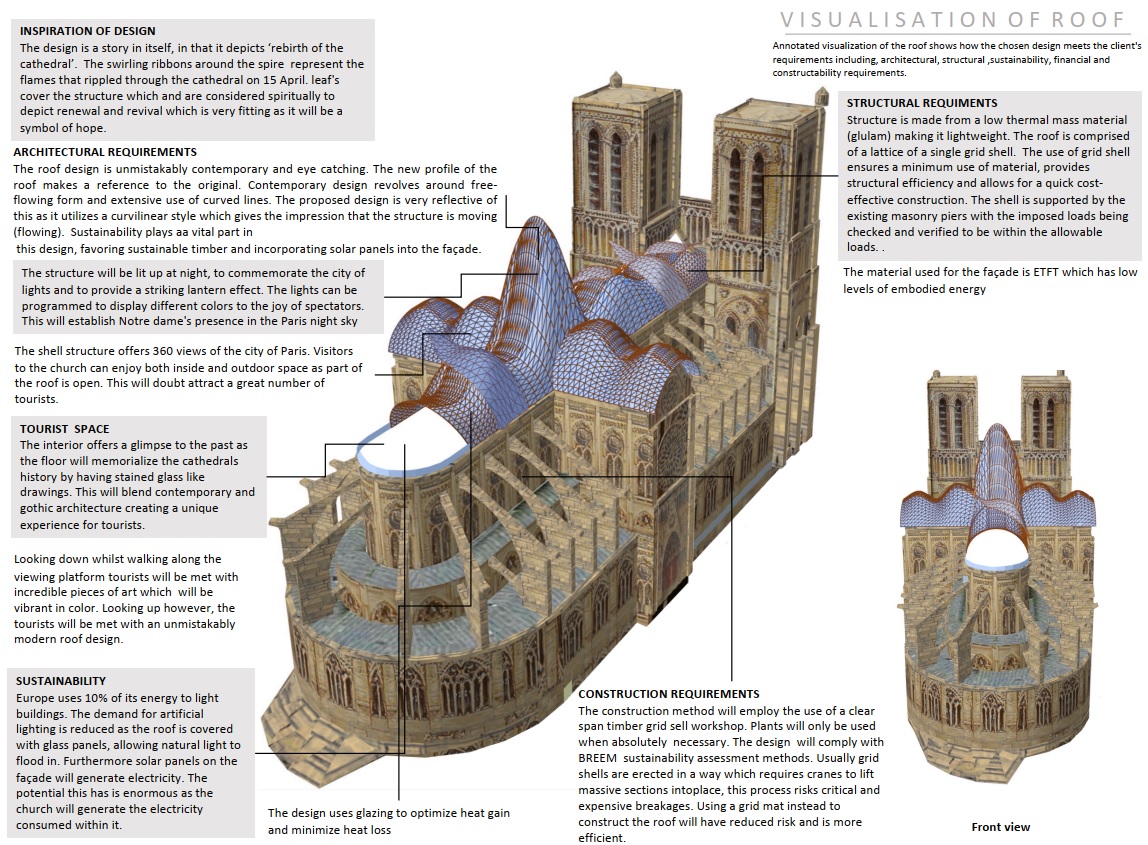
Instead of designing a direct replacement for the roof the client wanted to create a modern, eye-catching roof extension which houses a tourist space that overlooks the city. The roof had to be constructed on the existing piers so loading limits were provided. The brief recognised the climate emergency and a key criterion for evaluation was the sustainability aspects of the overall scheme. For this reason, it also stipulated that the primary roof and extension structure be, as far as practicable, made of engineered timber.
Figure 1. Image from the project brief indicating the potential building envelopes for the roof design
Given the location all entries had to produce schemes that were quick to build, cause minimal disruption to the local population, not negatively impact on tourism and, most importantly, be safe to construct.
Requirements
Teams (of 6) were required to propose a minimum of 2 initial concept designs with an appraisal of each and recommendation for 1 design to be taken forward.
The chosen design was developed to include:
Full structural design; Calculations to Eurocodes, load path diagrams, member sizing, connection design, explanation of structural choices.
Buildability (cost breakdown, site logistics, consideration of context)
Health and Safety risks, impacts on design and control measures
Construction sequence
Sustainability summary inc. embodied carbon calculations
Teams had to provide a 10xA3 page report, a set of structural calculations, 2xA3 drawings and a 10-minute presentation.
Figure 2. Connection detail drawing by group 9
Delivery
Course material was delivered over 4 sessions with a final session for presentations:
Session 1: Project introduction and scheme designing
Session 2: Timber design
Session 3: Construction and constructability
Session 4: Fire Engineering and sustainability
Session 5: Student Presentations
Sessions were co-designed and delivered by a UCL academic and engineers from ARUP. The sessions involved a mixture of elements incl. taught, tutorial and workshop time. ARUP engineers also created an optional evening workshop at their (nearby) office were groups or individuals could meet with a practicing engineer for some advice on their design.
These sessions built on learning from previous modules and projects.
Learning / Skills Development
The project aimed to develop skills and learning in the following areas:
Technical skills relating to structural design using timber, embodied energy calculations, drawing and H&S risk assessment.
Design skills relating to consideration of the site, its context and the need, creativity and assessing ideas, consideration and overlapping of numerous disciplines, design iteration and improvement.
Professional skills in relation to communicating with clients, producing reports to a professional standard, presenting a project, working in teams, organising resources, etc.
Visiting the ARUP office and working with practicing engineers also enhanced student understanding of professional practice and standards.
Benefits of Collaborating
The biggest benefit to the collaboration was the reinforcement of design approaches and principles, already taught by academics, by practicing engineers. This adds further legitimacy to the approaches in the minds of the students and is evidenced through the application of these principles in student outputs.
Figure 3. Development of design concepts by group 12
The increased range in technical expertise that such a collaboration brings provides obvious benefit and the increased resource means more staff / student interaction time (there were workshops where it was possible to have one staff member working with every group at the same time).
Working with an aspirational partner (i.e. somewhere the students want to work as graduates) provides extra motivation to improve designs, to communicate them professionally and impress the team. Working and presenting in the offices of ARUP also helped to develop an understanding of professional behaviour.
Reflections and Feedback
Reflections and feedback from all staff involved was that the work produced was of a high quality. It was pleasing to see the level of creativity that the students applied in their designs. Feedback from students gathered through end of module review forms suggested that this was due to the level of support available which allowed them to develop more complex and creative designs fully.
Wider feedback from students in the module review was very positive about the project. They could see that it built on previous experiences from the course and enjoyed that the project was challenging and relevant to the real world. They also valued the experiences of working in a practicing design office and working with practicing engineers from ARUP. Several students posted positively about the project on their LinkedIn profiles, possibly suggesting a link between the project and employability in the minds of the students.
Figure 4. Winning design summary diagram by group 12
Any views, thoughts, and opinions expressed herein are solely that of the author(s) and do not necessarily reflect the views, opinions, policies, or position of the Engineering Professors’ Council or the Toolkit sponsors and supporters.
Keywords: Civil Engineering Design, Building Information Modelling, BIM, Digital Engineering, Industry, Collaboration
Abstract: This project, developed jointly with industry partners at Multiplex, allowed Civil Engineering students at UCL to develop their understanding and technical skills around the use of Building Information Modelling (BIM) on civil engineering projects and related software. Students worked on a model of an emergency shelter (designed by UCL alumnus) and were required to consider the relevant parties involved (technical and non-technical), the information they require and how to utilise the model to organise and communicate this information effectively.
Background
Digital engineering tools and Building Information Modelling (BIM) are increasingly becoming important features of modern construction projects. The design teaching team in the Department of Civil, Environmental and Geomatic Engineering (CEGE) at University College London (UCL) recognised the need to embed this practice into parts of the design teaching delivery for students on the Civil Engineering undergraduate programmes.
UCL and Mulitplex (civil engineering contractor) had been partnering on school outreach activities for several years. A discussion at such an event led to a realisation that there was good alignment on how these topics should be taught, with a focus on information and communication rather than modelling. Staff at UCL had already started developing a project that would involve using elements of BIM in the design development of an emergency shelter for humanitarian relief and that the project should encourage students to think about the information and communication aspects of this. The digital engineering team at Multiplex then agreed to join the project and provide technical assistance, to develop and deliver teaching materials and to provide real life examples and case studies to supplement the project.
The Brief
Students were provided with a pre-developed REVIT® model of an emergency shelter design made, predominantly, from timber. The shelter had been designed by a UCL alumnus during their time as a UCL student and agreement was granted to use it for this project. Students were presented with an imagined scenario that they were working for a charity that was planning to build 10 of these shelters in Haiti to assist with humanitarian relief effort following an earthquake. The students needed to consider which parties would need to be communicated with, what information they would need, how this information could be communicated with them and how the digital model could assist with this process.
Figure 1. Image of Emergency Shelter model in REVIT®
Students were encouraged to consider (but not limited to) included:
Design information (limits, assumptions, etc)
Commercial
Construction (programme, logistics and sequencing)
Health and safety
Environmental factors
Handover information and future maintenance requirements
Students were required to research the relevant information and populate the REVIT® model appropriately and professionally.
Requirements
Teams (of 6) were required to provide a 10xA3 page report that would run through each of the potential parties to communicated with, what information they would need and how the model would be used to enable this communication. They also needed to describe any assumptions that were made and how information was selected during the research phase. They needed to highlight the critical thinking that had been carried out in relation to sources of information and its suitability and reliability.
Figure 2. Use of model to explain construction sequence
Teams also needed to submit their completed REVIT® model files for inspection as well as an 8 min video presentation that would:
Present the completed model and show competency in finding the relevant information for different elements
Showcase how the model enhanced communication to each of the relevant parties
Explain how the team collaborated to produce a justified proposal
Discuss problems encountered and how they were overcome
Figure 3. External view of model
Delivery
Course material was delivered over 4 sessions with a final session for presentations:
Session 1: Project introduction and software introduction
Session 2: (i) Information and exporting in REVIT®. (ii) Commercial overview
Session 3: (i) Construction and Logistics. (ii) Health, safety and environmental factors
Session 4: (i) Handover requirements. (ii) Maintainable assets. (iii) Building management
Session 5: Student presentations
Sessions were co-designed and delivered by a UCL academic and a digital manager from Multiplex. The sessions involved a mixture of elements incl. taught, tutorial and workshop time that allowed students to work in their groups.
Learning / Skills Development
The project aimed to develop skills and learning in the following areas:
Improve REVIT® / software skills
Understand the benefits of BIM to a multi-party construction project particularly in relation to information and communication.
Improve construction knowledge
Recognise that digital technology isn’t a replacement for engineering knowledge and input.
Improve employability of students by equipping them with relevant and up-to-date construction tools and techniques.
Benefits of Collaborating
The first benefit was the inspirational aspect of working on a shelter design that had been produced by a former UCL student. This Alumnus contributed to the introduction session by running through their design and this helped students understand just how much had been achieved by someone in their position.
The collaboration with Multiplex’s digital team brought obvious benefits to the technical skills development but also benefitted student understanding by showing how these skills are being used on live construction sites. The process of learning from and presenting to practicing construction professionals also allowed students to develop key professional behavioural skills that help develop and enhance employability.
Reflections and Feedback
Reflections and feedback from all staff involved was that the work produced was of a high quality and that this demonstrated an understanding of the project objectives from the student perspective. It was also apparent that students were becoming adept at using REVIT® software effectively and appropriately.
Wider feedback from students in the module review was very positive about the project and that it had improved their understanding of the role of digital technologies in the construction industry. Students said in feedback “BIM has helped us to look at all aspects of the design and to figure out more stuff in the same amount of time,” and, “Doing it this way [REVIT model] means you can see what you think might be a risk to the workers more easily.”
Several students posted positively about the project on their LinkedIn profiles, possibly suggesting a link between the project and employability in the minds of the students.
2 of the students successfully applied for summer internships with Multiplex’s digital team immediately following the project and were able to build on their digital engineering skills further.
The project was featured by trade magazine BIMPlus which ran an article on the project showcasing the relative novelty and uniqueness of the approach taken.
Any views, thoughts, and opinions expressed herein are solely that of the author(s) and do not necessarily reflect the views, opinions, policies, or position of the Engineering Professors’ Council or the Toolkit sponsors and supporters.