This database brings together peer-reviewed academic papers, reviews, and policy analyses that focus on digital technical standards and their development. It covers the work of major standards-development organisations such as ETSI, 3GPP, IEEE, IETF, W3C, ITU, ISO/IEC, and NIST. Each entry lists the title, authors, year of publication, and the standards organisations discussed. You can use the table to quickly scan the literature, search by author, topic, or standards organisation, and find works relevant to your teaching, research, or work with standards. The list is updated regularly.
However, given the large amount of standards-related research published each year in journals, conferences, and policy outlets, the database is not exhaustive, and some papers, especially very recent releases, non-English publications, and grey literature, may not be included. We welcome suggestions for additions to help keep the database as complete as possible.
Standards work comes with a language of its own. This glossary collects the abbreviations you’ll come across throughout the DTS Toolkit, the bodies that write the standards, and the telecoms, security, web and EU regulatory terms that sit alongside them, so you can look up anything unfamiliar without breaking your stride.
Standards Development Organisations (SDOs)
SDO: Standards Development Organization
BSI: British Standards Institution
NSB: National Standards Body
ETSI: European Telecommunications Standards Institute
IEEE: Institute of Electrical and Electronics Engineers
IEEE SAIEEE: Standards Association
IETF: Internet Engineering Task Force
ISO: International Organization for Standardization
DSIT: Department for Science, Innovation and Technology (UK)
NCSC: National Cyber Security Centre (UK)
SDG: Sustainable Development Goals
Technology
ICT: Information and Communications Technology
DLT: Distributed Ledger Technology
SBOM: Software Bill of Materials
PCI DSS: Payment Card Industry Data Security Standard
SWEBOK: Software Engineering Body of Knowledge
CyBOK: Cyber Security Body of Knowledge
Supporting UK engineering educators to embedDigital Technical Standards into curriculum design. A collaboration between the Engineering Professors’ Council (EPC) and the University of Lancashire. Funded by the Department for Science, Innovation & Technology (DSIT).
WHY: The case for digital technical standards in education
Introduction
Digital Technical Standards (DTS) are foundational to the UK’s digital infrastructure, innovation ecosystem, and global competitiveness. They underpin the technologies and systems that define modern engineering practice from telecommunications and cybersecurity to the Internet of Things and artificial intelligence. Yet engagement with DTS development remains limited among engineering students and early-career professionals.
The Digital Technical Standards Toolkit has been developed to address this gap. It is a comprehensive, academically aligned resource designed to support engineering and computing educators across UK higher education in embedding DTS into curriculum design and delivery.
The Toolkit is a collaboration between the Engineering Professors’ Council (EPC) and the University of Lancashire funded by the Department for Science, Innovation & Technology (DSIT). It builds on the success of the EPC’s growing series of widely used toolkits :including those covering ethics, sustainability, complex systems, and inclusive employability :which have collectively received over 100,000 visits in the past three years.
“The Digital Technical Standards Toolkit represents a timely and necessary intervention for UK engineering education. As digital technical standards become increasingly embedded within accredited programme requirements, there is a clear and urgent need to equip academics with curated, accessible resources that support confident and consistent delivery. This project is not about creating content in isolation it is about harnessing the collective expertise of a broad community, drawing together what already exists, and making it genuinely usable for educators within the pressures of a modern engineering curriculum.”– Professor Georgina Harris, Dean of Engineering and Computing, University of Lancashire; Chair, DTS Toolkit Project
“Digital technical standards are not simply technical documents; they are the foundations upon which our digital infrastructure, our industries, and ultimately our societies are built. For young engineers to be truly prepared for professional practice, they must understand not only that standards exist, but how the global standardisation ecosystem functions, why standards are needed, and how they themselves can contribute to shaping them. The DTS Toolkit has the opportunity to provide that foundational understanding by mapping the landscape from ETSI and IEEE to IETF, W3C, and ITU and by framing content around enduring principles rather than the specifics of any single standard.” – Dr. Hermann Brand, Standards Expert, IEEE; Co-Chair DTS Toolkit Project
Purpose
The DTS Toolkit will enhance understanding and engagement with digital technical standards, which underpin the UK’s digital infrastructure, engineering practice, and international competitiveness. Specifically, the Toolkit aims to:
Consolidate existing high-quality resources from international Standards Development Organisations (SDOs) and signpost relevant external materials in a single, accessible location.
Develop new UK-context content where gaps exist, including bridging articles, curriculum mapping guides, and career pathway resources.
Support educators in embedding DTS concepts, SDO structures, and standards-related career pathways within engineering and computing curricula.
Align with AHEP (Accreditation of Higher Education Programmes) requirements and the Engineering Council’s UK-SPEC competence framework.
Demystify DTS development and highlight its relevance to engineering careers, motivating students and early-career professionals to engage with standards work.
WHAT: Toolkit content and scope
What the Toolkit contains
The Toolkit brings together resources from eight International Standards Development Organisations (ISDOs) in one accessible location, providing educators with the materials they need to teach DTS effectively.
Types of resources
The Toolkit includes a range of resource types, designed for use across different teaching contexts including lectures, seminars, problem-based learning, and online delivery:
Knowledge articles: explaining key DTS concepts, SDO structures, and the role of standards in engineering practice.
Guidance articles: providing pedagogical support for educators embedding DTS into their teaching, including curriculum mapping and assessment design.
Teaching resources: ready-to-use classroom materials such as case studies, activities, and project ideas.
UK industry case studies: demonstrating real-world applications of digital technical standards in UK engineering contexts.
Signposted external resources: curated links to high-quality existing materials from SDOs, professional bodies, and academic literature.
HOW: Development, governance and getting involved
Project leadership
The project is co-chaired by:
Professor Georgina Harris: Dean of the School of Engineering & Computing at the University of Lancashire and President of the Engineering Professors’ Council. Professor Harris oversees content development, academic integration, and stakeholder engagement.
Dr. Hermann Brand (IEEE): specialist in international standards, serving as resource advisor and co-chair of the Expert Working Group.
The project is managed by Dhanushka Hewaralalage at the University of Lancashire, with strategic oversight from Johnny Rich, Chief Executive of the EPC.
The Expert Working Group
The development of the Toolkit is guided by an Expert Working Group comprising representatives from academia, industry, professional bodies, and Standards Development Organisations. The Working Group has been convened to:
Identify and review existing resources relevant to DTS education.
Highlight gaps where new, targeted content is required.
Commission and review original content for inclusion in the Toolkit.
Ensure alignment with UK accreditation frameworks and professional registration requirements.
Working Group members and contributing experts include representatives from organisations such as the Engineering Council, British Standards Institution (BSI), Institution of Engineering and Technology (IET), Royal Academy of Engineering, DSIT, and UK universities.
Background and context
This initiative builds on the meeting on Technical Standards convened on 11 September 2025 by the Engineering Council. Following that meeting, DSIT funded the creation of this Toolkit to support engineering academics in better understanding digital technical standards and embedding them in their teaching.
The project follows the successful model established by the EPC’s toolkit series, which provides free-to-use resources in areas where engineering educators need particular support to stay current and aligned with academic, professional, and accreditation requirements. Existing EPC toolkits cover topics including engineering ethics, sustainability, complex systems, enterprise collaboration, and inclusive employability.
How to get involved
The Toolkit is a community-owned project, and contributions from academics, industry professionals, and standards experts are welcomed. There are several ways to get involved:
Share existing materials that you use or that your organisation would like to contribute.
Signpost external resources relevant to DTS education.
Suggest content to fill identified gaps.
Produce short, targeted guidance content where required.
Authorise use of your institution’s resources for inclusion in the Toolkit.
All contributors and participating experts will be acknowledged publicly on a dedicated DTS Toolkit page on the EPC website.
Get in touch
To register your involvement or interest, contact:
Dhanushka Hewaralalage
Project Manager, Digital Technical Standards Toolkit
Email: dsahewaralalage1@lancashire.ac.uk
Hosting and sustainability
The Toolkit is hosted on the EPC website, which is widely used by engineering academics across the UK. It is be freely accessible to all users without the need for membership or subscription.
The Toolkit will remain on the EPC website for a minimum of three years, with the intention that it will be maintained indefinitely. Users will be invited to submit new content for inclusion, which will be reviewed by volunteers from the Expert Working Group, ensuring the Toolkit remains current and relevant.
A launch webinar and marketing campaign will promote the Toolkit to all EPC members: approximately 9,000 academics from over 90 engineering departments throughout the UK.
Any views, thoughts, and opinions expressed herein are solely that of the author(s) and do not necessarily reflect the views, opinions, policies, or position of the Engineering Professors’ Council or the Toolkit sponsors and supporters.
Subject: The race to standardise the Internet
Title:How Internet Standards Grew: A Bar Chart Race of RFC Publication by Technology Domain (1969–2025)
Requests for Comments (RFCs) are the technical documents that define how the internet works. Published by the Internet Engineering Task Force (IETF) since 1969, the RFC series now contains over 9,700 documents covering everything from the foundational TCP/IP protocols to modern security standards like TLS 1.3 and post-quantum cryptography.
Every time you load a webpage, send an email, connect to Wi-Fi, or make a video call, you are relying on technology defined in RFCs. They are freely available to anyone at rfc-editor.org: a core principle of the open internet.
About this visualisation
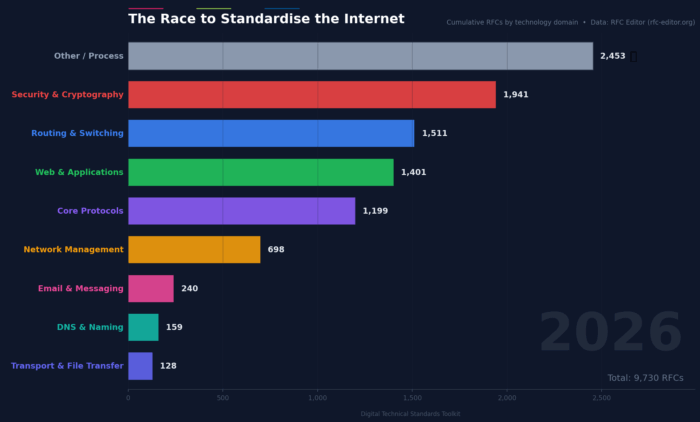
The animated bar chart race shows the cumulative number of RFCs published over time, classified into nine technology domains based on keyword analysis of each RFC’s title. The bars rank and re-sort dynamically as leadership shifts between domains, revealing how the priorities of internet standardisation have evolved over five decades.
Data: Per-year publication totals are exact figures from the RFC Editor’s official statistics page. Topic classification is derived from keyword frequency analysis of the complete rfc-index.txt file (~9,900 entries), mapped to IETF Area categories.
Final frame: The state of Internet standards in 2025
Figure 1: Cumulative RFCs by technology domain as of 2025. Data: RFC Editor (rfc-editor.org/rfcs-per-year/).
2025 rankings by technology domain
Rank
Technology domain
Cumulative RFCs
Share
Examples
1
Security & Cryptography
1,809
18.6%
TLS, IPsec, OAuth, DKIM
2
Routing & Switching
1,359
14.0%
BGP, OSPF, IS-IS, MPLS
3
Network Management
1,312
13.5%
SNMP, YANG, NETCONF
4
Web & Applications
1,277
13.2%
HTTP, QUIC, SIP, JSON
5
Core Protocols
1,204
12.4%
TCP, UDP, IP, ICMP
6
Other / Process
941
9.7%
IETF process, April 1st
7
Transport & File Transfer
688
7.1%
FTP, TFTP, NFS
8
Email & Messaging
640
6.6%
SMTP, IMAP, MIME
9
DNS & Naming
475
4.9%
DNS, DNSSEC, RDAP
Key findings for educators
Security went from almost nothing to #1. In the 1970s, security represented roughly 2% of new RFCs. By the 2020s, it accounts for 28% of new publications :reflecting the transformation of the internet from a trusted academic network to a global system requiring robust protection.
The Web emerged from nothing in 1993. Before HTTP, web-related RFCs simply did not exist. The domain now accounts for over 1,200 cumulative standards, driven by HTTP/2, QUIC, WebRTC, and application-layer protocols.
Foundational protocols are mature but still active. Core Protocols (TCP, IP, UDP) saw their highest growth in the 1970s–80s but continue to receive updates :for example, RFC 9293 (2022) formally revised the TCP specification after 41 years.
Email standards peaked early. Email was one of the first killer applications of the internet and dominated early RFC output. Its share has declined steadily as the web and security took over, though DMARC and SPF keep it active.
Routing remains the backbone. BGP, OSPF, and MPLS continue to generate significant standards activity. Routing has maintained a consistent 13–18% share across every era, reflecting its importance as the internet’s structural layer.
Category mapping: Based on IETF Area structure with title keyword matching
Animation: Generated using Python matplotlib + FuncAnimation
Any views, thoughts, and opinions expressed herein are solely that of the author(s) and do not necessarily reflect the views, opinions, policies, or position of the Engineering Professors’ Council or the Toolkit sponsors and supporters.
How digital technical standards keep our connected world working, and why engineers should understand them.
Why standards matter
Every time a video is streamed, a message is sent, or a contactless payment terminal is used, digital technical standards are at work. These shared rules and specifications determine how devices such as phones, routers, and computers, as well as software applications and networks, communicate and interact, regardless of manufacturer or country of origin. Without these standards, the seamless operation of the connected world would not be possible.
Yet for many engineers and computing professionals, especially those early in their careers, the world of standards development remains unfamiliar. Who writes these rules? How are decisions made? And why should it matter to someone studying engineering in the UK?
The reliability of digital infrastructure is maintained by a global digital standardisation ecosystem, comprising organisations that develop and uphold the technical foundations of modern systems. Familiarity with this ecosystem is now essential for engineering graduates, as highlighted in UK accreditation frameworks such as the Accreditation of Higher Education Programmes (AHEP).
What is a digital technical standard?
A digital technical standard is a documented specification that defines the operational requirements of a technology. Examples include communication protocols, which establish rules for data exchange between devices; data formats, which specify how information is organised; and interfaces, which outline methods for system connectivity and interaction. These standards are generally developed through collaborative, consensus-driven processes involving engineers, researchers, companies, and, in some cases, societal stakeholders and governments.
Most digital standards are voluntary, allowing manufacturers and developers to decide whether to implement them. However, strong market forces typically drive widespread adoption, as products that do not comply with prevailing standards lack commercial viability. In certain cases, legislators and regulators reference these standards in legal frameworks, such as the UK’s Product Security and Telecommunications Infrastructure Act 2022, thereby making compliance mandatory.
Key insight
Standards drive interoperability, but they also enable innovation, shape markets, and underpin regulation. Understanding how they are developed is a professional skill increasingly expected of engineers.
The eight key standards development organisations
The digital standards landscape is shaped by a range of organisations, each specialising in particular technology domains. The DTS Toolkit focuses on eight Standards Development Organisations (SDOs) that are central to the UK’s digital infrastructure: These include formal international bodies based on national delegation (ISO, IEC, ITU), global organisations with direct membership (IEEE, IETF, W3C), and European standards organisations recognised by the EU (ETSI).
How can these differing governance, participation models, and development practices best enable interoperability across the global digital ecosystem?
Standards by domain
Mobile and telecommunications
3GPP is a partnership of seven regional telecommunications standards bodies, including ETSI in Europe. It produces the specifications behind each generation of mobile communications. From GSM to LTE, and today’s 5G NR and emerging 5G-Advanced, 3GPP sets radio interfaces, core network architecture, and service capabilities. ETSI is both a 3GPP partner and a standards body in its own right, recognised by the EU as a European Standards Organization (ESO), producing standards across telecommunications, cybersecurity, and radio equipment. ETSI has also developed some of the most comprehensive educational materials for higher education in this space.
The Internet Engineering Task Force (IETF) develops the protocols that make the Internet function. Its output, published as Requests for Comments (RFCs), of which there are now over 9,900, includes foundational standards such as TCP/IP (data transmission), HTTP (web communication), DNS (domain name resolution), and TLS (encryption). The IETF is distinctive for its open participation model: anyone can join a working group and contribute. As its informal motto puts it, the IETF believes in “rough consensus and running code.”
The World Wide Web Consortium (W3C) develops the standards that enable the modern web. W3C defines HTML (HyperText Markup Language) and CSS (Cascading Style Sheets), the foundational languages for structuring and styling web pages. It also produces the Web Content Accessibility Guidelines (WCAG), which help make web content usable by people with disabilities, and a broad range of Web APIs (Application Programming Interface), which are protocols for building and interacting with web applications. W3C operates as a public interest, non-profit organisation and adopts a royalty-free patent policy to ensure free implementation of its standards. ISO/IEC 40500:2025 adopted W3C’s WCAG 2.2 standard, demonstrating how web standards increasingly intersect with formal international standardisation. (IPR policies across all SDOs are discussed in detail in the Standards, Law, and Intellectual Property section below.)
The Institute of Electrical and Electronics Engineers (IEEE) is the world’s largest technical professional organisation. Its standards arm, the IEEE Standards Association (IEEE SA), produces widely adopted standards including IEEE 802.11 (Wi;Fi), IEEE 802.3 (Ethernet), and standards for IoT, smart grid, and AI enabled autonomous systems, including socio-technical standards to support technology governance. IEEE also publishes the Software Engineering Body of Knowledge (SWEBOK), a key reference for computing education. IEEE SA operates under both an individual participation modelwhere anyone can contribute to standards projects such as Wi-Fi and Ethernet without requiring organisational membership—and an entity model for other programmes.
The International Telecommunication Union (ITU) is a United Nations specialised agency with two key sectors for digital standards. ITU;R manages global radio spectrum allocation and sets performance requirements for wireless technologies (including defining what qualifies as “5G”). ITU;T develops standards for fixed;line telecommunications infrastructure, including optical transport networks and numbering plans. Participation in the ITU operates through national delegations, reflecting its intergovernmental character.
ISO/IEC JTC 1 (the Joint Technical Committee of the International Organization for Standardization and the International Electrotechnical Commission) produces international standards for information technology. Its work covers information security (the ISO/IEC 27000 series), AI governance, cloud computing, and data management. Participation occurs through national standards bodies ;in the UK, this is the British Standards Institution (BSI).
Despite their differences, the eight SDOs fall broadly into three categories: At a fundamental level, standards organisations differ in whether individuals participate as delegates of member organisations or as independent technical experts in their own capacity.
Formal international bodies (ISO, IEC, ITU):
These are organisations composed of members from various countries. They use a national delegation model, where each country sends delegates to represent it, and decisions are made through official voting procedures. The standards developed by these organisations greatly influence regulations and purchasing requirements, but they usually take longer to develop.
Industry partnerships and consortia (3GPP, W3C, ETSI, IEEE entity model):
Driven by organisational membership, these bodies balance broad industry input with faster development cycles. They often set the standards most directly implemented in commercial products.
Open technical communities (IETF, IEEE individual model):
Individuals participate actively, follow open processes, and maintain a strong engineering focus. The IETF’s model demonstrates that voluntary, consensus-based collaboration produces globally significant infrastructure standards.
Did you know?
The distinction between “direct participation” (as in IETF and IEEE) and “national delegation” (as in ITU and ISO) is one of the most fundamental differences in how standards organisations operate. Understanding these governance models helps engineers navigate the ecosystem effectively. In organisations like the IETF and IEEE (under its individual model), anyone with relevant expertise can join a working group and contribute directly—making these among the most accessible entry points for engineers new to standardisation.
How standards organisations work together
Modern digital systems span multiple technology domains, so standards bodies must collaborate. For example, a 5G smartphone relies on 3GPP specifications (Third Generation Partnership Project, for cellular radio), IEEE standards (Institute of Electrical and Electronics Engineers, for Wi-Fi connectivity), IETF protocols (Internet Engineering Task Force, for Internet communication), and W3C standards (World Wide Web Consortium, for its web browser) all within a device that must comply with ITU radio spectrum allocations (International Telecommunication Union) and may need to meet ISO/IEC security requirements (International Organization for Standardization/International Electrotechnical Commission).
This interconnected environment means that standards organisations regularly coordinate their work. 3GPP’s organisational structure is built on partnerships with regional standards bodies, including ETSI. The ITU sets high-level performance targets (such as the requirements for 5G systems) that bodies like 3GPP then implement in detailed technical specifications. W3C’s WCAG 2.2 has been formally adopted by ISO/IEC, bridging the worlds of web standards and formal international standards.
Standards, regulation, antitrust, and intellectual property
Engineers need to understand three distinct ways in which standards intersect with the legal and regulatory environment.
Standards and regulation
Although most digital standards are voluntary, legislators and regulators frequently reference them in legal frameworks. In the UK, the Product Security and Telecommunications Infrastructure Act 2022 draws on ETSI EN 303 645. In the EU, harmonised standards support CE marking and the presumption of conformity with directives. Understanding which standards carry regulatory weight is essential for engineers designing products for domestic and export markets.
Antitrust and competition law
Standards development inherently requires competitors to collaborate on shared specifications. Because of this, every major SDO maintains antitrust and competition law policies that govern how participants interact during standards meetings and processes. Engineers who participate in standards work need to be aware of these obligations.
Intellectual property
Intellectual property rights (IPR) policies play a critical role in every standards organisation. Companies contribute patented technologies to standards, so each SDO maintains policies to balance innovation incentives with fair access. The two principal approaches are FRAND (Fair, Reasonable, and Non-Discriminatory) licensing terms, which require patent holders to offer licences on equitable terms, and royalty-free policies, which allow patented technologies to be implemented without fees. The interaction between these IPR models and open-source software is an area of active and contentious debate. Engineers working at the intersection of technology and business gain valuable knowledge by understanding why these policies exist and how organisations differ in their approaches.
Have you considered?
Have you considered how standards that seem voluntary might affect your work if referenced in legislation or procurement rules? In the UK, do you know which standards guide cybersecurity or accessibility in your sector?
Why this matters for UK Engineering Education
The UK’s digital economy depends on engineers who not only use standards but also understand how they are developed and can contribute to their evolution. The Department for Science, Innovation and Technology (DSIT) has identified standards engagement as strategically important for the UK’s competitiveness and innovation ecosystem.
For engineering educators, embedding digital technical standards into curricula supports alignment with AHEP requirements and prepares graduates for careers where standards literacy is a practical professional skill. Whether a graduate enters telecommunications, cybersecurity, web development, or any digitally enabled engineering discipline, they will encounter and need to work with the outputs of these eight ISDOs.
The Digital Technical Standards Toolkit, developed by the Engineering Professors’ Council and the University of Central Lancashire, with funding from DSIT, aims to make this knowledge accessible, structured, and ready for integration into teaching and learning.
DSIT Introduction to Technology Standards: Foundational overview for UK context
Any views, thoughts, and opinions expressed herein are solely that of the author(s) and do not necessarily reflect the views, opinions, policies, or position of the Engineering Professors’ Council or the Toolkit sponsors and supporters.
WHY
Engineering educators face a persistent challenge: how to teach standards effectively when the topic can seem abstract, process-heavy, and disconnected from the hands-on problem-solving that students expect. Without practical classroom materials, standards teaching risks becoming a tick-box exercise rather than a meaningful part of the curriculum. Teaching Resources exist because educators need ready-made, classroom-tested tools that bring standards to life ,turning what could be a dry regulatory topic into an engaging, interactive learning experience that prepares students for professional practice.
WHAT
This category provides ready-to-use classroom materials including slide decks, video tutorials, interactive games, free online courses, and direct access to standards documents. Highlights include ETSI’s comprehensive 380-slide teaching pack, the IEEE Mars Space Colony Standards Game (a role-play exercise in standards development), free W3C courses via edX on web standards and digital accessibility, and open-access ITU-T Recommendations. The collection also includes 3GPP-specific teaching materials, from introductory video walkthroughs to a full graduate-level university course on 5G NR standards.
HOW
Browse the resources below to find materials you can adopt or adapt for your teaching. Resources are drawn from SDOs, universities, and professional bodies, covering a range of formats and levels from introductory undergraduate to advanced postgraduate.
Any views, thoughts, and opinions expressed herein are solely that of the author(s) and do not necessarily reflect the views, opinions, policies, or position of the Engineering Professors’ Council or the Toolkit sponsors and supporters.
WHY
Embedding digital technical standards into engineering curricula requires more than content knowledge ,it requires pedagogical strategy. Educators need to understand how standards map to learning outcomes, where they fit within existing programme structures, and how to assess standards-related competencies in ways aligned with AHEP requirements and professional registration pathways. Guidance Articles exist to support this curriculum design challenge, helping educators move from awareness of standards to confident, structured integration of DTS across their teaching.
WHAT
This category offers pedagogical support for educators embedding DTS into their teaching, including curriculum mapping tools, assessment design guidance, and pathways to professional development. Resources include the EDU4Standards Teacher Support Tool, the IETF’s Getting Started Guide for newcomers to internet standards, ISO’s higher education initiatives, and career-context articles linking standards knowledge to professional competence frameworks such as SWEBOK and the IET’s professional registration requirements. The collection also includes navigational tools for the 3GPP specification ecosystem, from series-by-series guides to an AI-powered specification search engine.
HOW
Explore the resources below for practical support in designing curricula, assessments, and learning pathways that embed digital technical standards in your programmes.
Any views, thoughts, and opinions expressed herein are solely that of the author(s) and do not necessarily reflect the views, opinions, policies, or position of the Engineering Professors’ Council or the Toolkit sponsors and supporters.
WHY
Digital technical standards form the invisible architecture of modern engineering; they enable interoperability, ensure safety, and promote innovation across every sector from telecommunications to cybersecurity.
However, many engineering and computing graduates enter the profession with limited understanding of what standards are, how they are developed, or why they are important to the UK’s digital infrastructure and international competitiveness. Knowledge Articles address this gap by building foundational literacy in standards, ensuring that educators and students alike can confidently engage with the standards landscape that underpins professional practice.
WHAT
This category contains articles explaining key DTS concepts, the structures and processes of major Standards Development Organisations (ETSI, 3GPP, IETF, W3C, ITU-R, ITU-T, IEEE, and ISO/IEC JTC 1), and the role of standards in engineering practice. Resources range from comprehensive textbooks and SDO education portals to focused introductions on specific standards such as ISO/IEC 27001 for information security, IEC 62443 for industrial cybersecurity, and the W3C Web Content Accessibility Guidelines (WCAG). Together, they provide a structured knowledge base spanning the full breadth of the digital standards ecosystem, including UK-specific frameworks like UK-SPEC and BSI’s standards development guidance.
HOW
Use the resources below to enhance your understanding of digital technical standards, from introductory overviews suitable for undergraduate education to detailed specifications and knowledge bases for advanced study. Each link directly connects to a freely accessible or openly licensed resource.
Any views, thoughts, and opinions expressed herein are solely that of the author(s) and do not necessarily reflect the views, opinions, policies, or position of the Engineering Professors’ Council or the Toolkit sponsors and supporters.
WHY
Standards only become meaningful when students can see their real-world impact. UK engineering graduates need to understand not just what standards exist but also how they are applied in practice, shaping critical national infrastructure, enabling new technologies, and driving regulatory compliance across sectors from transport to energy. UK Industry Case Studies bridge the gap between theory and practice, grounding standards education in tangible examples drawn from the UK engineering context and demonstrating why standards competence is a career-defining skill.
WHAT
This category shows real-world use of digital technical standards in UK engineering. Case studies include the UK Cyber Security and Resilience Bill, CLC/TS 50701 for railway cybersecurity, and IET’s Electric Vehicles Guidance. This is the most active category, with more case studies planned to cover additional sectors.
HOW
Use the case studies below to bring real-world context into your teaching. Each links to an authoritative source demonstrating how digital technical standards operate in professional practice.
Any views, thoughts, and opinions expressed herein are solely that of the author(s) and do not necessarily reflect the views, opinions, policies, or position of the Engineering Professors’ Council or the Toolkit sponsors and supporters.