Peter Martin, Director of Research & Development at Quanser, and co-chair of the Complex Systems Toolkit Working Group, reflects on the importance of engineers understanding complex systems when working in the field of intelligent robotics.


“In late 2024 I had the opportunity to join the EPC Complex Systems Toolkit team as co-chair of the working group. At the time I felt a little fraudulent, as the intricacies of complex systems thinking was new to me. I had brushed up against complex systems numerous times over the years as I had studied and worked in the world of robotics for over 20 years. However, I had never discovered the world of formal complex systems analysis. Looking back, this is a perfect validation for the need to create a toolkit to better prepare students for careers like mine. As I have learned more over the last 18 months about the tools and techniques that systems engineers employ to model and manage complexity, the critical value that these techniques offer engineers in the world of intelligent robotics has become obvious. As we hear often in the field of engineering lab equipment for the academic space, “I wish I’d had this when I was at university”.

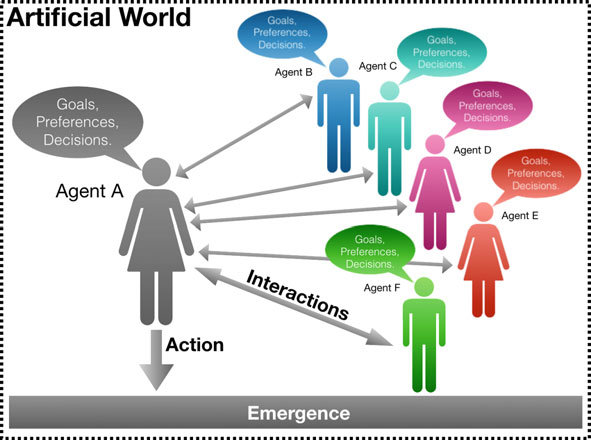
The other reassuring aspect of my experience, for me, is that I’m not alone. A growing need for better approaches to managing complexity has emerged in industry over the last couple of decades as robotics and their governing systems have become increasingly integrated into society. This transition of robotics out of the structured environment of the factory floor and into direct contact with both the dynamic and unstructured world and the public, has introduced a high degree of non-linear predictability, complex interactions with multiple robotic agents, and emergent behaviours as the decision-making algorithms that dictate robotic behaviour adapt. All of these elements are central to the world of complex systems analysis.

At a high level, modern robotics systems no longer represent technical engineering challenges in the narrow, discipline-specific sense that engineers would traditionally have seen in higher education. They are complex adaptive systems that routinely demonstrate behaviours that emerge from interactions with their environment rather than being fully specified in advance. A robot navigating a hospital corridor, a swarm coordinating warehouse logistics, or a surgical assistant adjusting in real time to tissue variability represent challenges in undefined, non-linear, and largely unpredictable spaces. Students, and later robotics engineers who lack a complex systems vocabulary are essentially tasked with trying to understand emergence without the tools to describe it.

An example that I like to use is one that we encountered a couple of years ago: a team of mobile robots transporting parts around a manufacturing space. In many cases, the agents (ground robots, arms, etc.) in this scenario are programmed with independent control and decision-making code to govern their behaviour, with some overarching supervisory code to manage tasks and assignments. The ground robots would have algorithms to localise, path plan, navigate, and avoid obstacles while communicating with other complementary agents and central task management. However, as I have learned, complexity lies in the emergence of unexpected interactions between the agents and their environment. How they avoid each other and the environment while achieving their tasks is largely a complex non-linear system where conflicts can routinely delay or disrupt their operation. Introducing more sources of disruption such as humans, unstructured environments, weather conditions etc. only makes dealing with unpredictable scenarios more and more complicated using traditional techniques.

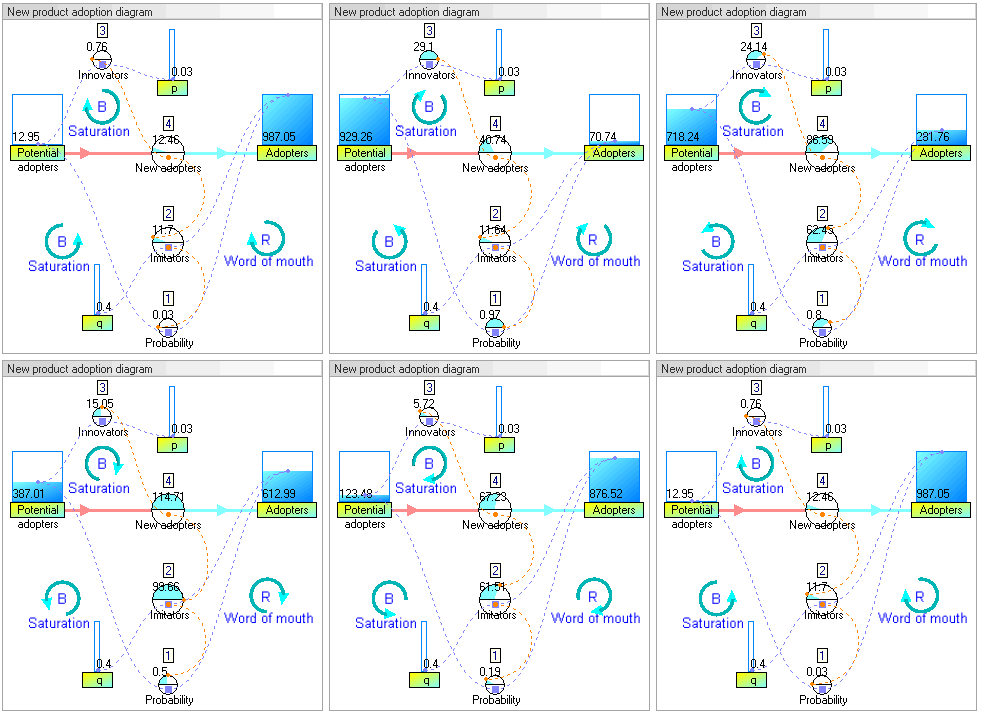
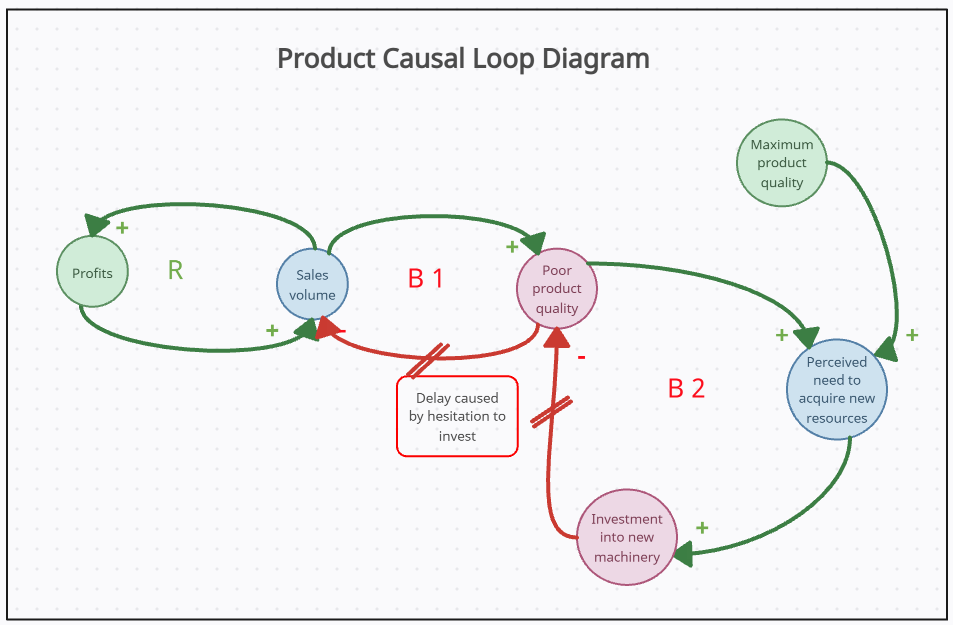
Luckily, many of the tools and techniques that are highlighted in the toolkit have direct applications to the challenges faced by engineers in the world of robotics. Causal Loop Diagrams (CLDs) are an excellent way to model the feedback dynamics that are at play in adaptive control systems. When a robot’s perception system updates its world model based on changes in what the sensors can perceive, that leads to changes in its action policy that when executed create a feedback loop. These diagrams are a great way to visualise and analyse these loops. Agent-Based Modelling (ABM) is directly relevant to the scenario I described above where swarms of robot must be coordinated or manage human-robot interaction scenarios. Using these simulation tools, engineers can test and manage emergent fleet behaviour without hardware. If things do go sideways, Fault Tree Analysis is a common approach to mapping causes and evaluating data to help develop robots that work in safety-critical applications. Finally, for long-term operations such as field robotics missions, Systems Dynamics Modelling can be a useful tool for predicting and managing a robot’s resource consumption (battery, compute, bandwidth) depending on the required task performance over time.

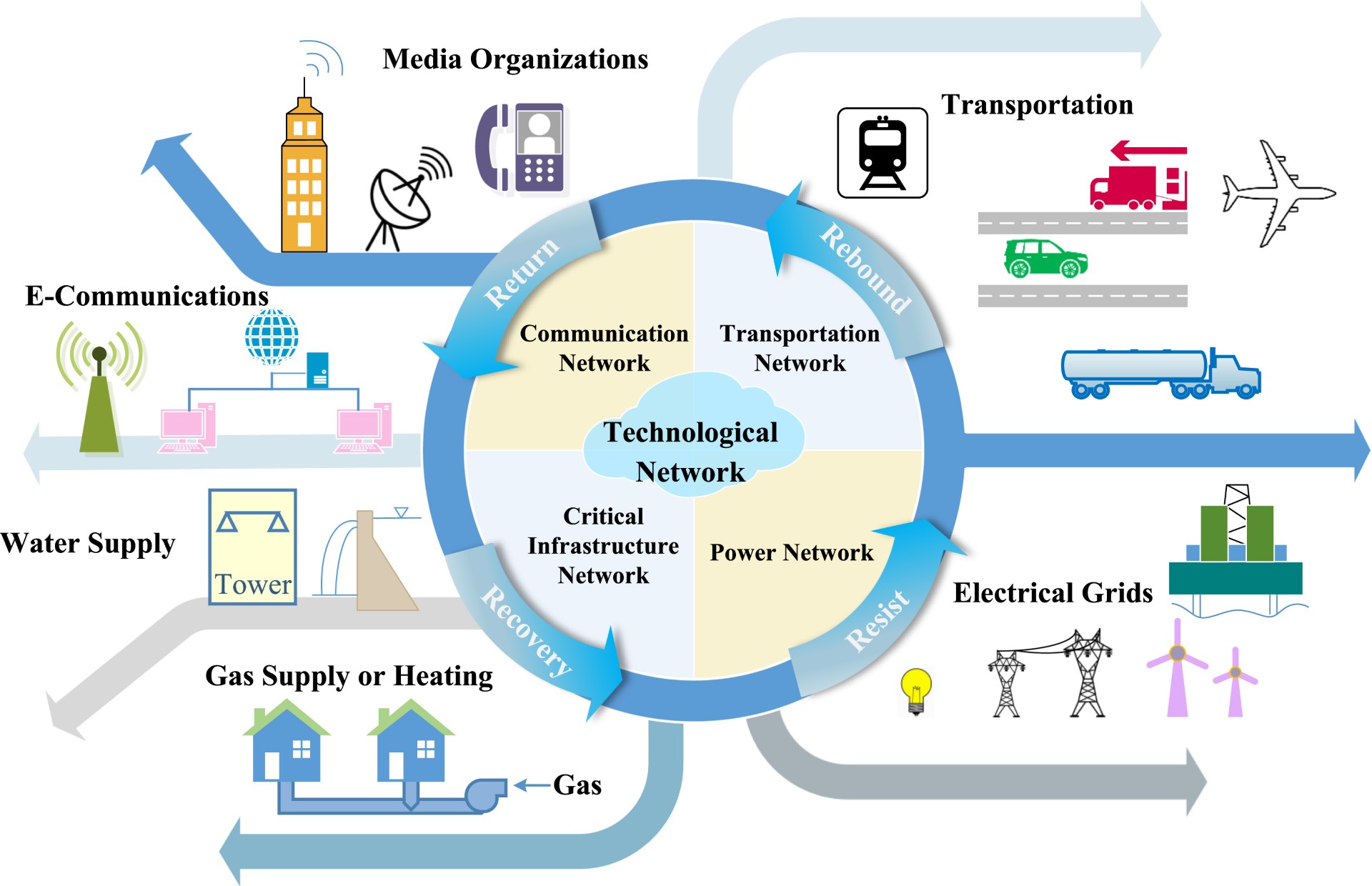
In addition to these considerations, there is a whole world of network modelling and the management of behaviour stemming from machine learning and applied AI algorithms that also overlaps quite closely with complex systems. Engineers that understand emergence, feedback loops, and attractors are far better equipped to reason about why a robot does something unexpected, than students who only have a component-driven technical understanding of the behaviour of an intelligent robot. Beyond the decisions, at an actual component level there are critical decisions that need to be made for efficient deployment of physical and edge AI algorithms.  What data is processed locally and what goes to the cloud, when models are updated and how decision making is distributed across a robot swarm are exactly the kind of questions that systems thinking trains engineers to answer. Systems tools are ready to help, including influence diagrams to manage information exchange and action planning.

Overall, the field of complex systems introduces a set of tools, techniques, and mental models that are increasingly essential to robotics engineers that seek to prepare their agents to be effective in performing complicated tasks in increasingly complex systems.”


Click here to see details of our newest call for content, on the subject of intelligent robotics and its relationship to complex systems. Register your interest by 12th July 2026

Intelligent robotics, and the more recent applications to physical AI, generally refers to artificial intelligence systems that are embedded in and interact directly with the physical world, rather than operating purely in digital environments. For engineering students, learning about intelligent robotics and physical AI workflows matters because it sits at the intersection of software, hardware, and real-world problem solving. It helps engineers think holistically: not just “does the code work?” but “does the system behave safely and effectively in the real world?”. 

We are seeking experts in intelligent robotics, from academia, industry, and engineering organisations, to develop resources on this topic for publication in the Toolkit. These resources will inform, guide and aid educators to embed teaching on intelligent robotics into their engineering lessons, modules or courses.


This post is also available here.


Any views, thoughts, and opinions expressed herein are solely that of the author(s) and do not necessarily reflect the views, opinions, policies, or position of the Engineering Professors’ Council or the Toolkit sponsors and supporters.  
Toolkit: Complex Systems Toolkit.

Author: Professor Nici Zimmermann (University College London).

Topic: Illuminating complex interactions in a system through participatory modelling methods.  

Title: Using a participatory modelling approach to urban regeneration.

Resource type: Teaching activity.

Relevant disciplines: Any; civil engineering.

Keywords: Available soon.

Licensing: This work is licensed under a Creative Commons Attribution-ShareAlike 4.0 International License. 

Related INCOSE Competencies: Toolkit resources are designed to be applicable to any engineering discipline, but educators might find it useful to understand their alignment to competencies outlined by the International Council on Systems Engineering (INCOSE). The INCOSE Competency Framework provides a set of 37 competencies for Systems Engineering within a tailorable framework that provides guidance for practitioners and stakeholders to identify knowledge, skills, abilities and behaviours crucial to Systems Engineering effectiveness.  A free spreadsheet version of the framework can be downloaded.

This resource relates to the Systems Thinking, Systems Modelling and Analysis and Critical Thinking INCOSE competencies. 

AHEP mapping: This resource addresses several of the themes from the UK’s Accreditation of Higher Education Programmes fourth edition (AHEP4):  Analytical Tools and Techniques (critical to the ability to model and solve problems), and Integrated / Systems Approach (essential to the solution of broadly-defined problems). In addition, this resource addresses the AHEP themes of Design and Practical and workshop skills. 

Educational level: Intermediate; Advanced.


Learning and teaching notes: 

This activity is suitable for those having acquired some familiarity with complex systems and related concepts – especially causal loop diagrams, stock and flow diagrams, cognitive maps or participatory maps – who are looking for additional ideas for activities or who have a specific interest in participatory modelling. The activity is also useful at the point when students learn about interaction between different elements of a complex system or when they learn about the importance of human factors. 

Learners have the opportunity to:  

Teachers have the opportunity to: 


Downloads: 


Learning and teaching resources:


Overview:

This activity introduces students to a participatory systems thinking – or more specifically –  participatory modelling exercise. This is an approach used in group settings to explore complex issues and represent them via models. In this activity, students assume the roles of stakeholders involved in an urban regeneration project and take part in a group model-building workshop.  

It teaches students core principles of a participatory modelling method called group model-building or participatory system dynamics, but it can also be used to teach the underlying system structure of a specific phenomenon. This makes it well-suited for modules that contain elements of systems thinking and system dynamics (including causal loop diagramming and simulation modelling) or modules that contain an element on group facilitation and participatory methods.  

The activity is designed to run over 1.5 to 2.5 hours and is adaptable. While the current example focuses on the phenomenon of urban dynamics around the population development in a city, the activity can be reframed using a case and model from a project management, water management, energy or other sustainability-related context. 

The activity is directly aligned with systems thinking by immersing students in a participatory modelling process. It develops students’ awareness of system content and its interactions by teaching them qualitative modelling skills. It develops their skills in managing complexity and representing system elements with visual models consisting of items and their relationships depicted in causal loop diagrams and/or stock and flow diagrams. This serves to build students’ analysis skills and ability to apply systems approaches to problems. It also develops their practitioner, practical and workshop skills of collaborating with stakeholders. It does so by advancing their facilitation skills essential for collaborative systems work. This includes rules of conduct and techniques for managing a group discussion and group dynamics, making a broad range of ideas heard, prioritising them and mapping them visually. 


Materials or software required:

For in-person sessions, the following materials are recommended: 

If software or an online tool are used, these are used to collate concepts (variables suggested by students) and to build a diagram of their interactions. This will be projected to the in-person and/or online participants, replicating the participatory nature of in-person workshops. 


Detailed explanation of the activity:  

This activity introduces students to participatory modelling, an approach used in group settings to explore and understand complex issues and represent them via models. In this case, participatory modelling is introduced through a structured group model-building workshop, using a simplified version (Alfeld & Graham, 1976; Richardson, 2014) of Jay Forrester’s (1969) famous Urban Dynamics model, which sparked quite some debate because of its counter-intuitive insights. The session begins with a brief historical overview of urban growth and decline in major cities up to the 1980s (e.g. New York, Boston, London; see files under ‘Downloads’, above), before focusing on the London Docklands in London in 1981, as an example of an opportunity for urban redevelopment to counter the trend of population decline. Student groups are assigned stakeholder roles from that time, including the founder of the London Docklands Development Corporation (1–2 students), the Surrey Quays Housing Action Group (2–6 students), the London Chamber of Commerce (2–6 students) and the Greater London Council (2–6 students). Each student group receives a role sheet outlining their perspective and a small set of key variables relevant to their stakeholder position (see linked files). These variables are intentionally curated to align with the Urban Dynamics model and to ensure that collaboration is necessary to draw the interlinkages between the variables, i.e. the relevant system structure.  

A list of variables provided to the student groups via the role sheets is included below. Note that not all variables that are necessary to draw the model are included; students need to infer a few variables to train their thinking. 

Before the workshop begins, students are introduced to core concepts of participatory modelling (see linked slides), including facilitator roles (based on Richardson & Andersen, 1995) and common workshop scripts (e.g. hopes and fears, variable elicitation, voting, model building, policy option elicitation and system storytelling, as described in Scriptapedia and Andersen & Richardson, 1997). 

The workshop proceeds in three main phases: 

1. Variable elicitation: After a short introduction by the student playing the founder of the London Docklands Development Corporation into the setting and by the facilitator/teacher into the process, each group sketches behaviour-over-time graphs of their assigned variables (10 minutes). These are presented using a round-robin or nominal group technique, meaning one variable per group at a time only, and placed on a whiteboard/blackboard or digital canvas. The round-robin collection is a technique useful to foster inclusivity and avoid talking heads. Behaviour-over-time graphs rather than just variable names are useful because the final model is believed to explain a behavioural trend over time, linking model structure and dynamics. However, it is also possible to simplify by letting students just write the variable names on sheets of paper. 

2. Voting and prioritisation: To decide on a starting point for modelling, each student votes on which variables they consider to be the most important to include in the model, e.g. giving the students as many votes as there are variables on the board and freedom of how to distribute their votes. While all variables will be included in the model, the voting activity provides a basis for reflection on different priorities and students’ personal vs. their group’s perspective, after the modelling activity. 

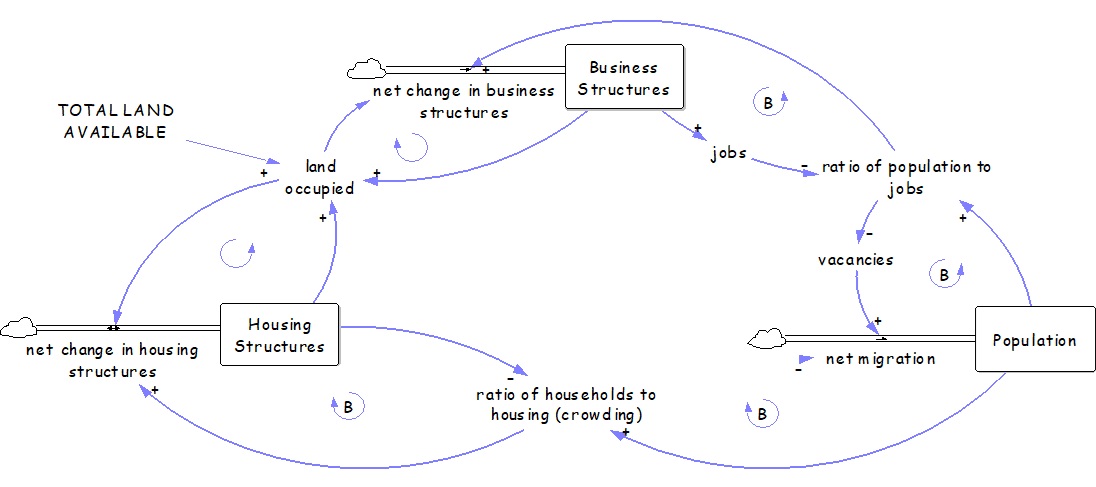
3. Model building: The class collaboratively constructs a stock and flow diagram (see Figure 1). Stocks such as Housing Structures, Business Structures, and Population are identified, and their net rates of change are discussed. To connect the variables, some more variables need to be added such as the ratio of population to jobs, total land available, and land occupied. To help students identify these variables, the teacher can ask questions: “Population and housing are linked by a ratio. What concepts and respective variables could link the other stocks?”. Students are encouraged to identify feedback loops and classify them as reinforcing or balancing. 

It is useful to pay attention to uncovering less obvious relationships, such as the spatial competition between housing and business infrastructure. Once the diagram is complete, the facilitator reviews the model with the class, highlighting key feedback structures. 

After the modelling activity, students can be shown images of the Docklands after the redevelopment as well as urban population trends of London and other major cities until today, prompting discussion on the long-term impacts of different types of development and prioritisation of a business vs. housing focus. The session can conclude with a reflection on the participatory process and its relevance to real-world decision-making and the value of participatory modelling in complex policy environments. 

A more comprehensive version of this activity – including a more introductory group model-building exercise that teaches basic causal loop diagramming concepts and an alternative context using project management as an example – is available: https://discovery.ucl.ac.uk/id/eprint/10160261/   


Figure 1: Stock and flow diagram of urban dynamics (produced with Vensim software). This figure is intended for educators and serves an illustrative purpose. It provides educators with a reference for how the model built during the activity is expected to look. 


Note: The author was originally inspired to focus on this case by the historical accounts found on the London Docklands Development Corporation (LDDC) History Pages (http://www.lddc-history.org.uk/index.html, now inactive).  


References:


Any views, thoughts, and opinions expressed herein are solely that of the author(s) and do not necessarily reflect the views, opinions, policies, or position of the Engineering Professors’ Council or the Toolkit sponsors and supporters.  
Let us know what you think of our website