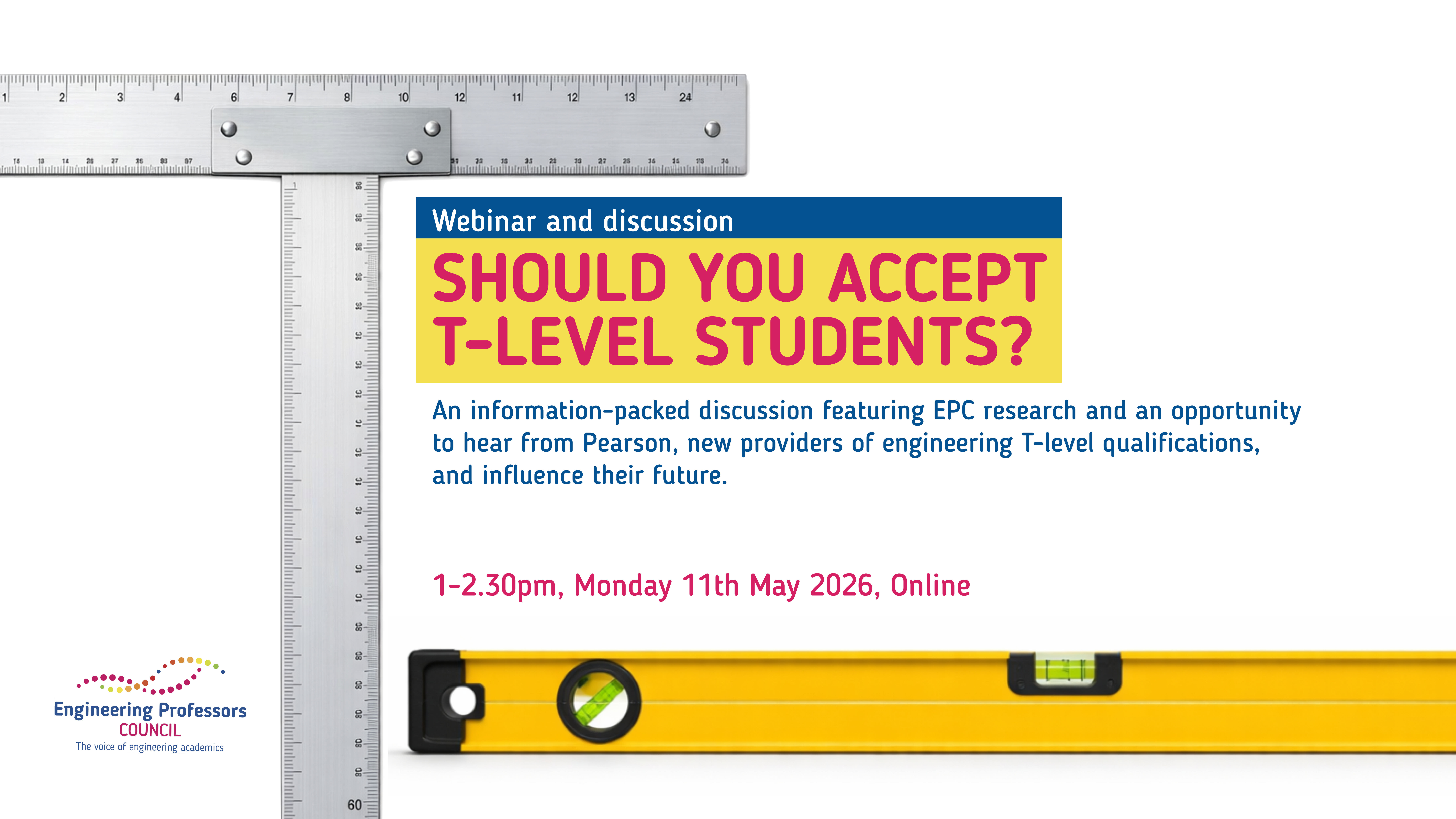
T-levels are a set of qualifications offered in England where one T-level, a mix of classroom-based study and work placement, equivalent to 3 A-levels. They are appearing ever more regularly on UCAS applications, but should you admit those students? If not, what? And what should be done?
This webinar will include:
The findings of the EPC’s in-depth research into the real strengths and weaknesses of T levels, A levels and other level 3 qualifications.
A presentation by Pearson, the new providers of future Engineering T-levels, about their plans for an overhaul.
Share your views on what you’d like to see changed – this is a genuine moment of consultation and an opportunity to influence the future.
This is an important webinar for anyone involved in admissions, recruitment and access; strategic planning or curriculum design, especially foundation years.
This event will feed into the wider consultation that Pearson is pursuing to inform its future development of T levels. As well as attending the webinar, you can contribute to the consultation through the survey.
Some universities have expressed concern that the 3 T-levels in Engineering subjects aren’t a suitable pathway directly into undergraduate courses. Specifically they’ve cited the maths content. Other universities, however, have welcomed the more applied nature of T-level learning and celebrated the practical aptitude that T-level students bring. The EPC conducted research to unpick these strengths and weaknesses in 2024.
Now that the first T-levels have had a chance to the work through the system, the DfE has turned its attention to improvements. Early this year, Pearson was awarded the contract to deliver generation two of the T Levels in Engineering which will be available for teaching from September 2027. They include:
Maintenance, Installation and Repair for Engineering and Manufacturing
Engineering, Manufacturing, Processing and Control
Design and Development for Engineering and Manufacturing.
Contract Developments and Programme Review
As part of the contract, Pearson is currently undertaking a review of potential updates and changes to the T Level programmes. This review process has highlighted certain issues with Maths relating to progression to Higher Education. Pearson, in collaboration with the EPC, aims to explore these matters during the webinar event.
Summary of the EPC’s work to date on HE perspectives of the T Levels in Engineering
Overview of the existing T Levels in Engineering (led by Pearson)
Pearson’s proposed changes to the T Levels in Engineering
Group discussion on proposed changes and HE perspectives
Mariam is an educational consultant and scholar whose work is mostly concerned with socio-cultural and socio-political questions of educational transfer across contextual boundaries. As a Cambridge Partnership consultant, she has been engaged in the post-reform activity at the Ministry of Education in Qatar and the Ministry of Education in the UAE on matters of educational reform. As a consultant, she is interested that buy in from pre-reform stakeholders is achieved so that the transfer can happen from within.
In 2024, Mariam worked with the EPC to produce our landmark report on Maths in Engineering, which explored whether T levels prepared students suitably for Engineering degrees.