 Engineering for One Planet (EOP) advances rapid innovation in engineering education, embedding sustainability and climate literacy to prepare engineers capable of solving today’s challenges without compromising tomorrow. For Earth Day on 22nd April, as part of our Sustainability Toolkit, we share details of their newest resources.
We know that engineering students are increasingly demanding the skills to address the climate crisis. We also know that educators’ syllabi are already packed, and finding the time to develop new, high-quality climate content can be a significant hurdle.
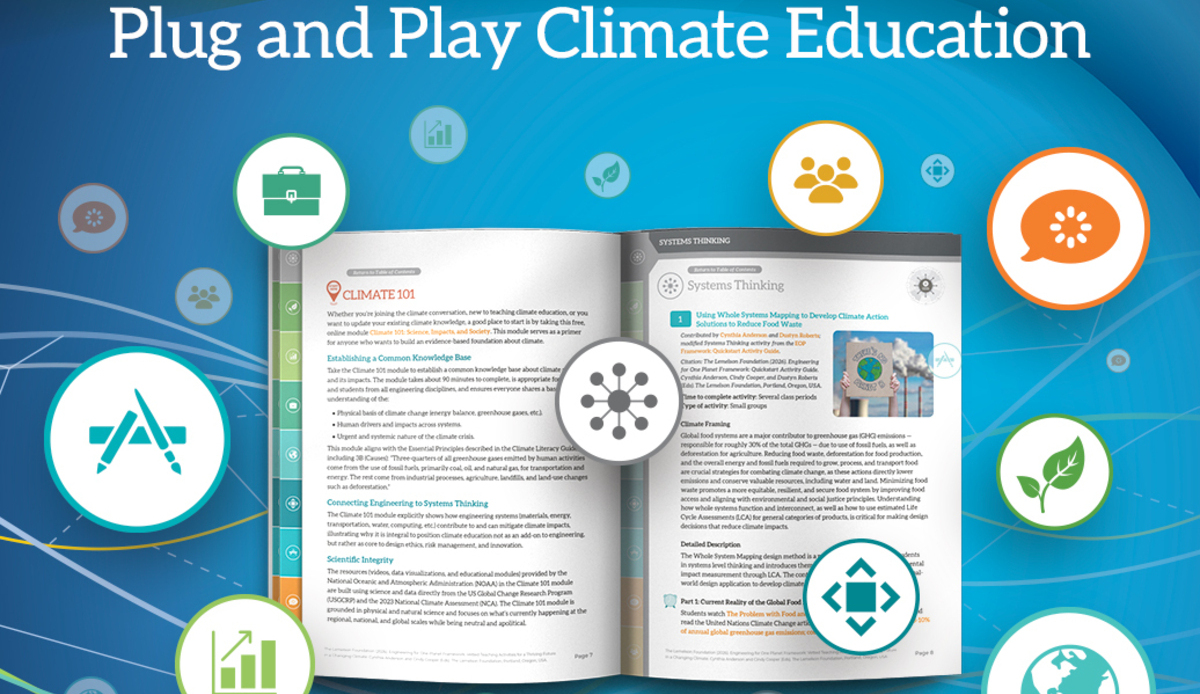
To bridge this gap, Engineering for One Planet (EOP) — in collaboration with 18 global organisations, including ABET, ASEE, ASME, and IEEE — is proud to release a new, open-access resource:
Link: Get Started with EOP | Engineering for One Planet
What is the Climate Guide?
This guide is a practical companion to the EOP Framework. It provides a “menu” of flexible, vetted teaching activities designed to integrate seamlessly into existing courses. Whether you are teaching introductory, advanced, required, or elective engineering classes, this guide provides the modular tools you need to equip students with essential climate-related competencies.
Why use this guide?
- Built for efficiency: You don’t need to overhaul your course. Pick a single activity that fits your current learning objectives and time constraints.
- Peer-vetted: Co-created by a cross-sector community of engineers, climate experts, and teaching faculty.
- Accreditation aligned: Activities have been mapped to AHEP4 and ABET Criteria 3 Student Outcomes (by educators, independently of ABET), Bloom’s Taxonomy, and the UN Sustainable Development Goals.
- Multidisciplinary and flexible: While rooted in engineering, the activities are adaptable for any technical or non-engineering discipline and for K12 or industry applications.
- Free and open access: Distributed under a Creative Commons license so you can use, share, and build upon the work freely.
How to get started:
- Download the Guide at: Get Started with EOP | Engineering for One Planet
- Select a Topic Area: Browse the 9 EOP competency areas (Systems Thinking, Environmental Literacy, Responsible Business and Economy, Social Responsibility, Environmental Impact Assessment, Materials, Design, Critical Thinking, Communication & Teamwork).
- Adapt & implement: Choose an activity level (introductory, intermediate, or advanced) that matches your student level and drop it into your next lesson plan.
As engineers and engineering educators, we have a moral and professional imperative to design, code, and build in ways that protect life on Earth. This guide is your “first step” in preparing the future workforce to lead that change.
We invite you to explore the guide and join the global community of educators making sustainability a core tenet of the engineering profession.
Any views, thoughts, and opinions expressed herein are solely that of the author(s) and do not necessarily reflect the views, opinions, policies, or position of the Engineering Professors’ Council or the Toolkit sponsors and supporters.