Toolkit: Complex Systems Toolkit.
Author: Professor Michael Ward, CEng, FIMechE, FIET (University of Strathclyde).
Topic: Defining and understanding complex systems.
Title: The role of Wicked Problems thinking to help understand the extent of engineering involvement in complex systems.
Resource type: Knowledge article.
Relevant disciplines: Any.
Keywords: Interdisciplinary; Wicked problems; Collaboration; Climate change; Decarbonisation; Research; Complexity framework; Scaffolded development framework.
Licensing: This work is licensed under a Creative Commons Attribution-ShareAlike 4.0 International License. The work on which this project has been based was funded by the Engineering and Physical Sciences Research Council of the UK through the UK FIRES Program (EP/S019111/1) and the Future Electrical Machines Manufacturing Hub (EP/S018034/1). Earlier work supported by High Value Manufacturing Catapult has also been essential in developing the basis for this work.
Downloads: A PDF of this resource will be available soon.
Who is this article for?: This article should be read by educators at all levels in higher education who are seeking an overall perspective on teaching approaches for integrating complex systems in engineering education.
Related INCOSE Competencies: Toolkit resources are designed to be applicable to any engineering discipline, but educators might find it useful to understand their alignment to competencies outlined by the International Council on Systems Engineering (INCOSE). The INCOSE Competency Framework provides a set of 37 competencies for Systems Engineering within a tailorable framework that provides guidance for practitioners and stakeholders to identify knowledge, skills, abilities and behaviours crucial to Systems Engineering effectiveness. A free spreadsheet version of the framework can be downloaded.
This resource relates to the Systems Thinking and Critical Thinking INCOSE competencies.
AHEP mapping: This resource addresses several of the themes from the UK’s Accreditation of Higher Education Programmes fourth edition (AHEP4): Analytical Tools and Techniques (critical to the ability to model and solve problems), and Integrated / Systems Approach (essential to the solution of broadly-defined problems).
Premise:
Engineering is crucial to achieving imperatives such as decarbonisation. Yet engineering typically addresses specific, well-defined challenges rather than broad, ambiguous ones. Education and practice reinforce this approach, with even postgraduate and academic engineers often focusing on problem depth over breadth. While this produces deep technical insights and tangible technological capability, it risks delaying uptake and impact unless multidisciplinary teams are involved. Recognising this gap between aspirations and execution suggests a role for structured frameworks and tools to trigger bridging activity. Wicked problem thinking is a way to understand complex problems and systems thinking, and it is related to situations which are ambiguous, contested, sometimes lacking an end state, evolving over time, requiring collaboration, adaptability, and inherently cross-disciplinary.
Background:
Climate change is a helpful case in illustrating the gap between global ‘wicked’ problems, and the work of the engineer. Engineering’s success, by underpinning industrialisation and thereby enabling mass consumption, can also be seen as its biggest failing in contributing to climate change (Datea & Chandrasekharana, 2022) and other environmental impacts. Going forward, engineers must help mitigate it, through better deployment of existing technologies and creation of new ones. Clearly climate change is complex, spanning scientific, technological, behavioural, and political dimensions, and this complexity limits what can be achieved solely from engineering consideration. Conventional engineering methods, though highly effective at the project and programme level, risk drifting away from the original issue and producing isolated solutions with limited systemic effect.
Wicked problems thinking:
Global challenges like climate change are sometimes labelled “super-wicked” problems—time-limited, caused partly by the problem-solvers, lacking central authority, and often deferred (Levin et al.). In engineering, wicked problems present a risk, because engineers are inherently tasked with addressing a part of the wider problem and often via particular approaches. Perhaps it is not surprising, then, that engineers are trained for structured problems with clear solution methods (Schuelke-Leech, 2021). Unfortunately such approaches are rarely transferable directly to wicked contexts, except when problem structure and solution approaches align unusually well. Education reinforces this, as engineering curricula focus on well-defined challenges (Lönngren, 2017).
At the research level, problems are often entangled, requiring both high-level perspective and detailed work. Sustainable engineering science (Seager et al., 2012) calls for ethical awareness, adaptive methods, and “interactional expertise” drawn from other disciplines. While this opens opportunities to measure cause and effect across scales, tangible short-term indicators often dominate.
A structured approach to Wicked Problems:
Alford & Head’s (2017) typology places problems on a spectrum from “Tame” to “Very Wicked.” Most engineering projects are tame, even when complex, because specification and management processes reduce ambiguity. Issues like decarbonisation-related engineering research, however, often involves wicked characteristics. This framework has recently been extended (Fehring, 2025) to allow consideration of a wider range of engineering research scenarios, Figure 1.
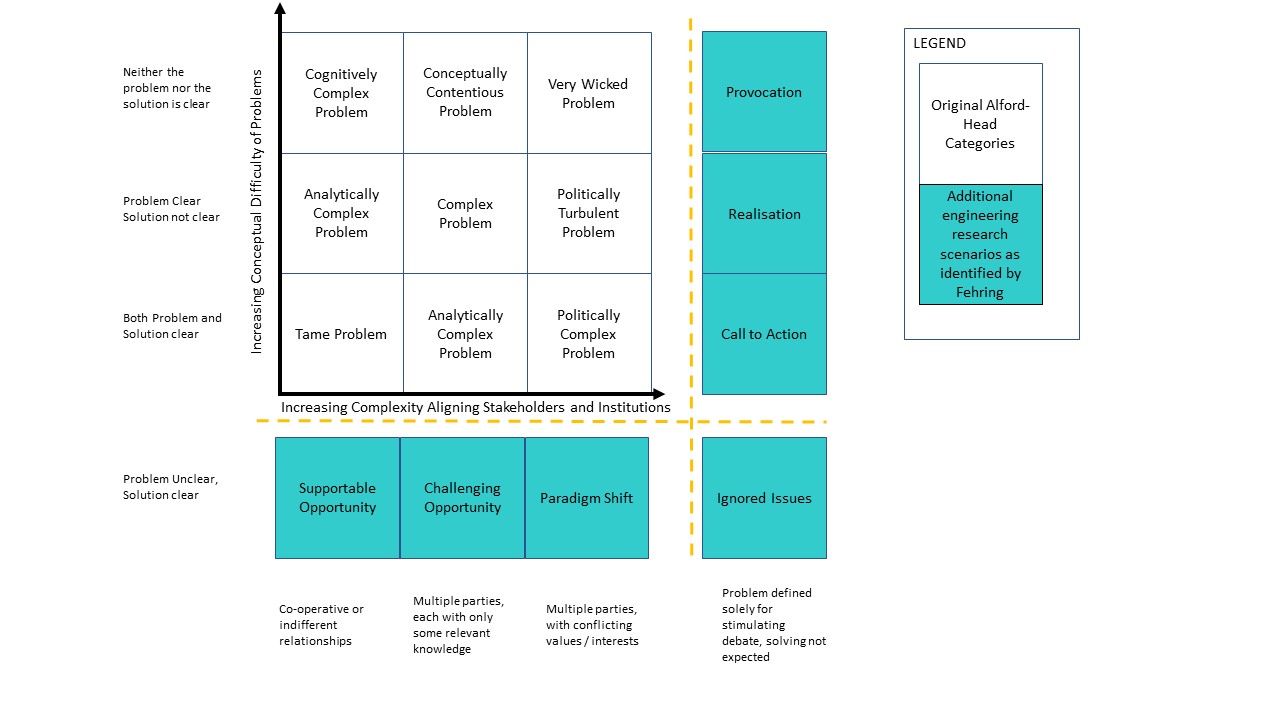
Figure 1. A framework for categorising complexity of engineering research scenarios (Fehring)
Each of the identified scenario types is somewhat distinctive, as follows:
- Tame: Challenge of delivery and execution within known (but potentially challenging) parameters.
- Analytically complex: Known and accepted performance gaps with corrective actions not obvious.
- Communicatively complex: Multiple elements being brought together at the discretion of different parties.
- Complex: Major external influences drive the need for fundamental change.
- Cognitively complex: All agree on the need for action, but the nature of the action is unclear.
- Politically complex: A known technological challenge, which can only be addressed collaboratively via multiple parties.
- Conceptually contentious: Many indicators of impending change and the need to respond, but response is open to interpretation.
- Politically turbulent: Major competing factions exist, promoting alterative interpretations to global problems.
- Very wicked: All that is known for certain is that there is a tangible basis for concern and no obvious route to resolution.
- Supportable opportunity: An area where research is interesting and sufficiently well aligned to available funding models to be well supported.
- Provocation: A general issue is raised as a burning platform for action, without any consideration of potential mitigations.
- Challenging opportunity: An area with potential for development, but not well aligned to themes supported by funders.
- Realisation: Evidence of the issue is presented and published without any proposal or speculation on solutions.
- Paradigm shift: An area of potential Research and Development and potential major breakthrough which is contrary to accepted thinking.
- Call to Action: A call to adopt a solution which is available but for the most part unacceptable at the human or social level.
- Ignored Issues: Situations that only become problems because they are not discussed based on their taboo nature or unacceptability of discussion in an area.
Conclusions:
- Engineers can often be drawn into issues and challenges which can require multidisciplinary approaches.
- A structured framework, such as the one described here, can be helpful in allowing the nature of a particular situation to be understood and the applicability of different approaches considered.
- Pure engineering approaches are most applicable in scenarios closest to Tame Problems.
- Multidisciplinary approaches seem most essential in cases closest to Very Wicked Problems.
- Engineering research extends to a wider range of scenarios than those considered problems per se, and these have been added to the categorisation framework. This extension of the framework, while not problem specific, is helpful in providing a logical means of extending the consideration to wider research situations.
- One of the primary areas of potential in this form of analysis is to demonstrate the degree of separation that can exist between focused and engineering R&D and the system level problem which drives it.
References:
- Alford, J and Head, B. W. ‘Wicked and less wicked problems: a typology and a contingency framework’, Policy and Society, 36:3, (2017) 397-413, DOI: 10.1080/14494035.2017.1361634
- Datea, Geetanjali. and Chandrasekharana, Sanjay., ‘Beyond Efficiency: Engineering for Sustainability Requires Solving for Pattern’, Engineering Studies, 10, 1, (2022), 12–37
- Fehring, F. ‘A wicked and complex problem-based analysis framework applying wicked problem thinking to the supply chain and engineering research domain’, Student thesis: Doctoral Thesis, University of Strathclyde, (2025)
- Lönngren, J., ‘Wicked Problems in Engineering Education : Preparing Future Engineers to Work for Sustainability’ PhD dissertation, Chalmers Tekniska Högskola), (2017)
- Schuelke-Leech, Beth-Anne., ‘A Problem Taxonomy for Engineering’, IEEE Transactions on Technology and Society’, 2, .2, pp.105-105, (2021)
- Seager, T., Selinger, E. and Wiek, A., ‘Sustainable Engineering Science for Resolving Wicked Problems’, J Agric Environ Ethics 25, (2012), 467–484, DOI 10.1007/s10806-011-9342-2
Any views, thoughts, and opinions expressed herein are solely that of the author(s) and do not necessarily reflect the views, opinions, policies, or position of the Engineering Professors’ Council or the Toolkit sponsors and supporters.