Who is this article for?: This article should be read by module coordinators, programme directors, and teaching teams in higher education who want to meaningfully integrate ESD into their curriculum design and delivery.
It’s always a struggle to get started on something new in the time- and resource-poor environment that is higher education. Sustainability can become just another box to tick rather than the world-changing priority it should be.
We knew there was more to ESD than simply labelling a module handbook with the SDG logos, especially when it was only SDG4 because it happens to mention education. There was a need to become familiar and comfortable with a deeper perspective on the SDGs and their related targets and indicators – without becoming intimidated by them. ESD should prepare students to tackle unforeseen challenges and navigate complex systems, rather than focusing on content alone. As higher education professionals, we recognised the inherent challenges of this.
As a result, we developed our CRAFTS (Co-Designing Reflective Approaches for the Teaching of Sustainability) model of curriculum design, based on an adaptation of Design Thinking, to provide a structured and usable, yet accessible, flexible, and not discipline-specific means of embedding and embodying ESD in the curriculum. We were then approached by AdvanceHE to develop this further into a practical, systematic resource that would empower educators to take genuine ownership of sustainability in their teaching and assessment.
The Toolkit helps tackle these issues in a straightforward way by breaking them down into five stages.
First, it shows how to analyse what stakeholders like students, employers and accrediting bodies want and need from a module when it comes to sustainability.
Then, it guides educators to map exactly what is being taught as the curriculum stands, aligning it to the SDGs and the ESD Competencies. This is a moment of real relief for many people, who discover that much of what they already do aligns perfectly with ESD.
After that, there’s a guided reflection to see where stronger integration might happen or where superficial coverage can be expanded into something more meaningful.
The redesign process helps to embed active learning and authentic assessments and finishes off with an action plan for moving forward and measuring impact for future evaluation.
We find it heartening to watch colleagues pivot from feeling like ESD is an add-on to realising it can enhance what they already do. Instead of worrying that they must become experts in every single SDG, the Toolkit reminds them that authentic engagement with a few well-chosen goals can lead to the deeper kind of learning we all aspire to provide.
This personal, reflective approach has helped academics overcome the sense that sustainability in the curriculum is an overwhelming requirement. They see it as a powerful lens through which students learn to handle uncertainty, become resilient critical thinkers and gain the confidence to tackle real-world problems.
We hope the Toolkit continues to spark conversations and encourage more creative approaches to ESD across disciplines. We don’t believe there’s a one-size-fits-all solution. It has been inspiring to see colleagues reclaim that sense of possibility and excitement, reassured that teaching for a sustainable future can be woven into what they’re already doing – just with an extra layer of intentionality and reflection.
If you’re looking for a way to bring ESD into your own classroom, we hope the Toolkit will be a reliable companion on that journey.
Dr Kieran Higgins (Lecturer in Higher Education Practice, Ulster University) and Dr Alison Calvert (Senior Lecturer in Biological Sciences, Queen’s University Belfast) have collaborated on Education for Sustainable Development projects for over 4 years, drawing on extensive and wide ranging experiences of higher education and sustainability. Their vision is of transformed global higher education curricula that empowers all graduates, regardless of discipline or career path, to become champions of a sustainable future.
Any views, thoughts, and opinions expressed herein are solely that of the author(s) and do not necessarily reflect the views, opinions, policies, or position of the Engineering Professors’ Council or the Toolkit sponsors and supporters.
PowerPoint Subtitles Guidelines
1. Benefits of subtitles
Improve accessibility for deaf people
Improve understanding for foreign students/non-native speakers
Improve communication with native and non-native speakers, reducing the issues when one of the parties has a strong accent
2. Main steps
STEP 1: Activate the subtitles (See section 3)
STEP 2: Customise your settings (See section 4)
2.1. Select the language to be used 2.2. Select the subtitles position 2.3. Customise subtitles appearance (background, text size and colour)
STEP 3: Create your slide to leave room for the subtitles in line with your settings (avoid overlapping)
Note 1: You need to be connected to the internet for the subtitles to work.
Note 2: You need to change your security settings to authorise PowerPoint to access the microphone.
Note 3: You do not have to customise your settings for each presentation unless you wish to change something.
3. How do you activate the subtitles?
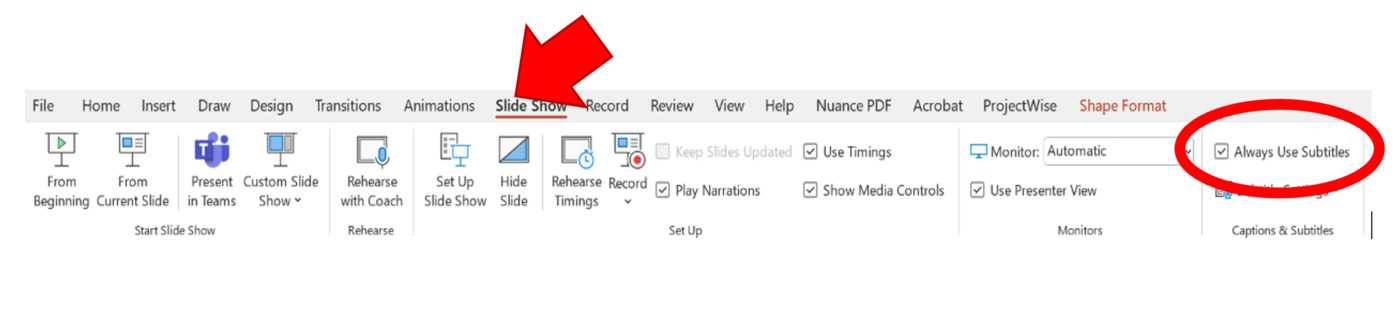
Open PowerPoint and on the main task bar select “Slide show” and tick “Always Use Subtitles” on the ribbon:
4. Subtitles settings
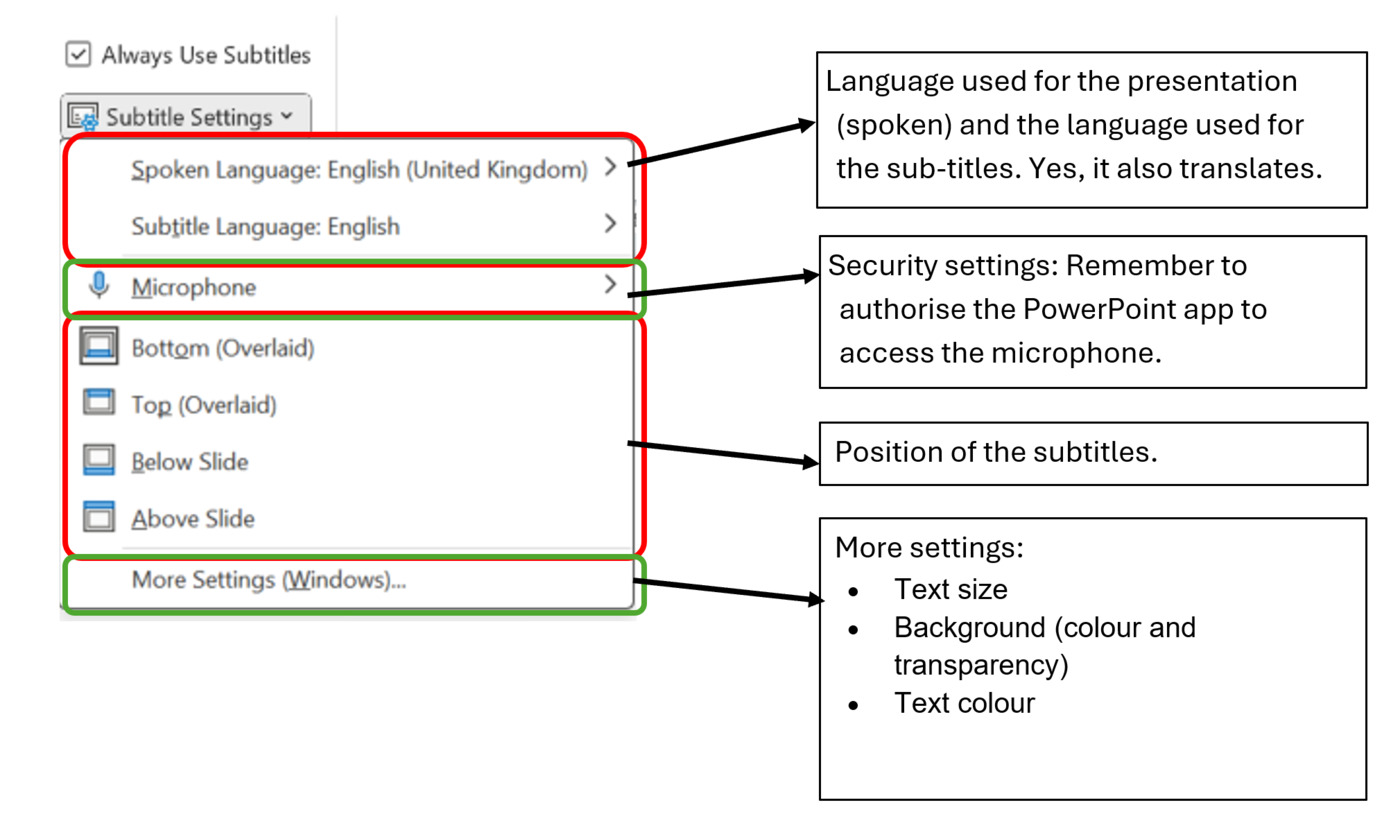
When activated, you can customise the subtitles:
Subtitles position
“Below slide” and “Above slide”
If one of the following options is selected
● Below slide
● Above slide
you do not have to worry about the subtitle background overlapping with slide content. However, the overall dimension of the projected slide will be reduced, so please check that it is still ok.
The examples below show the difference between “Bottom (Overlaid)” and “Below slide”.
Bottom (Overlaid)
Below slide
“Bottom (Overlaid)” and “Top (Overlaid)”
Important: If you select one of the following options
● Bottom (Overlaid)
● Top (Overlaid)
you will need to prepare your slides to leave room for the subtitles in line with your settings, and change the subtitle settings to improve visibility (see “Subtitles” > “More settings”).
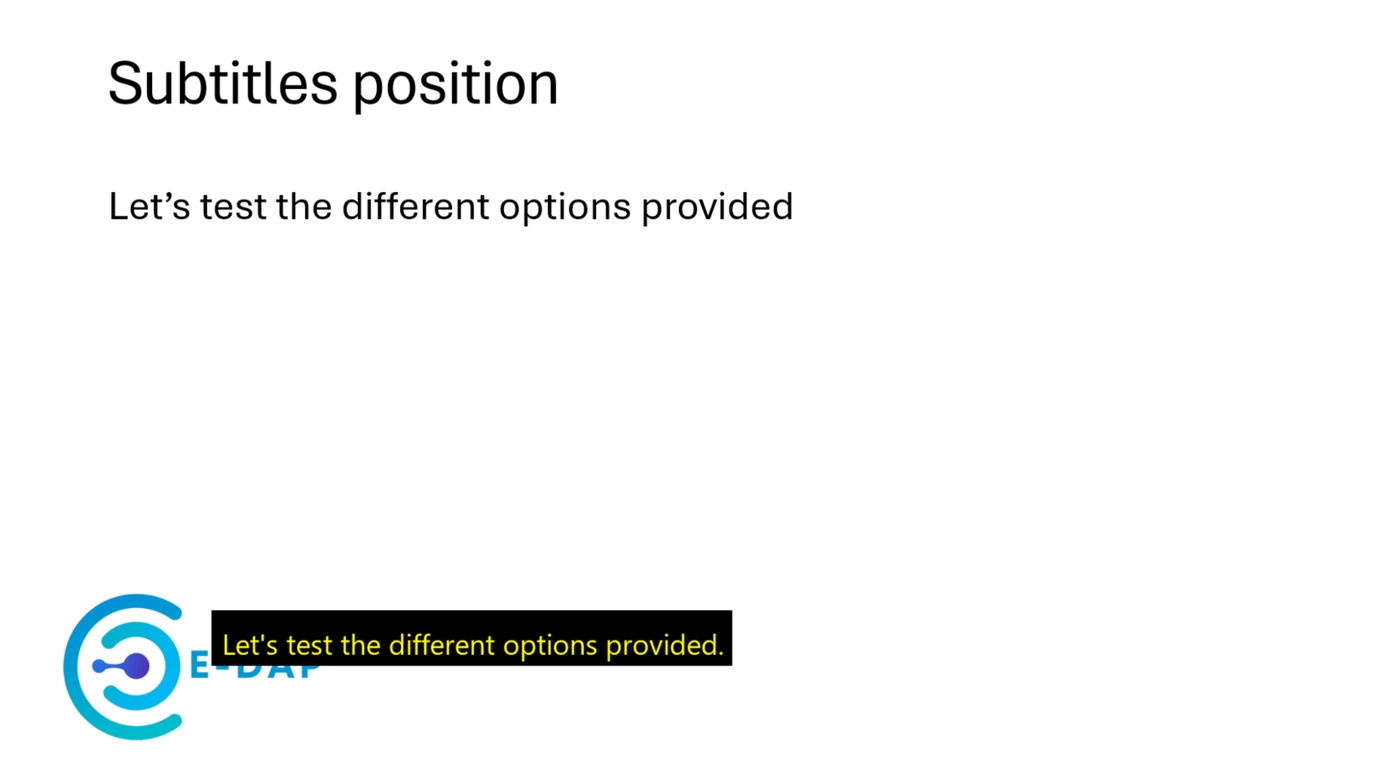
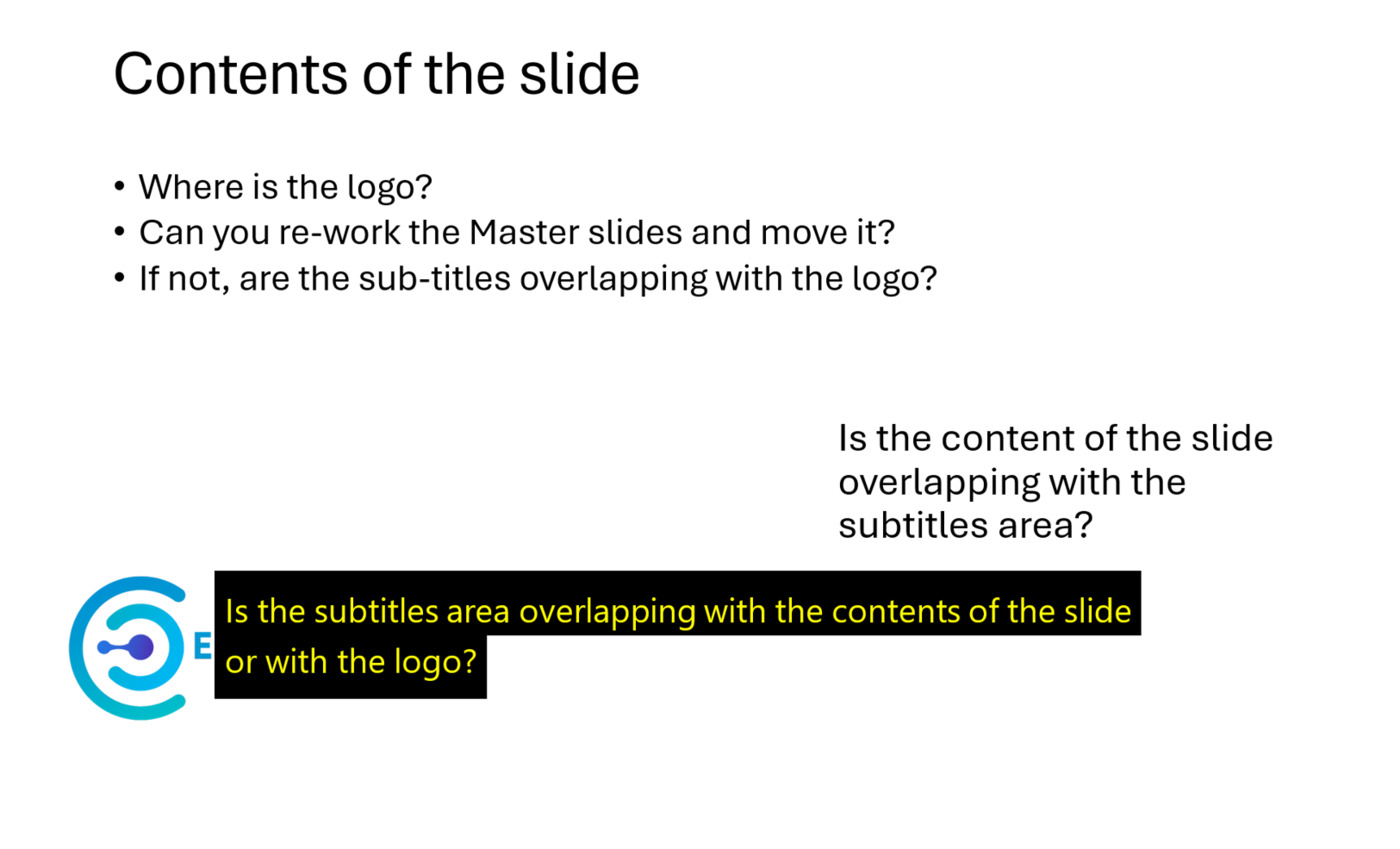
The example below uses “Bottom (Overlaid)” and default settings for text and background.
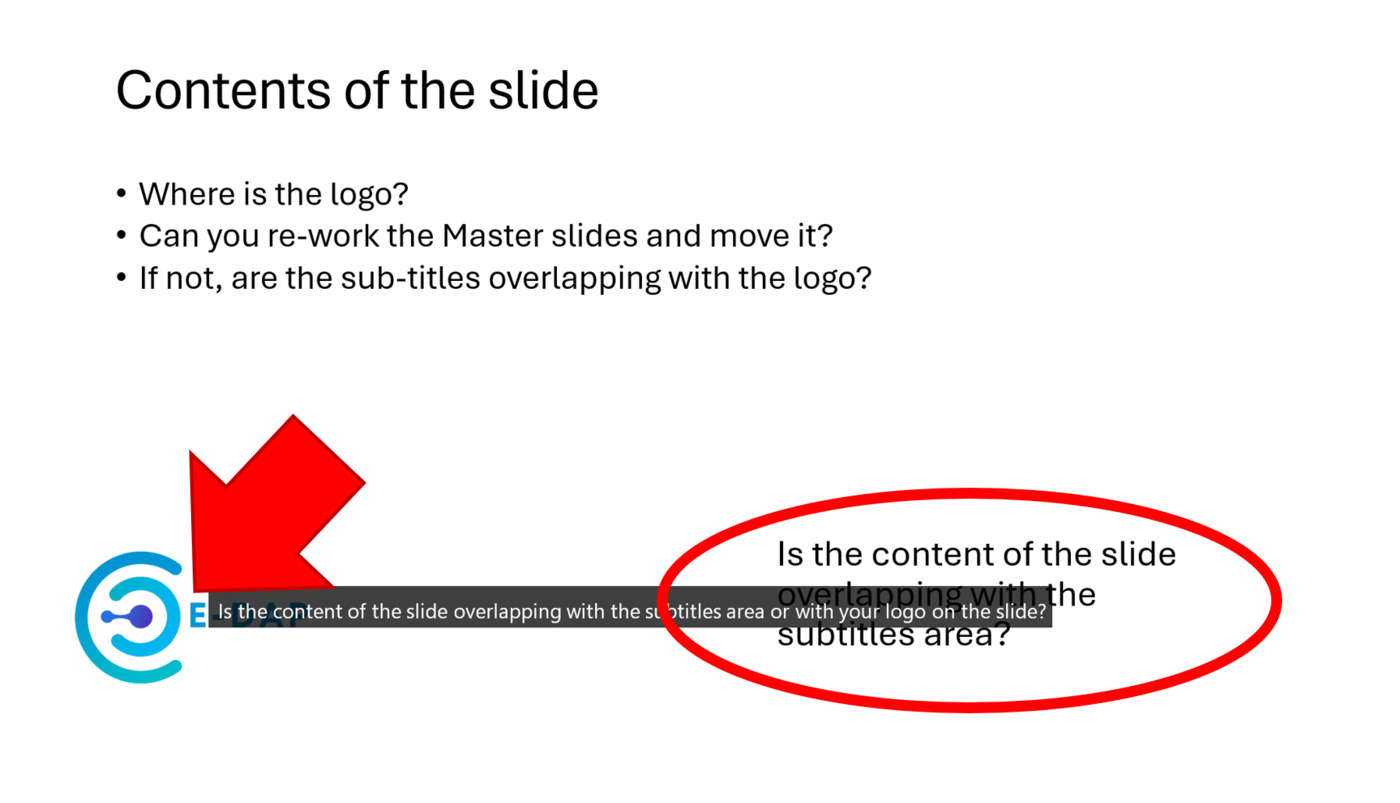
On the above example we can see that the subtitles overlap with both the logo and the contents of the slide, making the visibility poor. In addition, the size of the subtitles text appears to be quite small.
The following example shows how the settings may provide better visibility of the subtitles and the contents of the slide.
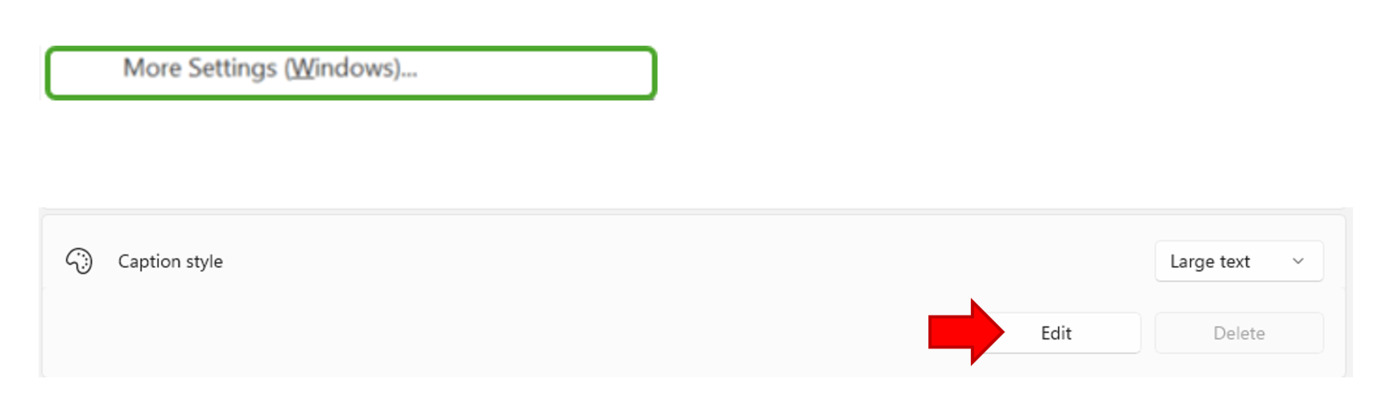
More settings: Text size and colour, background colour and transparency
1) Change the settings to use a “Large Text” or “Extra Large Text” and colours that improve visibility (e.g. yellow on solid black)
2) If you cannot rework the master slides and move the logo, select a solid background to provide more visibility to the subtitles. (Although you will make the logo less visible, this should give a better experience to the people attending the presentation.)
Subtitles background colour
How can the slide background influence the colour of the subtitles background and text colour?
• What colour is the slide background?
If the slide background is white or a light colour, you should consider using a dark colour as subtitle background to create the right level of contrast and improve the visibility of the subtitles. Similarly, if the slide background is black or another dark colour, you should consider using a light colour as subtitle background.
The subtitles text colour should in turn be in contrast with the subtitles background colour.
• Where is the logo? Are the subtitles overlapping with the logo? Can you re-work the master slides and move it?
If you cannot move the logo, you may want to consider this:
The subtitle background is not a solid colour by default, but has a certain degree of transparency. This may still be ok if there are no other objects (like a logo) under the subtitles background. Otherwise, you may need to update this setting to have a solid colour as background.
5. Guidance scope and feedback
Thank you for reading this guide and for your interest in E-DAP. We hope that this guide will help you to implement deaf awareness practises.
If you’d like to be involved in any further E-DAP led events, training materials or to join the E-DAP mailing list, please complete the form via the link below or scan the QR code.
Your feedback is important to us, as it allows us to improve our events and materials for others. Please provide your feedback on this guideline and on the subtitles usage by completing the following form:
Any views, thoughts, and opinions expressed herein are solely that of the author(s) and do not necessarily reflect the views, opinions, policies, or position of the Engineering Professors’ Council or the Toolkit sponsors and supporters.
Any views, thoughts, and opinions expressed herein are solely that of the author(s) and do not necessarily reflect the views, opinions, policies, or position of the Engineering Professors’ Council or the Toolkit sponsors and supporters.
Any views, thoughts, and opinions expressed herein are solely that of the author(s) and do not necessarily reflect the views, opinions, policies, or position of the Engineering Professors’ Council or the Toolkit sponsors and supporters.
Activity: Assessment. This example demonstrates how the questions provided in Assessing ethics: Rubric can be used to assess the competencies stipulated at each level.
Authors: Dr. Natalie Wint (UCL); Dr. William Bennett (Swansea University).
This example demonstrates how the questions provided in the accompanying rubric can be used to assess the competencies stipulated at each level. Although we have focused on ‘Water Wars’ here, the suggested assessment questions have been designed in such a way that they can be used in conjunction with the case studies available within the toolkit, or with another case study that has been created (by yourself or elsewhere) to outline an ethical dilemma.
Year 1
Personal values: What is your initial position on the issue? Do you see anything wrong with how DSS are using water? Why, or why not?
Students should provide a stance, but more importantly their stance should be justified. In this instance this may involve reference to common moral values such as environmental sustainability, risk associated with power issues and questions of ownership.
Professional responsibilities: What ethical principles and codes of conduct are relevant to this situation?
Students should refer to relevant principles (e.g. from the Joint Statement of Ethical Principles). For example, in this case some of the relevant principles may include (but not be limited to) “protect, and where possible improve, the quality of built and natural environment”, “maximise the public good and minimise both actual and potential adverse effects for their own and succeeding generations” and “take due account of the limited availability of natural resources”.
Ethical principles and codes of conduct can be used to guide our actions during an ethical dilemma. How does the guidance provided in this case align/differ with your personal views? (This is a question we had created in addition to those provided within the case study to meet the requirements stipulated in the accompanying rubric.)
Students’ answers will depend upon those given to the previous questions but should include some discussion of similarities and differences between their own initial thoughts and principles/codes of conducts, and allude to the tensions involved in ethical dilemmas and the impact on decision making.
What are the moral values involved in this case and why does it constitute an ethical dilemma? (This is a question we had created in addition to those provided within the case study to meet the requirements stipulated in the accompanying rubric.)
Students should be able to identify relevant moral values and explain that an ethical dilemma constitutes a problem in which two or more moral values or norms cannot be fully realised at the same time.
There are two (or a limited number of) options for action and whatever they choose they will commit a moral wrong. The crucial feature of a moral dilemma is not the number of actions that are available but the fact that all possible actions are morally unsatisfactory.
What role should an engineer play in influencing the outcome? What are the implications of not being involved? (This is a question we had created in addition to those provided within the case study to meet the requirements stipulated in the accompanying rubric.)
Engineers are responsible for the design of technological advancements which necessitate data storage. Although this brings many benefits, engineers need to consider the adverse impact of technological advancement such as increased water use. Students may therefore want to consider the wider implications of data storage on the environment and how these can be mitigated.
Year 2
Formulate a moral problem statement which clearly states the problem, its moral nature and who needs to act. (This is a question we had created in addition to those provided within the case study to meet the requirements stipulated in the accompanying rubric.)
An example could be: “Should the civil engineer working for DSS remain loyal to the company and defend them against accusations of causing environmental hazards, or defend their water rights and say that they will not change their behaviour”. It should be clear what the problem is, the moral values at play and who needs to act.
Stakeholder mapping: Who are all the stakeholders in the scenario? What are their positions, perspective and moral values?
Below is a non-exhaustive list of some of the relevant stakeholders and values that may come up.
Stakeholder
Perspectives/interests
Moralvalues
DataStorageSolutions (DSS)
Increasing production in a profitable way; meeting legal requirements; good reputationtomaintain/grow customer base.
Representviewsofthose concerned about biodiversity. May be interested in opening ofgreenbattery plant.
Human welfare; environmental sustainability;justice.
LocalCouncil
Represent views of all stakeholders and would needtoconsidereconomic benefits of DSS (tax and employment), the need of theuniversityandhospital, as well as the needs of local farmers and environmentalists. May beinterestedinopeningof green battery plant.
This may depend on their beliefs as an individual, their employment status and their use of services such as the hospital and university. Typically interested in low taxes/responsible spending of public money. May be interested in opening of green batteryplant.
Reliable storage. They mayalsobeinterestedin being part of an ethical supply chain.
Trust; privacy; accountability;autonomy.
Non-humanstakeholders
Environmental sustainability.
What are some of the possible courses of action in the situation. What responsibilities do you have to the various stakeholders involved? What are some of the advantages and disadvantages associated with each? (Reworded from case study.)
Students should provide a stance but may recognise the tensions involved. For example, at a micro level, tensions between loyalty to the profession and loyalty to the company/personal financial stability. Responsibilities to fellow employees may include the degree to which you risk their jobs by being honest. They may also feel that they should protect environmental and natural resources.
At a macro level, they may consider the need for engineers to inform decisions regarding issues that engineering and technology raise for society (e.g. increased water being needed for data storage) and listen to the aspirations and concerns of others, and challenging statements or policies that cause them professional concern.
What are the relevant facts in this scenario and what other information would you like to help inform your ethical decision making? (This is a question we had created in addition to those provided within the case study to meet the requirements stipulated in the accompanying rubric.)
Students should identify which facts within the case study are relevant in terms of making an ethical decision. In this case, some of the relevant facts may include:
Water use permissible by law (“the data centre always uses the maximum amount legally allotted to it.”)
This centre manages data which is vital for the local community, including the safe running of schools and hospitals, and that its operation requires sufficient water for cooling.
In more arid months, the nearby river almost runs dry, resulting in large volumes of fish dying.
Water levels in farmers’ wells have dropped, making irrigation much more expensive and challenging.
A new green battery plant is planned to open nearby that will create more data demand and has the potential to further increase DSS’ water use.
Obtaining water from other sources will be costly to DSS and may not be practically possible, let alone commercially viable.
Studentsshouldbeawarethatincompleteinformationhindersdecisionmakingduring ethical dilemmas, and that in some cases, further information will be needed to help inform decisions. In this case, some of the questions may pertain to:
Exactly how much water is being used and the legal rights.
Relationship between farmer and DSS/contractual obligations.
How costly irrigation is to the farmers (economic impact), as well as the knock-on impact to their business and supply chain.
How many people DSS employ and how important they are for local economy.
Detail regarding biodiversity loss and its wider impact.
How likely it is that the green battery plant will open and whether DSS is the only eligible supplier.
How much the green battery plant contract is worth to DSS.
How much water the green battery plant will use in the case that DSS get the contract.
Whether DSS is the only option for hospital and university.
What will happen if the services DSS provide to the hospital and university stop or becomes unreliable.
Year 2/Year 3
(At Year 2, students could provide options; at Year 3 they would evaluate and form a judgement.)
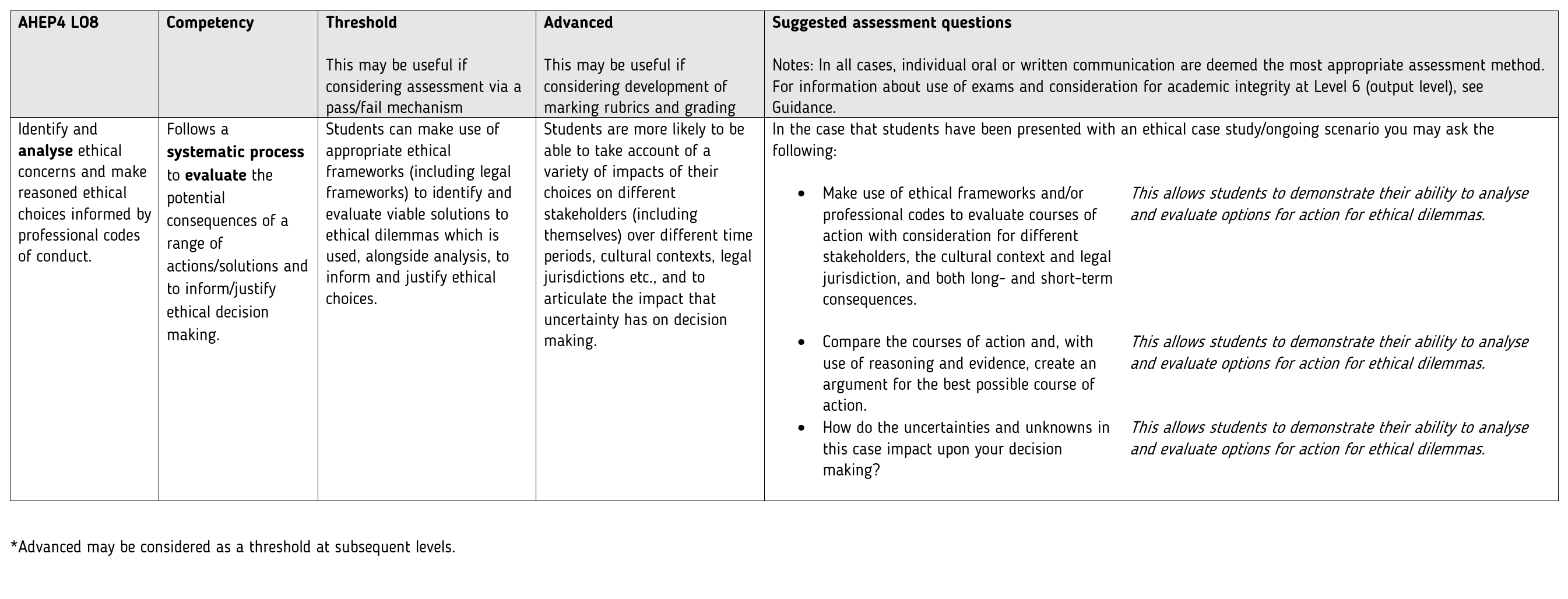
Make use of ethical frameworks and/or professional codes to evaluate the options for DSS both short term and long term. How do the uncertainty and assumptions involved in this case impact decision making?
Students should list plausible options. They can then analyse them with respect to different ethical frameworks (whilst we don’t necessary make use of normative ethical theories, analysis according to consequences, intention or action may be a useful approach to this). Below we have included a non-exhaustive list of options with ideas in terms of analysis.
Option
Consequences
Intention
Action
Keepusing water
May lead to expansion and profit of DSS and thus tax revenue/employment and supply.
Reputational damage of DSS may increase. Individual employee piece of mind may be at risk.
Farmers still don’t have water and biodiversity still suffers which may have further impact long term.
Intentionbehindaction notconsistentwith that expected by an engineer, other than with respect to legality
Actionfollowslegalnormsbut not social norms such as good will and concern for others.
Keep using the water but limit furtherwork
May limit expansion and profit of DSS and thus tax revenue/employment and supply.
Farmers still don’t have water and biodiversity still suffers and may have further impact long term. This could still result in reputation damage.
Intentionbehindaction partially consistent with that expected by an engineer.
Actionfollowslegalnormsbut only partially follow social norms such as good will and concern for others.
Makeuseof other sources of water
Data storage continues.
Potential for reputation to increase.
Potential increase in cost of water resulting in less profit potentially less tax revenue/employment.
Farmers have water and biodiversity may improve.
Alternativewatersourcesmaybeassociated with the same issues or worse.
Intention behind action seems consistent with that expected by an engineer. However, this is dependent upon
whether they chose to source sustainablewaterwithlessimpact on biodiversity etc.
Thismaybedependenton the degree to which DSS proactively source sustainable water.
Reduce worklevels or shut down
Impact on profit and thus tax revenue/employment and supply chain. Farmers have water and biodiversity may improve.
May cause operational issues for those whose data is stored.
Seems consistent with those expected of engineer. Raises questions more generally about viability and feasibility of datastorage.
Action doesn’t follow social norms of responsibility to employeesandshareholders.
Investigate othercooling methods which don’t require as much water/don’t take on extra work untilanother method identified.
May benefit whole sector.
May cause interim loss of service.
This follows expectations of the engineeringprofession in terms of evidence-baseddecisionmaking and consideration for impact of engineering in society.
It follows social norms in termsofresponsibledecision making.
Any views, thoughts, and opinions expressed herein are solely that of the author(s) and do not necessarily reflect the views, opinions, policies, or position of the Engineering Professors’ Council or the Toolkit sponsors and supporters.
Authors: Dr. Natalie Wint (UCL); Dr. William Bennett (Swansea University).
Who is this article for?: This article should be read by educators at all levels in higher education who wish to integrate ethics into the engineering and design curriculum or module design.
As engineering educators, it is uncommon that we were taught or assessed on ethical thinking within our own degree programmes. Although we may be able to think of plenty of ethical scenarios from our own experience, we may not necessarily be able to identify the best way to assess the ability of a student to engage in ethical thinking in a systematic and robust manner, something which is critical for both the evaluation of learning and teaching (as explained further here).
Furthermore, the complex, ill-structured nature of ethical dilemmas, which often involve a variety of diverse stakeholders, perspectives and cultural norms, necessitates an ability to navigate tensions and compromise. This results in situations in which multiple possible courses of action can be identified, meaning that there is not one single ‘good’ or ‘correct’ answer to ethical questions posed.
It is also necessary to evidence that students are able to meet the criteria outlined by accreditation bodies. Within the UK context, it is the Engineering Council (EC) that is responsible for providing the principal framework which guides engineering course content and sets accreditation threshold standards of competence through AHEP, the Accreditation of Higher Education Programs, as part of The UK Standard for Professional Engineering Competence (UKSPEC).
The knowledge, skills and attributes expected of engineering graduates constantly shifts, and since the advent of AHEP in 2004 there has been increased focus on strengthening design, and consideration for economic, ethical, environmental, legal, and social factors.
In-keeping with a need to assess engineering ethics in a robust manner, this article provides step-by-step considerations for designing assessment and is primarily intended to be used in conjunction with an existing ethics case study, such as those available through the EPC’s Engineering Ethics Toolkit (we later make use of the existing ‘Water Wars’ case study to exemplify the points made).
The guidance and accompanying rubric have been designed in a way that encourages students to grapple with the numerous tensions involved in ethical decision making, and the focus is thus on assessment of the decision-making process as opposed to the ‘answer’ given, the decision made or the outcome of the scenario.
Assessment purpose:
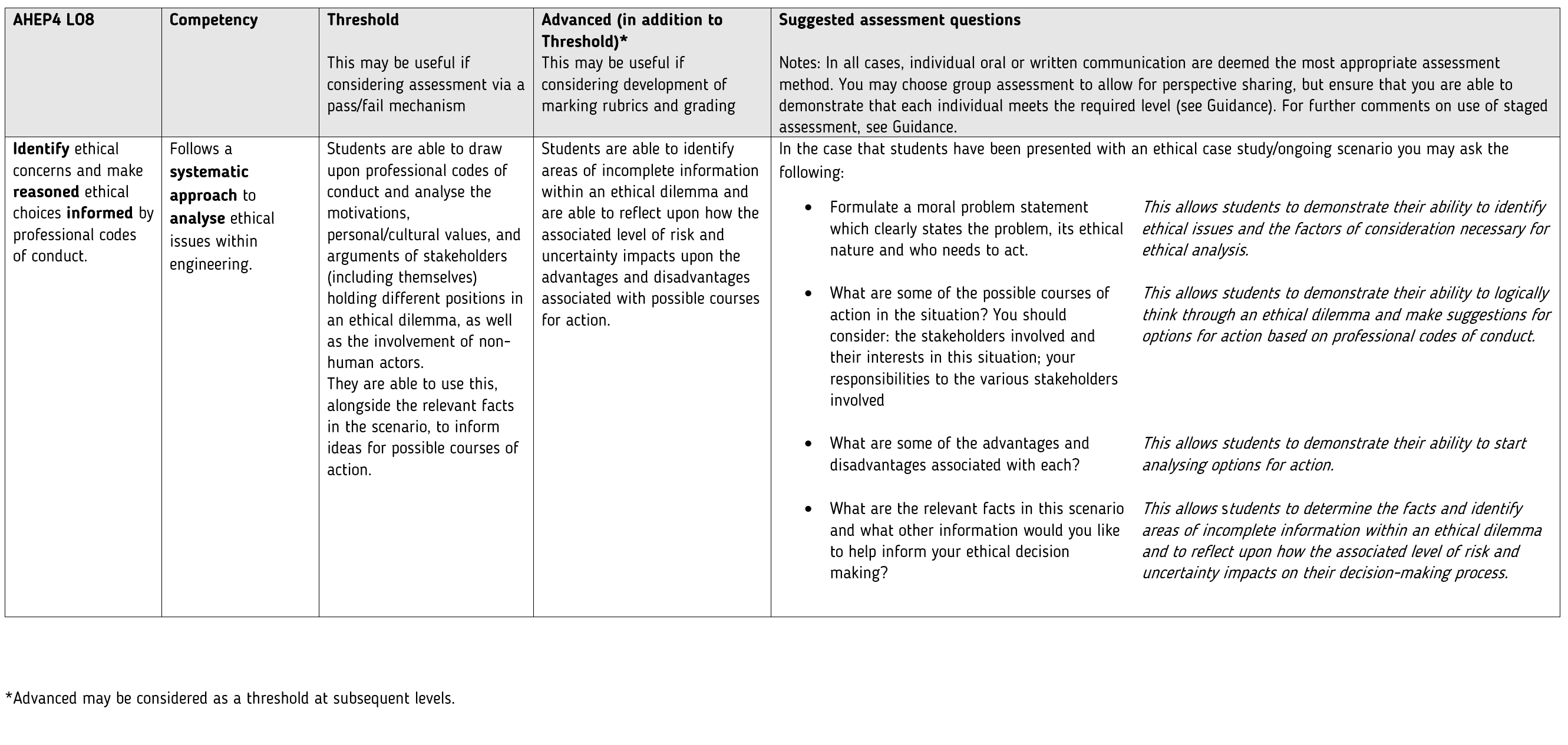
The first consideration is the year group you are assessing, and the competencies they have already acquired (for example in the case of Level 5 and Level 6 students). You may want to consider the (partial) learning outcome (LO) as defined by AHEP4 LO8 (Table 1). Whilst this shouldn’t act to limit what you choose to assess, it is a good place to start in terms of the level of ability your students should be demonstrating.
Note that the Engineering Council (EC) claim “This fourth edition of AHEP has reduced the total number of learning outcomes in order to focus attention on core areas, eliminate duplication and demonstrate progression between academic levels of study”. They are thus interested in the differences between level. You are recommended to make this explicit in module specification and associated assessment description. Key differentiations are shown in Table 1. For example, at Level 5 you may be more interested in students’ abilities to identify an ethical situation, whereas at Level 6 you may want them to be able to reason through options or make a judgement.
Table 1: AHEP4 Learning Outcomes
Year 1 (Level 4)
Year 2 (Level 5)
Year 3 (Level 6)
M Level (Level 7)
LO8
Apply ethical principles and recognise the need for engineers to exercise their responsibilities in an ethical manner and in line with professional codes of conduct.
Identify ethical concerns and make reasoned ethical choices informed by professional codes of conduct.
Identify and analyse ethical concerns and make reasoned ethical choices informed by professional codes of conduct.
Identify and analyse ethical concerns and make reasoned ethical choices informed by professional codes of conduct (MEng).
Interpretation
Awareness of issues, obligations, and responsibilities; sensitising students to ethical issues.
Ability to resolve practical problems; identify ethical issues and to examine opposing arguments.
Ability to resolve practical problems; identify ethical issues and examine and evaluate/critique opposing arguments.
Ability to resolve practical problems; identify ethical issues and examine and evaluate/critique opposing arguments.
The final row in Table 1 provides our interpretation of the LO, making use of language similar to that within the EPC’s Ethics Learning Landscape. We believe this is more accessible and more easily operationalised.
The following steps outline the process involved in designing your assessment. Throughout we make reference to an existing EPC case study (Water Wars) to exemplify the points made.
1.) The first consideration is how much time you have and how much of the case study you want to use. Many of the case studies have multiple stages and could be spread over several sessions depending on time constraints.
2.) Linked to this is deciding whether you want to assess any other LOs within the assessment. For example, many of the case studies have technical elements. Furthermore, when using reports, presentations, or debates as methods of assessment you may also want to assess communication skills. Whatever you decide you should be careful to design the assessment in such a way that assesses LO8 in a robust manner, whereby the student could not pass the element without demonstrating they have met the individual LO to the required level (this is a key requirement to meet AHEP4). For example, in an assessment piece where ethics is worth 50% of the grade, a student could still pass the element as a whole (with 40%) by achieving high scores in the other grading criteria without the need to demonstrate their ability to meet LO8.
3.) Once you are aware how much of a case study you have time for and have decided which LOs (other than LO8) you are assessing, you should start to determine which questions are aligned with the level of study you are considering and/or the ability of the students (for example you may query whether students at Level 5 have already developed the skills and competencies suggested for Level 4). At each level you can make use of the accompanying rubric to help you consider how the relevant attributes might be demonstrated by students. As an example, please refer to the accompanying document where we provide our thoughts about how we would assess Water Wars at Levels 4-6.
4.) Once you have selected questions you could look to add any complementary activities or tasks (that do not necessarily have to be assessed) to help the students broaden their understanding of the problem and ability to think through their response. For example, in the Water Wars case study, there are multiple activities (for example Part 1, Q3 and Part 2, Q3, Q4, Q6, Q7) aimed at helping students understand different perspectives which may help them to answer further ethical questions. There are also technical questions (for example Part 1, Q5) which help students understand the integrated nature of technical and social aspects and contextualise scenarios.
5.) Once you have selected your questions you will need to make a marking rubric which includes details of the weightings given for each component of the assessment. (This is where you will need to be careful in selecting whether other LOs are assessed e.g., communication, and whether a student can pass the assessment/module without hitting LO8). You can then make use of the guidance provided in terms of expectations at a threshold and advanced level, to write criteria for what is expected at each grade demarcation.
Although we have focused on ‘Water Wars’ here, the suggested assessment questions within the accompanying rubric have been designed in such a way that they can be used in conjunction with the case studies available within the toolkit, or with another case study that has been created (by yourself or elsewhere) to outline an ethical dilemma.
Other considerations:
As acknowledged elsewhere within the toolkit (see here), there are “practical limits on assessment” (Davis and Feinerman, 2012) of ethics, including demands on time, pressure from other instructors or administrators, and difficulty in connecting assessment of ethics with assessment of technical content. These are some other considerations you may wish to make when planning assessment.
• Number of students and/or marking burden: With large student numbers you may be more inclined to choose a group assessment method (which may also be beneficial in allowing students to share perspectives and engage in debate), or a format which is relatively quick to mark/allows automated marking (e.g. a quiz). In the case of group work it is important to find a way in which to ensure that all students within each group meet the LO in a robust manner. Whilst assessment formats such as quizzes may be useful for assessing basic knowledge, they are limited in their ability to ensure that students have developed the higher-level competencies needed to meet the LO at output level.
• Academic integrity: As with any LO there is a need to ensure academic integrity. This may be particularly difficult for large cohorts and group work. You may wish to have a range of case studies or ensure assessment takes place in a controlled environment (e.g. an essay/report under exam conditions). This is particularly important at output level where you may wish to provide individual assessment under exam conditions (although competencies may be developed in groups in class).
• Logistics/resourcing: Many of the competencies associated with ethics are heavily linked to communication and argumentation, and answers tend to be highly individual in nature. Role play, debates, and presentations may therefore be considered the most suitable method of assessment. However, their use is often limited by staffing, room, and time constraints. Many of these methods could, instead, be used within class time to help students develop competencies prior to formal assessment. You may also choose to assess ethics in another assessment which is more heavily resourced (for example design projects or third year projects).
• Staged assessment: The ethical reasoning process benefits from different perspectives. It may therefore be desirable to stage assessment in such a way that individuals form their own answer (e.g. a moral problem statement), before sharing within a group. In this way a group problem statement, which benefits from multiple perspectives and considerations, can be formed. Similarly, individuals may take the role of an individual stakeholder in an ethical dilemma before coming together as a group.
• Use of exams: Whilst we see an increasing movement away from exams, we feel that a (closed book) exam is a suitable method of assessment of ethics based LOs in the situation that:
o There is a need to ensure academic integrity, and that each student meets the LO at output level.
o The exam is assessing competencies (e.g. ethical argumentation) as opposed to knowledge.
o All the relevant information needed is provided and there is limited content for students to learn in advance (aside from argumentation, justification, decision making skills etc developed in class).
Their use may therefore be limited to Level 6.
Rubric
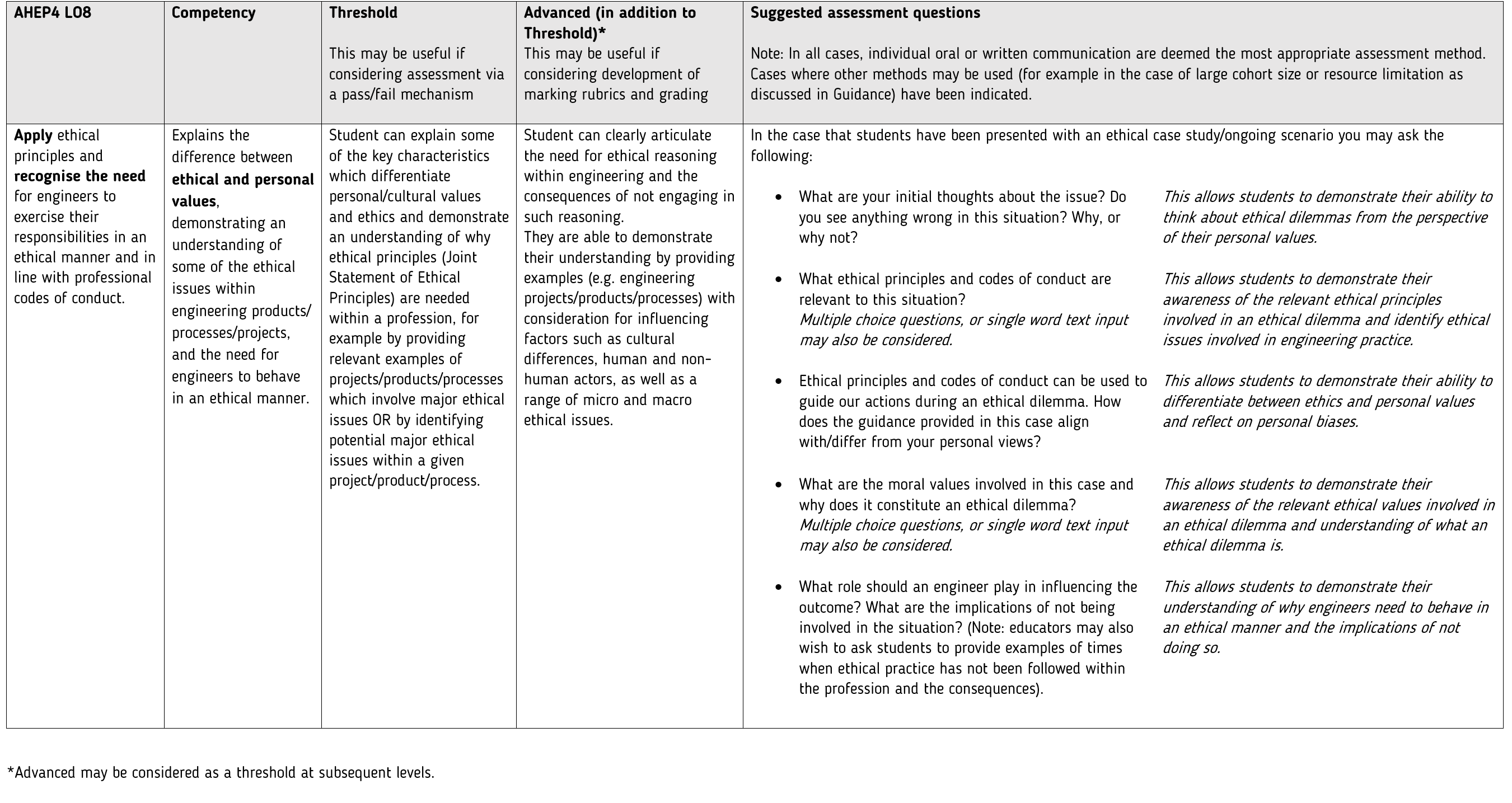
This document provides the partial AHEPLO8 at each level. The competences involved in meeting this LO have then been identified, along with what students would need to demonstrate to evidence meeting a threshold level, or advanced level. Example questions are given to show how students may demonstrate their competence at each level. For each question there is an explanation of how the question supports achievement of LO at that level. The rubrics should be used alongside the accompanying guidance document which offers practical suggestions and advice.
Year 1: This year focuses on developing awareness of issues, obligations, and responsibilities, and sensitising students to ethical issues.
Year 2: This year focuses on developing the ability to identify ethical issues and to examine opposing arguments, all of which is needed to examine, analyse, and evaluate ethical dilemmas in Year 3.
Year 3: This year focuses on ensuring that students can satisfy LO8 at an output level in a robust manner.
References:
Davis, M. and A. Feinerman. (2012). ‘Assessing graduate student progress in engineering ethics’, Science and Engineering Ethics, 18(2), pp. 351-367.
Any views, thoughts, and opinions expressed herein are solely that of the author(s) and do not necessarily reflect the views, opinions, policies, or position of the Engineering Professors’ Council or the Toolkit sponsors and supporters.
Keywords:Information literacy; digital literacy; misleading information; source and data reliability; ethical behaviour; sustainability.
Who is this article for?: This article should be read by educators at all levels in higher education who wish to integrate technical information literacy into the engineering and design curriculum or module design. It will also help to provide students, particularly those embarking on Bachelor’s or Master’s research projects, with the integrated skill sets that employers are looking for, in particular, the ability to critically evaluate information.
Introduction:
In an era dominated by digital information, engineering educators face the critical challenge of preparing students not just in technical skills, but in navigating the complex digital landscape with an ethical compass. This article explores how integrating information and digital literacy into engineering education is not only essential for fostering ethical behaviour but also crucial for ensuring sustainability in engineering practices.
The intertwined nature of information and digital literacy in engineering is undeniable. Engineering practitioners need to be able to select and critically assess the reliability of the information sources they use to ensure they comply with ethical practice. The Engineering Council and Royal Academy of Engineering’s Joint Statement of Ethical Principles underscores the need for accuracy and rigour, a core component of these literacies. Faculty members play a pivotal role in cultivating these skills, empowering students and practitioners to responsibly source and utilise information.
The challenge of information overload:
One of the challenges facing trained engineers, engineering faculty and students alike is that of accessing, critically evaluating, and using accurate and reliable information.
A professional engineer needs to gather insights and information to solve problems, deliver projects, and drive innovation. This involves undertaking as much research as possible: looking at case-studies, standards, best practices, and examples that will support or disprove what they think is the best approach. In a profession where the analysis of failures is a core competence, critical, dispassionate thinking is vital. In fact, to be digitally literate, an ethically responsible engineer must know how to access, evaluate, utilise, manage, analyse, create, and interact using digital resources (Martin, 2008).
Students, while adept at online searching, often struggle with assessing the credibility of sources, particularly information gleaned on social media, especially in their early academic years. This scenario necessitates faculty guidance in discerning reputable and ethical information sources, thereby embedding an ethical approach to information use early in their professional development.
Accuracy and rigour:
Acquisition of ‘information literacy’ contributes to compliance with the Statement of Ethical Principles in several ways. It promotes the ‘accuracy and rigour’ essential to engineering. It guarantees the basis and scope of engineering expertise and reliability so that engineers effectively contribute to the well-being of society and its safety and understand the limits of their expertise. It also contributes to promoting ‘respect for the environment and public good’, not just by ensuring safety in design, drawing up safety standards and complying with them, but also by integrating the concept of social responsibility and sustainability into all projects and work practices. In addition, developing students’ capacity to analyse and assess the accuracy and reliability of environmental data enables them to recognise and avoid ‘green-washing’, a growing concern for many of them.
Employability:
In the workplace, the ability to efficiently seek out relevant information is invaluable. In a project-based, problem-solving learning environment students are often confronted with the dilemma of how to refine their search to look for the right level of information from the very beginning of an experiment or research project. By acquiring this ‘information literacy’ competence early on in their studies they find themselves equipped with skills that are ‘workplace-ready’. For employers this represents a valuable competence and for students it constitutes an asset for their future employability.
Tapping into specialised platforms:
In 2006 the then-CEO of Google, Eric Schmidt famously said “Google is not a truth machine”, and the recent wave of AI-powered chatbots all come with a stark disclaimer that they “may display incorrect or harmful information”, and “can make mistakes. Consider checking important information.” Confronted with information overload and the difficulty of sifting through non-specialised and potentially unreliable material provided by major search engines, students and educators need to be aware of the wealth of reliable resources available on specialised platforms. For example, Elsevier’s engineering-focused, purpose-built platform, Knovel, offers trustworthy, curated engineering content from a large variety of providers. By giving students access to the same engineering resources and tools as professionals in the field it enables them to incorporate technical information into their work and provides them with early exposure to the industry standard. For educators, it offers support for the foundational years of teaching, covering all aspects of problem-based learning and beyond. It is also an efficient way of remaining up-to-date with the latest information and data on key issues. The extensive range of information and data available equips students and engineers with the ability to form well-rounded, critical perspectives on the various interests and power dynamics that play a role in the technical engineering challenges they endeavour to address.
Conclusion:
By embedding information and digital literacy into the fabric of engineering education (such as by using this case study), we not only promote ethical behaviour but also prepare students for the challenges of modern engineering practice. These skills are fundamental to the ethical and sustainable advancement of the engineering profession.
Knovel for Higher Education is an Elsevier product. As a publisher-neutral platform, Knovel helps engineering students explore foundational literature with interactive tools and data.
46% of EPC members already have access to Knovel. If you don’t currently have access but would like to try Knovel in your teaching or to brainstorm how you can make the best use of Knovel in your classroom, please contact: Susan Watson, susan.watson@elsevier.com. Check out this useful blog post from James Harper on exactly that topic here.
Faculty and students can check their access to Knovel using their university email address at the following link: Account Verification – Knovel
References:
Martin, A. (2008). Digital Literacy and the “Digital Society”. In C. Lankshear, & M. Knobel (Eds.), Digital Literacies: Concepts, Policies, and Practices (pp. 151-176). New York: Peter Lang.
Any views, thoughts, and opinions expressed herein are solely that of the author(s) and do not necessarily reflect the views, opinions, policies, or position of the Engineering Professors’ Council or the Toolkit sponsors and supporters.
Dr Emma A Taylor, founder of the Engineering Deaf Awareness Project (E-DAP), Royal Academy of Engineering Visiting Professor, Cranfield University, and Professor Sarah Jayne Hitt, PhD SFHEA, NMITE, Edinburgh Napier University, discuss embedding ethics in engineering education through wide use of deaf awareness: a gateway to a more inclusive practice.
“An ethical society is an inclusive society”. This is a statement that most people would find it hard to disagree strongly with. As users of the EPC’s Engineering Ethics Toolkit and readers of this blog we hope our message is being heard loud and clear.
But hearing is a problem:
One in five adults in the UK are deaf, have hearing loss or tinnitus. That is 12 million adults or 20% of the population. In the broader context of‘ ‘communication exclusion’ (practices that exclude or inhibit communication), this population figure may be even larger, when including comprehension issues experienced by non-native speakers and poor communication issues such as people talking over one another in group settings such as during meetings.
This ‘communication exclusion’ gap is also visible in an education context, where many educators have observed group discussion and group project dynamics develop around those who are the most dominant (read: loudest) communicators. This creates an imbalanced learning environment with the increased potential for unequal outcomes. Even though this ‘communication exclusion’ and lack of skills is such a huge problem, you could say it’s hidden in plain sight. Identification of this imbalance is an example of ethics in action in the classroom.
Across all spheres, we suggest that becoming deaf aware is one way to begin to address communication exclusion issues. Simple and practical effective tips are already widely disseminated by expert organisations with deep in the field experience (see list of resources below from RNID). Our collective pandemic experience took us all a great step forward in seeing the benefits of technology, but also in understanding the challenges of communicating through the barriers of technology. As engineering educators we can choose to become more proactive in using tools that are already available, an action that supports a wider range of learners beyond those who choose to disclose hearing or understanding related needs. This approach is inclusive; it is ethical.
And as educators we propose that there is an even greater pressing need to amplify the issue and promote practical techniques towards improving communication. Many surveys and reports from industry have indicated that preparing students for real world work environments needs improving. Although they often become proficient in technical skills, unless they get an internship, students may not develop the business skills needed for the workplace. Communication in all its forms is rightly embedded in professional qualifications for engineers, whether EngTech, IEng, CEng or other from organisations such as the UK’s Engineering Council.
And even when skills are explicitly articulated in the syllabus and the students are assessed, much of what is already being taught is not actually being embedded into transferable skills that are effectively deployed in the workplace. As education is a training ground for professional skills, a patchy implementation of effective and active practice of communication skills in the education arena leads to variable skill levels professionally.
As engineers we are problem solvers, so we seek clarification of issues and derivation of potential solutions through identification and optimisation of requirements. The problem-solving lens we apply to technology can also be applied to finding ways to educate better communicators. The “what” is spoken about in generic terms but the “how”, how to fix and examine root causes, is less often articulated.
So what can be done? What is the practical framework that can be applied by both academics and students and embedded in daily life? And how can deaf awareness help get us there?
Our proposal is to work to embed and deploy deaf awareness in all aspects of engineering education. Not only because it is just and ethical to do so, but because it can help us see (and resolve) other issues. But this won’t, and can’t, be done in one step. Our experience in the field shows that even the simplest measures aren’t broadly used despite their clear potential for benefit. This is one reason why blogs and toolkits like this one exist: to help educators embed resources and processes into their teaching practice.
It’s important to note that this proposal goes beyond deaf awareness and is really about reducing or removing invisible barriers that exist in communication and education, and addressing the communication problem through an engineering lens. Only when one takes a step back with a deaf awareness filter and gets the relevant training, do your eyes (and ears) open and see how it helps others. It is about improving the effectiveness of teaching and communication.
This approach goes beyond EDI principles and is about breaking barriers and being part of a broader student development approach, such as intellectual, emotional, social, and personal growth. The aim is to get students present and to be in the room with you, during the process of knowledge transfer.
As we work on making our engineering classrooms better for everyone, we are focusing on understanding and supporting students with hearing impairments. We are taking a step back and getting re-trained to have a fresh perspective. This helps us see things we might have missed before. The goal is not just to be aware but to actually improve how we teach and communicate.
We want our classrooms to be inclusive, where everyone’s needs are considered and met. It is about creating an environment where all our students, including those with hearing impairments, feel supported and included in the learning process. And stepping back and taking a whole human (“humanist”) view, we can define education as an endeavour that develops human potential—not just an activity that produces nameless faceless quantifiable outcomes or products. As such, initiatives such as bringing forward deaf awareness to benefit broader communication and engagement provide a measurable step forward into bringing a more humanistic approach to Engineering Education.
So what can you do?
The first step is always awareness. Inform yourself, raise awareness amongst yourself and your colleagues, and make improvements where you can in your daily education practice
Consider how you might incorporate deaf awareness in your teaching case studies, and consider how deaf awareness can improve the quality of your group work discussions
We’re pleased to report that we are aiming to launch an EDI Toolkit project soon, building on the work that we’ve begun on neurodiversity. Soon we’ll be seeking people to get involved and contribute resources, so stay tuned! (i.e. “If you have a process or resource that helped your teaching become more inclusive, please share it with us!”).
Any views, thoughts, and opinions expressed herein are solely that of the author(s) and do not necessarily reflect the views, opinions, policies, or position of the Engineering Professors’ Council or the Toolkit sponsors and supporters.
Authors: The Lemelson Foundation; Cynthia Anderson, Sarah Jayne Hitt and Jonathan Truslove (Eds.)
Topic: Accreditation mapping for sustainability in engineering education.
Tool type: Guidance.
Engineering disciplines: Any.
Keywords: Accreditation and standards; Learning outcomes; AHEP; Student support; Sustainability; Higher education; Students; Teaching or embedding sustainability.
Sustainability competency: Critical thinking; Systems thinking; Integrated problem-solving; Collaboration.UNESCO has developed eight key competencies for sustainability that are aimed at learners of all ages worldwide. Many versions of these exist, as are linked here*. In the UK, these have been adapted within higher education by AdvanceHE and the QAA with appropriate learning outcomes. The full list of competencies and learning outcome alignment can be found in the Education for Sustainable Development Guidance*. *Click the pink ''Sustainability competency'' text to learn more.
AHEP mapping: This resource addresses themes from the UK’s Accreditation of Higher Education Programmes fourth edition (AHEP4). See details about mapping within the guide.
Related SDGs: SDG 12 (Responsible consumption and production).
Reimagined Degree Map Intervention: Adapt and repurpose learning outcomes; More real-world complexity; Cross-disciplinarity.The Reimagined Degree Map is a guide to help engineering departments navigate the decisions that are urgently required to ensure degrees prepare students for 21st century challenges. Click the pink ''Reimagined Degree Map Intervention'' text to learn more.
Learning and teaching notes:
This guide, currently under review by the Engineering Council, maps the Engineering for One Planet (EOP) Framework to AHEP4. The EOP Framework is a practical tool for curricular supplementation and modification, comprising 93 sustainability focused learning outcomes in 9 topic areas.
The Lemelson Foundation, VentureWell, and Alula Consulting stewarded the co-development of the EOP Framework with hundreds of individuals mostly situated in the United States. Now, in collaboration with the EPC and Engineers Without Borders UK, the EOP Framework’s student learning outcomes have been mapped to AHEP4 at the Chartered Engineer (CEng) level to ensure that UK educators can more easily align these outcomes and corresponding resources with learning activities, coursework, and assessments within their modules.
Any views, thoughts, and opinions expressed herein are solely that of the author(s) and do not necessarily reflect the views, opinions, policies, or position of the Engineering Professors’ Council or the Toolkit sponsors and supporters.
Authors: Dr Homeira Shayesteh (Senior Lecturer/Programme Leader for Architectural Technology, Design Engineering & Mathematics Department, Faculty of Science & Technology, Middlesex University),Professor Jarka Glassey(Director of Education, School of Engineering, Newcastle University).
Topic: How to integrate the SDGs using a practical framework.
Type: Guidance.
Relevant disciplines: Any.
Keywords: Accreditation and standards; Assessment; Global responsibility; Learning outcomes; Sustainability; AHEP; SDGs; Curriculum design; Course design; Higher education; Pedagogy.
Sustainability competency: Anticipatory; Integrated problem-solving; Strategic.UNESCO has developed eight key competencies for sustainability that are aimed at learners of all ages worldwide. Many versions of these exist, as are linked here*. In the UK, these have been adapted within higher education by AdvanceHE and the QAA with appropriate learning outcomes. The full list of competencies and learning outcome alignment can be found in the Education for Sustainable Development Guidance*. *Click the pink ''Sustainability competency'' text to learn more.
AHEP mapping: This resource addresses two of the themes from the UK’s Accreditation of Higher Education Programmes fourth edition (AHEP4):The Engineer and Society(acknowledging that engineering activity can have a significant societal impact) andEngineering Practice(the practical application of engineering concepts, tools and professional skills). To map this resource to AHEP outcomes specific to a programme under these themes, access AHEP 4hereand navigate to pages 30-31 and 35-37.
Related SDGs: SDG 4 (Quality education); SDG 13 (Climate action).
Reimagined Degree Map Intervention: Adapt and repurpose learning outcomes; Authentic assessment; Active pedagogies and mindset development.The Reimagined Degree Map is a guide to help engineering departments navigate the decisions that are urgently required to ensure degrees prepare students for 21st century challenges. Click the pink ''Reimagined Degree Map Intervention'' text to learn more.
Who is this article for? This article should be read by educators at all levels of higher education looking to embed and integrate sustainability into curriculum, module, and / or programme design.
Premise:
The critical role of engineers in developing sustainable solutions to grand societal challenges is undisputable. A wealth of literature and a range of initiatives supporting the embedding of sustainability into engineering curricula already exists. However, a practicing engineering educator responsible for achieving this embedding would be best supported by a practical framework providing a step-by-step guide with example resources for either programme or module/course-level embedding of sustainability into their practice. This practical framework illustrates a tested approach to programme wide as well as module alignment with SDGs, including further resources as well as examples of implementation for each step. This workflow diagram provides a visual illustration of the steps outlined below. The constructive alignment tool found in the Ethics Toolkit may also be adapted to a Sustainability context.
b. Review government targets and discipline-specific guidance.
c. Review accreditation body requirements such as found in AHEP4 and guidance from professional bodies. For example, IChemE highlights the creation of a culture of sustainability, not just a process of embedding the topic.
e. Consider convening focus groups with employers in general and some employers of course alumni in particular. Carefully select attendees to represent a broad range of employers with a range of roles (recruiters, managers, strategy leaders, etc.). Conduct semi-structured focus groups, opening with broad themes identified from steps a through d. Identify any missing knowledge, skills, and competencies specific to particular employers, and prioritize those needed to be delivered by the programme together with the level of competency required (aware, competent, or expert).
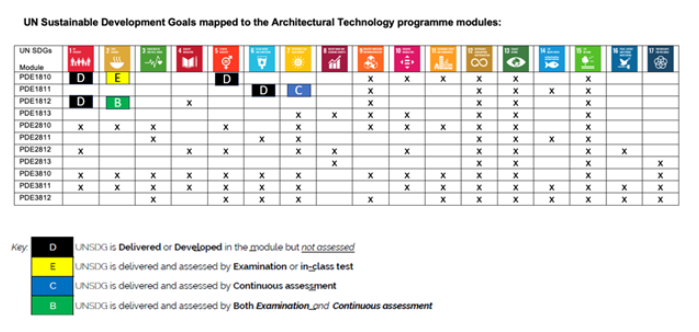
2. Look back. The outcome of this phase is a programme map (see appendix) of the SDGs that are currently delivered and highlighting gaps in provision.
b. Conduct a SWOT analysis as a team, considering the strengths, weaknesses, opportunities, and threats of the programme from the perspective of sustainability and relevance/competitiveness.
c. Convene an alumni focus group to identify gaps in current and previous provision, carefully selecting attendees to represent a broad range of possible employment sectors with a range of experiences (fresh graduates to mid-career). Conduct semi-structured discussions opening with broad themes identified from steps 1a-e. Identify any missing knowledge, skills, and competencies specific to particular sectors, and those missing or insufficiently delivered by the programme together with the level of competency required (aware, competent, or expert).
d. Convene a focus group of current students from various stages of the programme. Conduct semi-structured discussions opening with broad themes identified from steps 1a-e and 2a-c. Identify student perceptions of knowledge, skills, and competencies missing from the course in light of the themes identified.
e. Review external examiner feedback, considering any feedback specific to the sustainability content of the programme.
3. Look ahead. The goal of this phase is programme delivery that is aligned with the SDGs and can be evidenced as such.
b. Revise module descriptors so that there are clear linkages to sustainability competencies or the SDGs generally within the aims of the modules.
c. Revise learning outcomes according to which SDGs relate to the module content, projects or activities. The Reimagined Degree Map and the Constructive Alignment Tool for Ethics provides guidance on revising module outcomes. An example that also references AHEP4 ILOS is:
“Apply comprehensive knowledge of mathematics, biology, and engineering principles to solve a complex bioprocess engineering challenge based on critical awareness of new developments in this area. This will be demonstrated by designing solutions appropriate within the health and safety, diversity, inclusion, cultural, societal, environmental, and commercial requirements and codes of practice to minimise adverse impacts (M1, M5, M7).”
e. Create an implementation plan with clear timelines for module descriptor approvals and modification of delivery materials.
For module-wide alignment:
1. Look around. The outcome of this phase is a confirmed approach to embedding sustainability within a particular module or theme.
a. Seek resources available on the SDGs and sustainability teaching in this discipline/theme. For instance, review these examples for Computing, Chemical Engineering and Robotics.
b. Determine any specific guidelines, standards, and regulations for this theme within the discipline.
2. Look back. The outcome of this phase is a module-level map of SDGs currently delivered, highlighting any gaps.
b. Conduct a SWOT analysis as a module team that considers the strengths, weaknesses, opportunities, and threats of the module from the perspective of sustainability and relevance of the module to contribute to programme-level delivery on sustainability and/or the SDGs.
c. Review feedback from current students on the clarity of the modules links to the SDGs.
d. Review feedback from external examiners on the sustainability content of the module.
3. Look ahead.
a. Create introduction slides for the modules that explicitly reference how sustainability topics will be integrated.
b. Embed specific activities involving the SDGs in a given theme, and include students in identifying these. See below for suggestions, and visit the Teaching resources in this toolkit for more options.
Appendix:
A. Outcome I.2 (programme level mapping)
B. Outcome II.5 (module level mapping) – same as above, but instead of the modules in individual lines, themes delivered within the module can be used to make sure the themes are mapped directly to SDGs.
C. II.6.b – Specific activities
Activity 1: Best carried out at the start of the module and then repeated near the end of the module to compare students perception and learning. Split students into groups of 3-4, at the start of the module use the module template (attached as a resource) to clearly outline the ILOs. Then present the SDGs and ask students to spend no more than 5 min identifying the top 3 SDGs they believe the material delivered in the module will enable them to address. Justify the selection. Can either feed back or exchange ideas with the group to their right. Capture these SDGs for comparison of the repeat exercise towards the end of the module. How has the perception of the group changed following the delivery of the module and why?
Activity 2: Variation on the above activity – student groups to arrange the SDGs in a pyramid with the most relevant ones at the top, capture the picture and return to it later in module delivery
Activity 3: Suitable particularly for the earlier stages. Use https://go-goals.org/ to increase the general awareness of SDGs.
Activity 4: The coursework geared to the SDGs, with each student choosing a goal of their choice and developing a webmap to demonstrate the role of module-relevant data and analysis in tackling that goal.
Any views, thoughts, and opinions expressed herein are solely that of the author(s) and do not necessarily reflect the views, opinions, policies, or position of the Engineering Professors’ Council or the Toolkit sponsors and supporters.
 Authors: Dr. Kieran Higgins (Ulster University); Dr. Alison Calvert (Queen’s University Belfast).
 PowerPoint Subtitles Guidelines