Standards work comes with a language of its own. This glossary collects the abbreviations you’ll come across throughout the DTS Toolkit, the bodies that write the standards, and the telecoms, security, web and EU regulatory terms that sit alongside them, so you can look up anything unfamiliar without breaking your stride.
Standards Development Organisations (SDOs)
SDO: Standards Development Organization
BSI: British Standards Institution
NSB: National Standards Body
ETSI: European Telecommunications Standards Institute
IEEE: Institute of Electrical and Electronics Engineers
IEEE SAIEEE: Standards Association
IETF: Internet Engineering Task Force
ISO: International Organization for Standardization
DSIT: Department for Science, Innovation and Technology (UK)
NCSC: National Cyber Security Centre (UK)
SDG: Sustainable Development Goals
Technology
ICT: Information and Communications Technology
DLT: Distributed Ledger Technology
SBOM: Software Bill of Materials
PCI DSS: Payment Card Industry Data Security Standard
SWEBOK: Software Engineering Body of Knowledge
CyBOK: Cyber Security Body of Knowledge
Supporting UK engineering educators to embedDigital Technical Standards into curriculum design. A collaboration between the Engineering Professors’ Council (EPC) and the University of Lancashire. Funded by the Department for Science, Innovation & Technology (DSIT).
WHY: The case for digital technical standards in education
Introduction
Digital Technical Standards (DTS) are foundational to the UK’s digital infrastructure, innovation ecosystem, and global competitiveness. They underpin the technologies and systems that define modern engineering practice from telecommunications and cybersecurity to the Internet of Things and artificial intelligence. Yet engagement with DTS development remains limited among engineering students and early-career professionals.
The Digital Technical Standards Toolkit has been developed to address this gap. It is a comprehensive, academically aligned resource designed to support engineering and computing educators across UK higher education in embedding DTS into curriculum design and delivery.
The Toolkit is a collaboration between the Engineering Professors’ Council (EPC) and the University of Lancashire funded by the Department for Science, Innovation & Technology (DSIT). It builds on the success of the EPC’s growing series of widely used toolkits :including those covering ethics, sustainability, complex systems, and inclusive employability :which have collectively received over 100,000 visits in the past three years.
“The Digital Technical Standards Toolkit represents a timely and necessary intervention for UK engineering education. As digital technical standards become increasingly embedded within accredited programme requirements, there is a clear and urgent need to equip academics with curated, accessible resources that support confident and consistent delivery. This project is not about creating content in isolation it is about harnessing the collective expertise of a broad community, drawing together what already exists, and making it genuinely usable for educators within the pressures of a modern engineering curriculum.”– Professor Georgina Harris, Dean of Engineering and Computing, University of Lancashire; Chair, DTS Toolkit Project
“Digital technical standards are not simply technical documents; they are the foundations upon which our digital infrastructure, our industries, and ultimately our societies are built. For young engineers to be truly prepared for professional practice, they must understand not only that standards exist, but how the global standardisation ecosystem functions, why standards are needed, and how they themselves can contribute to shaping them. The DTS Toolkit has the opportunity to provide that foundational understanding by mapping the landscape from ETSI and IEEE to IETF, W3C, and ITU and by framing content around enduring principles rather than the specifics of any single standard.” – Dr. Hermann Brand, Standards Expert, IEEE; Co-Chair DTS Toolkit Project
Purpose
The DTS Toolkit will enhance understanding and engagement with digital technical standards, which underpin the UK’s digital infrastructure, engineering practice, and international competitiveness. Specifically, the Toolkit aims to:
Consolidate existing high-quality resources from international Standards Development Organisations (SDOs) and signpost relevant external materials in a single, accessible location.
Develop new UK-context content where gaps exist, including bridging articles, curriculum mapping guides, and career pathway resources.
Support educators in embedding DTS concepts, SDO structures, and standards-related career pathways within engineering and computing curricula.
Align with AHEP (Accreditation of Higher Education Programmes) requirements and the Engineering Council’s UK-SPEC competence framework.
Demystify DTS development and highlight its relevance to engineering careers, motivating students and early-career professionals to engage with standards work.
WHAT: Toolkit content and scope
What the Toolkit contains
The Toolkit brings together resources from eight International Standards Development Organisations (ISDOs) in one accessible location, providing educators with the materials they need to teach DTS effectively.
Types of resources
The Toolkit includes a range of resource types, designed for use across different teaching contexts including lectures, seminars, problem-based learning, and online delivery:
Knowledge articles: explaining key DTS concepts, SDO structures, and the role of standards in engineering practice.
Guidance articles: providing pedagogical support for educators embedding DTS into their teaching, including curriculum mapping and assessment design.
Teaching resources: ready-to-use classroom materials such as case studies, activities, and project ideas.
UK industry case studies: demonstrating real-world applications of digital technical standards in UK engineering contexts.
Signposted external resources: curated links to high-quality existing materials from SDOs, professional bodies, and academic literature.
HOW: Development, governance and getting involved
Project leadership
The project is co-chaired by:
Professor Georgina Harris: Dean of the School of Engineering & Computing at the University of Lancashire and President of the Engineering Professors’ Council. Professor Harris oversees content development, academic integration, and stakeholder engagement.
Dr. Hermann Brand (IEEE): specialist in international standards, serving as resource advisor and co-chair of the Expert Working Group.
The project is managed by Dhanushka Hewaralalage at the University of Lancashire, with strategic oversight from Johnny Rich, Chief Executive of the EPC.
The Expert Working Group
The development of the Toolkit is guided by an Expert Working Group comprising representatives from academia, industry, professional bodies, and Standards Development Organisations. The Working Group has been convened to:
Identify and review existing resources relevant to DTS education.
Highlight gaps where new, targeted content is required.
Commission and review original content for inclusion in the Toolkit.
Ensure alignment with UK accreditation frameworks and professional registration requirements.
Working Group members and contributing experts include representatives from organisations such as the Engineering Council, British Standards Institution (BSI), Institution of Engineering and Technology (IET), Royal Academy of Engineering, DSIT, and UK universities.
Background and context
This initiative builds on the meeting on Technical Standards convened on 11 September 2025 by the Engineering Council. Following that meeting, DSIT funded the creation of this Toolkit to support engineering academics in better understanding digital technical standards and embedding them in their teaching.
The project follows the successful model established by the EPC’s toolkit series, which provides free-to-use resources in areas where engineering educators need particular support to stay current and aligned with academic, professional, and accreditation requirements. Existing EPC toolkits cover topics including engineering ethics, sustainability, complex systems, enterprise collaboration, and inclusive employability.
How to get involved
The Toolkit is a community-owned project, and contributions from academics, industry professionals, and standards experts are welcomed. There are several ways to get involved:
Share existing materials that you use or that your organisation would like to contribute.
Signpost external resources relevant to DTS education.
Suggest content to fill identified gaps.
Produce short, targeted guidance content where required.
Authorise use of your institution’s resources for inclusion in the Toolkit.
All contributors and participating experts will be acknowledged publicly on a dedicated DTS Toolkit page on the EPC website.
Get in touch
To register your involvement or interest, contact:
Dhanushka Hewaralalage
Project Manager, Digital Technical Standards Toolkit
Email: dsahewaralalage1@lancashire.ac.uk
Hosting and sustainability
The Toolkit is hosted on the EPC website, which is widely used by engineering academics across the UK. It is be freely accessible to all users without the need for membership or subscription.
The Toolkit will remain on the EPC website for a minimum of three years, with the intention that it will be maintained indefinitely. Users will be invited to submit new content for inclusion, which will be reviewed by volunteers from the Expert Working Group, ensuring the Toolkit remains current and relevant.
A launch webinar and marketing campaign will promote the Toolkit to all EPC members: approximately 9,000 academics from over 90 engineering departments throughout the UK.
Any views, thoughts, and opinions expressed herein are solely that of the author(s) and do not necessarily reflect the views, opinions, policies, or position of the Engineering Professors’ Council or the Toolkit sponsors and supporters.
How digital technical standards keep our connected world working, and why engineers should understand them.
Why standards matter
Every time a video is streamed, a message is sent, or a contactless payment terminal is used, digital technical standards are at work. These shared rules and specifications determine how devices such as phones, routers, and computers, as well as software applications and networks, communicate and interact, regardless of manufacturer or country of origin. Without these standards, the seamless operation of the connected world would not be possible.
Yet for many engineers and computing professionals, especially those early in their careers, the world of standards development remains unfamiliar. Who writes these rules? How are decisions made? And why should it matter to someone studying engineering in the UK?
The reliability of digital infrastructure is maintained by a global digital standardisation ecosystem, comprising organisations that develop and uphold the technical foundations of modern systems. Familiarity with this ecosystem is now essential for engineering graduates, as highlighted in UK accreditation frameworks such as the Accreditation of Higher Education Programmes (AHEP).
What is a digital technical standard?
A digital technical standard is a documented specification that defines the operational requirements of a technology. Examples include communication protocols, which establish rules for data exchange between devices; data formats, which specify how information is organised; and interfaces, which outline methods for system connectivity and interaction. These standards are generally developed through collaborative, consensus-driven processes involving engineers, researchers, companies, and, in some cases, societal stakeholders and governments.
Most digital standards are voluntary, allowing manufacturers and developers to decide whether to implement them. However, strong market forces typically drive widespread adoption, as products that do not comply with prevailing standards lack commercial viability. In certain cases, legislators and regulators reference these standards in legal frameworks, such as the UK’s Product Security and Telecommunications Infrastructure Act 2022, thereby making compliance mandatory.
Key insight
Standards drive interoperability, but they also enable innovation, shape markets, and underpin regulation. Understanding how they are developed is a professional skill increasingly expected of engineers.
The eight key standards development organisations
The digital standards landscape is shaped by a range of organisations, each specialising in particular technology domains. The DTS Toolkit focuses on eight Standards Development Organisations (SDOs) that are central to the UK’s digital infrastructure: These include formal international bodies based on national delegation (ISO, IEC, ITU), global organisations with direct membership (IEEE, IETF, W3C), and European standards organisations recognised by the EU (ETSI).
How can these differing governance, participation models, and development practices best enable interoperability across the global digital ecosystem?
Standards by domain
Mobile and telecommunications
3GPP is a partnership of seven regional telecommunications standards bodies, including ETSI in Europe. It produces the specifications behind each generation of mobile communications. From GSM to LTE, and today’s 5G NR and emerging 5G-Advanced, 3GPP sets radio interfaces, core network architecture, and service capabilities. ETSI is both a 3GPP partner and a standards body in its own right, recognised by the EU as a European Standards Organization (ESO), producing standards across telecommunications, cybersecurity, and radio equipment. ETSI has also developed some of the most comprehensive educational materials for higher education in this space.
The Internet Engineering Task Force (IETF) develops the protocols that make the Internet function. Its output, published as Requests for Comments (RFCs), of which there are now over 9,900, includes foundational standards such as TCP/IP (data transmission), HTTP (web communication), DNS (domain name resolution), and TLS (encryption). The IETF is distinctive for its open participation model: anyone can join a working group and contribute. As its informal motto puts it, the IETF believes in “rough consensus and running code.”
The World Wide Web Consortium (W3C) develops the standards that enable the modern web. W3C defines HTML (HyperText Markup Language) and CSS (Cascading Style Sheets), the foundational languages for structuring and styling web pages. It also produces the Web Content Accessibility Guidelines (WCAG), which help make web content usable by people with disabilities, and a broad range of Web APIs (Application Programming Interface), which are protocols for building and interacting with web applications. W3C operates as a public interest, non-profit organisation and adopts a royalty-free patent policy to ensure free implementation of its standards. ISO/IEC 40500:2025 adopted W3C’s WCAG 2.2 standard, demonstrating how web standards increasingly intersect with formal international standardisation. (IPR policies across all SDOs are discussed in detail in the Standards, Law, and Intellectual Property section below.)
The Institute of Electrical and Electronics Engineers (IEEE) is the world’s largest technical professional organisation. Its standards arm, the IEEE Standards Association (IEEE SA), produces widely adopted standards including IEEE 802.11 (Wi;Fi), IEEE 802.3 (Ethernet), and standards for IoT, smart grid, and AI enabled autonomous systems, including socio-technical standards to support technology governance. IEEE also publishes the Software Engineering Body of Knowledge (SWEBOK), a key reference for computing education. IEEE SA operates under both an individual participation modelwhere anyone can contribute to standards projects such as Wi-Fi and Ethernet without requiring organisational membership—and an entity model for other programmes.
The International Telecommunication Union (ITU) is a United Nations specialised agency with two key sectors for digital standards. ITU;R manages global radio spectrum allocation and sets performance requirements for wireless technologies (including defining what qualifies as “5G”). ITU;T develops standards for fixed;line telecommunications infrastructure, including optical transport networks and numbering plans. Participation in the ITU operates through national delegations, reflecting its intergovernmental character.
ISO/IEC JTC 1 (the Joint Technical Committee of the International Organization for Standardization and the International Electrotechnical Commission) produces international standards for information technology. Its work covers information security (the ISO/IEC 27000 series), AI governance, cloud computing, and data management. Participation occurs through national standards bodies ;in the UK, this is the British Standards Institution (BSI).
Despite their differences, the eight SDOs fall broadly into three categories: At a fundamental level, standards organisations differ in whether individuals participate as delegates of member organisations or as independent technical experts in their own capacity.
Formal international bodies (ISO, IEC, ITU):
These are organisations composed of members from various countries. They use a national delegation model, where each country sends delegates to represent it, and decisions are made through official voting procedures. The standards developed by these organisations greatly influence regulations and purchasing requirements, but they usually take longer to develop.
Industry partnerships and consortia (3GPP, W3C, ETSI, IEEE entity model):
Driven by organisational membership, these bodies balance broad industry input with faster development cycles. They often set the standards most directly implemented in commercial products.
Open technical communities (IETF, IEEE individual model):
Individuals participate actively, follow open processes, and maintain a strong engineering focus. The IETF’s model demonstrates that voluntary, consensus-based collaboration produces globally significant infrastructure standards.
Did you know?
The distinction between “direct participation” (as in IETF and IEEE) and “national delegation” (as in ITU and ISO) is one of the most fundamental differences in how standards organisations operate. Understanding these governance models helps engineers navigate the ecosystem effectively. In organisations like the IETF and IEEE (under its individual model), anyone with relevant expertise can join a working group and contribute directly—making these among the most accessible entry points for engineers new to standardisation.
How standards organisations work together
Modern digital systems span multiple technology domains, so standards bodies must collaborate. For example, a 5G smartphone relies on 3GPP specifications (Third Generation Partnership Project, for cellular radio), IEEE standards (Institute of Electrical and Electronics Engineers, for Wi-Fi connectivity), IETF protocols (Internet Engineering Task Force, for Internet communication), and W3C standards (World Wide Web Consortium, for its web browser) all within a device that must comply with ITU radio spectrum allocations (International Telecommunication Union) and may need to meet ISO/IEC security requirements (International Organization for Standardization/International Electrotechnical Commission).
This interconnected environment means that standards organisations regularly coordinate their work. 3GPP’s organisational structure is built on partnerships with regional standards bodies, including ETSI. The ITU sets high-level performance targets (such as the requirements for 5G systems) that bodies like 3GPP then implement in detailed technical specifications. W3C’s WCAG 2.2 has been formally adopted by ISO/IEC, bridging the worlds of web standards and formal international standards.
Standards, regulation, antitrust, and intellectual property
Engineers need to understand three distinct ways in which standards intersect with the legal and regulatory environment.
Standards and regulation
Although most digital standards are voluntary, legislators and regulators frequently reference them in legal frameworks. In the UK, the Product Security and Telecommunications Infrastructure Act 2022 draws on ETSI EN 303 645. In the EU, harmonised standards support CE marking and the presumption of conformity with directives. Understanding which standards carry regulatory weight is essential for engineers designing products for domestic and export markets.
Antitrust and competition law
Standards development inherently requires competitors to collaborate on shared specifications. Because of this, every major SDO maintains antitrust and competition law policies that govern how participants interact during standards meetings and processes. Engineers who participate in standards work need to be aware of these obligations.
Intellectual property
Intellectual property rights (IPR) policies play a critical role in every standards organisation. Companies contribute patented technologies to standards, so each SDO maintains policies to balance innovation incentives with fair access. The two principal approaches are FRAND (Fair, Reasonable, and Non-Discriminatory) licensing terms, which require patent holders to offer licences on equitable terms, and royalty-free policies, which allow patented technologies to be implemented without fees. The interaction between these IPR models and open-source software is an area of active and contentious debate. Engineers working at the intersection of technology and business gain valuable knowledge by understanding why these policies exist and how organisations differ in their approaches.
Have you considered?
Have you considered how standards that seem voluntary might affect your work if referenced in legislation or procurement rules? In the UK, do you know which standards guide cybersecurity or accessibility in your sector?
Why this matters for UK Engineering Education
The UK’s digital economy depends on engineers who not only use standards but also understand how they are developed and can contribute to their evolution. The Department for Science, Innovation and Technology (DSIT) has identified standards engagement as strategically important for the UK’s competitiveness and innovation ecosystem.
For engineering educators, embedding digital technical standards into curricula supports alignment with AHEP requirements and prepares graduates for careers where standards literacy is a practical professional skill. Whether a graduate enters telecommunications, cybersecurity, web development, or any digitally enabled engineering discipline, they will encounter and need to work with the outputs of these eight ISDOs.
The Digital Technical Standards Toolkit, developed by the Engineering Professors’ Council and the University of Central Lancashire, with funding from DSIT, aims to make this knowledge accessible, structured, and ready for integration into teaching and learning.
DSIT Introduction to Technology Standards: Foundational overview for UK context
Any views, thoughts, and opinions expressed herein are solely that of the author(s) and do not necessarily reflect the views, opinions, policies, or position of the Engineering Professors’ Council or the Toolkit sponsors and supporters.
WHY
Embedding digital technical standards into engineering curricula requires more than content knowledge ,it requires pedagogical strategy. Educators need to understand how standards map to learning outcomes, where they fit within existing programme structures, and how to assess standards-related competencies in ways aligned with AHEP requirements and professional registration pathways. Guidance Articles exist to support this curriculum design challenge, helping educators move from awareness of standards to confident, structured integration of DTS across their teaching.
WHAT
This category offers pedagogical support for educators embedding DTS into their teaching, including curriculum mapping tools, assessment design guidance, and pathways to professional development. Resources include the EDU4Standards Teacher Support Tool, the IETF’s Getting Started Guide for newcomers to internet standards, ISO’s higher education initiatives, and career-context articles linking standards knowledge to professional competence frameworks such as SWEBOK and the IET’s professional registration requirements. The collection also includes navigational tools for the 3GPP specification ecosystem, from series-by-series guides to an AI-powered specification search engine.
HOW
Explore the resources below for practical support in designing curricula, assessments, and learning pathways that embed digital technical standards in your programmes.
Any views, thoughts, and opinions expressed herein are solely that of the author(s) and do not necessarily reflect the views, opinions, policies, or position of the Engineering Professors’ Council or the Toolkit sponsors and supporters.
WHY
Digital technical standards form the invisible architecture of modern engineering; they enable interoperability, ensure safety, and promote innovation across every sector from telecommunications to cybersecurity.
However, many engineering and computing graduates enter the profession with limited understanding of what standards are, how they are developed, or why they are important to the UK’s digital infrastructure and international competitiveness. Knowledge Articles address this gap by building foundational literacy in standards, ensuring that educators and students alike can confidently engage with the standards landscape that underpins professional practice.
WHAT
This category contains articles explaining key DTS concepts, the structures and processes of major Standards Development Organisations (ETSI, 3GPP, IETF, W3C, ITU-R, ITU-T, IEEE, and ISO/IEC JTC 1), and the role of standards in engineering practice. Resources range from comprehensive textbooks and SDO education portals to focused introductions on specific standards such as ISO/IEC 27001 for information security, IEC 62443 for industrial cybersecurity, and the W3C Web Content Accessibility Guidelines (WCAG). Together, they provide a structured knowledge base spanning the full breadth of the digital standards ecosystem, including UK-specific frameworks like UK-SPEC and BSI’s standards development guidance.
HOW
Use the resources below to enhance your understanding of digital technical standards, from introductory overviews suitable for undergraduate education to detailed specifications and knowledge bases for advanced study. Each link directly connects to a freely accessible or openly licensed resource.
Any views, thoughts, and opinions expressed herein are solely that of the author(s) and do not necessarily reflect the views, opinions, policies, or position of the Engineering Professors’ Council or the Toolkit sponsors and supporters.
Licensing:This work is licensed under a Creative Commons Attribution-ShareAlike 4.0 International License. The work on which this project has been based was funded by the Engineering and Physical Sciences Research Council of the UK through the UK FIRES Program (EP/S019111/1) and the Future Electrical Machines Manufacturing Hub (EP/S018034/1). Earlier work supported by High Value Manufacturing Catapult has also been essential in developing the basis for this work.
Downloads: A PDF of this resource will be available soon.
Who is this article for?: This article should be read by educators at all levels in higher education who are seeking an overall perspective on teaching approaches for integrating complex systems in engineering education.
Related INCOSE Competencies: Toolkit resources are designed to be applicable to any engineering discipline, but educators might find it useful to understand their alignment to competencies outlined by the International Council on Systems Engineering (INCOSE). The INCOSE Competency Framework provides a set of 37 competencies for Systems Engineering within a tailorable framework that provides guidance for practitioners and stakeholders to identify knowledge, skills, abilities and behaviours crucial to Systems Engineering effectiveness.A free spreadsheet version of the framework can be downloaded.
This resource relates to the Systems Thinking and Critical Thinking INCOSE competencies.
AHEP mapping: This resource addresses several of the themes from the UK’s Accreditation of Higher Education Programmes fourth edition (AHEP4): Analytical Tools and Techniques (critical to the ability to model and solve problems), and Integrated / Systems Approach (essential to the solution of broadly-defined problems).
Premise:
Engineering is crucial to achieving imperatives such as decarbonisation. Yet engineering typically addresses specific, well-defined challenges rather than broad, ambiguous ones. Education and practice reinforce this approach, with even postgraduate and academic engineers often focusing on problem depth over breadth. While this produces deep technical insights and tangible technological capability, it risks delaying uptake and impact unless multidisciplinary teams are involved. Recognising this gap between aspirations and execution suggests a role for structured frameworks and tools to trigger bridging activity. Wicked problem thinking is a way to understand complex problems and systems thinking, and it is related to situations which are ambiguous, contested, sometimes lacking an end state, evolving over time, requiring collaboration, adaptability, and inherently cross-disciplinary.
Background:
Climate change is a helpful case in illustrating the gap between global ‘wicked’ problems, and the work of the engineer. Engineering’s success, by underpinning industrialisation and thereby enabling mass consumption, can also be seen as its biggest failing in contributing to climate change (Datea & Chandrasekharana, 2022) and other environmental impacts. Going forward, engineers must help mitigate it, through better deployment of existing technologies and creation of new ones. Clearly climate change is complex, spanning scientific, technological, behavioural, and political dimensions, and this complexity limits what can be achieved solely from engineering consideration. Conventional engineering methods, though highly effective at the project and programme level, risk drifting away from the original issue and producing isolated solutions with limited systemic effect.
Wicked problems thinking:
Global challenges like climate change are sometimes labelled “super-wicked” problems—time-limited, caused partly by the problem-solvers, lacking central authority, and often deferred (Levin et al.). In engineering, wicked problems present a risk, because engineers are inherently tasked with addressing a part of the wider problem and often via particular approaches. Perhaps it is not surprising, then, that engineers are trained for structured problems with clear solution methods (Schuelke-Leech, 2021). Unfortunately such approaches are rarely transferable directly to wicked contexts, except when problem structure and solution approaches align unusually well. Education reinforces this, as engineering curricula focus on well-defined challenges (Lönngren, 2017).
At the research level, problems are often entangled, requiring both high-level perspective and detailed work. Sustainable engineering science (Seager et al., 2012) calls for ethical awareness, adaptive methods, and “interactional expertise” drawn from other disciplines. While this opens opportunities to measure cause and effect across scales, tangible short-term indicators often dominate.
A structured approach to Wicked Problems:
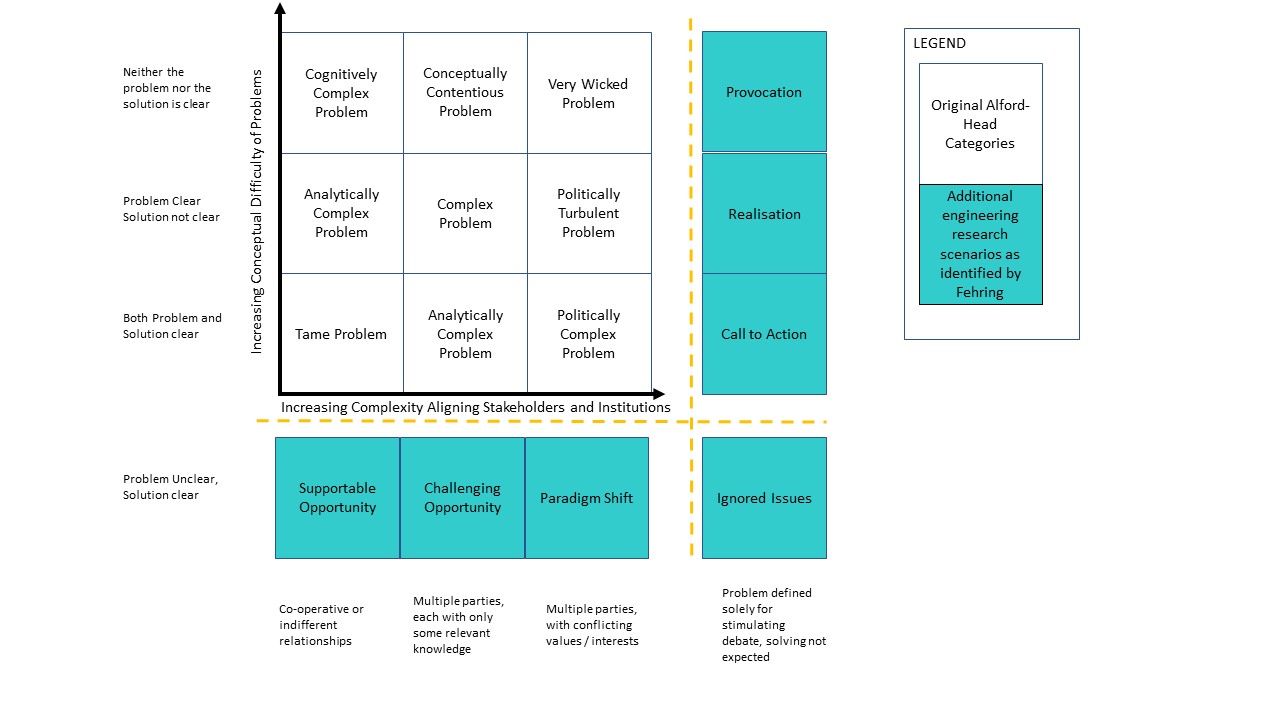
Alford & Head’s (2017) typology places problems on a spectrum from “Tame” to “Very Wicked.” Most engineering projects are tame, even when complex, because specification and management processes reduce ambiguity. Issues like decarbonisation-related engineering research, however, often involves wicked characteristics. This framework has recently been extended (Fehring, 2025) to allow consideration of a wider range of engineering research scenarios, Figure 1.
Figure 1. A framework for categorising complexity of engineering research scenarios (Fehring)
Each of the identified scenario types is somewhat distinctive, as follows:
Tame: Challenge of delivery and execution within known (but potentially challenging) parameters.
Analytically complex: Known and accepted performance gaps with corrective actions not obvious.
Communicatively complex: Multiple elements being brought together at the discretion of different parties.
Complex: Major external influences drive the need for fundamental change.
Cognitively complex: All agree on the need for action, but the nature of the action is unclear.
Politically complex: A known technological challenge, which can only be addressed collaboratively via multiple parties.
Conceptually contentious: Many indicators of impending change and the need to respond, but response is open to interpretation.
Politically turbulent: Major competing factions exist, promoting alterative interpretations to global problems.
Very wicked: All that is known for certain is that there is a tangible basis for concern and no obvious route to resolution.
Supportable opportunity: An area where research is interesting and sufficiently well aligned to available funding models to be well supported.
Provocation: A general issue is raised as a burning platform for action, without any consideration of potential mitigations.
Challenging opportunity: An area with potential for development, but not well aligned to themes supported by funders.
Realisation: Evidence of the issue is presented and published without any proposal or speculation on solutions.
Paradigm shift: An area of potential Research and Development and potential major breakthrough which is contrary to accepted thinking.
Call to Action: A call to adopt a solution which is available but for the most part unacceptable at the human or social level.
Ignored Issues: Situations that only become problems because they are not discussed based on their taboo nature or unacceptability of discussion in an area.
Conclusions:
Engineers can often be drawn into issues and challenges which can require multidisciplinary approaches.
A structured framework, such as the one described here, can be helpful in allowing the nature of a particular situation to be understood and the applicability of different approaches considered.
Pure engineering approaches are most applicable in scenarios closest to Tame Problems.
Multidisciplinary approaches seem most essential in cases closest to Very Wicked Problems.
Engineering research extends to a wider range of scenarios than those considered problems per se, and these have been added to the categorisation framework. This extension of the framework, while not problem specific, is helpful in providing a logical means of extending the consideration to wider research situations.
One of the primary areas of potential in this form of analysis is to demonstrate the degree of separation that can exist between focused and engineering R&D and the system level problem which drives it.
References:
Alford, J and Head, B. W. ‘Wicked and less wicked problems: a typology and a contingency framework’, Policy and Society, 36:3, (2017) 397-413, DOI: 10.1080/14494035.2017.1361634
Datea, Geetanjali. and Chandrasekharana, Sanjay., ‘Beyond Efficiency: Engineering for Sustainability Requires Solving for Pattern’, Engineering Studies, 10, 1, (2022), 12–37
Fehring, F. ‘A wicked and complex problem-based analysis framework applying wicked problem thinking to the supply chain and engineering research domain’, Student thesis: Doctoral Thesis, University of Strathclyde, (2025)
Lönngren, J., ‘Wicked Problems in Engineering Education : Preparing Future Engineers to Work for Sustainability’ PhD dissertation, Chalmers Tekniska Högskola), (2017)
Schuelke-Leech, Beth-Anne., ‘A Problem Taxonomy for Engineering’, IEEE Transactions on Technology and Society’, 2, .2, pp.105-105, (2021)
Seager, T., Selinger, E. and Wiek, A., ‘Sustainable Engineering Science for Resolving Wicked Problems’, J Agric Environ Ethics 25, (2012), 467–484, DOI 10.1007/s10806-011-9342-2
Any views, thoughts, and opinions expressed herein are solely that of the author(s) and do not necessarily reflect the views, opinions, policies, or position of the Engineering Professors’ Council or the Toolkit sponsors and supporters.
Keywords: Systems thinking; Problem-solving; Critical thinking; Digital literacy; Modelling and simulation; Design; Project management; Life cycle; Risk; Collaboration; Communication; Professional conduct; Social responsibility.
Downloads: A PDF of this resource will be available soon.
Learning and teaching resources:
Glossary: This article refers to many concepts and terms which are more fully described and explained in this companion resource.
Who is this article for?: Thisarticle should be read by educators at all levels in higher education who are seeking an overall perspective on teaching approaches for integrating complex systems in engineering education.
Related INCOSE Competencies: Toolkit resources are designed to be applicable to any engineering discipline, but educators might find it useful to understand their alignment to competencies outlined by the International Council on Systems Engineering (INCOSE). The INCOSE Competency Framework provides a set of 37 competencies for Systems Engineering within a tailorable framework that provides guidance for practitioners and stakeholders to identify knowledge, skills, abilities and behaviours crucial to Systems Engineering effectiveness. A free spreadsheet version of the framework can be downloaded.
This article outlines the core competencies required for engineering students to effectively engage with complex systems. Such systems involve a range of technical and non-technical components that interact in non-linear and unpredictable ways. Working effectively with such complex systems requires collaboration across engineering disciplines, as well as other fields and stakeholder groups.
Within AHEP4, complex problems are referred to as those which “have no obvious solution and may involve wide-ranging or conflicting technical issues and/or user needs that can be addressed through creativity and the resourceful application of engineering science” (p.26). The ability to work productively with complex systems is therefore essential for engineers and helps them address problems increasingly experienced in business and society, which have many interdependent components and lack clear or stable solutions.
The aim of this article is to provide a foundational framework that integrates the knowledge, skills and attitudes necessary for undergraduate and graduate engineering students to navigate complexity. In so doing, it serves educators, curriculum designers, and students seeking to develop the mindset and skills required to tackle the challenges of the 21st century within an increasingly volatile, uncertain, complex, and ambiguous (VUCA) world (SEFI, 2025).
This knowledge article, informed by the INCOSE Competency Framework for Systems Engineering (INCOSE, 2018), categorises complex systems competencies into eight core competencies. These competencies encompass mindset and foundations, technical methods and tools, management and delivery, and attributes and behaviours. The description of each competency references learning outcomes (LOs) outlined in AHEP4 (Engineering Council, 2025) and the International Engineering Alliance (IEA) Graduate Attributes (2021) to establish a common baseline for all engineering graduates (see Appendix for mapping).
The eight core complex systems competencies:
1. Systems thinking and problem framing
The ability to take a holistic approach, to consider a problem from multiple perspectives and to understand how a system’s parts interact to produce emergent behaviour.
Students must be able to understand what makes a system ‘complex’ and move beyond narrow problem-solving to identify root causes. This involves understanding fundamental Systems thinking concepts including hierarchies and interfaces (structural dimension), holism and cause-effect (dynamic dimension), lifecycles (time dimension), and multiple perspectives (perception dimension).
Systems thinking enables engineers to anticipate ripple effects, emergent behaviours, and trade-offs, designing solutions that remain robust under uncertainty. AHEP4 requires students to “formulate and analyse complex problems to reach substantiated conclusions” (LO2) and to “apply an integrated or systems approach to the solution of complex problems” (LO6).
2. Critical thinking
The ability to question assumptions, evaluate evidence, apply logical reasoning, and justify decisions based on reasoned arguments and evidence.
Navigating complex systems involves working with a variety of (often conflicting) goals, information, and data types from across discipline and stakeholder groups. Critical thinking is thus necessary to enable engineers to identify biases, avoid oversimplification and flawed reasoning, and to make ethical, transparent and evidence-informed decisions with consideration for unintended consequences. AHEP4 requires graduates to “critically evaluate technical literature and other sources of information to solve complex problems” (LO4).
3. Simulation, modelling and data literacy
The ability to apply scientific, mathematical, and engineering principles to model, test, and improve complex systems.
Working with complex systems involves a range of resources including people, data and information, tools and appropriate technologies. Students must be able to create, apply and validate system models (as physical, mathematical, or logical representation of systems) and demonstrate competence in simulation and data literacy to address uncertainty and complexity at scale. This may involve using models and data to justify assumptions, explore scenarios, predict the consequences of actions, solve difference equations, conduct sensitivity and stability analysis, and predict the probability of risk.
This aligns with several AHEP4 outcomes: “apply mathematics, statistics, and engineering principles to solve complex problems” (LO1); “apply computational and analytical techniques while recognising limitations” (LO3); and “select and critically evaluate technical literature and other data sources” (LO4).
4. Design for complexity and changeability
The ability to design adaptable, robust, and resilient systems across their lifecycle.
Changes (both planned and unplanned) are inherent in complex systems. Long-term success of a system therefore requires design for resilience to first hand/internal (by the system), second hand/external (to the system) or third hand (around the system) change. Design for complexity and changeability ensures systems can evolve and integrate new capabilities across their lifecycle.
AHEP4 requires engineers to be able to innovatively “design solutions that meet a combination of societal, user, business and customer needs” (LO5). This may involve designing systems that deliver required functions over time, including evolution, adaptability, and integration across subsystems (capability engineering), and supports evaluation of alternatives, balance competing objectives, and justify transparent decisions (decision management).
5. Project and lifecycle management
The ability to plan and deliver engineering activities across the system lifecycle, ensuring outcomes are delivered on time, on cost, and with integrity.
Complex systems involve many subsystems with various purposes and lifecycles. This necessitates effective coordination and delivery processes and a focus on early planning and lasting systemic impacts. Project and lifecycle management allows for concurrent engineering (parallelisation of tasks), and verification and validation of tasks in dynamic environments. Graduates must “apply knowledge of engineering management principles, commercial context, project and change management” (AHEP4, LO15).
This aligns with the Engineering Attribute of Project Management and Teamwork and the INCOSE Framework competencies in Lifecycle Processes, Integration, and Project Management, emphasising coordinated delivery and long-term value creation across socio-technical systems. Lifecycle awareness prevents short-term optimisation and emphasises aspects such as maintainability, whole-life value delivery and total expenditure (TOTEX) thinking, all of which support efforts towards sustainability and net-zero.
6. Risk and uncertainty management
The ability to identify, assess, and manage technical, social, environmental, and ethical risks at multiple levels of complex systems.
Complex systems are inherently uncertain, with cascading risks that must be anticipated and managed proactively. Risk management enables students to quantify source and impact of uncertainties where possible and apply precaution where uncertainty is irreducible, ensuring safety, sustainability, and governance.
AHEP4 requires graduates to “use a structured risk management process to identify, evaluate and mitigate risks (the effects of uncertainty)” (LO9), ranging from project-specific challenges to systemic threats, which need to “adopt a holistic and proportionate approach to the mitigation of security risks” (LO10).
7. Collaboration and communication
The ability to work effectively across disciplines, boundaries, and cultures, while conveying complex insights clearly to technical and non-technical audiences.
Complex systems challenges cannot be solved by individuals alone and include consideration for stakeholders across industry, policy and society. Such collaborative processes involve participatory problem-solving, learning from others, inclusive communication, and negotiation and persuasion strategies, all of which necessitate emotional intelligence.
AHEP4 expects graduates to “function effectively as an individual, and as a member or leader of a team, being able to evaluate own and team performance” (LO16). They must be able to influence stakeholder decisions, foster alignment, and shape outcomes across industry, policy, and society (AHEP4, LO17).
8. Professional responsibility
The ability to apply professional and societal responsibilities in decision-making, with awareness of ethical implications and long-term impacts and unintended consequences of engineered systems.
Engineers increasingly work on complex systems that shape lives, societies, and ecosystems. Ethical responsibility ensures that technical competence aligns with social good and involves consideration for trade-offs between factors including environmental impact, affordability and social acceptance. This aligns with AHEP4, IEA, and INCOSE principles on ethics, professionalism, and leadership, ensuring engineers act responsibly within complex systems and contribute positively to society and sustainability. AHEP4 requires graduates to “identify and analyse ethical concerns and make reasoned ethical choices informed by professional codes of conduct” (LO8) and “evaluate the environmental and societal impact of solutions to complex problems” (LO7).
Conclusions:
This article defines a set of eight integrated competencies that prepare engineering graduates to navigate complex systems. Together, they combine knowledge (what graduates must know), skills (what they can do), and attitudes (how they behave and think). Embedding these competencies requires project-based learning, interdisciplinary collaboration, and reflective exercises, while assessment should include portfolios, teamwork, and scenario analysis. Employers and professional bodies can reinforce these competencies through mentoring, internships, and early career development.
By aligning with INCOSE, AHEP4, and IEA GA frameworks (see Appendix for mapping), this guidance provides an internationally consistent foundation that can be adapted to local contexts, equipping engineering graduates to address complex, interdependent challenges of the 21st century with competence, integrity, and resilience.
Appendix:
Mapping between Eight Core Competencies and Standard frameworks
Proposed Core Competency
INCOSE *
AHEP4 **
IEA GA ***
Systems Thinking & Problem Framing
ST
LO2, LO6
WA2
Critical Thinking
CT
LO4
WA4, WA11
Simulation, Modelling & Data Literacy
IM, SM
LO1, LO3, LO4
WA1, WA4, WA5
Design for Complexity & Changeability
CP, DM, DF
LO5
WA3
Project & Lifecycle Management
LC, PL,CE, CP
LO15
WA10
Risk & Uncertainty Management
CE, PL, RO
LO9, LO10
–
Collaboration & Communication
CC, TD, TL, EI
LO16, LO17
WA8, WA9
Professional Responsibility
EI, EP
LO7, LO8
WA6, WA7
* INCOSE Competency Framework, 2nd edition (2018)
** AHEP4 Learning Outcome (LO) (2025)
*** International Engineering Alliance (IEA) Graduate Attributes (GA) (2021)
Any views, thoughts, and opinions expressed herein are solely that of the author(s) and do not necessarily reflect the views, opinions, policies, or position of the Engineering Professors’ Council or the Toolkit sponsors and supporters.
Who is this article for?: Thisarticle should be read by educators at all levels in higher education who are seeking an understanding of the connection between complex systems in engineering education and public policy.
Related INCOSE Competencies: Toolkit resources are designed to be applicable to any engineering discipline, but educators might find it useful to understand their alignment to competencies outlined by the International Council on Systems Engineering (INCOSE). The INCOSE Competency Framework provides a set of 37 competencies for Systems Engineering within a tailorable framework that provides guidance for practitioners and stakeholders to identify knowledge, skills, abilities and behaviours crucial to Systems Engineering effectiveness. A free spreadsheet version of the framework can be downloaded.
This resource relates to the Systems Thinking andCritical Thinking INCOSE competencies.
AHEP mapping: This resource addresses several of the themes from the UK’s Accreditation of Higher Education Programmes fourth edition (AHEP4): Analytical Tools and Techniques (critical to the ability to model and solve problems), and Integrated / Systems Approach (essential to the solution of broadly-defined problems). Additionally, this resource addresses the Communication theme.
Premise:
In engineering there is often a direction/endpoint: the building is completed, the project finalised, the product made. In policy, different groups want different things: the goals may shift and the values become contested, uncertain, and emergent (depending on ‘events’) – more of an on-going ‘dance’ than a final outcome. So what happens when the relatively simple/complicated field of engineering and physical systems bump into the complex/chaotic and often tumultuous, emotional, and values-laden arena of public policy?
Engineering complexity and public policy:
For the past 30+ years, there has been a growing literature on complex systems/complexity and policy making, and more recently, increasing work within UK government circles (2023 UK Systems Thinking Toolkit ; 2020 Magenta Book – Handling Complexity in Policy Evaluation) on how to use systems and complex systems thinking to better understand public policy. This short article introduces one popular tool for conceptualising complexity and policy: the Complexity Diagram (also known as a Stacey Diagram/Matrix) and how it can help people to see the larger policy picture and an engineer’s role in it.
The diagram was originally developed by Professor Ralph Stacey in the 1990s and has been used widely in complexity and systems thinking (including in the aforementioned 2020 Magenta Book). The description below is from Geyer and Rihani (2010), and there is also a related YouTube video.
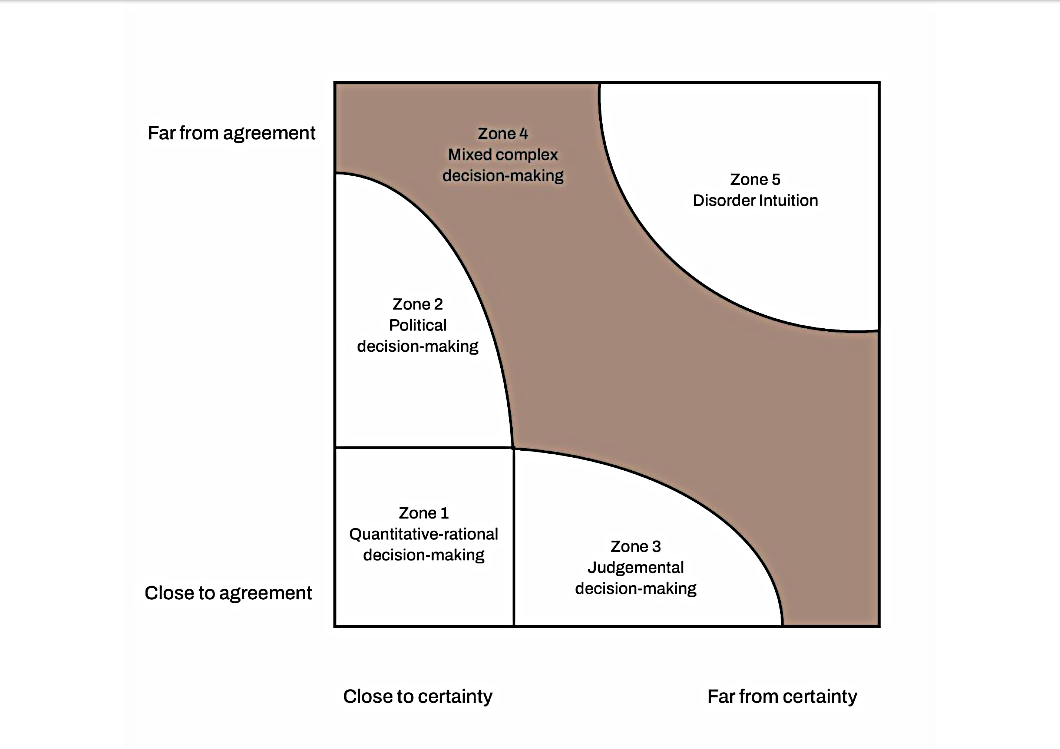
Figure 1: A Version of the Complexity Diagram. Harrison and Geyer (2022).
As shown in Figure 1, the Complexity Diagram combines two axes based on the degree of certainty and the degree of agreement for a particular policy area. High levels of certainty indicate that the issue is well known, understood, and data is available, while low levels of certainty imply that it is unknown and contested with poor or no data. Meanwhile, high levels of agreement denote substantial public agreement over the issue and its solution, while low levels of certainty imply substantial public debate and disagreement. These two axes create five main zones of decision-making:
Zone 1 (Quantitative-rational): high certainty-high agreement. The issue is well understood, and the policy response agreed between the majority of key stakeholders. Data is clear, abundant and easily accessible. Evidence-based actions and audit and targeting strategies work well here.
Zone 2 (Political): high certainty-low agreement. Data is clear and abundant, and the experts/actors understand the problem. However, the stakeholders disagree over the solution/response. More evidence is of little use and political bargaining, and consensus-building become key decision-making tactics.
Zone 3 (Judgemental): low certainty-high agreement. All the main actors agree about the nature of the issue, but there is no simple policy response to the problem. Available data may be contradictory, and more data may only increase the uncertainty. Experts do not know how to properly respond to it. Multiple strategies may be required, and discretionary decision-making becomes increasingly important.
Zone 4 (mixed complex): mixed certainty-mixed agreement. Data may be uncertain and contested. Stakeholders and experts disagree, to varying levels, over the nature of, and responses to the issue. This requires a flexible response that blends political decision-making with evidence-based processes and discretionary decision-making.
Zone 5 (disorder/intuition): low certainty-low agreement. Data is negligible, unclear and untrustworthy. There is significant disagreement and no clear answer. Evidence is very poor, limited and continually shifting. Moreover, the issue may be highly emotive and politicised, effectively nullifying evidence-based strategies. Intuitive responses based on emotional intelligence/skills may be just as important as evidence-informed thinking.
It is important to note that the complexity diagram can be applied to any level of policy.
Complexity and policy in practice:
At a local level, one example of the complexity diagram in practice would be the need for transmission masts that emerged with the development of mobile phones. The technological need for some form of mast system was relatively clear and particular specifications (distance of coverage, etc.) could be mapped out. However, there was substantial political disagreement over where they should be placed (In which neighbourhoods? Near schools?). Moreover, there were clear judgemental debates over whether the masts could or should be disguised (What was the best disguise? How much should locals be involved in making these decisions?). In many areas, decisions over mast placements were a mixture of technical demands, political consultation and debate, and chance (having easily accessible land and infrastructure available). Occasionally, they involved the techno-social fears of physical harm and led to protests and occasional acts of destruction against masts.
At a national/global level, one can easily see climate change as a case for using the Complexity diagram. The evidence for climate change is very clear. Engineering a solution to it is relatively straightforward – reduce CO2 outputs. However, as demonstrated by the continued lack of global/national consensus, the politics surrounding this are fraught with different values and political debates are clearly part of the process for resolving this issue. At the same time, there is substantial debate over the specific type of transformation required (reduce consumption, green energy, nuclear power), even by the experts, and judgemental decisions linked to particular situations will be needed as well. Clearly, a mix of approaches is essential, particularly in relation to strong emotional elements that the issue generates.
Does the Stacey Diagram solve all of these difficulties? NO! However, it does allow students to recognise that there are a range/spectrum of policy systems and system dynamics and not a hierarchy with quantitative-rational/evidence-based approaches at the top. When confronting a complex problem embedded in physical and human systems (building a new hospital, altering an urban electrical grid, changing a road system), engineering students should try to recognise the type of zone they are dealing with and adjust their approach to fit the situation. Using the diagram to reflect on this range and choose the right approach for the right situation is fundamental to learning that the engineer’s role in society is more than just a builder of things. She/he may also be playing a key role in social/political debates and policy choices that will continually change over time and place. Hence, the policy world is more akin to a dance with multiple actors, often pulling in different directions, than orderly Newtonian science.
Any views, thoughts, and opinions expressed herein are solely that of the author(s) and do not necessarily reflect the views, opinions, policies, or position of the Engineering Professors’ Council or the Toolkit sponsors and supporters.
Downloads: A PDF of this resource will be available soon.
Who is this article for?: This article should be read by educators at all levels of higher education looking to highlight the connection between complex systems and sustainability within engineering learning.
Related INCOSE Competencies: Toolkit resources are designed to be applicable to any engineering discipline, but educators might find it useful to understand their alignment to competencies outlined by the International Council on Systems Engineering (INCOSE). The INCOSE Competency Framework provides a set of 37 competencies for Systems Engineering within a tailorable framework that provides guidance for practitioners and stakeholders to identify knowledge, skills, abilities and behaviours crucial to Systems Engineering effectiveness. A free spreadsheet version of the framework can be downloaded.
This resource relates to the Systems Thinking, Life Cycles, Capability Engineering, Systems Modelling and Analysis, and Design INCOSE competencies.
AHEP mapping: This resource addresses several of the themes from the UK’s Accreditation of Higher Education Programmes fourth edition (AHEP4): Analytical Tools and Techniques (critical to the ability to model and solve problems), and Integrated / Systems Approach(essential to the solution of broadly-defined problems). In addition, this resource addresses AHEP themes of Materials, equipment, technologies and processes, and Sustainability.
Several sustainability challenges, such as transitioning to a circular economy, are embedded in complex socio-technical systems. A circular economy is an economic model that replaces the linear take-make-dispose pattern with systems that keep materials and products in use for longer through designing for durability, reuse, remanufacturing, and recycling, while minimising waste and regenerating natural systems (Rizos, Tuokko, and Behrens, 2017).
Complex systems like these exhibit feedback loops, delays, non-linear change, path dependence and emergent behaviour (Sterman, 2000; Meadows, 2008). This article introduces the idea of systems-based interventions using the example of aluminium recycling systems. It is designed for engineering educators who plan to provide learners with a baseline understanding of complexity and practical entry points for designing and developing and evaluating interventions that can move a system towards sustainability.
Complexity of aluminium recycling systems:
Aluminium is infinitely recyclable, yet achieving truly closed material loops at scale remains a challenge. Most of today’s recycling occurs in situations where post-consumer scrap is collected from a wide variety of end-of-life products and the boundaries of the recycling system are difficult to define and control. This creates high variability in both the composition and the quality of recovered aluminium, since different products contain different alloys and levels of contamination (IRT M2P, 2023). At the same time, the volume of available scrap is difficult to predict, as it depends on product lifespans and consumer behaviour. These fluctuations make it harder for producers to plan and optimise secondary aluminium output, particularly when industries rely on consistent standards or just-in-time manufacturing.
The recycling system is also shaped by broader economic and regulatory forces. On the one hand, demand for low-carbon materials and the cost advantage of recycled over primary aluminium are powerful drivers of growth. On the other hand, the system faces constraints from volatile scrap prices and shifting global trade dynamics, such as U.S. tariffs on aluminium imports. Meanwhile, new policy instruments are adding further complexity. The EU’s Carbon Border Adjustment Mechanism (CBAM) is set to reshape trade flows and investment patterns, while the forthcoming Digital Product Passport (DPP) will transform how information is shared across the value chain. Together, these forces influence technologies, markets and business models, underscoring the dynamic and interconnected nature of aluminium recycling.
These interconnected factors highlight aluminium recycling as a complex socio-technical system, in which technological capabilities, market incentives, policy frameworks, and global trade are deeply interconnected. For educators, this makes aluminium an effective example for teaching students how multiple forces interact to create both opportunities and challenges for sustainable engineering.
Intervention from systems perspective:
System Dynamics (SD), first formalised byForrester (1968), has proven to be a highly valuable approach for understanding and managing complex resource and recovery systems. SD is an interdisciplinary approach, drawing on insights from psychology, organisational theory, economics, and related fields (Sterman, 2000). More supporting information about SD pedagogical tools and techniques can be found through the System Dynamics Society and Insight Maker.
From a systems perspective, interventions are not isolated events but strategic effort to influence system behaviour by targeting its structure and dynamics. A key concept here is leverage points – places within a complex system where small changes can lead to significant, systemic effects (Meadows, 1999). Meadows identified twelve types of leverage points, ranging from adjusting parameters to transforming the system’s underlying goals and paradigms, proving a conceptual framework for identifying impactful intervention.
Figure 1. Donella Meadows’ leverage points (Source: based on Meadows (1999); credit: UNDP/Carlotta Cataldi; reproduced fromBovarnick and Cooper (2021))
Exploration of potential leverage points:
System Dynamics (SD) tools such as Causal Loop Diagrams (CLDs) can help explore leverage points. CLDs can help visualise main components of a system and their interdependencies, making complex dynamics easier to understand. Besides, the process of building a CLD or more computational SD model encourages practitioners to clarify system boundaries, relationships, and drivers, laying the foundation for identifying leverage points.
For example, a CLD of aluminium recycling might capture how classification and sorting processes influence scrap quality, which then affects remelting efficiency and ultimately market uptake of recycled alloys (see Figure 2 below).
Figure 2. The causal loop diagram for auto aluminium recycling (Liu et al., 2025)
By tracing these circular cause-and-effect relationships, learners can see where interventions may ripple through the system. Highlighting reinforcing loops, balancing loops, and delays also shows why some interventions produce limited short-term results but more substantial long-term effects.
Leverage points can also be examined through the lens of information, rules, and goals. Improved information flows, such as those enabled by the Digital Product Passport, could reshape how scrap is sorted and valued. Rules, such as alloy specifications or trade tariffs, determine what types of recycled material can enter the market. At a deeper level, the goals of the system, whether to maximise throughput or to retain material value, fundamentally shape behaviour. Here too, CLDs are valuable because they allow users to visualise how changes to information, rules, or goals can shift system dynamics, providing a clearer picture of where interventions might be most effective.
Implication for educators:
This article equips educators with a focused, practical pathway to teach systems thinking through the example of aluminium recycling. Students can gain both conceptual understanding and hands-on skills to map feedback loops, identify delays, and design interventions that account for short-term trade-offs and long-term system behaviour. Teaching a single clear CLD followed by one modelling or scenario activity produces measurable learning gains while keeping the task accessible for beginners.
Educational approach:
Prioritise structure before solutions: have students map feedback loops and delays before proposing fixes.
Use one classroom-ready CLD as the anchor activity and one hands-on modelling task to test interventions.
Emphasise leverage thinking: move from parameter tweaks to information, rules, goals and paradigms as students mature.
Keep language simple and concrete: avoid jargon, introduce terms with examples, and reuse the same CLD across activities.
Use open-access tools (Insight Maker, Loopy, Vensim PLE) so students can visualise and experiment without software barriers.
Focus assessment on reasoning about system behaviour and predicted long-term effects rather than exact numerical answers.
Potential related learning outcomes within this topic:
Define stocks, flows, feedback loops, delays, reinforcing and balancing loops.
Explain why aluminium recycling is a complex socio-technical system influenced by technology, markets, policy, and information.
Construct a simple CLD for an aluminium recycling pathway and identify at least two reinforcing and one balancing loop.
Identify two leverage points and justify which one to prioritise, citing anticipated short- and long-term system effects.
Translate the CLD into a basic stock-and-flow sketch in an open-access tool and run one scenario to compare outcomes.
Further resources:
European Commission: Joint Research Centre, Environmental and socio-economic impacts of the circular economy transition in the EU cement and concrete sector – Analysing plastics material flows with life cycle-based and macroeconomic assessment models, Publications Office of the European Union, 2025, https://data.europa.eu/doi/10.2760/6579506
The Complexity and Interconnectedness of Circular Cities and the Circular Economy for Sustainability — analysis of research themes and networked interactions relevant for urban/material systems; useful for teaching complexity and cross-sector links. https://onlinelibrary.wiley.com/doi/pdf/10.1002/sd.2766
Bovarnick, A. and Cooper, S. (2021) “From what to how: rethinking food systems interventions,” Agriculture for Development. Edited by K. Hussein, 22 April, pp. 49–53.
Forrester, J.W. (1968) “Industrial Dynamics—After the First Decade,” Management Science, 14(7), pp. 398–415. Available at: https://doi.org/10.1287/mnsc.14.7.398.
Liu, M., Schneider, K., Litos, L., Salonitis, K., 2025. Enhancing Secondary Aluminium Supply: Optimising Urban Mining Through a Systems Thinking Approach, in: Edwards, L. (Ed.), Light Metals 2025. Springer Nature Switzerland, Cham, pp. 1273–1279.
Meadows, D.H. (1999) Leverage Points – Places to Intervene in a System, The Sustainability Institute.
Meadows, D.H. (2008) Thinking in systems: A primer. White River Junction, VT: Chelsea Green Publishing Company.
Sterman, J. (2000) “Business Dynamics, System Thinking and Modeling for a Complex World.” Available at: http://hdl.handle.net/1721.1/102741 (Accessed: September 4, 2025).
Any views, thoughts, and opinions expressed herein are solely that of the author(s) and do not necessarily reflect the views, opinions, policies, or position of the Engineering Professors’ Council or the Toolkit sponsors and supporters.
Who is this article for?: Thisarticle should be read by educators at all levels in higher education who are seeking an overall perspective on teaching approaches for integrating complex systems in engineering education.
Related INCOSE Competencies: Toolkit resources are designed to be applicable to any engineering discipline, but educators might find it useful to understand their alignment to competencies outlined by the International Council on Systems Engineering (INCOSE). The INCOSE Competency Framework provides a set of 37 competencies for Systems Engineering within a tailorable framework that provides guidance for practitioners and stakeholders to identify knowledge, skills, abilities and behaviours crucial to Systems Engineering effectiveness. A free spreadsheet version of the framework can be downloaded.
This resource relates to the Systems Thinking and Critical Thinking INCOSE competencies.
AHEP mapping: This resource addresses several of the themes from the UK’s Accreditation of Higher Education Programmes fourth edition (AHEP4): Analytical Tools and Techniques (critical to the ability to model and solve problems), and Integrated / Systems Approach (essential to the solution of broadly-defined problems).
Premise:
This document aims to provide definitions of key terms regarding engineered complex systems.
There are many existing relevant glossaries (for example, the Systems Engineering Body of Knowledge or SEBoK) so we have implemented a process to select a curated list of 14 common terms that are fundamental when considering the idea of complexity in engineered solutions, and therefore of importance to educators in this space. Rather than adding new definitions for each term we offer appropriate and accessible definitions from the literature, together with commentary exploring wider context and consideration where relevant.
Approach:
Some care is needed when using any definition around terms relating to complexity – because complexity itself is complex. There are multiple valid perspectives and so any one definition is unlikely to capture the totality of nuance and satisfy the variety of viewpoints. The process for selecting these terms involved collating an initial long list for potential inclusion, along with the ways in which each has been previously defined. These are provided as a supplementary annex to the main glossary. The method is further described in the following sub-section.
An initial list of potential terms to define was generated by cross-referencing existing glossaries. Terms that occurred in multiple glossaries were included in the long list. The definitions of these terms were extracted from these existing glossaries and are cited in the references. In addition, the relationship to the INCOSE Competencies is shown. The range of potential terms, and the variety of definitions that already exist, illustrate the complexity of describing complexity!
The authors used three categorisations of the definitions to help further group and classify the terms. The following categories are tagged to relevant terms in the glossary:
1. Property – whether or not the term describes a property applied to systems;
2. Principle – whether or not the term represents a principle that should be used when engineering complex situations or systems;
3. Approach – whether or not the term represents an approach, or element of an approach that should / could be used when engineering complex situations or systems.
Finally, explanatory commentary was added to most definitions to more specifically address an engineering education context.
Glossary:
Architecture
Definition: “an abstract description of the entities of a system and the relationship between those entities.” Crawley et al. (2016) System Architecture: Strategy & Product Development for Complex Systems
Boundary
#Property #Principle
Definition: “Define the system to be addressed. A description of the boundary of the system can include the following: definition of internal and external elements/items involved in realizing the system purpose as well as the system boundaries in terms of space, time, physical, and operational. Also, identification of what initiates the transitions of the system to operational status and what initiates its disposal is important.” NASA (2007) NASA Systems Engineering Handbook, p304
Commentary: The boundary defines the scope of the system being considered, and by implication, what sits outside of the system. As such, it is critically important to define the boundary of the system-of-interest. When dealing with complex systems this can be a challenging task and may even benefit from acknowledging multiple boundaries (e.g. physical, spatial, functional, logical etc.). For example, the boundary of the physical elements of a system could be considered within a wider boundary of the problem space.
Complexity
#Property
Definition: “A complex system is a system in which there are non-trivial relationships between cause and effect: each effect may be due to multiple causes; each cause may contribute to multiple effects; causes and effects may be related as feedback loops, both positive and negative; and cause-effect chains are cyclic and highly entangled rather than linear and separable.” INCOSE (2019) INCOSE Systems Engineering and Systems Definitions
Commentary: Early conceptions of complexity emphasised the difficulty in understanding, predicting or verifying the behaviours of a system. A key distinction arising from this is the complicated and complex are not synonymous. This concept of the difficulty in predicting behaviours is reflected in the definitions of the NASA Systems Engineering Handbook, SEBoK and ISO 24765. This is the key resultant consideration but does not describe the underlying property which causes this difficulty. While this definition relates more to complex systems than complexity, it is chosen for the way in which it goes beyond the consequences of complexity.
Coupling
#Property #Principle
Definition: “Coupling […] means to fasten together, or simply to connect things […] Coupling suggests a relationship between connected entities. If they are coupled, in some way they can affect each other […] For the system to be useful, its components have to be connected – coupled – so that they can work together. That said, putting them together arbitrarily won’t do the trick. The components have to be coupled in a way that achieves the goals of the system. Not only is coupling the glue that holds a system together, but it also makes the value of the system higher than the sum of its parts.” Khononov (2024) Balancing Coupling in Software Design: Universal Design Principles for Architecting Modular Software Systems, Ch1
Commentary: Coupling is a very important concept. It is the interconnection and interdependence that makes the system more (or less) than the sum of its parts. Standard Systems architecture advice is to minimise coupling between system elements (or between the systems in a system-of-systems). This is because high coupling correlates to higher structural complexity, reduced resilience and flexibility in the system, and introduces challenges for modularity in the system design. Lower or looser coupling means changes in one part of the system (in design or operation) are less likely to induce or require changes in another part. However, this lower coupling is not always possible and may be necessary to improve system performance (for example communication through intermediate layers in a system to reduce coupling can introduce unacceptable amounts of overhead and latency in the system). In design terms, high coupling between system elements means that those elements cannot be designed independently.
Emergence
#Principle
Definition: “As the entities of a system are brought together, their interaction will cause function, behaviour, performance and other intrinsic (anticipated and unanticipated) properties to emerge… Emergence refers to what appears, materializes, or surfaces when a system operates.” Crawley et al. (2016) System Architecture: Strategy & Product Development for Complex Systems
Commentary: It is worth noting that Crawley et al. (2014) go on to add “As a consequence of emergence, change propagates in unpredictable ways. System success occurs when anticipated emergence occurs, while system failure occurs when anticipated emergent properties fail to appear or when unanticipated undesirable emergent properties appear.” This emergence that gives rise to the difficulty in understanding, predicting or verifying the behaviours of a system (see Complexity).
Form
#Property
Definition: “The shape, size, dimensions, mass, weight, and other measurable parameters which uniquely characterize an item.” SAE International (2019) ANSI/EIA-649C
Function
#Principle #Approach
Definition: “A function is defined as the transformation of input flows, with defined performance targets for how well the function is performed in different conditions. A function usually has logical pre-conditions that trigger its operation. ”Systems Engineering Body of Knowledge v2.12 (2025)
Commentary: In general usage it is common to hear reference to ‘Form and Function’ in tandem, but it is the distinction between them and their relationship to one another that is important to engineering complex systems. Thinking in terms of functionality is a good way of abstracting the system to define what it does (or is needed to do) rather than what it is (and therefore by extension its form). Functions are normally allocated to single sub-elements of the system. Complexity arises at functional interfaces, or when different elements perform the same function. Thinking in terms of functionality encourages creativity as designers consider all the different ways in which the function could be performed – and then apply requirement constraints to choose the best/most feasible option. Thinking in terms of “objects” first constrains design by presupposing the solutions. Equally, when the solution goes wrong, thinking in terms of what function is failing and why, rather than focusing on a failed part allows identification of the true root cause. Organisations also have functions (such as Engineering, Human Resources, etc.) as a group of roles that perform a specific set of activities. This is important for considering the organisation/System that creates the engineered solution (which is itself a complex system, but secondary to the main application of the idea of function).
Iteration
#Approach
Definition: “Iteration is used as a generic term for successive application of a systems approach to the same problem situation, learning from each application, in order to progress towards greater stakeholder satisfaction.” Systems Engineering Body of Knowledge v2.12 (2025)
Lifecycle
#Property #Principle #Approach
Definition: “The evolution of a system, product, service, project or other human-made entity from conception through retirement.” ISO (2024) ISO/IEC/IEEE 24748-1:2024
Commentary: Understanding the lifecycle of an engineered artefact is very important. Issues arising in later stages (e.g. production, support/maintenance, upgrade and disposal) must be considered during the system’s initial development. In a system-of-systems or a capability system a significant source of complexity is the fact that different system elements have different lifecycles, and so may change or be changed independently of other elements with which they may interact or interdepend.
Model
#Approach
Definition: “An abstraction of a system, aimed at understanding, communicating, explaining, or designing aspects of interest of that system” Dori, D. (2003) Conceptual modelling and system architecting, p286
Commentary: An abstraction is a simplification. The selection of what to exclude, what to include, and at what level of granularity to depict it, is informed by the purpose of the model and the point of view from which it is created. Models do not have to be quantitative, nor is their purpose exclusively analytical.
Stakeholder
Definition: “A group or individual who is affected by or has an interest or stake in a program or project.” NASA (2019) NASA Systems Engineering Handbook SP-2016-6105 (Rev. 2)
Commentary: It is worth noting the potential difference between a stakeholder of the project that develops the system, and a stakeholder of the system that is developed.
System
#Principle #Approach
Definition: “A system is an arrangement of parts or elements that together exhibit behaviour or meaning that the individual constituents do not.” INCOSE (2019) INCOSE Fellows Briefing to INCOSE Board of Directors, January 2019
Commentary: There are many similar definitions of a system, each may offer a slightly different phrasing which can resonate better with different individuals. The origins of this definition is explained in the Systems Engineering Body of Knowledge. In assessing complexity in engineered system, the concept of “systems” is of course of key value. There are two important aspects two consider:
1) Many schools of Systems Science argue that systems do not actually exist (apart from perhaps the complete universe) – they are defined for the convenience of consideration, and so the definition of the boundary of the “system of interest” is both important and somewhat arbitrary. As such, the system-of-interest can have multiple useful boundaries. While it might be possible to identify and articulate the physical boundary of an engineered artefact (and it should be acknowledged), it might not be the most useful boundary to consider.
2) The point of defining a “system of interest” includes being able to consider it as a system and so use the properties seen in systems (boundary, interface with outside, affected by/affecting environment, made up of parts, part of something larger, has a lifecycle, seen differently by different people (with different perspectives), are dynamic, exhibit emergence etc.) as a “framework for curiosity” (as the INCOSE SE competency framework defines systems thinking).
In engineered systems (rather than natural systems) it is important to distinguish between purpose (what those engineering or creating it want it do) and emergence (what it actually does).
Systems Engineering
#Principle #Approach
Definition: “Systems Engineering is a transdisciplinary and integrative approach to enable the successful realization, use, and retirement of engineered systems, using systems principles and concepts, and scientific, technological, and management methods.” INCOSE (2019) INCOSE Systems Engineering and Systems Definitions
Systems Thinking
#Approach
Definition: “Systems thinking is thinking about a question, circumstance, or problem explicitly as a system – a set of interrelated entities.” Crawley et al. (2016) System Architecture: Strategy & Product Development for Complex Systems
Commentary: Crawley et al (2016) go on to add “This means identifying the system, its form and function, by identifying its entities and their interrelationships, its system boundary and context, and the emergent properties of the system based on the function of the entities, and their functional interactions.”
References:
Crawley, E. Cameron, B. & Selva, D. (2016). System Architecture: Strategy & Product Development for Complex Systems, Pearson
Dori, D. (2003). “Conceptual modeling and system architecting.” Communications of the ACM, 46(10), pp. 62-65.
ISO (2024). Systems and software engineering — Life cycle management -ISO/IEC/IEEE 24748-1:2024
Khononov, V. (2024). Balancing Coupling in Software Design: Universal Design Principles for Architecting Modular Software Systems, Addison-Wesley Professional,
NASA. (2007). Systems Engineering Handbook – Revision 1. Washington, DC, USA: National Aeronautics and Space Administration (NASA). NASA/SP-2007-6105.
NASA (2016). Systems Engineering Handbook – Revision 2. Washington, DC, USA, National Aeronautics and Space Administration (NASA). NASA/SP-2016-6105 (Rev. 2)
SAE International (2019). National Consensus Standard for Configuration Management -ANSI/EIA-649C
Any views, thoughts, and opinions expressed herein are solely that of the author(s) and do not necessarily reflect the views, opinions, policies, or position of the Engineering Professors’ Council or the Toolkit sponsors and supporters.