Author:
Wendy Attwell (Engineering Professors’ Council).

Topic: Balancing personal values and professional conduct in the climate emergency. 

Engineering disciplines: Civil engineering; Energy and Environmental engineering; Energy. 

Ethical issues: Respect for the environment; Justice; Accountability; Social responsibility; Risk; Sustainability; Health; Public good; Respect for the law; Future generations; Societal impact. 

Professional situations: Public health and safety; Communication; Law / Policy; Integrity; Legal implications; Personal/professional reputation. 

Educational level: Intermediate. 

Educational aim: Practicing Ethical Reasoning: the application of critical analysis to specific events in order to evaluate and respond to problems in a fair and responsible way. 


Learning and teaching notes:  

This case study involves an engineer who has to weigh personal values against professional codes of conduct when acting in the wake of the climate crisis. This case study allows students to explore motivations and justifications for courses of action that could be considered morally right but legally wrong.  

This case study addresses two of the themes from the Accreditation of Higher Education Programmes fourth edition (AHEP4): The Engineer and Society (acknowledging that engineering activity can have a significant societal impact) and Engineering Practice (the practical application of engineering concepts, tools and professional skills). To map this case study to AHEP outcomes specific to a programme under these themes, access AHEP 4 here and navigate to pages 30-31 and 35-37. 

The dilemma in this case is presented in three parts. If desired, a teacher can use Part one in isolation, but Parts two and three develop and complicate the concepts presented in Part one to provide for additional learning. The case study allows teachers the option to stop at multiple points for questions and/or activities, as desired. 

Learners have the opportunity to: 

Teachers have the opportunity to: 


Learning and teaching resources: 

Professional organisations: 

Educational institutions: 

Education and campaign groups: 

 News articles:  


Summary: 

Kelechi is a civil engineer in a stable job, working on the infrastructure team of a County Council that focuses on regeneration and public realm improvements. Kelechi grew up in an environment where climate change and its real impacts on people was discussed frequently. She was raised with the belief that she should live as ethically as possible, and encourage others to consider their impact on the world. These beliefs were instrumental in leading Kelechi into a career as a civil engineer, in the hope that she could use her skills and training to create a better world. In one of her engineering modules at university, Kelechi met Amanda, who encouraged her to join a student group pushing for sustainability within education and the workplace. Kelechi has had some success with this within her own job, as her employer has been willing to participate in ongoing discussions on carbon and resilience, and is open to implementing creative solutions.  

But Kelechi is becoming frustrated at the lack of larger scale change in the wake of the climate emergency. Over the years she has signed petitions and written to her representatives, then watched in dismay as each campaign failed to deliver real world carbon reduction, and as the government continued to issue new licenses for fossil fuel projects. Even her own employers have failed to engage with climate advocates pushing for further changes in local policy, changes that Kelechi believes are both achievable and necessary. Kelechi wonders what else she can do to set the UK – if not the world – on a path to net zero. 


Dilemma – Part one: 

Scrolling through a news website, Kelechi is surprised to see a photo of her friend and ex-colleague Amanda, in a report about climate protesters being arrested. Kelechi messages Amanda to check that she’s ok, and they get into a conversation about the protests. Amanda is part of a climate protest group of STEM professionals that engages in non-violent civil disobedience. The group believes that by staging direct action protests they can raise awareness of the climate emergency and ultimately effect systemic change.  

Amanda tries to convince Kelechi to join the group and protest with them. Amanda references the second principle of the Statement of Ethical Principles published by the Engineering Council and the Royal Academy of Engineering: “Respect for life, law, the environment and public good.” Amanda believes that it is ok to ignore the tenet about respect for the law in an effort to safeguard the other three, and says that there have been plenty of unjust laws throughout history that have needed to be protested in order for them to be changed for the public good. She also references another part of the Statement: that engineers should ”maximise the public good and minimise both actual and potential adverse effects for their own and succeeding generations”. Amanda believes that by protesting she is actually fulfilling her duty to uphold these principles.  

Kelechi isn’t sure. She has never knowingly broken the law before, and is worried about being arrested. Kelechi consults her friend Max, who is a director of a professional engineering institution, of which Kelechi is a member. Max, whilst she has some sympathies for the aims of the group, immediately warns Kelechi away from the protests. “Forget about being arrested; you could lose your job and end your career.”  


Optional STOP for questions and activities: 

1. Discussion: What personal values will Kelechi have to weigh in order to decide whether or not to take part in a civil disobedience protest? 

2. Discussion: Consider the tenet of the Statement of Ethical Principles “Respect for life, law, the environment and public good.” To what extent (if at all) do the four tenets of this ethical principle come into conflict with one another in this situation? Can you think of other professional situations in which they might conflict? 

3. Discussion: Is breaking the law always unethical? Are there circumstances when breaking the law might be the ethical thing to do in the context of engineering practice? What might these circumstances be? 

4. Discussion: To what extent (if at all) does the content of the Statement of Ethical Principles make a case for or against being part of a protest where the law is broken?  

5. Discussion: Following on from the previous question – does it make a difference what is being protested, if a law is broken? For example, is protesting fossil fuels that lead to climate change different from protesting unsafe but legal building practices, such as cladding that causes a fire risk? Why? 

6. Activity: Research other professional codes of engineering: do these have clear guidelines for this situation? Assemble a bibliography of other professional codes or standards that might be relevant to this scenario. 

7. Discussion: What are the potential personal and professional risks or benefits for Kelechi if she takes part in a protest where the law is broken? 

8. Discussion: From a professional viewpoint, should Kelechi take part in the protest? What about from a personal viewpoint? 


Dilemma – Part two: 

After much deliberation, Kelechi decides to join the STEM protest group. Her first protest is part of a direct action to blockade a busy London bridge. To her own surprise, she finds herself volunteering to be one of two protesters who will climb the cables of the bridge. She is reassured by the risk assessment undertaken by the group before selecting her. She has climbing experience (although only from her local leisure centre), and safety equipment is provided.  

On the day of the protest, Kelechi scales the bridge. The police are called and the press arrive. Kelechi stays suspended from the bridge for 36 hours, during which time all traffic waiting to cross the bridge is halted or diverted. Eventually, Kelechi is convinced that she should climb down, and the police arrest all of the protesters.  

Later on, Kelechi is contacted by members of the press, asking for a statement about her reason for taking part in the protest. Kelechi has seen that press coverage of the protest is so far overwhelmingly negative, and poll results suggest that the majority of the public see the protesters’ actions as selfish, inconvenient, and potentially dangerous, although some have sympathy for their cause. “What if someone died because an ambulance couldn’t use the bridge?” asks someone via social media. “What about the five million deaths a year already caused by climate change?” asks another, citing a recent news article 

Kelechi would like to take the opportunity to make her voice heard – after all, that’s why she joined the protest group – but she isn’t sure whether she should mention her profession. Would it add credibility to her views? Or would she be lambasted because of it? 


Optional STOP for questions and activities: 

1. Discussion: What professional principles or codes is Kelechi breaking or upholding by scaling the bridge?  

2. Activity: Compare the professional and ethical codes for civil engineers in the UK and elsewhere. How might they differ in their guidance for an engineer in this situation?  

3. Activity: Conduct a risk assessment for a) the protesters who have chosen to be part of this scenario, and b) members of the public who are incidentally part of this scenario. 

4. Discussion: Who would be responsible if, as a direct or indirect result of the protesters blocking the bridge, a) a member of the public died, or b) a protester died? Who is responsible for the excess deaths caused directly or indirectly by climate change? 

5. Discussion: How can Kelechi best convey to the press and public the quantitative difference between the short-term disruption caused by protests and the long-term disruption caused by climate change? 

6. Discussion: Should Kelechi give a statement to the press? If so, should she discuss her profession? What would you do in her situation? 

7. Activity: Write a statement for Kelechi to release to the press. 

8. Discussion: Suggest alternative ways of protesting that would have as much impact in the news but potentially cause less disruption to the public. 


Dilemma – Part three: 

Kelechi decides to speak to the press. She talks about the STEM protest group, and she specifically cites the Statement of Ethical Principles as her reason for taking part in the protest: “As a professional civil engineer, I have committed to acting within our code of ethics, which requires that I have respect for life, the environment and public good. I will not just watch lives be destroyed if I can make a difference with my actions.”  

Whilst her statement gets lots of press coverage, Kelechi is called out by the media and the public because of her profession. The professional engineering institution of which Kelechi is a member receives several complaints about her actions, some from members of the public and some from other members of the institution. “She’s bringing the civil engineering profession into disrepute,” says one complaint. “She’s endangering the public,” says another. 

It’s clear that the institution must issue a press release on the situation, and it falls to Kelechi’s friend Max, as a director of the institution, to decide what kind of statement to put out, and to recommend whether Kelechi’s membership of the institution could – or should – be revoked. Max looks closely at the institution’s Code of Professional Conduct. One part of the Code says that “Members should do nothing that in any way could diminish the high standing of the profession. This includes any aspect of a member’s personal conduct which could have a negative impact upon the profession.” Another part of the Code says: “All members shall have full regard for the public interest, particularly in relation to matters of health and safety, and in relation to the well-being of future generations.” 

As well as the institution’s Code of Conduct, Max considers the historic impact of civil resistance in achieving change, and how those engaging in such protests – such as the suffragettes in the early 1900s – could be viewed negatively at the time, whilst later being lauded for their efforts. Max wonders at what point the tide of public opinion begins to turn, and what causes this change. She knows that she has to consider the potential impacts of the statement that she puts out in the press release; how it might affect not just her friend, but the institution’s members, other potential protesters, and also her own career.  


Optional STOP for questions and activities: 

1. Discussion: Historically, has civil resistance been instrumental or incidental in achieving systemic change? Research to find out if and when engineers have been involved in civil resistance in the past. 

2. Discussion: Could Kelechi’s actions, and the results of her actions, be interpreted as having “a negative impact on the profession”? 

3. Discussion: Looking at Kelechi’s actions, and the institution’s code of conduct, should Max recommend that Kelechi’s membership be revoked? 

4. Discussion: Which parts of the quoted code of conduct could Max emphasise or omit in her press release, and how might this affect the tone of her statement and how it could be interpreted? 

5. Activity: Debate which position Max should take in her press release: condemning the actions of the protesters as being against the institution’s code of conduct; condoning the actions as being within the code of conduct; remaining as neutral as possible in her statement. 

6. Discussion: What are the wider impacts of Max’s decision to either remain neutral, or to stand with or against Kelechi in her actions?  

7. Activity: Write a press release for the institution, taking one of the above positions. 

8. Discussion: Which other authorities or professional bodies might be impacted by Max’s decision? 

9. Discussion: What are the potential impacts of Max’s press release on the following stakeholders, and what decisions or actions might they take because of it? Kelechi; Kelechi’s employer; members of the STEM protest group; the institution; institution members; government policymakers; the media; the public; the police; fossil fuel businesses; Max’s employers; Max herself. 


This work is licensed under a Creative Commons Attribution-ShareAlike 4.0 International License.

Any views, thoughts, and opinions expressed herein are solely that of the author(s) and do not necessarily reflect the views, opinions, policies, or position of the Engineering Professors’ Council or the Toolkit sponsors and supporters.
Author: Dr J.L. Rowlandson (University of Bristol).

Topic: Home heating in the energy transition. 

Engineering disciplines: Chemical; Civil; Mechanical; Energy. 

Ethical issues: Sustainability; Social responsibility. 

Professional situations: Public health and safety; Conflicts of interest; Quality of work; Conflicts with leadership/management; Legal implication. 

Educational level: Intermediate. 

Educational aim: Becoming Ethically Sensitive: being broadly cognizant of ethical issues and having the ability to see how these issues might affect others. 


Learning and teaching notes: 

This case study considers not only the environmental impacts of a clean technology (the heat pump) but also the social and economic impacts on the end user. Heat pumps form an important part of the UK government’s net-zero plan. Our technical knowledge of heat pump performance can be combined with the practical aspects of implementing and using this technology. However, students need to weigh the potential carbon savings against the potential economic impact on the end user, and consider whether current policy incentivises consumers to move towards clean heating technologies.  

This case study offers students an opportunity to practise and improve their skills in making estimates and assumptions. It also enables students to learn and practise the fundamentals of energy pricing and link this to the increasing issue of fuel poverty. Fundamental thermodynamics concepts, such as the second law, can also be integrated into this study.  

This case study addresses two of the themes from the Accreditation of Higher Education Programmes fourth edition (AHEP4): The Engineer and Society (acknowledging that engineering activity can have a significant societal impact) and Engineering Practice (the practical application of engineering concepts, tools and professional skills). To map this case study to AHEP outcomes specific to a programme under these themes, access AHEP 4 here and navigate to pages 30-31 and 35-37. 

The dilemma in this case is presented in six parts. If desired, a teacher can use the Summary and Part one in isolation, but Parts two to six develop and complicate the concepts presented in the Summary and Part one to provide for additional learning. The case study allows teachers the option to stop at multiple points for questions and/or activities, as desired. 

Learners have the opportunity to: 

Teachers have the opportunity to: 


Learning and teaching resources: 

Open access textbooks: 

Journal articles: 

Educational institutions: 

Business: 

Government reports: 

Other organisations: 

Stakeholder mapping: 


Summary – Heating systems and building requirements: 

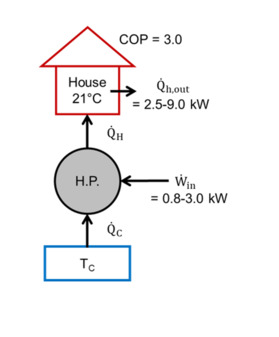
You are an engineering consultant working for a commercial heat pump company. The company handles both the manufacture and installation of heat pumps. You have been called in by a county council to advise and support a project to decarbonise both new and existing housing stock. This includes changes to social housing (either directly under the remit of the council or by working in partnership with a local housing association) and also to private housing, encouraging homeowners and landlords to move towards net zero emissions. In particular, the council is interested in the installation of clean heating technologies with a focus on heat pumps, which it views as the most technologically-ready solution. Currently most heating systems rely on burning natural gas in a boiler to provide heat. By contrast, a heat-pump is a device that uses electricity to extract heat from the air or ground and transfer it to the home, avoiding direct emission of carbon dioxide.  

The council sets your first task of the project as assessing the feasibility of replacing the existing gas boiler systems with heat pumps in social housing. You are aware that there are multiple stakeholders involved in this process you need to consider, in addition to evaluating the suitability of the housing stock for heat pump installation.  


Optional STOP for questions and activities: 

1. Discussion: Why might the council have prioritised retrofitting the social housing stock with heat pumps as the first task of the project? How might business and ethical concerns affect this decision?  

2. Activity: Use stakeholder mapping to determine who are the main stakeholders in this project and what are their main priorities? In which areas will these stakeholders have agreements or disagreements? What might their values be, and how do those inform priorities?  

3. Discussion: What key information about the property is important for choosing a heating system? What does the word feasibility mean and how would you define it for this project? 

4. Activity: Research the Energy Performance Certificate (EPC):  what are the main factors that determine the energy performance of a building?  

5. Discussion: What do you consider to be an ‘acceptable’ EPC rating? Is the EPC rating a suitable measure of energy efficiency? Who should decide, and how should the rating be determined?  


Technical pre-reading for Part one: 

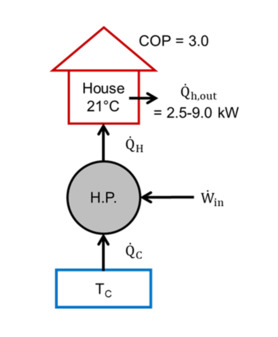
It is useful to introduce the thermodynamic principles on which heat pumps operate in order to better understand the advantages and limitations when applying this engineering technology in a real-world situation. A heat pump receives heat (from the air, ground, or water) and work (in the form of electricity to a compressor) and then outputs the heat to a hot reservoir (the building you are heating). We recommend covering: 

An online, open-source textbook that covers both topics is Applications of Thermodynamics – Heat Pumps & Refrigerators. 


Dilemma – Part one – Considering heat pump suitability: 

You have determined who the main stakeholders are and how to define the project feasibility. A previous investigation commissioned by the council into the existing housing stock, and one of the key drivers for them to initiate this project, has led them to believe that most properties will not require significant retrofitting to make them suitable for heat pump installation.  


Optional STOP for question and activities: 

1. Activity: Research how a conventional gas boiler central heating system works. How does a heat pump heating system differ? What heat pump technologies are available? What are the design considerations for installing a heat pump in an existing building? 


Dilemma – Part two – Inconsistencies: 

You spot some inconsistencies in the original investigation that appear to have been overlooked. On your own initiative, you decide to perform a more thorough investigation into the existing housing stock within the local authority. Your findings show that most of the dwellings were built before 1980 and less than half have an EPC rating of C or higher. The poor energy efficiency of the existing housing stock causes a potential conflict of interest for you: there are a significant number of properties that would require additional retrofitting to ensure they are suitable for heat pump installation. Revealing this information to the council at this early stage could cause them to pull out of the project entirely, causing your company to lose a significant client. You present these findings to your line manager who wants to suppress this information until the company has a formal contract in place with the council.  


Optional STOP for question and activities: 

1. Discussion: How should you respond to your line manager? Is there anyone else you can go to for advice? Do you have an obligation to reveal this information to your client (the council) when it is they who overlooked information and misinterpreted the original study? 

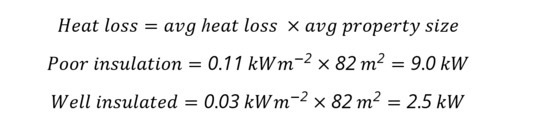
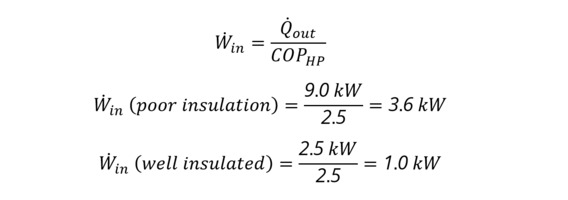
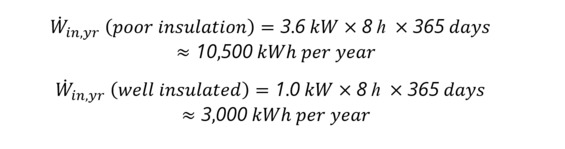
2. Activity: An example of a factor that causes a poor EPC rating is how quickly the property loses heat. A common method for significantly reducing heat loss in a home is to improve the insulation. Estimate the annual running cost of using an air-source heat pump in a poorly-insulated versus a well-insulated home to look at the potential financial impact for the tenant (example approach shown in the Appendix, Task A). 

3. Discussion: What recommendations would you make to the council to ensure the housing is heat-pump ready? Would your recommendation change for a new-build property? 


Dilemma – Part three – Impact of energy costs on the consumer: 

Your housing stock report was ultimately released to the council and they have decided to proceed, though for a more limited number of properties. The tenants of these dwellings are important stakeholders who are ultimately responsible for the energy costs of their properties. A fuel bill is made up of the wholesale cost of energy, network costs to transport it, operating costs, taxes, and green levies. Consumers pay per unit of energy used (called the unit cost) and also a daily fixed charge that covers the cost of delivering energy to a home regardless of the amount of energy used (called the standing charge). In the UK, currently the price of natural gas is the main driver behind the price of electricity; the unit price of electricity is typically three to four times the price of gas. 

Your next task is to consider if replacing the gas boiler in a property with a heat pump system will have a positive or negative effect on the running costs.  


Optional STOP for questions and activities: 

1. Activity: Estimate the annual running cost for a property when using a heat pump versus a natural gas boiler (see Appendix Task B for an example approach). 

2. Discussion: Energy prices are currently rising and have seen drastic changes in the UK over the past year. The lifetime of a new heat pump system is around 20 years. How would rising gas and electric prices affect the tenant? Does this impact the feasibility of using a gas boiler versus a heat pump? How can engineering knowledge and expertise help inform pricing policies? 


Dilemma – Part four – Tenants voice concerns: 

After a consultation, some of the current tenants whose homes are under consideration for heat pump installation have voiced concerns. The council is planning to install air-source heat pumps due to their reduced capital cost compared to a ground-source heat pump. The tenants are concerned that the heat pump will not significantly reduce their fuel bills in the winter months (when it is most needed) and instead could increase their bills if the unit price and standing charge for electricity continue to increase. They want a guarantee from the council that their energy bills will not be adversely affected. 


Optional STOP for questions and activities: 

1. Discussion: Why would air-source heat pumps be less effective in winter? What are the potential effects of increased energy bills on the tenants? How much input should the tenants have on the heating system in their rented property? 

2. Discussion: Do the council have any responsibility if the installation does result in an increased energy bill in the winter for their tenants? Do you and your company have any responsibility to the tenants?  


Dilemma – Part five – The council consultation: 

The council has hosted an open consultation for private homeowners within the area that you are involved in. They want to encourage owners of private dwellings to adopt low-carbon technologies and are interested in learning about the barriers faced and what they can do to encourage the adoption of low carbon-heating technologies. The ownership of houses in the local area is similar to the overall UK demographic: around 20% of dwellings are in the social sector (owned either by the local authority or a housing association), 65% are privately owned, and 15% are privately rented.  


Optional STOP for questions and activities: 

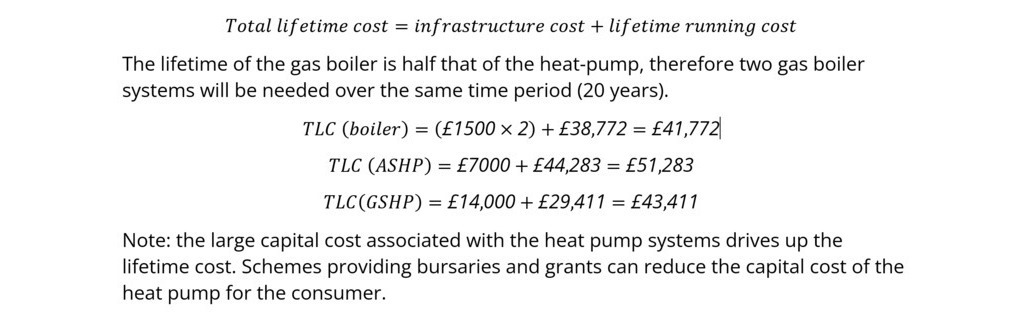
1. Activity: Estimate the lifetime cost of running an air-source heat pump and ground-source heat pump versus a natural gas boiler. Include the infrastructure costs associated with installation of the heating system (see Appendix Task C for an example approach). This can be extended to include the impact of increasing energy prices.  

2. Activity: Research the policies, grants, levies, and schemes available at local and national levels that aim to encourage uptake of net zero heating. 

3. Discussion: From your estimations and research, how suitable are the current schemes? What recommendations would you make to improve the uptake of zero carbon heating? 


Dilemma – Part six – Recommendations: 

Energy costs and legislation are important drivers for encouraging homeowners and landlords to adopt clean heating technologies. There is a need to weigh up potential cost savings with the capital cost associated with installing a new heat system. Local and national policies, grants, levies, and bursaries are examples of tools used to fund and support adoption of renewable technologies. Currently, an environmental and social obligations cost, known as the ‘green levies,’ are added to energy bills which contribute to a mixture of social and environmental energy policies (including, for example, renewable energy projects, discounts for low-income households, and energy efficiency improvements).  

Your final task is to think more broadly on encouraging the uptake of low-carbon heating systems in private dwellings (the majority of housing in the UK) and to make recommendations on how both councils locally and the government nationally can encourage uptake in order to reduce carbon emissions.  


Optional STOP for questions and activities: 

1. Discussion: In terms of green energy policy, where does the ethical responsibility lie –  with the consumer, the local government, or the national government?  

2. Discussion: Should the national Government set policies like the green levy that benefit the climate in the long-term but increase the cost of energy now?  

3. Discussion: As an employee of a private company, to what extent is the decarbonisation of the UK your problem? Do you or your company have a responsibility to become involved in policy? What are the advantages or disadvantages to yourself as an engineer?  


Appendix: 

The three tasks that follow are designed to encourage students to practise and improve their zeroth order approximation skills (for example a back of the envelope calculation). Many simplifying assumptions can be made but they should be justified.  

Task A: Impact of insulation 

Challenge: Estimate the annual running cost for an air-source heat pump in a poorly insulated home. Compare to a well-insulated home.  

Base assumptions around the heat pump system and the property being heated can be researched by the student as a task or given to them. In this example we assume:  

Example estimation: 

1. Estimate the overall heat loss for a poorly- and well-insulated property.

Note: heat loss is greater in the poorly insulated building.


 2. Calculate the work input for the heat pump.  

Assumption: heat pump matches the heat loss to maintain a consistent temperature.

 Note: a higher work input is required in the poorly insulated building to maintain a stable temperature.


3. Determine the work input over a year. 

Assumption: heat pump runs for 8 hours per day for 365 days.


4. Determine the running cost 

For an electricity unit price of 33.8 p per kWh.


Note: running cost is higher for the poorly insulated building due to the higher work input required to maintain temperature. 


Task B: Annual running cost estimation 

Challenge: Estimate the annual running cost for a property when using a heat pump versus a natural gas boiler.  

Base assumptions around the boiler system, heat pump system, and property can be researched by the student as a task or given to them. In this example we assume: 

Energy tariffs (correct at time of writing) for the domestic consumer including the energy price guarantee discount: 

Domestic energy tariffs 
Electric standing charge  51.0p per day 
Unit price of electricity  33.8p per kWh 
Gas standing charge  26.8p per kWh 
Unit price of gas  10.4p per kWh 


Example estimation: 

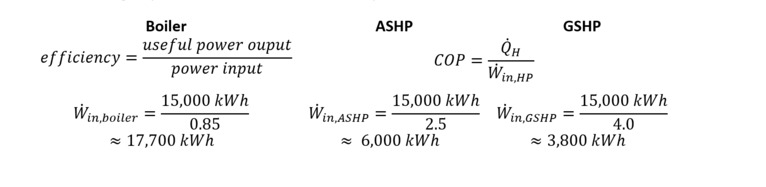
1. Calculate the annual power requirement for each case. 

Assumed heating requirement is 15,000 kWh for the year. 

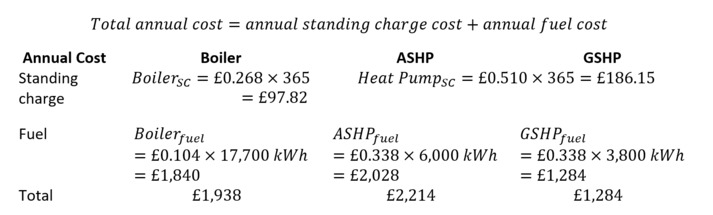
2. Calculate the annual cost for each case: 

Note: the higher COP of the ground-source heat pump makes this the more favourable option (dependent on the fuel prices).  


Task C: Lifetime cost estimation  

Challenge: Estimate the total lifetime cost for a property when using a heat pump versus a natural gas boiler.  

Base assumptions around the boiler system, heat pump system, and property can be researched by the student as a task or given to them. In this example we assume: 

Energy tariffs (correct at time of writing) for the domestic consumer including the energy price guarantee discount: 

Domestic energy tariffs 
Electric standing charge  51.0p per day 
Unit price of electricity  33.8p per kWh 
Gas standing charge  26.8p per kWh 
Unit price of gas  10.4p per kWh 


1. Calculate the lifetime running cost for each case.


2. Calculate the total lifetime cost for each case.


This work is licensed under a Creative Commons Attribution-ShareAlike 4.0 International License.

Any views, thoughts, and opinions expressed herein are solely that of the author(s) and do not necessarily reflect the views, opinions, policies, or position of the Engineering Professors’ Council or the Toolkit sponsors and supporters.

Case enhancement: Developing an internet constellation

Activity: Anatomy of an internet satellite.

Author: Sarah Jayne Hitt, Ph.D. SFHEA (NMITE, Edinburgh Napier University).


Overview:

This enhancement is for an activity found in the Dilemma Part two section. It is based on the work done by Kate Crawford and Vladan Joler and published by the SHARE Lab of the SHARE Foundation and the AI Now Institute of New York University, which investigates the “anatomy” of an Amazon Echo device in order to “understand and govern the technical infrastructures” of complex devices. Educators should review the Anatomy of an AI website to see the map and the complementary discussion in order to prepare and to get further ideas. This activity is fundamentally focused on developing systems thinking, a competency viewed as essential in sustainability that also has many ethical implications. Systems thinking is also an AHEP outcome (area 6). The activity could also be given a supply chain emphasis.

This could work as either an in-class activity that would likely take an entire hour or more, or it could be a homework assignment or a combination of the two. It could easily be integrated with technical learning. The activity is presented in parts; educators can choose which parts to use or focus on.


1. What are the components needed to make an internet satellite functional?:

First, students can be asked to brainstorm what they think the various components of an internet satellite are without using the internet to help them. This can include electrical, mechanical, and computing parts.

Next, students can be asked to brainstorm what resources are needed for a satellite to be launched into orbit. This could include everything from human resources to rocket fuel to the concrete that paves the launch pad. Each of those resources also has inputs, from chemical processing facilities to electricity generation and so forth.

Next, students can be asked to brainstorm what systems are required to keep the internet satellite operational throughout its time in orbit. This can include systems related to the internet itself, but also things like power and maintenance.

Finally, students can be asked to brainstorm what resources will be needed to manage the satellite’s end of life.

Small groups of students could each be given a whiteboard to make a tether diagram showing how all these components connect, and to try to determine the path dependencies between all of them.

To emphasise ethics explicitly, educators could ask students to imagine where within the tether diagram there could be ethical conflicts or dilemmas and why. Additionally, students could reflect on how changing one part of the system in the satellite would affect other parts of the system.


2. How and where are those components made?:

In this portion of the activity, students can research where all the parts of those components and systems come from – including metals, plastics, glass, etc. They should also research how and where the elements making up those parts are made – mines, factories, chemical plants, etc. – and how they are then shipped to where they are assembled and the corresponding inputs/outputs of that process.

Students could make a physical map of the globe to show where the raw materials come from and where they “travel” on their path to becoming a part of the internet satellite system.

To emphasise ethics explicitly, educators could ask students to imagine where within the resources map there could be ethical conflicts or dilemmas and why, and what the sustainability implications are of materials sourcing.


3. The anatomy of data:

In this portion of the activity, students can research how the internet provides access to and stores data, and the physical infrastructures required to do so. This includes data centres, fibre optic cables, energy, and human labour. Whereas internet service is often quite localised (for instance, students may be able to see 5G masts or the service vans of their internet service provider), in the case of internet satellites it is very distant and therefore often “invisible”.

To emphasise ethics explicitly, educators could ask students to debate the equity and fairness of spreading the supply and delivery of these systems beyond the area in which they are used. In the case of internet satellites specifically, this includes space and the notion of space as a common resource for all. This relates to other questions and activities presented in the case study.


This work is licensed under a Creative Commons Attribution-ShareAlike 4.0 International License.

Any views, thoughts, and opinions expressed herein are solely that of the author(s) and do not necessarily reflect the views, opinions, policies, or position of the Engineering Professors’ Council or the Toolkit sponsors and supporters.

Case enhancement: Water wars: managing competing water rights

Activity: Role-play the council meeting, with students playing different characters representing different perspectives.

Author: Cortney Holles (Colorado School of Mines, USA).


Overview:

This enhancement is for an activity found in the Dilemma Part two, Point 6 section: “Role-play the council meeting, with students playing different characters representing different perspectives.” Below are several prompts for discussion questions and activities that can be used. Each prompt could take up as little or as much time as the educator wishes, depending on where they want the focus of the discussion to be.


Prompts for questions:

After discussing the case in class, and completing the stakeholder mapping activity (Dilemma Part one, Point 4 – repeated below) from the Water Wars case study, this lesson guides teachers through conducting a role-play of the council meeting scenario.

1. Discuss the stakeholder mapping activity: Who are all the characters in the scenario? What are their positions and perspectives? How can you use these perspectives to understand the complexities of the situation more fully?

2. To prepare for the council meeting role-play activity, assign students in advance to take on different stakeholder roles (randomly or purposefully), or let them self-assign based on their interests.  Roles can include any of the following:

Suggestions from Stakeholder mapping activity:

Additional stakeholders to consider:

3. Before the class session in which the role-play will occur, students should research their stakeholder to get a sense of their values and motivations in regard to the case. Where no information is available, students can imagine the experiences and perspectives of the stakeholder with the goal of articulating what the stakeholder values and what motivates them to come to the council meeting to be heard on this issue. Students should prepare some statements about the stakeholder position on the water use by DSS, what the stakeholder values, and what the stakeholder proposes the solution should be. Students assigned to be council members will prepare for the role-play by learning about the conflict and writing potential questions they would want to ask of the stakeholders representing different views on the conflict.

4. In class, students prepare to role-play the council meeting by first connecting with others in the same stakeholder role (if applicable – you may have few enough students to have only one student assigned to a stakeholder) and deciding who can speak (you may want to require each student to speak or ask that one person be nominated to speak on behalf of the stakeholder group).

5. As the session begins, remind students to jot down notes from the various perspectives’ positions so there can be a debrief conversation at the end.  Challenge students to consider their personal biases and position at the outset and reflect on those positions and biases at the end of the council meeting. If they were a lead member of the council, what solution would they propose or vote for?

6. As the Council Meeting begins, the teacher should act as a moderator to guide students through the session. First the teacher will briefly highlight the issue up for discussion, then pass it to the students representing the Council members.  Council members will open the meeting with their description of the matter at hand between DSS and other local parties. They set the tone for the meeting with a call for feedback from the community members. The teacher can help the Council members call up the stakeholders in turn. Each stakeholder group will have a chance to state their argument, values, and reasons for or against DSS’ water use.  Each stakeholder will have an opportunity to suggest a proposed solution and Council members can engage in discussion with each stakeholder to clarify anything about their position that was unclear.

7. At the end of the meeting, the council members privately confer and then publicly vote on a resolution for the community.  All students, no matter their role, end the class by reflecting on the outcome and their original position on the case. Has anything shifted in their position or rationale after the council meeting? Why or why not?

8. The whole class could then engage in a discussion about the outcome of the council meeting. Teachers could focus on an analysis of how the process went, a discussion about the persuasiveness of different values and positions, and/or an exploration of the internal thinking students went through to arrive at their positions.


Related materials:


This work is licensed under a Creative Commons Attribution-ShareAlike 4.0 International License.

Any views, thoughts, and opinions expressed herein are solely that of the author(s) and do not necessarily reflect the views, opinions, policies, or position of the Engineering Professors’ Council or the Toolkit sponsors and supporters.


Case enhancement:
Business growth models in engineering industries within an economic system

Activity: Defending a profit-driven business versus a non-profit-driven business.

Author: Dr Sandhya Moise (University of Bath).


Overview:

This enhancement is for an activity found in the Dilemma Part one, Point 4 section of the case: “In a group, split into two sides with one side defending a profit-driven business and the other defending a non-profit driven business. Use Maria’s case in defending your position.” Below are several prompts for discussion questions and activities that can be used. These correspond with the stopping points outlined in the case. Each prompt could take up as little or as much time as the educator wishes, depending on where they want the focus of the discussion to be.


Session structure:

1. As pre-class work, the students can be provided the case study in written format.

2. During class, the students will need to be introduced to the following concepts, for which resources are provided below (~20 min):

3. Group activity (15 min +)

4. Whole class discussion/debate (15 min +)


Learning resources:

Ethics in Engineering resources:

Professional Codes of Conduct resources:

Corporate Social Responsibility Resources:

ESG Mandate Resources:

In recent years, there have been calls for more corporate responsibility in environmental and socioeconomic ecosystems globally. For example:

In 2017, the economist Kate Raworth set out to reframe GDP growth to a different indicator system that reflects on social and environmental impact. A Moment for Change?

Further reading:


Group Activity – Structure:

Split the class into two or more groups. One half of the class is assigned as Group 1 and the other, Group 2. Ask students to use Maria’s case in defending their position.


Group activity 1:

Group 1: Defend a profit-driven business model – Aims at catalysing the company’s market and profits by working with big corporations as this will enable quicker adoption of technology as well as economically benefit surrounding industries and society.

Group 2: Defend a non-profit driven business – Aims at preventing the widening of the socioeconomic gap by working with poorly-funded local authorities to help ensure their product gets to the places most in need (opportunities present in Joburg).


Pros and Cons of each approach:

Group 1: Defend a profit-driven business model:

Advantages and ethical impact:

Disadvantage and ethical impacts:

Group 2: Defend a non-profit driven business:

Advantages and ethical impact:

Disadvantage and ethical impacts:


Relevant ethical codes of conduct examples:

Royal Academy’s Statement of Ethical Principles:

Both of the above statements can be interpreted to mean that engineers have a professional duty to not propagate social inequalities through their technologies/innovations.


Discussion and summary:

This case study involves very important questions of profit vs values. Which is a more ethical approach both at first sight and beyond? Both approaches have their own set of advantages and disadvantages both in terms of their business and ethical implications.

If Maria decides to follow a profit-driven approach, she goes against her personal values and beliefs that might cause internal conflict, as well as propagate societal inequalities.

However, a profit-driven model will expand the company’s business, and improve job opportunities in the neighbourhood, which in turn would help the local community. There is also the possibility to establish the new business and subsequently/slowly initiate CSR activities on working with local authorities in Joburg to directly benefit those most in need. However, this would be a delayed measure and there is a possible risk that the CSR plans never unfold.

If Maria decides to follow a non-profit-driven approach, it aligns with her personal values and she might be very proactive in delivering it and taking the company forward. The technology would benefit those in most need. It might improve the reputation of the company and increase loyalty of its employees who align with these values. However, it might have an impact on the company’s profits and slow its growth. This in turn would affect the livelihood of those employed within the company (e.g. job security) and risks.


This work is licensed under a Creative Commons Attribution-ShareAlike 4.0 International License.

Any views, thoughts, and opinions expressed herein are solely that of the author(s) and do not necessarily reflect the views, opinions, policies, or position of the Engineering Professors’ Council or the Toolkit sponsors and supporters.
Theme: Collaborating with industry for teaching and learning

Authors: Prof Lucy Rogers (RAEng Visiting Professor at Brunel University, London and freelance engineering consultant) and Petra Gratton (Associate Dean of Professional Development and Graduate Outcomes in the College of Engineering, Design and Physical Science at Brunel University London, and Lecturer in the Department of Mechanical and Aerospace Engineering)

Keywords: Industry, Interview, Video, Real Life, Engineers

Abstract: A number of short videos that can be re-used in teaching undergraduate modules in Engineering Business, instead of inviting guest presentations. The interview technique got each individual to talk about their life experiences and topics in engineering business that are often considered mundane (or challenging) for engineers, such as ethics, risks and regulation, project management, innovation, intellectual property, life-cycle assessment, finance and creativity. They also drew attention to their professional development.


Project outcomes

The outcomes of this project are a number of short videos that were used, and can be re-used, in teaching delivery of an undergraduate module in Engineering Business in the Department of Mechanical and Aerospace Engineering at Brunel University London instead of having guest presentations from invited speakers.  Lucy’s interview technique got the individuals featured in each film to talk about their life experiences and topics in engineering business that are often considered mundane (or challenging) for engineers, such as ethics, risks and regulation, project management, innovation, intellectual property, life-cycle assessment and finance; and drew attention to their professional development. 

The shorter videos were inspirational for students to make videos of themselves as part of the assessment of the module, which required them to carry out a personal professional reflection exercise and report upon what they had learned from the exercise in a simple 90-second video using their smartphone or laptop. 

Having used the videos with Brunel students, Lucy has made them available on her YouTube channel: Dr Lucy Rogers – YouTube. Each of the videos are listed in the following table:


Topic Who Video Link
Creativity in Engineering: Your CV Reid Derby https://youtu.be/qQILO4uXJ24
Creativity in Engineering: Your CV Leigh-Ann Russell https://youtu.be/LJLG2SH0CwM
Creativity in Engineering: Your CV Richard Hopkins https://youtu.be/tLQ7lZ3nlvg
Corporate Social Responsibility Alexandra Knight
(Amey Strategic Consulting)
https://youtu.be/N7ojL6id_BI
Ethics and Diversity Alexandra Knight
(Amey Strategic Consulting)
https://youtu.be/Q4MhkLQqWuI
Project Management and Engineers Fiona Neads (Rolls Royce) https://youtu.be/-TZlwk6HuUI
Project Management – Life Cycle Paul Kahn
(Aerospace and Defence Industry)
https://youtu.be/1Z4ZXMLRPt4
Ethics at Work Emily Harford (UKAEA) https://youtu.be/gmBq9FIX6ek
Communication Skills at Work Emily Harford (UKAEA) https://youtu.be/kmgAlyz7OhI
Client Brief Andy Stanford-Clark (IBM) https://youtu.be/WNYhDA317wE
Intellectual Property from Artist’s Point of View Dave Corney
(Artist and Designer)
https://youtu.be/t4pLkletXIs
Intellectual Property Andy Stanford-Clark (IBM) https://youtu.be/L5bO0IdxKyI
Project Management Fiona Neads – Rolls Royce https://youtu.be/XzgS5SJhiA0


Lessons learned and reflections

We learned that students generally engaged with the videos that were used.  Depending which virtual learning environment (VLE) was being used, using pre-recorded videos in synchronous online lectures presents various challenges.  To avoid any unplanned glitches, in future we know to use the pre-recorded videos as part of the teaching-delivery preparation (e.g. in a flipped classroom mode). 

As part of her legacy, Lucy is going to prepare a set of simple instructions on producing video interviews that can be carried out by both staff and students in future.


Any views, thoughts, and opinions expressed herein are solely that of the author(s) and do not necessarily reflect the views, opinions, policies, or position of the Engineering Professors’ Council or the Toolkit sponsors and supporters.
Authors:  Dr Nik Whitehead (University of Wales Trinity Saint David); Dr Sarah Jayne Hitt SFHEA (NMITE); Professor Thomas Lennerfors (Uppsala University); Claire Donovan (Royal Academy of Engineering); Professor Raffaella Ocone OBE FREng FRSE (Heriot Watt University); Isobel Grimley (Engineering Professors’ Council).

Topic: Low earth orbit satellites for internet provision. 

Engineering disciplines: Electronics, Mechanical engineering.

Ethical issues: Respect for environment, Public good, Future generations.

Professional situations: Communication, Management, Working cultures.

Educational level: Intermediate.

Educational aim: Practise ethical analysis. Ethical analysis is a process by which ethical issues are defined, affected parties and consequences are identified, so that relevant moral principles can be applied to a situation in order to determine possible courses of action. 


Learning and teaching notes:

This case is about an experienced engineer leading a team at a tech start-up. The company has been awarded a contract to produce an innovative satellite that will be used in an internet constellation. While the team was initially excited about their work, some members are now concerned about the impact of the internet constellation. While mainly focused on environmental ethics, effects on human communities are also raised in this case study.

This case study addresses two of AHEP 4’s themes: The Engineer and Society (acknowledging that engineering activity can have a significant societal impact) and Engineering Practice (the practical application of engineering concepts, tools and professional skills). To map this case study to AHEP outcomes specific to a programme under these themes, access AHEP 4 here and navigate to pages 30-31 and 35-37.

The dilemma in this case is presented in two parts. If desired, a teacher can use Part one in isolation, this section enables students to practise different types of analysis and to introduce aspects of environmental ethics. It highlights the challenges of making ethical decisions with global consequences, in scenarios where policy isn’t clear. Part two develops and complicates the concepts presented in Part one to provide for additional learning by focusing on the course of actions taken by an individual engineer based on the dilemma presented in Part one. The Challenge of Environmental Ethics linked below is recommended, though not required, for students engaging with this case. Additionally, throughout the case, there is the option to stop at multiple points for questions and / or activities as desired.

Learners have the opportunity to:

Teachers have the opportunity to:


Learning and teaching resources: 


Summary: 

After years of working your way up the corporate ladder, you are now Head of Engineering for a tech start-up. The company has won a contract connected to a project creating a constellation of thousands of low Earth orbit satellites. This constellation has the potential to create a reliable system of internet access for areas of the world that are hard to reach by conventional infrastructure. Your company is one of those chosen to develop and build a low-cost, lightweight, efficient satellite that can be produced at scale. This is a huge accomplishment for you, as well as for your company. 


Dilemma – Part one:

A conference that brings together various project partners is met by protesters whose message is that the internet constellation has several potential negative impacts for nature and human communities. Disparaging comments have been made about your company’s participation in the project on social media. Some members of your team seem quite rattled by the protests, and you convene at a coffee shop to discuss. 


Optional STOP for questions and activities:

1. Discussion: Technical analysis – Undertake a technical activity in the areas of electronic and / or mechanical engineering related to internet constellations.

2. Activity: Position analysis – Divide students into three groups—constellation project managers; satellite engineers and protestors. Imagine how their positions are related to the internet constellation. What values might inform their positions? What knowledge might inform their position that the other groups do not have access to or understanding of?

3. Discussion: Environmental analysis – While nature cannot speak for itself, if it could, what might be its position on the internet constellation? What aspects of the natural world might be affected by this technology in both the short- and long-term? For example, are there any direct or indirect effects on the health of humans and the ecosystems around them? Should the natural world of space be treated the same way as the natural world on earth?

4. Discussion: Policy analysis – Who should make decisions about projects that affect nature on a global scale? What laws or regulations exist that govern internet constellations?

5. Discussion and Activity: Moral analysis – Use environmental ethics principles such as intrinsic value and anthropocentrism to debate the project. Beyond environmental concerns, how might other ethical approaches, such as consequentialism or justice, inform positions on the issue?


Dilemma – Part two:

You remind and explain to your team members that they, and the company, have a duty to the client. Everyone has been hired to deliver a specific project and been excited about overcoming the technical challenges to ensure the project’s success. The team agrees, but also expresses concern about aspects that aren’t in the project remit, such as how the satellite will be maintained and what will happen to it at the end of its life. They demand that you pause your work until an ethical review is conducted. 

You report all of this to the CEO, who reacts with disappointment and unhappiness at your team’s actions. She argues that the only thing your company is doing is building the satellite: it’s not your responsibility what happens to it afterwards. She feels that it’s your job to get your team back in line and on task. How do you approach this situation? 


Optional STOP for questions and activities:

1. Discussion and Activity: How do you respond to this situation? What responsibilities do you have to your team, your boss, and the client? How will you balance these? Are the team’s engineers right to be concerned about the impact of their satellite within the wider constellation, or is it beyond their scope? Role-play an interaction between you and the engineering team, or between you and your boss.

2. Activity: Life cycle analysis – Research life cycles of satellites and their environmental impact.

3. Discussion and Activity: Debate if, and how, we have obligations to future generations. Is it possible to have a moral contract with a person that may never be born? How do we know that people in the future, will value the same things we do now? Both creating the internet constellation and preventing its implementation seem to potentially benefit future generations. How do we balance these ‘goods’ and make a decision on how to proceed? Who gets to decide?

4. Activity: Anatomy of an internet satellite – use the Anatomy of an AI case study as an example of a tether map, showing the inputs and outputs of a device. Create a tether map showing the anatomy of an internet satellite.


Enhancements:

An enhancement for this case study can be found here.


This work is licensed under a Creative Commons Attribution-ShareAlike 4.0 International License.

Any views, thoughts, and opinions expressed herein are solely that of the author(s) and do not necessarily reflect the views, opinions, policies, or position of the Engineering Professors’ Council or the Toolkit sponsors and supporters.

 

Authors: Professor Dawn Bonfield MBE (Aston University);Professor Sarah Hitt SFHEA (NMITE); Dr Darian Meacham (Maastricht University); Dr Nik Whitehead (University of Wales Trinity Saint David); Dr Matthew Studley (University of the West of England, Bristol); Professor Mike Bramhall (TEDI-London); Isobel Grimley (Engineering Professors’ Council).

Topic: Data centres’ impact on sustainable water resources.

Engineering disciplines: Civil engineering, Electronic engineering.

Ethical issues: Sustainability, Respect for environment, Future generations, Risk, Societal impact.

Professional situations: Law or policy, Communication, Integrity.

Educational level: Intermediate.

Educational aim: Practise ethical judgement. Ethical Judgment is the activity of thinking about whether something has a moral attribute. Judgments involve reaching moral decisions and providing the rationale for those decisions.


Learning and teaching notes:

This case involves a situation where environmental damage may be occurring despite the mechanism causing this damage being permissible by law. The engineer at this centre of the case is to represent the company that is responsible for the potential damage, at a council meeting. It requires the engineer to weigh up various harms and goods, and make a decision that could seriously impact their own job or career. There is also a section at the end of this case study that contains technical information providing further details about the water cooling of ICT equipment.

This case study addresses two of AHEP 4’s themes: The Engineer and Society (acknowledging that engineering activity can have a significant societal impact) and Engineering Practice (the practical application of engineering concepts, tools and professional skills). To map this case study to AHEP outcomes specific to a programme under these themes, access AHEP 4 here and navigate to pages 30-31 and 35-37.

The dilemma in this case is presented in two parts. If desired, a teacher can use Part one in isolation, but Part two develops and complicates the concepts presented in Part one to provide for additional learning. The case allows teachers the option to stop at multiple points for questions and/or activities as desired.

Students have the opportunity to:

Teachers have the opportunity to:


Learning and teaching resources:


Summary:

The company Data Storage Solutions (DSS) has built a large data centre on land that was historically used for agriculture and owned by a farming operation. DSS was incorporated as a subsidiary of the farming company so that it could retain the water rights that were attached to the property. This ensured access to the large amount of water needed to cool their servers. This centre manages data from a variety of sources including the local hospital and university.

When the property was used as a farm, the farming operation never used its full allocation of water. Now, the data centre always uses the maximum amount legally allotted to it. For the rainy half of the year, this isn’t a problem. However, in more arid months, the nearby river almost runs dry, resulting in large volumes of fish dying. Other farmers in the area have complained that the water level in their wells has dropped, making irrigation much more expensive and challenging.


Dilemma – Part one:

You are a civil engineer working for DSS and have been requested by your boss to represent the company at a forthcoming local council meeting where the issue will be discussed. Your employer is sending you to justify the company’s actions and defend them against accusations of causing an environmental hazard in the local area which is reducing the water table for farmers and affecting local biodiversity. Your boss has told you that DSS has a right to the water and that it does not intend to change its behaviour. This meeting promises to be a contentious one as the local Green party and farmers’ union have indicated that they will be challenging the company’s water usage. How will you prepare for the meeting?


Optional STOP for questions and activities: 

1. Discussion: Personal values – What is your initial position on the issue? Do you see anything wrong with DSS’s water use? Why, or why not?

2. Discussion: Professional responsibilities – What ethical principles and codes of conduct are relevant to this situation?

3. Activity: Define and identify the relevant data you should compile to take to the meeting. What information do you need in order to be prepared?

4. Activity: Stakeholder mapping – Who are all the characters in the scenario? What are their positions and perspectives? How can you use these perspectives to understand the complexities of the situation more fully? Examples include:

Data Storage Solutions

5. Activity: Undertake a technical activity such as civil and / or electronic engineering related to the measurement of stream flow and calculating data centre cooling needs.


Dilemma – Part two:

As you prepare for the meeting, you reflect on several competing issues. For instance, you are an employee of DSS and have a responsibility to represent its interests, but can see that the company’s actions are environmentally harmful. You appreciate that the data centre is vital for the local community, including the safe running of schools and hospitals, and that its operation requires sufficient water for cooling. Your boss has told you that you must not admit responsibility for any environmental damage or biodiversity loss. You also happen to know that a new green battery plant is planning to open nearby that will create more data demand and has the potential to further increase DSS’s water use. You know that obtaining water from other sources will be costly to DSS and may not be practically possible, let alone commercially viable. What course of action will you pursue?


Optional STOP for questions and activities: 

1. Activity: Debate what course of action you should take. Should you take the company line despite knowing about the environmental impacts? Should you risk your reputation or career? What responsibilities do you have to fellow employees, the community, and the environment?

2. Activity: Risk analysis – What are the short- and long- term burdens and benefits of each course of action? Should environmental concerns outweigh others? Is there a difference between the environment locally and globally?

3. Activity and discussion: Read Sandra Postel’s case for a Water Ethic, and consider New Zealand’s recent legislation that gives a rainforest the same rights as a human. With this in mind, does the stream have a right to thrive? Do the fish have a right to a sustainable environment? Are humans ultimately at risk here, or just the environment? Does that answer change your decision? Why?

4. Activity: Prepare a statement for the council meeting. What will you argue?

5. Activity: The students should interrogate the pros and cons of each possible course of action including the ethical, the practical, the cost, the local relationship and the reputational damage implications. They should decide on their own preferred course of action and explain why the balance of pros and cons is preferable to other options. The students may wish to consider this from other perspectives, such as:

6. Activity: Role-play the council meeting, with students playing different characters representing different perspectives.

7. Activity: Allow students to reflect on how this case study has enabled them to see the situation from different angles, and whether this has helped them to understand the ethical concerns and come to an acceptable conclusion.


Annex – Accompanying technical information:

ICT equipment generates heat and so most devices must have a mechanism to manage their temperature. Drawing cool air over hot metal transfers heat energy to that air, which is then pushed out into the environment. This works because the computer temperature is usually higher than the surrounding air. There are several different mechanisms for data centre cooling, but the general approach involves chillers reducing air temperature by cooling water – typically to 7–10 °C, which is then used as a heat transfer mechanism. Some data centres use cooling towers where external air travels across a wet media so that the water evaporates. Fans expel the hot, wet air and the cooled water is recirculated. Other data centres use adiabatic economisers – where water is sprayed directly into the air flow, or onto a heat exchange surface, thereby cooling the air entering the data centre. With both techniques the evaporation results in water loss. A small 1 MW data centre using one of these types of traditional cooling can use around 25.5 million litres of water per year. Data centre water efficiency deserves greater attention. Annual reports show water consumption for cooling directly paid for by the operator, so there is an economic incentive to increase efficiency. As the total energy share of cooling has fallen with improving PUEs (Power Usage Effectiveness metric), the focus has been on electricity consumption, and so water has been a low priority for the industry. However, the largest contributor to the water footprint of a data centre is electricity generation. Where data centres own and operate the entire facility, there is more flexibility for exploring alternative sources of water, and different techniques for keeping ICT equipment cool.


Related materials:


This work is licensed under a Creative Commons Attribution-ShareAlike 4.0 International License.

Any views, thoughts, and opinions expressed herein are solely that of the author(s) and do not necessarily reflect the views, opinions, policies, or position of the Engineering Professors’ Council or the Toolkit sponsors and supporters.
 

Authors: Professor Sarah Hitt SFHEA (NMITE); Dr Nik Whitehead (University of Wales Trinity Saint David); Dr Matthew Studley (University of the West of England, Bristol); Dr Darian Meacham (Maastricht University); Professor Mike Bramhall (TEDI-London); Isobel Grimley (Engineering Professors’ Council).

Topic: Trade-offs in the energy transition.

Engineering disciplines: Chemical engineering, Electrical engineering, Energy.

Ethical issues: Sustainability, Honesty, Respect for the environment, Public good.

Professional situations: Communication, Bribery, Working cultures.

Educational level: Intermediate.

Educational aim: Practise ethical reasoning. Ethical reasoning applies critical analysis to specific events in order to consider, and respond to, a problem in a fair and responsible way.


Learning and teaching notes:

This case requires an engineer with strong convictions about sustainable energy to make a decision about whether or not to take a lucrative contract from the oil industry. Situated in Algeria, the engineer must weigh perspectives on environmental ethics that may differ from those informed by a different cultural background, as well as navigate unfamiliar workplace expectations. The engineer’s own financial wellbeing is also at stake, which may complicate decision-making. As a result, this case has several layers of relations and potential value-conflicts. These include values that underlie assumptions held about the environment and its connection to human life and services.

This case study addresses two of AHEP 4’s themes: The Engineer and Society (acknowledging that engineering activity can have a significant societal impact) and Engineering Practice (the practical application of engineering concepts, tools and professional skills). To map this case study to AHEP outcomes specific to a programme under these themes, access AHEP 4 here and navigate to pages 30-31 and 35-37.

The case is presented in two parts. If desired, a teacher can use Part one in isolation, but Part two develops and complicates the concepts presented in Part one to provide for additional learning. The case allows teachers the option to stop at multiple points for questions and/or activities as desired. To prepare for activities related to environmental ethics, teachers may want to read, or assign students to pre-read the following academic articles: ‘Environmental ethics: An overview’ or ‘Mean or Green: Which values can promote stable pro-environmental behavior?’

Learners have the opportunity to:

Teachers have the opportunity to:


Learning and teaching resources:


Summary:

You are an electrical engineer who had a three-year contract with a charity in Algeria to install solar systems on remote houses and farms that were not yet connected to the grid. The charity’s project came to an end and you have set up your own company to continue the work. It has been difficult raising money from investors to fund the project and the fledgling business is in debt. It is doubtful that your company will survive for much longer without a high-profit project.

During your time in Algeria, you have made many local and regional contacts in the energy industry. Through one of these contacts, you learn of an energy company operating a large oil field in the region that is looking to convert to solar energy to power its injection pumping, monitoring, and control systems. In doing so, the oil field will eliminate its dependency on coal-fired electricity, increasing production while boosting the company’s environmental credentials. It also hopes to make use of a governmental tax credit for businesses that make such solar conversions.


Optional STOP for questions and activities:

1. Discussion: What is your initial reaction to using solar energy for oil and gas production? What might your initial reaction reveal to you about your own perspectives and values?

2. Discussion and activity: List the potential benefits and risks to implementing this technology. Are these benefits and risks the same no matter which country they are implemented in?

3. Activity: Research the trend for using solar energy in oil and gas production. Which companies are promoting it and which countries are using this technology?

4. Discussion and activity related to optional pre-readings: Consider how your perspective is related to the following environmental values, and pair/share or debate with a peer.


Dilemma – Part one:

The following week you receive a phone call in your home office. It is a representative of the energy company named Sami. He asks you to bid for the solar installation contract for the oilfield. At first you are reluctant, it doesn’t seem right to use solar power to extract fuel that will contribute to the ongoing climate emergency. You explain your hesitation, saying “I got into the solar business because I believe we have a responsibility to future generations to develop sustainable energy.” Sami laughs and says “While you’re busy helping people who don’t exist yet, I’m trying to provide energy to the people who need it now. Surely we have a responsibility to them too?”

Sami then quotes a figure that the company is willing to pay you for the project work. You are taken aback at how large it is – the profit made on this contract would be enough to pay off your debts and give your business financial security moving forward. Still, you hesitate, telling Sami you need some time to think it over. He agrees and persuades you to attend dinner with him and his family later that week.


Optional STOP for questions and activities:

1. Discussion: Have you done anything wrong by accepting Sami’s dinner invitation?

2. Discussion: Environmental ethics deals with assumptions that are often unstated, such as the obligation to future generations. Like Sami, some people find that our obligation is greater to people who exist at this moment, not to those that don’t yet exist. Do you agree or disagree with this position? Why? Can we maintain an obligation to future generations while simultaneously saying that this must be weighed against the obligations in the here and now?

3. Activity: Both cost-benefit and value trade-off analyses are valuable approaches to consider in this case.  Determine the possible courses of action and undertake both types of analysis for each position by considering both short- and long-term consequences. [use the Mapping actors and processes article to help with this activity].

4. Activity: Using reasoning and evidence, create arguments for choosing one of the possible courses of action.

5. Activity: Undertake technical calculations in the areas of chemical and / or electrical engineering related to carbon offset and solar installations.


Dilemma – Part two:

When you arrive at Sami’s house for dinner you are surprised to find you aren’t the only guest. Leila, a finance manager at the oil company is also present. During the meal, she suggests they are considering investing in your business. “After all,” she points out, “many of our employees and their families could really use solar at their homes. We have even decided to subsidise the installation as a benefit to them.”

You are impressed by the oil company’s commitment to their workers and this would also guarantee you an income stream for 3-5 years. Of course, to guarantee the investment in your company, you will have to agree to undertake the oil field installation. You comment to Leila and Sami that it feels strange to be having these formal discussions over a family meal. “This is how we do business here,” says Sami. “You become part of our family too.”


Optional STOP for questions and activities:

1. Discussion: Do you accept the contract to complete the installation? Do you accept the investment in your company? Why, or why not?

2. Discussion: Is this bribery? Why, or why not?

3. Activity: Role-play the conversation between Sami, Leila, and the engineer.

4. Activity: Use heuristics to analyse possible courses of action. One heuristic is the Environmental ethics decision making guide. Another is the 7-step guide to ethical decision-making.


This work is licensed under a Creative Commons Attribution-ShareAlike 4.0 International License.

Any views, thoughts, and opinions expressed herein are solely that of the author(s) and do not necessarily reflect the views, opinions, policies, or position of the Engineering Professors’ Council or the Toolkit sponsors and supporters.
Authors: Professor Sarah Hitt SFHEA (NMITE); Professor Raffaella Ocone OBE FREng FRSE (Heriot Watt University); Johnny Rich (Engineering Professors’ Council); Dr Matthew Studley (University of the West of England, Bristol); Dr Nik Whitehead (University of Wales Trinity Saint David); Dr Darian Meacham (Maastricht University); Professor Mike Bramhall (TEDI-London); Isobel Grimley (Engineering Professors’ Council).

Topic: Data security of smart technologies.

Engineering disciplines: Electronics, Data, Mechatronics.

Ethical issues: Autonomy, Dignity, Privacy, Confidentiality.

Professional situations: Communication, Honesty, Transparency, Informed consent.

Educational level: Intermediate.

Educational aim: Practise ethical analysis. Ethical analysis is a process whereby ethical issues are defined and affected parties and consequences are identified so that relevant moral principles can be applied to a situation in order to determine possible courses of action.


Learning and teaching notes:

This case involves a software engineer who has discovered a potential data breach in a smart home community. The engineer must decide whether or not to report the breach, and then whether to alert and advise the residents. In doing so, considerations of the relevant legal, ethical, and professional responsibilities need to be weighed. The case also addresses communication in cases of uncertainty as well as macro-ethical concerns related to ubiquitous and interconnected digital technology.

This case study addresses two of AHEP 4’s themes: The Engineer and Society (acknowledging that engineering activity can have a significant societal impact) and Engineering Practice (the practical application of engineering concepts, tools and professional skills). To map this case study to AHEP outcomes specific to a programme under these themes, access AHEP 4 here and navigate to pages 30-31 and 35-37.

The dilemma in this case is presented in two parts. If desired, a teacher can use Part one in isolation, but Part two develops and complicates the concepts presented in Part one to provide for additional learning. The case allows teachers the option to stop at multiple points for questions and/or activities as desired

Learners will have the opportunity to:

Teachers will have the opportunity to:


Learning and teaching resources:


Summary:

Smart homes have been called “the road to independent living”. They have the potential to increase the autonomy and safety of older people and people with disabilities. In a smart home, the internet of things (IoT) is coupled with advanced sensors, chatbots and digital assistants. This combination enables residents to be connected with both family members and health and local services, so that if there there are problems, there can be a quick response.

Ferndale is a community of smart homes. It has been developed at considerable cost and investment as a pilot project to demonstrate the potential for better and more affordable care of older people and people with disabilities. The residents have a range of capabilities and all are over the age of 70. Most live alone in their home. Some residents are supported to live independently through: reminders to take their medication; prompts to complete health and fitness exercises; help completing online shopping orders and by detecting falls and trips throughout the house. The continuous assessment of habits, diet and routines allows the technology to build models that may help to predict any future negative health outcomes. These include detecting the onset of dementia or issues related to dietary deficiencies. The functionality of many smart home features depends on a reliable and secure internet connection.


Dilemma – Part one:

You are the software engineer responsible for the integrity of Ferndale’s system. During a routine inspection you discover several indicators suggesting a data breach may have occurred via some of the smart appliances, many of which have cameras and are voice-activated. Through the IoT, these appliances are also connected to Amazon Ring home security products – these ultimately link to Amazon, including supplying financial information and details about purchases.


Optional STOP for questions and activities: 

1. Activity: Technical analysis – Before the ethical questions can be considered, the students might consider a number of immediate technical questions that will help inform the discussion on ethical issues. A sample data set or similar technical problem could be used for this analysis. For example:

2. Activity: Identify legal and ethical issues. The students should reflect on what might be the immediate ethical concerns of this situation. This could be done in small groups or a larger classroom discussion.

Possible prompts:

3. Activity: Determine the wider ethical context. Students should consider what wider moral issues are raised by this situation. This could be done in small groups or a larger classroom discussion.

Possible prompts:


Dilemma – Part two:

You send an email to Ferndale’s manager about the potential breach, emphasising that the implications are possibly quite serious. She replies immediately, asking that you do not reveal anything to anyone until you are absolutely certain about what has happened. You email back that it may take some time to determine if the software security has been compromised and if so, what the extent of the breach has been. She replies explaining that she doesn’t want to cause a panic if there is nothing to actually worry about and says “What you don’t know won’t hurt you.” How do you respond?     


Optional STOP for questions and activities: 

1. Discussion: Professional values – What guidance is given by codes of ethics such as the Royal Academy of Engineering/Engineering Council’s Statement of Ethical Principles or the Association for Computing Machinery Code of Ethics?

2. Activity: Map possible courses of action. The students should think about the possible actions they might take. They can be prompted to articulate different approaches that could be adopted, such as the following, but also develop their own alternative responses.

3. Activity: Hold a debate on which is the best approach and why. The students should interrogate the pros and cons of each possible course of action including the ethical, technical, and financial implications. They should decide on their own preferred course of action and explain why the balance of pros and cons is preferable to other options.

4. Activity: Role-play a conversation between the engineer and the manager, or a conversation between the engineer and a resident.

5. Discussion: consider the following questions:

6. Activity: Change perspectives. Imagine that you are the child of one of Ferndale’s residents and that you get word of the potential data security breach. What would you hope the managers and engineers would do?

7. Activity: Write a proposal on how the system might be improved to stop this happening in the future or to mitigate unavoidable risks. To inform the proposal, the students should also explore the guidance of what might be best practice in this area. For example, in this instance, they may decide on a series of steps.


This work is licensed under a Creative Commons Attribution-ShareAlike 4.0 International License.

Any views, thoughts, and opinions expressed herein are solely that of the author(s) and do not necessarily reflect the views, opinions, policies, or position of the Engineering Professors’ Council or the Toolkit sponsors and supporters.
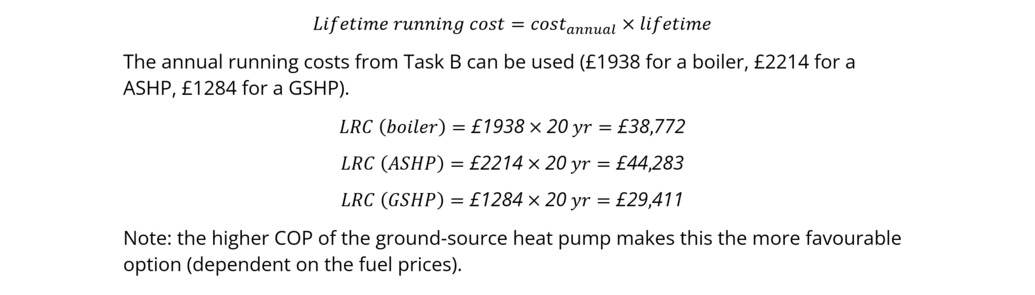
Let us know what you think of our website