 Toolkit: Complex Systems Toolkit.
Author: Dr. Scott Strachan (University of Strathclyde).
Topic: Sociotechnical aspects of implementing renewable energy systems.
Title: Climate science and policy solutions workshops.
Resource type: Teaching activity: Workshop.
Relevant disciplines: Any.
Keywords: Climate change; Policy; Carbon emissions; Built environment; Energy production; Renewable energy; Sustainability; Simulation.
Licensing: This work is licensed under a Creative Commons Attribution-ShareAlike 4.0 International License. It was originally developed as part of the Strathclyde Climate Ambassadors Networks (StrathCAN) at Strathclyde in collaboration with the Centre for Sustainable Development.
Related INCOSE Competencies: Toolkit resources are designed to be applicable to any engineering discipline, but educators might find it useful to understand their alignment to competencies outlined by the International Council on Systems Engineering (INCOSE). The INCOSE Competency Framework provides a set of 37 competencies for Systems Engineering within a tailorable framework that provides guidance for practitioners and stakeholders to identify knowledge, skills, abilities and behaviours crucial to Systems Engineering effectiveness. A free spreadsheet version of the framework can be downloaded.
This resource relates to the Systems Thinking, and Critical Thinking INCOSE Competencies.
AHEP mapping: This resource addresses several of the themes from the UK’s Accreditation of Higher Education Programmes fourth edition (AHEP4): Integrated / Systems Approach (essential to the solution of broadly-defined problems), Problem analysis, Sustainability, and Science, mathematics, and engineering principles.
Educational level: Beginner.
Learning and teaching notes:
The two complementary workshops, Climate Fresk and En-ROADS, are introduced to situate Renewable Energy Technologies within the wider context of the Net Zero transition. Their purpose is first to deepen students’ understanding of the climate science that underpins climate change as the driver of technical innovation, and then to broaden awareness of the social, economic, political, and environmental factors that shape global decarbonisation pathways. Building on this foundation, the workshops shift focus to the policy levers required to enable systems change – highlighting, often with surprising insights, their relative effectiveness in reducing emissions and limiting temperature rise. Together, they provide the context for a Renewable Energy Technologies module, where attention turns to the role of renewables and other low-carbon technologies as climate solutions. The central takeaway is that there is no single “silver bullet” solution; instead, a coordinated “silver buckshot” approach is essential.
Learners do not require any prior learning in the area of climate change or climate solutions for these workshops. The workshops are the perfect introduction to these. Climate Fresk facilitator training begins with attending a workshop as a participant, followed by a session on facilitation. Staff can train via local workshops, the CF MOOC and peer-to-peer practice, or through official training, enabling institutions to build a self-sustaining community of facilitators at minimal cost.
Learners have the opportunity to:
- Learn about the climate science that underpins the IPCC assessment reports.
- Develop an understanding of systems thinking by applying it to climate science and the impacts of climate change, while also exploring the policy solutions needed to drive systems-level change.
- Be Introduced to the En-Roads Climate Simulator tool and the possibility of becoming trained Climate Fresk Facilitators themselves.
Teachers have the opportunity to:
- Actively engage the students in taking a systems thinking approach to their understanding of ‘the problem’ of climate change, and exploring ‘the solutions’ to it.
- Use these workshops as stand-alone activities (for outreach) or embed within the curriculum.
- Collaborate with other teachers and students, by training them as facilitators to support future workshops.
- Engage students with different competencies such as systems thinking, critical thinking, and anticipatory thinking and highlight to students how these are relevant and applied.
Downloads: A PDF of this resource will be available soon.
Learning and teaching resources:
- Climate Fresk (2025) Climate Fresk (world) – Climate Fresk.
- Climate Interactive (no date) The En-Roads Climate Solutions Simulator. (Accessed: August 27, 2025).
- En-ROADS resources (no date).
- The En-ROADS guided assignment (no date).
- Training, C.I. (no date) Mastering En-ROADS.
- Strachan, S. et al. (no date) From StrathCEKO to StrathCAN – building a community of climate education ambassadors from the bottom up in a higher education institution. International Conference on Sustainable Development.
- TEDx Talks (2023) Positive Tipping Points – Viewing the world as a system | Tim Lenton | TEDxPorto.
Activity overview:
This activity utilises off-the-shelf educational tools in the form of the Climate Fresk workshop and the En-Roads Climate Simulator tool. These are used in two separate (but connected) workshops adapted from the guided assignment that is presented in the resources above. These are not intended to be run back-to-back. In fact, some gap (of days) in between is desirable as together, this would be too exhausting, and also give time for reflection in between.
- The Climate Fresk workshop is designed to build a solid understanding of cause-and-effect in climate systems. This develops baseline systems thinking without overloading students.
- En-ROADS, is designed to engage students with the types of sectors that we need to decarbonise and get them thinking about the need for system wide policies to achieve system wide decarbonisation of our energy system.
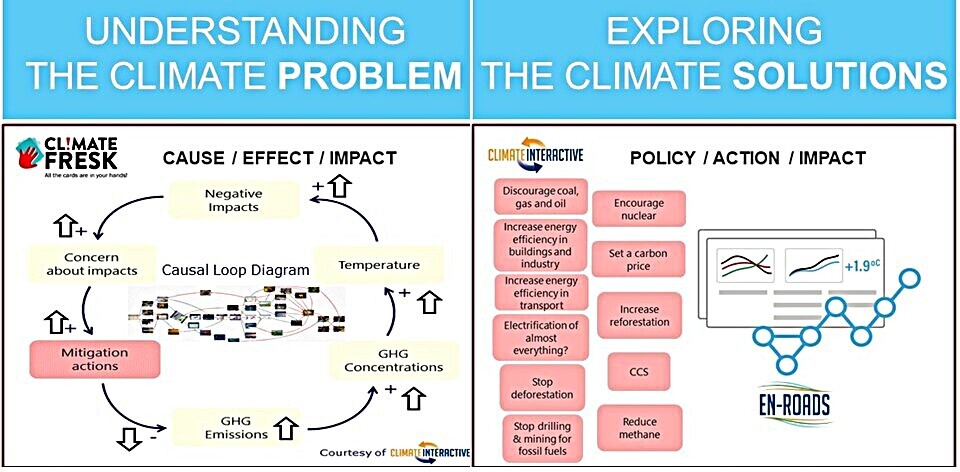
Figure 1. Using Climate Fresk and En-ROADS as complementary workshops focusing on ‘the climate problem’ and ‘climate solutions’.
A key aspect of both workshops is highlighting the need for systems thinking in both understanding the problem of, and exploring the solutions to, climate change. This involves introducing students to the cause and effects of climate change, feedback loops and the concept of tipping points – both in terms of climate tipping points (BBC Sounds – The Climate Tipping Points, no date) that can potentially trigger irreversible changes in the climate system, as well as positive, social tipping points (TEDx Talks 2023) that once crossed can shift social norms, and how policies can affect this. It allows discussions around leverage points in the context of climate solutions and policies, which Donella Meadows describes as where “a small shift in one thing can produce big changes in everything”.
Part one: Climate Fresk workshop: Understanding the problem of climate change (or the ‘science piece’):
Overview:
Climate Fresk is a 2-2.5 hour facilitator-led gamified workshop based on the latest IPCC report, where participants work in groups to build a causal-loop diagram (or fresk) of the Earth’s climate system using specially designed cards. The activity encourages discussion, challenges assumptions, and develops systems thinking by illustrating the interconnections, feedback loops, and tipping points of climate change. In doing so, it supports UNESCO Education for Sustainable Development competencies in anticipatory and systems thinking, helping participants understand the potential impacts of climate dynamics on ecological, social, and economic systems in a way that is accessible.
Scalability and setup:
The Climate Fresk workshop can be delivered to almost any number of participants, limited only by the size of the space, the number of trained facilitators available, and the number of card decks. Participants are usually divided into groups of 8 (10 at a push), each working around a table roughly 2m x 1m in size. Each group (table) requires a dedicated facilitator to guide the process.
Facilitation and training:
Facilitators must be trained before running the activity. Training can be undertaken through official Climate Fresk courses (see resources) or, once enough experience has been built, in-house peer-to-peer training supported by staff development units. Facilitators use a “crib sheet” containing guiding questions and timings to help keep groups on track.
Workshop materials:
The Fresk uses a deck of 42 cards, each representing a cause, effect, or impact within the climate system-ranging from fossil fuel use across industry, buildings, transport and agriculture, to wider impacts on society, biodiversity, and ecosystems. Each card has a graphic on one side and explanatory text on the other, which participants use to determine its role in the system.
Learning process:
Over the session, participants collaboratively arrange the cards on a large sheet of paper to construct a causal-loop diagram of the climate system. In doing so, they identify drivers of carbon emissions, critical carbon sinks, feedback loops, and potential tipping points. The activity encourages discussion, challenges assumptions, and introduces key climate science terminology, while making visible the complex interdependencies of Earth systems.
Reflection and discussion:
After constructing the Fresk, participants are encouraged to reflect on how the process made them feel (normative competency) and what insights they gained. This is followed by open discussion on mitigation strategies and possible solutions. In a standard Climate Fresk workshop, around 45 minutes is devoted to this. However, when combined with the En-Roads simulator, this discussion naturally transitions from the “problem space” of the Fresk workshop to the “solutions space” of the subsequent En-Roads workshop, where participants explore the realistic impacts of different climate solutions, their co-benefits, and the equity issues they raise – engaging participants in deeper systems-level thinking.
Part two: En-ROADS workshop: ‘Exploring the solutions’ to climate change (or the ‘policy piece’):
Overview:
This En-ROADS workshop can be run from one to two hours, and can follow a role-play format, where participants are asked to take on the role of policymakers, exploring different policy options to limit global temperatures to 1.5oC (or 2oC). They are introduced to the workshop by telling them “you are policymakers tasked with limiting global heating”. En-Roads is a climate change simulator developed by Climate Interactive and MIT that uses roleplay to explore global policy interventions for limiting temperature rise. It enables participants—from students to policymakers—to test combinations of climate solutions, examine trade-offs and unintended consequences, and understand that no single “silver bullet” exists. The workshop develops UNESCO Education for Sustainable Development competencies in anticipatory, systems, critical, and strategic thinking, while highlighting the challenges of achieving policy consensus across diverse stakeholders.
Preparation:
1. Participants
-
- Suitable for classes split into small groups.
-
- Works well in groups of 3–5 for discussions.
2. Facilitators
-
- 1 facilitator to introduce the tool and guide reflection.
-
- Teaching assistants can circulate during group tasks to prompt discussion.
3. Materials and tools
-
- Internet access and projector.
-
- EN-ROADS simulator: https://en-roads.climateinteractive.org.
-
- Handouts: list of possible climate “levers” (policy actions) – See resources – En-Roads Control Panel
-
- Online polling software (e.g. Mentimeter)
Step-by-step instructions for 60-minute workshop (but can be expanded to 2 hours involving more discussion and more interaction with En-Roads simulator):
1. Introduction (5 mins)
-
- Introduce EN-ROADS as an interactive simulator for testing climate solutions.
-
- Explain the goal: Can we keep global heating below 1.5 °C?
-
- Use causal loop diagram below to demonstrate how mitigating actions effect positive change.
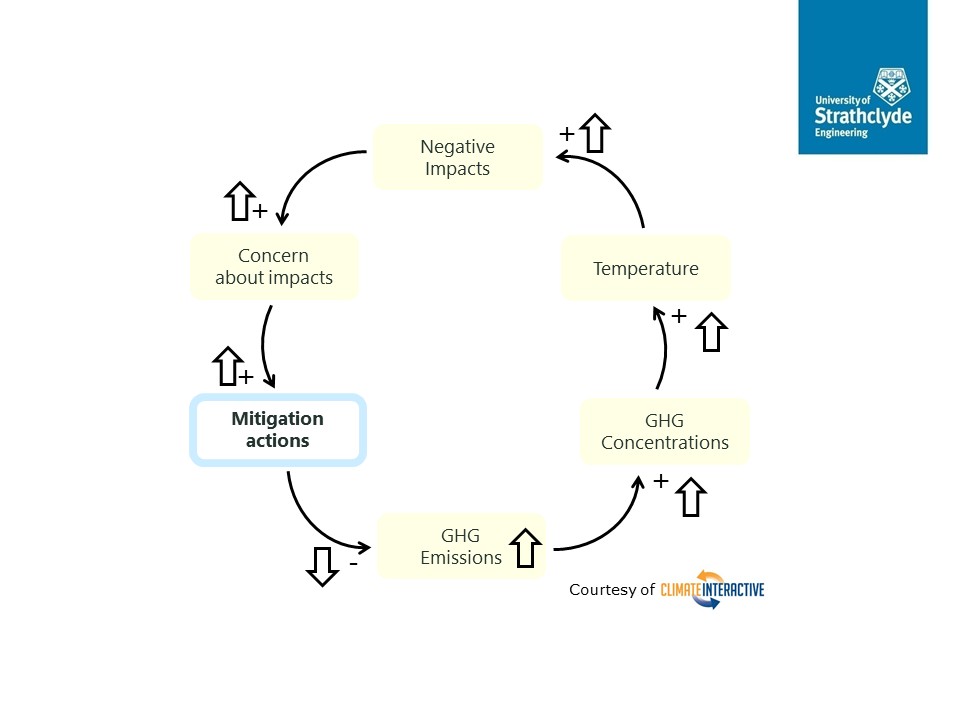
Figure 2. Causal loop diagram showing how increasing GHG emissions drive climate action and emissions reduction.
2. Initial actions brainstorm (5 mins)
-
- Ask cohort to use an online polling system, asking them to vote for their Top action (from the list of mitigating actions – see resources – En-Roads Control Panel) that that they think will have the greatest impact on reducing emissions and temperature.
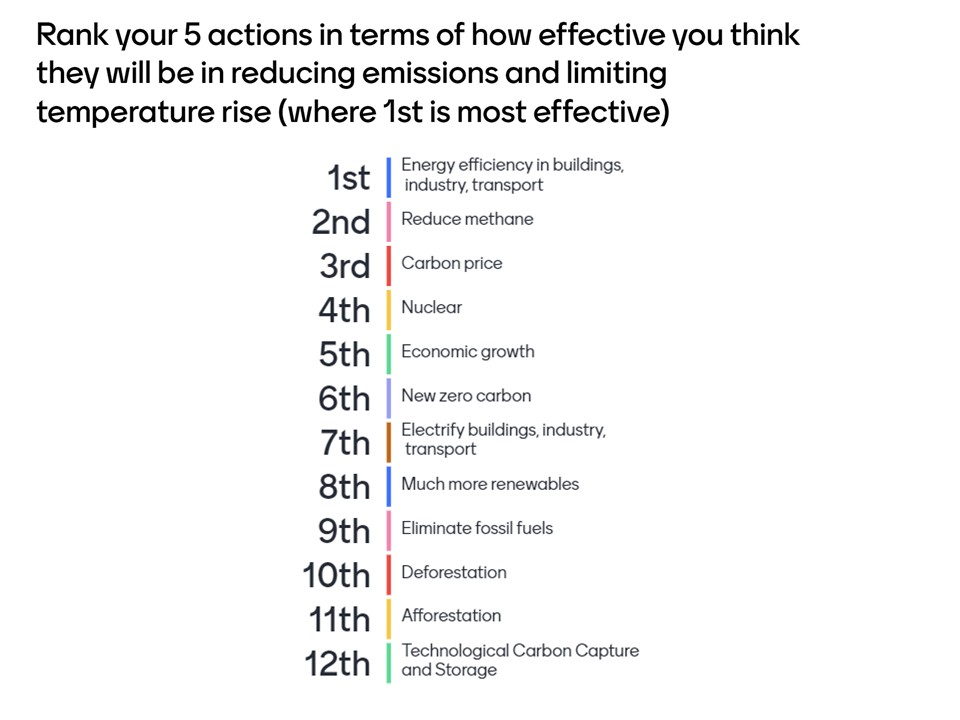
Figure 3. Example of a Menti poll to capture learners’ understanding of climate solution impacts.
- Don’t show this yet – keep this for later, when you will ask them to vote again and can then compare how their views have changed from beginning to end of session.
- Ask participants to self-sort into groups of 3–4, and now ask them to discuss what their Top 3 actions would be – they must agree on these.
3.Using EN-ROADS (15 mins)
-
- As facilitator, ask one group to volunteer their top action. Demonstrate their action using the simulator with an example (e.g. applying a coal phase-out or carbon tax).
-
- IMPORTANT: Before you implement the action – ask the group (and others) what they expect to happen to emissions and temperature.
-
- Apply their action and ask if it is what they expected. Then discuss why it is, or is not, what they expected to see.
-
- Highlight unintended consequences (e.g. rising energy prices and discussion on the real-world impacts this can have on local communities or households, land-use impacts).
-
- This does require the facilitator to be familiar with the simulator and what these impacts might be and how to use the simulator to show these (there is a Climate Interactive course available (Training, no date), which is free, and there are also many resources available for individuals to work through at their own pace).
-
- Can repeat this with other groups volunteering their top action. Ask for a group who has a different top action, or ask a group for their second top action to ensure you cover different levers.
4. Group simulation (15 mins)
-
- Ask groups to now use En-Roads to consider other levers to get temperature as close to 1.5oC as possible, to determine whether their initial top 5 ranking has changed.
-
- They should record how much each action reduces emissions and temperature rise.
-
- Take the poll again.
-
- Show both polls and look at differences – have they changed their views on certain actions – ask them why.
-
- Discuss: Which actions had the biggest effect? Which had less than expected? Why?
5. Achieving 1.5 °C (10 mins)
-
- Ask who reached 1.5oC
-
- Ask them to show their combined actions.
-
- Open up for discussion on how feasible these actions look – what are the implementation challenges associated with them. Are there risks of unintended consequences such as GDP, equity, biodiversity, etc?
6. Reflection and debrief (5 mins)
-
- Discuss key takeaways:
-
- The importance of combining multiple actions (“silver buckshot” rather than a silver bullet).
-
- Trade-offs and co-benefits (e.g. health, equity, biodiversity).
-
- The role (and challenge) of collaboration and consensus in policy decisions.
7. Post Workshop – optional
-
- Challenge groups to adjust policies and combinations of levers to approach the IEA’s Net Zero 2050 (1.5 °C) pathway, and compare their pathways with this. Gives them a sense of how challenging/possible the net-zero pathway will be.
Any views, thoughts, and opinions expressed herein are solely that of the author(s) and do not necessarily reflect the views, opinions, policies, or position of the Engineering Professors’ Council or the Toolkit sponsors and supporters.
 Author: Onyekachi Nwafor (KatexPower).