
Toolkit: Complex Systems Toolkit.

Author: Dr. Zareena Gani (University College London); Mohammed Alabdullatif, (University College London).

Topic: Designing and evaluating additively manufactured heat sinks: A systems approach to digital manufacturing.

Title: Teaching complex systems in advanced manufacturing.

Resource type: Teaching activity.

Relevant disciplines: Mechanical engineering; Production and manufacturing engineering.

Keywords: Additive manufacturing; Prototype evaluation; LabVIEW; Data acquisition; Systems thinking.

Licensing: This work is licensed under a Creative Commons Attribution-ShareAlike 4.0 International License. 

Downloads: A PDF of this resource will be available soon.

Related INCOSE Competencies: Toolkit resources are designed to be applicable to any engineering discipline, but educators might find it useful to understand their alignment to competencies outlined by the International Council on Systems Engineering (INCOSE). The INCOSE Competency Framework provides a set of 37 competencies for Systems Engineering within a tailorable framework that provides guidance for practitioners and stakeholders to identify knowledge, skills, abilities and behaviours crucial to Systems Engineering effectiveness.   A free spreadsheet version of the framework can be downloaded.

AHEP4 mapping:This resource addresses several of the themes from the UK’s Accreditation of Higher Education Programmes fourth edition (AHEP4):  Analytical Tools and Techniques (critical to the ability to model and solve problems), and Integrated / Systems Approach (essential to the solution of broadly-defined problems).

Educational level:  Intermediate; Advanced.

Learners have the opportunity to:

Teachers have the opportunity to:


Materials and tools required:

This activity utilises both computational design tools and an experimental thermal testing facility to establish a complete system feedback loop:

The experimental facility integrates the following components:


Learning and teaching resources:

Pre-reading includes literature on additive manufacturing, design for manufacture, and systems thinking in engineering. Students can review the references listed below to learn the fundamentals of heat sinks, guidance on heat sink design, and important considerations.


Overview:

This teaching activity introduces students to complex systems thinking by having them design, fabricate, and experimentally evaluate additively manufactured heat sinks. It can form part of an advanced manufacturing module, in which learners apply systems engineering principles to understand the interdependencies among design, manufacturing, and performance. The activity demonstrates how complex systems principles—such as feedback, emergence, and uncertainty—manifest in physical engineering systems. Students are guided to see the design–test–evaluate cycle as an iterative, data-driven process that links digital design environments with real-world performance outcomes.


Activity description:

The experiential learning activity links digital design, manufacturing, and physical evaluation using a complex systems framework. Students iterate designs, fabricate prototypes, and measure thermal performance, reflecting on interdependencies and feedback loops.


Session 1: Introduction:

Students are introduced to complex systems and additive manufacturing principles. Variables affecting heat sink performance – geometry, material, surface finish – are identified. The session frames these variables as part of an interconnected thermal management system.

Notes for educators:


Session 2*: Design and manufacture:

Teams create CAD models in Fusion 360 and prepare designs for metal additive manufacturing. Students analyse trade-offs between thermal performance, printability, and material efficiency, applying complex design thinking to balance competing requirements. Feedback from earlier simulations informs iterative design refinement.

Notes for educators:

Provide a design prompt (e.g. “Optimise heat sink geometry for maximum heat dissipation under given constraints”).

Share an evaluation rubric that assesses the following: design rationale, manufacturability, thermal performance, and discussion/reflection, including consideration of environmental and societal impacts.

Encourage peer-review sessions in which teams critique one another’s designs before fabrication.

*Advanced option:
Academics may incorporate Thermal Analysis Tools within Fusion 360 or CFD simulations (e.g. ANSYS Fluent) to evaluate design performance and refine heat sink geometry for optimal efficiency.


Session 3: Experimental set-up and evaluation:

Each prototype is tested using the dedicated testing facility, as shown in Figure 1.
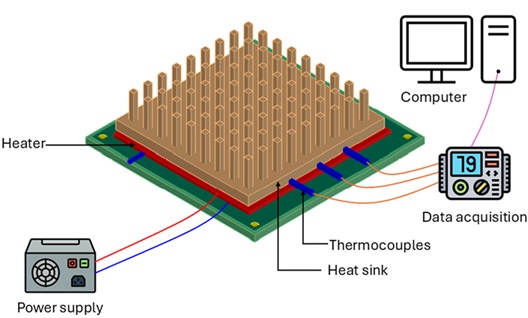
 

Figure 1: Schematic of the experimental facility for heat sink testing.

The experimental set-up used for evaluating the heat sink performance consists of a DC power supply (i.e. Velleman LABPS3003 30V, 3A), a polyimide-insulated flexible heater (i.e. OMEGA KHLVA-202/40), thermocouples (i.e. K type), a data acquisition system (i.e. NI USB-6210), and a computer for data recording, as shown schematically in Figure 1. A flexible heater is mounted beneath the heat sink, powered by a DC supply to simulate heat generation in microprocessors. Thermocouples are positioned at the heat sink base and calibrated to ASTM E230. A DOWSIL 340 thermal paste layer ensures optimal thermal contact. This enables accurate measurement of the thermal performance of fabricated heat sinks under controlled heat flux conditions.


Session 4: Data analysis and comparison:

A custom LabVIEW interface is developed to acquire, visualise, and log temperature and power data in real time, thereby providing a digital bridge between the physical test rig and the data analysis environment. Temperature and power data are acquired using LabVIEW with the NI USB-6210 DAQ card.
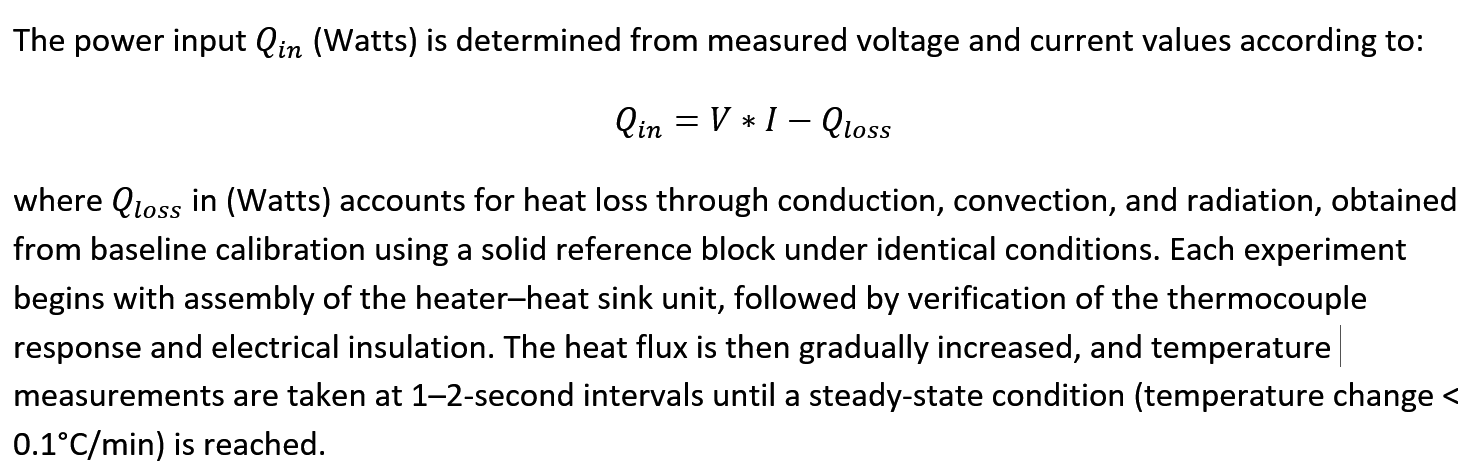
The evaluation and comparison of thermal performance among heat sink geometries designed by various student groups are conducted by recording the base temperature of each configuration as a function of time under a constant heat flux and identical ambient conditions. The transient temperature response, illustrated in Figure 2 (a), provides insight into the rate at which each design approaches steady state, whereas the steady-state base temperature indicates its overall heat dissipation capability. This procedure can be applied to any heat sink to assess and compare its thermal behaviour.
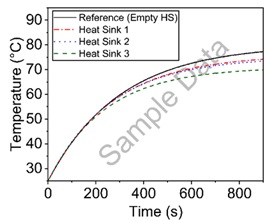
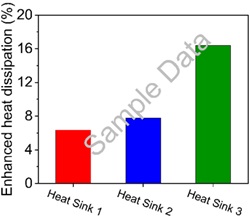
Figure 2: (a) Transient base temperature variation with time for the reference and three heat sink configurations. (b) Enhanced heat dissipation relative to the reference block, illustrating the method used to compare thermal performance across different designs. 

Students compare results and interpret the impact of geometry on heat dissipation. They connect observed variations to systemic dependencies between design, manufacture, and experimental performance.
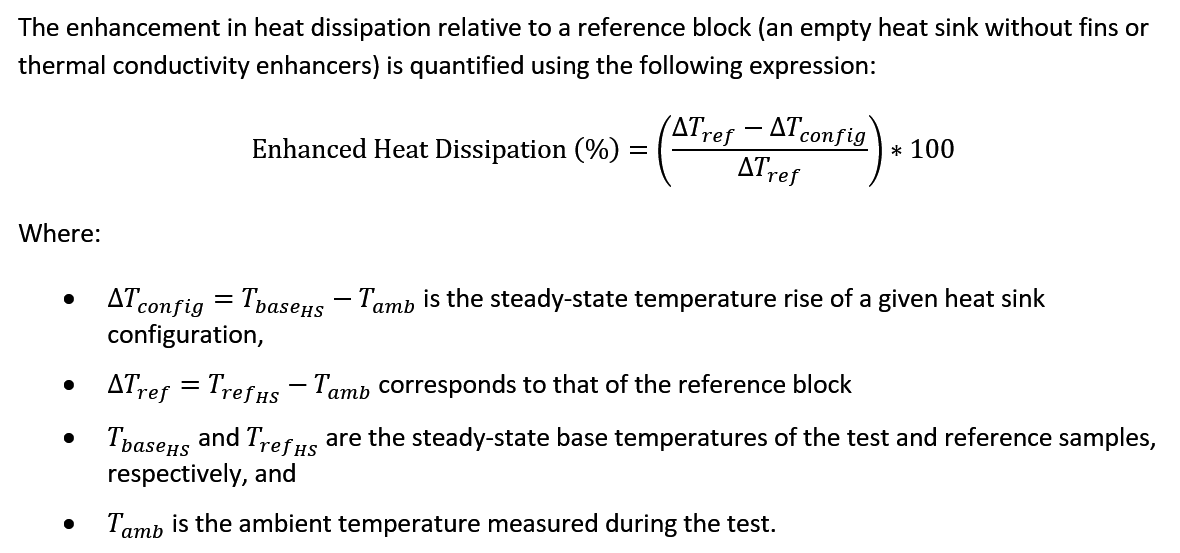
The computed enhancement values, shown in Figure 2 (b) allow direct comparison of heat dissipation efficiency among the different designs. By examining both the temperature–time response and the enhancement ratio, the effect of geometric modification on thermal performance can be quantitatively assessed within a unified experimental framework.

The experimental facility thus forms a closed digital loop connecting design, fabrication, and performance evaluation. The data acquired through LabVIEW and the DAQ system feed back into the design process, enabling iterative optimisation of heat-sink geometry and thermal-management strategies.


Session 5: Reflection:

Teams map out interdependencies between process variables, performance metrics, and uncertainties. They construct feedback diagrams (flowcharts) using Microsoft PowerPoint SmartArt, linking design iterations, measurements, and outcomes to identify emergent system behaviour.


Assessment and reflection:

The assessment can comprise a reflective report and a presentation.

Reports should include:

Presentations should summarise:


Additional image:  Heatsink fabricated using a metal 3D printer. 


Any views, thoughts, and opinions expressed herein are solely that of the author(s) and do not necessarily reflect the views, opinions, policies, or position of the Engineering Professors’ Council or the Toolkit sponsors and supporters.  

Toolkit: Complex Systems Toolkit.

Author: Professor Nici Zimmermann (University College London).

Topic: Illuminating complex interactions in a system through participatory modelling methods.  

Title: Using a participatory modelling approach to urban regeneration.

Resource type: Teaching activity.

Relevant disciplines: Any; civil engineering.

Keywords: Available soon.

Licensing: This work is licensed under a Creative Commons Attribution-ShareAlike 4.0 International License. 

Related INCOSE Competencies: Toolkit resources are designed to be applicable to any engineering discipline, but educators might find it useful to understand their alignment to competencies outlined by the International Council on Systems Engineering (INCOSE). The INCOSE Competency Framework provides a set of 37 competencies for Systems Engineering within a tailorable framework that provides guidance for practitioners and stakeholders to identify knowledge, skills, abilities and behaviours crucial to Systems Engineering effectiveness.  A free spreadsheet version of the framework can be downloaded.

This resource relates to the Systems Thinking, Systems Modelling and Analysis and Critical Thinking INCOSE competencies. 

AHEP mapping: This resource addresses several of the themes from the UK’s Accreditation of Higher Education Programmes fourth edition (AHEP4):  Analytical Tools and Techniques (critical to the ability to model and solve problems), and Integrated / Systems Approach (essential to the solution of broadly-defined problems). In addition, this resource addresses the AHEP themes of Design and Practical and workshop skills. 

Educational level: Intermediate; Advanced.


Learning and teaching notes: 

This activity is suitable for those having acquired some familiarity with complex systems and related concepts – especially causal loop diagrams, stock and flow diagrams, cognitive maps or participatory maps – who are looking for additional ideas for activities or who have a specific interest in participatory modelling. The activity is also useful at the point when students learn about interaction between different elements of a complex system or when they learn about the importance of human factors. 

Learners have the opportunity to:  

Teachers have the opportunity to: 


Downloads: 


Learning and teaching resources:


Overview:

This activity introduces students to a participatory systems thinking – or more specifically –  participatory modelling exercise. This is an approach used in group settings to explore complex issues and represent them via models. In this activity, students assume the roles of stakeholders involved in an urban regeneration project and take part in a group model-building workshop.  

It teaches students core principles of a participatory modelling method called group model-building or participatory system dynamics, but it can also be used to teach the underlying system structure of a specific phenomenon. This makes it well-suited for modules that contain elements of systems thinking and system dynamics (including causal loop diagramming and simulation modelling) or modules that contain an element on group facilitation and participatory methods.  

The activity is designed to run over 1.5 to 2.5 hours and is adaptable. While the current example focuses on the phenomenon of urban dynamics around the population development in a city, the activity can be reframed using a case and model from a project management, water management, energy or other sustainability-related context. 

The activity is directly aligned with systems thinking by immersing students in a participatory modelling process. It develops students’ awareness of system content and its interactions by teaching them qualitative modelling skills. It develops their skills in managing complexity and representing system elements with visual models consisting of items and their relationships depicted in causal loop diagrams and/or stock and flow diagrams. This serves to build students’ analysis skills and ability to apply systems approaches to problems. It also develops their practitioner, practical and workshop skills of collaborating with stakeholders. It does so by advancing their facilitation skills essential for collaborative systems work. This includes rules of conduct and techniques for managing a group discussion and group dynamics, making a broad range of ideas heard, prioritising them and mapping them visually. 


Materials or software required:

For in-person sessions, the following materials are recommended: 

If software or an online tool are used, these are used to collate concepts (variables suggested by students) and to build a diagram of their interactions. This will be projected to the in-person and/or online participants, replicating the participatory nature of in-person workshops. 


Detailed explanation of the activity:  

This activity introduces students to participatory modelling, an approach used in group settings to explore and understand complex issues and represent them via models. In this case, participatory modelling is introduced through a structured group model-building workshop, using a simplified version (Alfeld & Graham, 1976; Richardson, 2014) of Jay Forrester’s (1969) famous Urban Dynamics model, which sparked quite some debate because of its counter-intuitive insights. The session begins with a brief historical overview of urban growth and decline in major cities up to the 1980s (e.g. New York, Boston, London; see files under ‘Downloads’, above), before focusing on the London Docklands in London in 1981, as an example of an opportunity for urban redevelopment to counter the trend of population decline. Student groups are assigned stakeholder roles from that time, including the founder of the London Docklands Development Corporation (1–2 students), the Surrey Quays Housing Action Group (2–6 students), the London Chamber of Commerce (2–6 students) and the Greater London Council (2–6 students). Each student group receives a role sheet outlining their perspective and a small set of key variables relevant to their stakeholder position (see linked files). These variables are intentionally curated to align with the Urban Dynamics model and to ensure that collaboration is necessary to draw the interlinkages between the variables, i.e. the relevant system structure.  

A list of variables provided to the student groups via the role sheets is included below. Note that not all variables that are necessary to draw the model are included; students need to infer a few variables to train their thinking. 

Before the workshop begins, students are introduced to core concepts of participatory modelling (see linked slides), including facilitator roles (based on Richardson & Andersen, 1995) and common workshop scripts (e.g. hopes and fears, variable elicitation, voting, model building, policy option elicitation and system storytelling, as described in Scriptapedia and Andersen & Richardson, 1997). 

The workshop proceeds in three main phases: 

1. Variable elicitation: After a short introduction by the student playing the founder of the London Docklands Development Corporation into the setting and by the facilitator/teacher into the process, each group sketches behaviour-over-time graphs of their assigned variables (10 minutes). These are presented using a round-robin or nominal group technique, meaning one variable per group at a time only, and placed on a whiteboard/blackboard or digital canvas. The round-robin collection is a technique useful to foster inclusivity and avoid talking heads. Behaviour-over-time graphs rather than just variable names are useful because the final model is believed to explain a behavioural trend over time, linking model structure and dynamics. However, it is also possible to simplify by letting students just write the variable names on sheets of paper. 

2. Voting and prioritisation: To decide on a starting point for modelling, each student votes on which variables they consider to be the most important to include in the model, e.g. giving the students as many votes as there are variables on the board and freedom of how to distribute their votes. While all variables will be included in the model, the voting activity provides a basis for reflection on different priorities and students’ personal vs. their group’s perspective, after the modelling activity. 

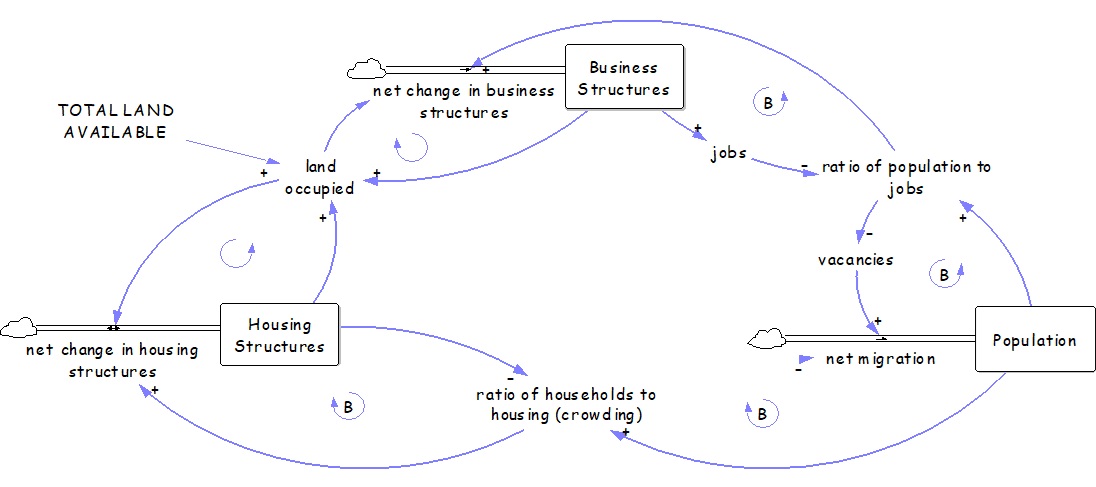
3. Model building: The class collaboratively constructs a stock and flow diagram (see Figure 1). Stocks such as Housing Structures, Business Structures, and Population are identified, and their net rates of change are discussed. To connect the variables, some more variables need to be added such as the ratio of population to jobs, total land available, and land occupied. To help students identify these variables, the teacher can ask questions: “Population and housing are linked by a ratio. What concepts and respective variables could link the other stocks?”. Students are encouraged to identify feedback loops and classify them as reinforcing or balancing. 

It is useful to pay attention to uncovering less obvious relationships, such as the spatial competition between housing and business infrastructure. Once the diagram is complete, the facilitator reviews the model with the class, highlighting key feedback structures. 

After the modelling activity, students can be shown images of the Docklands after the redevelopment as well as urban population trends of London and other major cities until today, prompting discussion on the long-term impacts of different types of development and prioritisation of a business vs. housing focus. The session can conclude with a reflection on the participatory process and its relevance to real-world decision-making and the value of participatory modelling in complex policy environments. 

A more comprehensive version of this activity – including a more introductory group model-building exercise that teaches basic causal loop diagramming concepts and an alternative context using project management as an example – is available: https://discovery.ucl.ac.uk/id/eprint/10160261/   


Figure 1: Stock and flow diagram of urban dynamics (produced with Vensim software). This figure is intended for educators and serves an illustrative purpose. It provides educators with a reference for how the model built during the activity is expected to look. 


Note: The author was originally inspired to focus on this case by the historical accounts found on the London Docklands Development Corporation (LDDC) History Pages (http://www.lddc-history.org.uk/index.html, now inactive).  


References:


Any views, thoughts, and opinions expressed herein are solely that of the author(s) and do not necessarily reflect the views, opinions, policies, or position of the Engineering Professors’ Council or the Toolkit sponsors and supporters.  

Toolkit: Complex Systems Toolkit.

Author: Dr. Ewa Ura-Binczyk (Warsaw University of Technology).

Topic: Rail accident investigation and material failure analysis using systems thinking.

Title: Using fault tree analysis in a rail failure investigation.

Resource type: Teaching – Case study.

Relevant disciplines: Mineral, metallurgy & materials engineering; Civil engineering.

Keywords: Public health and safety; Risk; Fault tree analysis; Failure; Ethics; Public trust; Stakeholders; Trade offs; Uncertainty.

Licensing: This work is licensed under a Creative Commons Attribution-ShareAlike 4.0 International License. 

Related INCOSE Competencies: Toolkit resources are designed to be applicable to any engineering discipline, but educators might find it useful to understand their alignment to competencies outlined by the International Council on Systems Engineering (INCOSE). The INCOSE Competency Framework provides a set of 37 competencies for Systems Engineering within a tailorable framework that provides guidance for practitioners and stakeholders to identify knowledge, skills, abilities and behaviours crucial to Systems Engineering effectiveness.   A free spreadsheet version of the framework can be downloaded.

This resource relates to the Systems Thinking, Systems Modelling and Analysis, Ethics and Professionalism, Technical Leadership and Critical Thinking INCOSE Competencies.

AHEP4 mapping: This resource addresses several of the themes from the UK’s Accreditation of Higher Education Programmes fourth edition (AHEP4): Analytical Tools and Techniques (critical to the ability to model and solve problems), and Integrated / Systems Approach (essential to the solution of broadly-defined problems). In addition, this resource addresses AHEP themes of Design, Ethics and Communication. 

Educational level: Intermediate; Advanced.


Learning and teaching notes:

The case is built around 3 × 90-minute sessions and independent report writing. A suggested breakdown of the activities can be seen below. 

Learners have the opportunity to: 

Teachers have the opportunity to: 


Downloads: 


Learning and teaching resources:


Session  Focus  Suggested activities and timing 
1  Introduction and problem framing  20 min: Introduce case scenario and system context; 30 min: Group discussion on initial impressions, key stakeholders, and potential causes; 40 min: Begin Fault Tree Analysis (FTA) construction using initial evidence. 
2  Investigation and analysis  30 min: Continue FTA construction and data evaluation; 30 min: Peer review of other groups’ fault trees; 30 min: Consolidate findings and prepare draft report outline. 
3  Reporting and reflection  30 min: Present findings to a simulated stakeholder panel; 30 min: Discuss feedback and defend conclusions; 30 min: Individual reflection on complexity, uncertainty, and assumptions. 


Summary of the system or context:

Rail transport systems consist of thousands of interdependent components, including rails, fasteners, sleepers, signalling systems, and maintenance processes. Failures in a single component can cascade, affecting: 


Complex system features: 


Narrative of the case:

On a cold January morning, a commuter train was halted after inspectors discovered a fractured rail joint component. Services were disrupted for several hours, stranding thousands of passengers. The media quickly picked up the story, raising questions about safety and reliability. 

The rail operator urgently commissioned an engineering consultancy (the students) to investigate the failure. Their findings will inform both the safety authority’s decision on whether the line can reopen and the legal proceedings to determine liability. 


The dilemma: 

As consultants, students face incomplete evidence: some lab tests are missing, inspection logs are inconsistent, and eyewitness accounts conflict. They must use Fault Tree Analysis (FTA) to map possible causes, evaluate data, and produce an expert opinion report — knowing that their conclusions could influence legal outcomes and public safety decisions. 

Groups: 3–5 students per group; 3-4 groups can run in parallel. 

Materials required: case narrative handouts, sample inspection log, example FTA, whiteboards/flipcharts, sticky notes for FTA mapping. 

Activity flow: 

1. Introduce case and assign roles. 

2. Construct initial fault trees using evidence. 

3. Peer-review across groups. 

4. Draft expert report and present to simulated stakeholder panel. 

5. Individual reflection on complexity and uncertainty. 


Why use Fault Tree Analysis (FTA):

FTA is a structured approach to trace a failure from an observed event back to potential causes, including technical, human, and organisational factors. 

FTA is particularly suitable for this case because it allows students to structure complex, uncertain information in a logical and transparent way. It helps them trace the chain of causes behind the rail component failure, linking material, human, and organisational factors into one coherent framework. By visualising how small events combine into system-level failures, FTA encourages learners to think critically about interdependencies, data gaps, and assumptions. It also mirrors real-world engineering investigations, where professionals must justify conclusions under uncertainty and demonstrate clear reasoning to stakeholders such as regulators or courts. 

Advantages in this case: 


Questions and activities: 

Prompt  Expected insight / reflection 
What technical, human, and organisational factors might have contributed to this failure?  Students identify multiple interacting factors, illustrating interdependencies and emergent risks. 
How does Fault Tree Analysis help structure uncertainty in this investigation?  Learners recognise FTA’s role in visualising cause-effect pathways and clarifying assumptions. 
Which assumptions are you forced to make, and how might they affect your conclusions?  Students reflect on data gaps, biased observations, and ethical implications of assumptions. 
How do different stakeholders’ interests shape urgency and framing of your analysis?  Learners understand trade-offs, pressures from conflicting priorities, and the precautionary principle. 
What are the risks of issuing a preliminary report under time pressure?  Students explore implications for safety, liability, professional integrity, and public trust. 


Activity  Focus  What “good practice” looks like  Facilitator notes / tips 
1. FTA construction  Collaborative problem analysis  Teams discuss evidence openly, question assumptions, and co-create a logical tree linking technical, human, and organisational causes.   Encourage each group to identify at least one “human/organisational” branch and to label any data gaps explicitly. 
2. Peer review  Critical reflection and systems perspective  Groups provide constructive critique, highlighting hidden assumptions, missing branches, or unclear logic. Dialogue stays professional and evidence-based.  Provide coloured sticky notes or digital comments to record feedback; model how to frame critique as questions (“Have you considered…?”). 
3. Report writing (in-class drafting)  Synthesis and professional communication  Drafts show a clear, defensible reasoning chain from evidence to conclusion. Teams justify assumptions and note uncertainties.  Remind students to separate “facts” from “interpretations.” Encourage use of structured headings (Findings – Analysis – Conclusions). 
4. Simulation role-Play  Perspective-taking and communication under pressure  Presentations are concise (≤5 min), factual, and adapted to stakeholder roles. Learners respond respectfully and clearly to challenging questions.  Provide role cards for the panel (operator, regulator, manufacturer, public). Rotate students if possible. 
5. Reflection  Metacognition and learning from uncertainty  Students identify what surprised them, what they found ambiguous, and how their view of engineering judgment evolved.  Offer prompts like “What would you do differently next time?” or “Where did your reasoning feel uncertain?” 


Further challenge:

Instructors may choose to introduce a second “reveal” phase: a new metallurgical test result or a whistle-blower statement emerges halfway through the case. Students must revise their fault tree and defend whether and how their conclusions change. This highlights the evolving nature of complex systems investigations. 


Assessment opportunities:


Any views, thoughts, and opinions expressed herein are solely that of the author(s) and do not necessarily reflect the views, opinions, policies, or position of the Engineering Professors’ Council or the Toolkit sponsors and supporters.  


Case study example: Water wars: managing competing water rights

Activity: Assessment. This example demonstrates how the questions provided in Assessing ethics: Rubric can be used to assess the competencies stipulated at each level.

Authors: Dr. Natalie Wint (UCL); Dr. William Bennett (Swansea University).

Related content:


Water wars: managing competing water rights 

This example demonstrates how the questions provided in the accompanying rubric can be used to assess the competencies stipulated at each level. Although we have focused on ‘Water Wars’ here, the suggested assessment questions have been designed in such a way that they can be used in conjunction with the case studies available within the toolkit, or with another case study that has been created (by yourself or elsewhere) to outline an ethical dilemma. 

Year 1 

Personal values: What is your initial position on the issue? Do you see anything wrong with how DSS are using water? Why, or why not?

Professional responsibilities: What ethical principles and codes of conduct are relevant to this situation?

Ethical principles and codes of conduct can be used to guide our actions during an ethical dilemma. How does the guidance provided in this case align/differ with your personal views? (This is a question we had created in addition to those provided within the case study to meet the requirements stipulated in the accompanying rubric.)

What are the moral values involved in this case and why does it constitute an ethical dilemma? (This is a question we had created in addition to those provided within the case study to meet the requirements stipulated in the accompanying rubric.)

What role should an engineer play in influencing the outcome? What are the implications of not being involved? (This is a question we had created in addition to those provided within the case study to meet the requirements stipulated in the accompanying rubric.)

Year 2 

Formulate a moral problem statement which clearly states the problem, its moral nature and who needs to act. (This is a question we had created in addition to those provided within the case study to meet the requirements stipulated in the accompanying rubric.)

Stakeholder mapping: Who are all the stakeholders in the scenario? What are their positions, perspective and moral values?

Stakeholder  Perspectives/interests  Moral values 
Data Storage Solutions (DSS)  Increasing production in a profitable way; meeting legal requirements; good reputation to maintain/grow customer base.  Accountability; sustainability (primarily economic). 
Farmers’ union  Represent farmers who suffer from economic implications associated with costly irrigation.  Accountability; environmental sustainability; justice. 
Farm  The farm (presumably) benefits from DSS using the land.  Ownership and property; environmental sustainability; justice. 
Local Green Party  Represent views of those concerned about biodiversity. May be interested in opening of green battery plant.  Human welfare; environmental sustainability; justice. 
Local Council  Represent views of all stakeholders and would need to consider economic benefits of DSS (tax and employment), the need of the university and hospital, as well as the needs of local farmers and environmentalists. May be interested in opening of green battery plant.  Human welfare and public health; trust; accountability; environmental sustainability; justice. 
Member of the public  This may depend on their beliefs as an individual, their employment status and their use of services such as the hospital and university. Typically interested in low taxes/responsible spending of public money. May be interested in opening of green battery plant.  Human welfare; trust; accountability; environmental sustainability; justice. 
Stakeholders using DSS data storage  Reliable storage. They may also be interested in being part of an ethical supply chain.  Trust; privacy; accountability; autonomy. 
Non-human stakeholders  Environmental sustainability. 


What are some of the possible courses of action in the situation. What responsibilities do you have to the various stakeholders involved? What are some of the advantages and disadvantages associated with each? (Reworded from case study.)

What are the relevant facts in this scenario and what other information would you like to help inform your ethical decision making? (This is a question we had created in addition to those provided within the case study to meet the requirements stipulated in the accompanying rubric.)


Year 2/Year 3  

(At Year 2, students could provide options; at Year 3 they would evaluate and form a judgement.) 

Make use of ethical frameworks and/or professional codes to evaluate the options for DSS both short term and long term. How do the uncertainty and assumptions involved in this case impact decision making?

Option  Consequences  Intention  Action 
Keep using water  May lead to expansion and profit of DSS and thus tax revenue/employment and supply. 

Reputational damage of DSS may increase. Individual employee piece of mind may be at risk. 

Farmers still don’t have water and biodiversity still suffers which may have further impact long term. 

Intention behind action not consistent with that expected by an engineer, other than with respect to legality  Action follows legal norms but not social norms such as good will and concern for others. 
Keep using the water but limit further work  May limit expansion and profit of DSS and thus tax revenue/employment and supply. 

Farmers still don’t have water and biodiversity still suffers and may have further impact long term. This could still result in reputation damage. 

Intention behind action partially consistent with that expected by an engineer.  Action follows legal norms but only partially follow social norms such as good will and concern for others. 
Make use of other sources of water  Data storage continues. 

Potential for reputation to increase. 

Potential increase in cost of water resulting in less profit potentially less tax revenue/employment. 

Farmers have water and biodiversity may improve.

Alternative water sources may be associated with the same issues or worse. 

Intention behind action seems consistent with that expected by an engineer. However, this is dependent upon 

whether they chose to source sustainable water with less impact on biodiversity etc. 

This may be dependent on the degree to which DSS proactively source sustainable water. 
Reduce work levels or shut down  Impact on profit and thus tax revenue/employment and supply chain. Farmers have water and biodiversity may improve. 

May cause operational issues for those whose data is stored. 

Seems consistent with those expected of engineer. Raises questions more generally about viability and feasibility of data storage.  Action doesn’t follow social norms of responsibility to employees and shareholders. 
Investigate other cooling methods which don’t require as much water/don’t take on extra work until another method identified. 
May benefit whole sector. 

May cause interim loss of service. 


This follows expectations of the engineering profession in terms of evidence-based decision making and consideration for impact of engineering in society.  It follows social norms in terms of responsible decision making. 


Downloads:

Assessing ethics: Guidance

Assessing ethics: Rubric

Assessing ethics: Case study assessment example: Water Wars


This work is licensed under a Creative Commons Attribution-ShareAlike 4.0 International License.

Any views, thoughts, and opinions expressed herein are solely that of the author(s) and do not necessarily reflect the views, opinions, policies, or position of the Engineering Professors’ Council or the Toolkit sponsors and supporters.

Authors: Mr. Neil Rogers (Independent Scholar), Dr. Sarah Jayne Hitt Ph.D. SFHEA (NMITE, Edinburgh Napier University) 

Topic: Designing a flood warning system to communicate risk. 

Tool type: Teaching. 

Engineering disciplines: Electronic; Energy; Mechanical. 

Keywords: Climate change; Water and sanitation; Renewable energy; Battery Technologies; Recycling or recycled materials; AHEP; Sustainability; Student support; Local community; Environment; Future generations; Risk; Higher education; Assessment; Project brief. 

Sustainability competency: Systems thinking; Anticipatory; Strategic; Integrated problem-solving; Normative.

AHEP mapping: This resource addresses two of the themes from the UK’s Accreditation of Higher Education Programmes fourth edition (AHEP4): The Engineer and Society (acknowledging that engineering activity can have a significant societal impact) and Engineering Practice (the practical application of engineering concepts, tools and professional skills). To map this resource to AHEP outcomes specific to a programme under these themes, access AHEP 4 here and navigate to pages 30-31 and 35-37. Potential alignments with AHEP criteria are shown below. 

Related SDGs: SDG 7 (Affordable and Clean Energy); SDG 11 (Sustainable Cities and Communities). 

Reimagined Degree Map Intervention: More real-world complexity; Active pedagogies and mindset development; Authentic assessment.

Educational level: Intermediate / Advanced. 


Learning and teaching notes: 

This resource outlines a project brief that requires an engineer to assess the local area to understand the scale of flooding and the local context. This will highlight how climate change affects everyday life, how water usage is changing and happening on our doorstep.

The project also requires the engineer to be considerate of the needs of a local business and showcases how climate change affects the economy and individual lives, enabling some degree of empathy and compassion to this exercise.

Depending upon the level of the students and considering the needs of modules or learning outcomes, the project could follow either or both of the following pathways: 


Pathway 1 – Introduction to Electronic Engineering (beginner/intermediate- Level 4) 

In this pathway, the project deliverables could be in the form of a physical artefact, together with a technical specification. 


Pathway 2 – Electromagnetics in Engineering (intermediate/advanced- Level 5) 

This project allows teachers the option to stop at multiple points for questions and/or activities as desired.  


Learners have the opportunity to: 

Teachers have the opportunity to: 


Learning and teaching resources: 


Overview:  

A local business premises near to a river has been suffering from severe flooding over the last 10 years. The business owner seeks to install a warning system that can provide adequate notice of a possible flood situation. 


Time frame & structure:
This project can be completed over 30 hours, either in a block covering 2-3 weeks (preferred) or 1 hour per week over the academic term. This project should be attempted in teams of 3-5 students. This would enable the group to develop a prototype, but the Specification (Pathway 1) and Technical Report (Pathway 2) could be individual submissions without collusion to enable individual assessment.

It is recommended that a genuine premises is found that has had the issues described above and a site visit could be made. This will not only give much needed context to the scenario but will also trigger emotional response and personal ownership to the problem. 

To prepare for activities related to sustainability, teachers may want to read, or assign students to pre-read the following article:
‘Mean or Green: Which values can promote stable pro-environmental behaviour?’ 


Context and Stakeholders: 

Flooding in the local town has become more prevalent over recent years, impacting homes and businesses. A local coffee shop priding itself on its ethical credentials is located adjacent to the river and is one of the businesses that has suffered from severe flooding over the last 10 years, causing thousands of pounds worth of spoilt stock and loss of revenue. The local council’s flood warning system is far from adequate to protect individuals on a site-by-site basis. So the shop is looking for an individual warning system, giving the manager and staff adequate notice of a possible flood situation. This will enable stock to be moved in good time to a safer drier location. The shop manager is very conscious of wanting to implement a sustainable design that uses sustainable materials and renewable energy, to promote the values of the shop. It is becoming clear that such a solution would also benefit other businesses that experience flooding and a wider solution should also be considered. 


Pathway 1 

This project requires assessment of the local area and ideally a visit to the retailer to understand their needs and consider options for water level monitoring. You are required to consider environmental and sustainable factors when presenting a solution.

After a visit to the premises:  

  1. Discussion: What is your initial reaction to the effects of the flooding and does it surprise you? What might your initial reaction reveal to you about your own perspectives and values?
  2. Discussion: What is your initial reaction to the causes of the flooding and does it surprise you? What might your initial reaction reveal to you about your own perspectives and values?
  3. Discussion and activity: List the potential issues and risks to installing a device in or near to the river bank.
  4. Activity: Research water level monitoring. What are the main technical and logistical issues with this technology in this scenario?
  5. Activity: Both cost-benefit and sustainable trade-off analyses are valuable approaches to consider in this case.  Determine the possible courses of action and undertake both types of analysis for each position by considering both short- and long-term consequences.    
  6. Reflection: Obligations to future generations: Do we have a responsibility to provide a safe and healthy environment for humans that don’t yet exist, or for an ecosystem that will eventually change? 


Design Process​:

To satisfy the learning outcomes identified above the following activities are suggested. 


Assessment activity 1 – Physical artefact: 

Design, build and test a prototype flood warning device, monitoring various water levels and controlling an output or outputs in an alarm condition to meet the following as a minimum:
 

a) The device will require the use of an analogue sensor that will directly or indirectly output an electrical signal proportional to the water level. 

b) It will integrate to appropriate Operational Amplifier circuitry. 

c) The circuitry will control an output device or devices. 

d) The power consumption of the complete circuit will be assessed to allow an appropriate renewable energy supply to be specified (but not necessarily be part of the build). 


Assessment activity 2 – Technical specification: 

The written specification and accompanying drawings shall enable a solution to be manufactured based on the study, evaluation and affirmation of the product requirements. 

The evaluation of the product requirements and consequent component selection will reference the use of design tools and problem-solving techniques. In compiling the specification the component selection and integration will highlight the underlying engineering principles that have been followed. The specification shall be no more than 1000 words (plus illustrations and references). 


Pathway 2

This project requires assessment of the local area and ideally a visit to the retailer to understand their needs and consider options for water level monitoring.

You are required to consider environmental and sustainable factors when presenting a solution. 

After a visit to the premises:  

  1. Discussion: What is your initial reaction to the effects of the flooding and does it surprise you? What might your initial reaction reveal to you about your own perspectives and values?
  2. Discussion: What is your initial reaction to the causes of the flooding and does it surprise you? What might your initial reaction reveal to you about your own perspectives and values?
  3. Discussion and activity: List the potential issues and risks to installing a device in or near to the river bank.
  4. Activity: Both cost-benefit and sustainable trade-off analyses are valuable approaches to consider in this case.  Determine the possible courses of action and undertake both types of analysis for each position by considering both short- and long-term consequences.      


Wireless communication of information electronically is now commonplace. It’s important for the learners to understand the differences between the various types both technically and commercially to enable the most appropriate form of communication to be chosen.

Pathway 1 above explains the need for a flood warning device to monitor water levels of a river. In Pathway 2, this part of the challenge (which could be achieved in isolation) is to communicate this information from the river to an office location within the town. 


Design Process: 

Design a communications system that will transmit data, equivalent to the height of the river in metres. The maximum frequency and distance over which the data can be transmitted should be explored and defined, but as a minimum this data should be sent every 20 seconds over a distance of 500m. 


Assessment activity – Technical report:       

A set of user requirements and two possible technical solutions shall be presented in the form of a Technical Report: 

The report shall be no more than 3000 words (plus illustrations and references)  


This work is licensed under a Creative Commons Attribution-ShareAlike 4.0 International License.  

Any views, thoughts, and opinions expressed herein are solely that of the author(s) and do not necessarily reflect the views, opinions, policies, or position of the Engineering Professors’ Council or the Toolkit sponsors and supporters. 

To view a plain text version of this resource, click here to download the PDF.

Authors: Ahmet Omurtag (Nottingham Trent University); Andrei Dragomir (National University of Singapore / University of Houston).

Topic: Data security of smart technologies.

Engineering disciplines: Electronics; Data; Biomedical engineering.

Ethical issues: Autonomy; Dignity; Privacy; Confidentiality.

Professional situations: Communication; Honesty; Transparency; Informed consent; Misuse of data.

Educational level: Advanced.

Educational aim: Practising Ethical Analysis: engaging in a process by which ethical issues are defined, affected parties and consequences are identified, so that relevant moral principles can be applied to a situation in order to determine possible courses of action.


Learning and teaching notes:

This case involves Aziza, a biomedical engineer working for Neuraltrix, a hypothetical company that develops Brain-computer interfaces (BCI) for specialised applications. Aziza has always been curious about the brain and enthusiastic about using cutting-edge technologies to help people in their daily lives. Her team has designed a BCI that can measure brain activity non-invasively and, by applying machine learning algorithms, assess the job-related proficiency and expertise level of a person. She is leading the deployment of the new system in hospitals and medical schools, to be used in evaluating candidates being considered for consultant positions. In doing so, and to respond to requests to extend and use the BCI-based system in unforeseen ways, she finds herself compelled to weigh various ethical, legal and professional responsibilities.

This case study addresses two of AHEP 4’s themes: The Engineer and Society (acknowledging that engineering activity can have a significant societal impact) and Engineering Practice (the practical application of engineering concepts, tools and professional skills). To map this case study to AHEP outcomes specific to a programme under these themes, access AHEP 4 here and navigate to pages 30-31 and 35-37.

The dilemma in this case is presented in three parts. If desired, a teacher can use the Summary and Part one in isolation, but Parts two and three develop and complicate the concepts presented in the Summary and Part one to provide for additional learning. The case allows teachers the option to stop at multiple points for questions and/or activities as desired.

Learners have the opportunity to:

Teachers have the opportunity to:


Learning and teaching resources:

Legal regulations:

Professional organisations:

Philanthropic organisations:

Journal articles:

Educational institutions:


Summary:

Brain-computer interfaces (BCIs) detect brain activity and utilise advanced signal analysis to identify features in the data that may be relevant to specific applications. These features might provide information about people’s thoughts and intentions or about their psychological traits or potential disorders, and may be interpreted for various purposes such as for medical diagnosis, for providing real-time feedback, or for interacting with external devices such as a computer. Some current non-invasive BCIs employ unobtrusive electroencephalography headsets or even optical (near-infrared) sensors to detect brain function and can be safe and convenient to use.

Evidence shows that the brains of people with specialised expertise have identifiable functional characteristics. Biomedical technology may translate this knowledge soon into BCIs that can be used for objectively assessing professional skills. Researchers already know that neural signals support features linked to levels of expertise, which may enable the assessment of job applicants or candidates for promotion or certification.

BCI technology would potentially benefit people by improving the match between people and their jobs, and allowing better and more nuanced career support. However, the BCI has access to additional information that may be sensitive or even troubling. For example, it could reveal a person’s health status (such as epilepsy or stroke), or it may suggest psychological traits ranging from unconscious racial bias to psychopathy. Someone sensitive about their privacy may be reluctant to consent to wearing a BCI.

In everyday life, we show what is on our minds through language and behaviour, which are normally under our control, and provide a buffer of privacy. BCIs with direct access to the brain and increasing capability to decode its activity may breach this buffer. Information collected by BCIs could be of interest not only to employers who will decide whether to hire and invest in a new employee, but also to health insurers, advertising agencies, or governments.


Optional STOP for questions and activities:

1. Activity: Risks of brain activity decoding – Identify the physical, ethical, and social difficulties that could result from the use of devices that have the ability to directly access the brain and decipher some of its psychological content such as thoughts, beliefs, and emotions.

2. Activity: Regulatory oversight – Investigate which organisations and regulatory bodies currently monitor and are responsible for the safe and ethical use of BCIs.

3. Activity: Technical integration – Investigate how BCIs work to translate brain activity into interpretable data.


Dilemma – Part one:

After the company, Neuraltrix, deployed their BCI and it had been in use for a year in several hospitals, its lead developer Aziza became part of the customer support team. While remaining proud and supportive of the technology, she had misgivings about some of its unexpected ramifications. She received the following requests from people and institutions for system modifications or for data sharing:

1. A hospital asked Neuraltrix for a technical modification that would allow the HR department to send data to their clinical neurophysiologists for “further analysis,” claiming that this might benefit people by potentially revealing a medical abnormality that might otherwise be missed.

2. An Artificial Intelligence research group partnering with Neuraltrix requested access to the data to improve their signal analysis algorithms.

3. A private health insurance company requested Neuraltrix provide access to the scan of someone who had applied for insurance coverage; they stated that they have a right to examine the scan just as life insurance agencies are allowed to perform health checks on potential customers.

4. An advertising agency asked Neuraltrix for access to their data to use them to fine-tune their customer behavioural prediction algorithms.

5. A government agency demanded access to the data to investigate a suspected case of “radicalisation”.

6. A prosecutor asked for access to the scan of a specific person because she had recently been the defendant in an assault case, where the prosecutor is gathering evidence of potential aggressive tendencies.

7. A defence attorney requested data because they were gathering potentially exonerating evidence, to prove that the defendant’s autonomy had been compromised by their brain states, following a line of argument known as “My brain made me do it.”


Optional STOP for questions and activities: 

1. Activity: Identify legal issues – Students could research what laws or regulations apply to each case and consider various ways in which Neuraltrix could lawfully meet some of the above requests while rejecting others, and how their responses should be communicated within the company and to the requestor.

2. Activity: Identify ethical issues – Students could reflect on what might be the immediate ethical concerns related to sharing the data as requested.

3. Activity: Discussion or Reflection – Possible prompts:


Dilemma – Part two:

The Neuraltrix BCI has an interface which allows users to provide informed consent before being scanned. The biomedical engineer developing the system was informed about a customer complaint which stated that the user had felt pressured to provide consent as the scan was part of a job interview. The complaint also stated that the user had not been aware of the extent of information gleaned from their brains, and that they would not have provided consent had been made aware of it.


Optional STOP for questions and activities: 

1. Activity: Technical analysis – Students might try to determine if it is possible to design the BCI consent system and/or consent process to eliminate the difficulties cited in the complaint. Could the device be designed to automatically detect sensitive psychological content or allow the subject to stop the scan or retroactively erase the recording?

2. Activity: Determine the broader societal impact and the wider ethical context – Students should consider what issues are raised by the widespread availability of brain scans. This could be done in small groups or a larger classroom discussion.

Possible prompts:


Dilemma – Part three:

Neuraltrix BCI is about to launch its updated version, which features all data processing and storage moved to the cloud to facilitate interactive and mobile applications. This upgrade attracted investors and a major deal is about to be signed. The board is requesting a fast deployment from the management team and Aziza faces pressure from her managers to run final security checks and go live with the cloud version. During these checks, Aziza discovers a critical security issue which can be exploited once the BCI runs in the cloud, risking breaches in the database and algorithm. Managers believe this can be fixed after launch and request the engineer to start deployment and identify subsequent solutions to fix the security issue.


Optional STOP for questions and activities: 

1. Activity: Students should consider if it is advisable for Aziza to follow requests from managers and the Neuraltrix BCI board and discuss possible consequences, or halt the new version deployment which may put at risk the new investment deal and possibly the future of the company.

2. Activity: Apply an analysis based on “Duty-Ethics” and “Rights Ethics.” This could be done in small groups (who would argue for management position and engineer position, respectively) or a larger classroom discussion. A tabulation approach with detailed pros and cons is recommended.

3. Activity: Apply a similar analysis as above based on the principles of “Act-Utilitarianism” and “Rule-Utilitarianism.”

Possible prompts:


This work is licensed under a Creative Commons Attribution-ShareAlike 4.0 International License.

Any views, thoughts, and opinions expressed herein are solely that of the author(s) and do not necessarily reflect the views, opinions, policies, or position of the Engineering Professors’ Council or the Toolkit sponsors and supporters.

 

Case enhancement: Industrial pollution from an ageing pipeline

Activity: Prompts to facilitate discussion activities.

Author: Sarah Jayne Hitt, Ph.D. SFHEA (NMITE, Edinburgh Napier University).


Overview:

There are several points in this case during which an educator can facilitate a class discussion about relevant issues. Below are prompts for discussion questions and activities that can be used. These correspond with the stopping points outlined in the case. Each prompt could take up as little or as much time as the educator wishes, depending on where they want the focus of the discussion to be.


Case Summary – Discussion prompts:

1. Professional Contexts. The question listed in the case study is meant to elicit students’ consideration of working as an engineer in a professional culture different from the one they are familiar with. To answer this question, educators could have students reflect quietly and make notes for a few minutes, or discuss with a partner before sharing with the class. If students are hesitant to engage in questions of cultural differences, they could be prompted to examine why they have that discomfort. Educators might also want to prepare for conversations like this by reviewing the guidance article Tackling tough topics in discussion.

2. Meeting Preparation. The question listed in the case study focuses on the choices that engineers make when presenting data; that is, should they show managers a complete or incomplete picture of the situation in question? What implications does that have in terms of managers’ ability to make decisions? The question also is meant to help students consider aspects of professional communication. Students could be tasked with actually doing a version of the meeting preparation as pairs in the classroom, or they could do this as a reflective exercise as well.


Dilemma – Part one – Discussion prompts:

1. Personal and Professional Responsibility. Here, students are being asked to explore their own personal responses to the informal housing situation outside the factory and interrogate whether or not that response could or should affect their professional actions. The question also investigates the scope of professional responsibility, and at what point an engineer has fulfilled this or fallen short. To engage students in this discussion, educators could split the class in half, with half the room discussing the position that Yasin does NOT have a responsibility, and why; and the other half discussing the position that Yasin DOES have a responsibility and why. Alternatively, students could be asked to write down their own answer to this question along with reasoning why or why not, and then the educator could ask volunteers to share responses in order to open up the discussion.

2. Economic Contexts. Students can use this question to expand on question 1 of this section, and in fact they may already have drawn cost into their reasoning. One way to open up this discussion is to think of the broader costs, meaning: is there a social or environmental cost that the company externalises through its polluting activities? Another way into the question is to go back to the question of responsibility, because engineers are routinely responsible for making budgets and judgements related to costs. Through this financial activity, are they able to advocate for more ethical practices, and should they?


Dilemma – Part two – Discussion prompts

1. Job Offer. This question is meant to point to the issue of bribery, and have students wrestle with the situations presented in the case. Educators could have students review various definitions of bribery, including the one in the Engineering Council/RAEng’s Statement of Ethical Principles. They could compare this with the Engineering Council of India’s Code of Ethics. What do these two codes say about Yasin’s case? If they don’t give clear guidance, what should Yasin do? Students could discuss why or why not they think this is bribery in small or large groups, and could debate what Yasin’s action should be and why.

2. External Reporting. This question addresses whistleblowing, and what responsibilities engineers have for reporting unethical actions to professional or legal entities. Students could be asked individually to answer the question and give reasons why, based on the codes of ethics relevant to the case. They could also answer the question based on their own personal values. Then they could discuss their responses in small groups and interrogate whether or not the codes conflict with their values. Educators could at this point raise the question of whether or not there may be different cultural expectations in this area that Yasin might have to navigate, and if so, if this should make any difference to the action he should take. Students could also be asked to chart out the personal and professional repercussions Yasin could experience for either action. This discussion could be good preparation for activity #5, the debate.


This work is licensed under a Creative Commons Attribution-ShareAlike 4.0 International License.

Any views, thoughts, and opinions expressed herein are solely that of the author(s) and do not necessarily reflect the views, opinions, policies, or position of the Engineering Professors’ Council or the Toolkit sponsors and supporters.

Authors: Diana Martin (Eindhoven University of Technology); Sarah Jayne Hitt, Ph.D. SFHEA (NMITE, Edinburgh Napier University).

Topic:  Participatory approaches for engaging with a local community about the development of risky technologies. 

Engineering disciplines: Nuclear engineering; Energy; Chemical engineering. 

Ethical issues: Corporate Social Responsibility; Risk; Accountability; Respect for the Environment. 

Professional situations: Conflicts of interest; Public health and safety; Communication. 

Educational level: Advanced.  

Educational aim: Engaging in ethical judgement: reaching moral decisions and providing the rationale for those decisions.  


Learning and teaching notes:  

This case study involves an early career engineer tasked with leading the development of plans for the construction of the first nuclear plant in a region. The case can be customised by instructors when specifying the name of the region, as to whether the location of the case study corresponds to the location of the educational institution or if a more remote context is preferred. The case incorporates several components, including stakeholder mapping, participatory methods for assessing risk perception and community engagement, qualitative risk analysis, and policy-making.  

The case study asks students to identify and define an open-ended risk problem in engineering and develop a socially acceptable solution, on the basis of limited and possibly contradictory information and differing perspectives. Additionally, students can gain awareness of broader responsibilities of engineers in the development of risky technologies, as well as the role of engineers in public debates and community engagement related to the adoption or development of risky technologies. 

This case study addresses two of the themes from the Accreditation of Higher Education Programmes fourth edition (AHEP4): The Engineer and Society (acknowledging that engineering activity can have a significant societal impact) and Engineering Practice (the practical application of engineering concepts, tools and professional skills). To map this case study to AHEP outcomes specific to a programme under these themes, access AHEP 4 here and navigate to pages 30-31 and 35-37. 

The dilemma in this case is presented in three parts. If desired, a teacher can use Part one in isolation, but Part two and Part three develop and complicate the concepts presented in Part one to provide for additional learning. The case allows teachers the option to stop at multiple points for questions and / or activities as desired.

 Learners have the opportunity to: 

Teachers have the opportunity to:  


Learning and teaching resources: 

Journal articles: 

Community engagement organisations: 


Dilemma – Part one:

You are an early career engineer working in the civil nuclear industry for Ultra Nuclear. This is a major company overseeing the construction of new power stations that has a strong reputation as a leader in the field with no controversies associated with its activity. Indeed, you have been impressed with Ultra Nuclear’s vision that the transition to using more nuclear energy can significantly reduce carbon emissions, and their development of next-generation nuclear technologies. After two years of working on the strictly technical side of the business, you have been promoted to a project manager role which requires you to do more public engagement. Your manager has assigned your first major project which involves making the plans for the development of a new power plant.  


Optional STOP for questions and activities: 

1. Activity: Societal context – What is the context in which Ultra Nuclear operates? Identify the national and supranational policies and regulation in your country related to the adoption of nuclear energy. Reflect on the broader rationale given for the adoption of nuclear energy. Research the history of nuclear technological developments (including opposition and failures) in your country. When tracing the context, you may consider:

2. Discussion: Personal values – What is your initial position on the adoption of nuclear energy? What are the advantages and disadvantages that you see for the adoption of nuclear energy in your country? What alternatives to nuclear energy do you deem more suitable and why?

3. Discussion: Risk perception – How do you perceive the risk of nuclear energy? How do your family and friends see this risk? How is nuclear energy portrayed in the media? Do you see any differences in how people around you see these risks? Why do you think this is so?

4. Activity: Risk mapping – Using a qualitative risk matrix, map the risks of a nuclear power plant.


Dilemma – Part two:

As it happens, this will be the first power plant established in the region where you were born, and your manager counts on your knowledge of the local community in addition to your technical expertise. To complete your project successfully, you are expected to ensure community approval for the new nuclear power plant. In order to do this, you will have to do some research to understand different stakeholders and their positions.  


Optional STOP for questions and activities:

1. Activity: Stakeholder mapping – Who are all the groups that are involved in the scenario? 

1.a. Activity: Read the article by Sven Ove Hansson, which puts forward a method for categorising stakeholders as risk-exposed, beneficiaries, or decision-makers (including overlaps of the three categories). Place each stakeholder group in one of these categories.

1.b. Discussion: Why are some groups risk-exposed, others beneficiaries, and others decision-makers? Why is it undesirable to have stakeholder groups solely in one of the categories? 

1.c. Discussion: What needs to change for some stakeholder groups to be not only in the category of risk-exposed, but also in the category of beneficiaries or decision-makers?  

2. Activity: Stakeholder mapping – How does each stakeholder group view nuclear energy? For each stakeholder group identified, research the arguments they put forward, their positions and preferences in regard to the adoption of nuclear energy. In addition to the stakeholder groups previously identified, you may consider:

For your research, you may consult the webpage of the stakeholder group (if it exists); any manifesto they present; mass media features (including interviews, podcasts, news items or editorials); flyers and posters. 

3. Discussion: How convincing are these arguments according to you? Do you see any contradictions between the arguments put forward by different groups? 

3.a. Discussion: Which group relies most on empirical data when presenting their position? Which stakeholders take the most extreme positions, according to you (radical either against or for nuclear energy), and why do you think this is so?  

3.b. Discussion: In groups of five students, rank the stakeholders from those that provide the most convincing to the least convincing arguments, then discuss these rankings in plenary. 

3.c. Roleplay (with students divided into groups): Each group is assigned a stakeholder, and gets to prepare and make the case for why their group is right, based on the empirical data and position put forward publicly by the group. The other groups grade on different criteria for how convincing the group is (such as 1. reliability of data, 2. rhetoric, 3. soundness of argument). 

4. Guest speaker activity: The instructor can invite as a guest speaker a representative of one of the stakeholder groups to talk with students about the theme of nuclear energy. Students can prepare a written reflection after the session on the topic of “What I learned about risks from the guest speaker” or “What I learned about my responsibility as a future engineer in regard to the adoption of nuclear energy.” 


Dilemma – Part three:

You arrive at the site of the intended power plant. You are received with mixed emotions. Although you are well liked and have many friends and relatives here, you are also warned that some residents are against the plans for the development of nuclear energy in the area. Several people with whom you’ve had informal chats have significant concerns about the power plant, and whether their health or safety will be negatively affected. At the same time, many people from the surrounding area do not yet know anything about the plans for building the nuclear site. In addition, in the immediate vicinity of the power plant site, the community hosts a small number of refugees who, having just arrived, are yet to be proficient in the language, and whose communication relies mostly on a translator. How will you ensure that this community is well informed of the plans for developing the power plant in their region and approves the plans of Ultra Nuclear? How will you engage with the community and towards what aims? 


Optional STOP for questions and activities: 

1. Activity: Research empirical data on the risk awareness and risk perception of public attitudes about nuclear energy, and sum up any findings that you find interesting or relevant for the case study. 

1.a. Discussion: According to you, is risk awareness and perception the same thing? How do they differ as concepts? Considering the research you just did, is there a relation between people’s risk awareness and perception? What does this imply? 

1.b Discussion: Do you identify any differences in the risk perception of the public (based on gender, age, geographical location, educational level)? Why do you think this is so?  

1.c. Discussion: Does the public see the same risks about nuclear energy as technical experts do? Why is this so? 

1.d. Activity: Read Sheila Jasanoff – The political science of risk perception. What is the key takeaway message for you?

2. Group activity: Compose a survey to understand the risk awareness and risk perception of members of the local community.

2.a. Discussion: What are the key questions for the survey? 

2.b. Discussion: How will you distribute the survey and to how many people? 

2.c. Discussion: Do you need to make any special arrangements to ensure that the views of all relevant groups are represented in the survey? 

2.d. Discussion: How will you use the data from the survey and how do you plan to follow-up on the survey?

3. Group activity: Develop a method for engaging with the community in the stages of developing and operating the nuclear plant.

3.a. Discussion: What values and principles do you highlight by engaging with the community? 

3.b. Discussion: How do you choose which participatory methods to use? 

You can use the following resources: Participation toolkit  or Performing Participatory Foresight Methods, Mazzurco and Jesiek, Bertrand, Pirtle and Tomblin. 


Annex:  

Localised case study: The development of Nuclear Energy in Ireland. 

Context description: Wikipedia entry for Nuclear power in Ireland and the Carnsore Point protests. 

Summary: 

The entire island of Ireland, comprising The Republic of Ireland and Northern Ireland (part of the UK), has never produced any electricity from nuclear power stations. Previous plans have been opposed as early as the 1970s through large public rallies, concerts, and demonstrations against the production of nuclear energy on the island. At the time, Carnsore Point was proposed as a site for the development of four nuclear reactors by the Electricity Supply Board. Public opposition led to the cancelling of this nuclear project and its replacement with a coal burning power station at Moneypoint. Since the 2000s there has been a renewed interest in the possibilities for producing nuclear energy on the island, in response to climate change and the need to ensure energy security. Surveys for identifying public acceptance and national forums have been proposed as ways to identify current perceptions and prospects for the development of nuclear energy. Nevertheless, nuclear energy in the Republic of Ireland is still prohibited by law, through the Electricity Regulation Act (1999). Nuclear energy is currently a contentious topic of debate, with many involved parties holding varying positions and arguments. 

Example of stakeholders: The Irish government; the UK government; political parties; electricity supply board (state owned electricity company); BENE – Better Environment with Nuclear Energy (lobby group); Friends of the Irish Environment (environmental group), Friends of the Earth – Ireland (environmental group); The Union of Concerned Scientists; Wind Aware (lobby group); local community (specified further based on demographic characteristics, such as the Traveller community); scientists in the National Centre for Plasma Science & Technology at Dublin City University (university researchers). 

Sources used for the description of the roles: Policy documents; official websites; institutional or group manifestos; news articles, editorials and other appearances in the media. 


This work is licensed under a Creative Commons Attribution-ShareAlike 4.0 International License.

Any views, thoughts, and opinions expressed herein are solely that of the author(s) and do not necessarily reflect the views, opinions, policies, or position of the Engineering Professors’ Council or the Toolkit sponsors and supporters.

Authors: Mr Neil Rogers (Independent Scholar); Sarah Jayne Hitt, Ph.D. SFHEA (NMITE, Edinburgh Napier University).

Topic: Suitable technology for developing countries. 

Engineering disciplines: Mechanical engineering; Electrical engineering; Energy. 

Ethical issues: Sustainability; Honesty; Integrity; Public good. 

Professional situations: Communication; Bribery; Working cultures; Honesty; Transparency. 

Educational level: Advanced. 

Educational aim: Practicing Ethical Reasoning: the application of critical analysis to specific events in order to evaluate and respond to problems in a fair and responsible way. 


Learning and teaching notes: 

This case study requires a newly appointed engineer to make a decision about whether or not to sell unsuitable equipment to a developing country. Situated in Ghana, the engineer must weigh perspectives on environmental ethics that may differ from those informed by a different cultural background, as well as navigate unfamiliar workplace expectations. 

The engineer’s own job security is also at stake, which may complicate decision-making. As a result, this case has several layers of relations and potential value-conflicts. These include values that underlie assumptions held about honesty, integrity, the environment and its connection to human life and services. 

This case study addresses two of the themes from the Accreditation of Higher Education Programmes fourth edition (AHEP4): The Engineer and Society (acknowledging that engineering activity can have a significant societal impact) and Engineering Practice (the practical application of engineering concepts, tools and professional skills). To map this case study to AHEP outcomes specific to a programme under these themes, access AHEP 4 here and navigate to pages 30-31 and 35-37. 

This case study is presented in two parts. If desired, a teacher can use Part one in isolation, but Part two develops and complicates the concepts presented in Part one to provide for additional learning. The case study allows teachers the option to stop at multiple points for questions and/or activities as desired.  

Learners have the opportunity to: 

Teachers have the opportunity to: 


Learning and teaching resources: 

Educational institutions: 

Journal articles: 

Professional organisations: 

News articles: 

NGOs: 


Pre-reading: 

To prepare for activities related to environmental ethics, teachers may want to read, or assign students to pre-read, the academic articles found in the resource list: ‘Environmental ethics: An overview’ or ‘Mean or Green: Which values can promote stable pro-environmental behaviour?’ 


Dilemma – Part one: 

You have just graduated from university as a mechanical engineer and you are starting your first job as a sales engineer for JCD Engineering, a company that designs and manufactures pumping equipment. JCD has recently expanded operations in sub-Saharan Africa and you took the job because you were excited for the opportunity to travel and work in a country and culture different from your own.  

For your first project, you have been asked to put together quite a large bid for a water pumping aid project for some farms in northern Ghana. It just so happens that there is a trade show being held in Accra, so your manager has suggested you attend the show with a colleague to help on the company stand and combine this with a site visit to where the pumping equipment is to be installed. A representative from the aid organisation agrees to drive you to where the project will be sited before the trade show takes place. 

On arrival in Ghana, you are met by the rep to take you on your journey up country. This is your first visit to a developing country; you are excited, a little apprehensive and quite surprised by disorganisation at the airport, poor infrastructure, and obvious poverty in the villages up country. Still, you immediately see the difference that water pump installation could make to improve quality of life in villages. After two days of travelling, you eventually arrive at the village where the project JCD is bidding on will be situated. You are surprised to hear that the aid rep is quite cynical about engineering aid projects from the UK; this is because many have failed and she hopes that this won’t be another one. She is very busy and leaves you with local school teacher Amadou, who will host you during your stay and act as your interpreter. 

The local chief, farmers, and their families are very excited to see you and you are taken aback by the lavish food, dancing, and reception that they have laid on especially for you. You exchange social media contacts with Amadou, who you understand has been instrumental in winning this contract. You get excited about working with Amadou on this project and the prospect of improving the livelihoods of the locals with better access to clean water. 

After some hours you get shown some of the existing pumping equipment, but you don’t recognise it and it has obviously been left idle for some time and looks to be in a poor state. The farmers appear confused and are surprised that you aren’t familiar with the pumps. They explain that the equipment is from China and was working well for many years. They understand how it operates and have even managed to repair some of the fittings in local workshops, but there are now key parts they have been waiting many months for and they assume that you have brought them with you. 

You try to explain through Amadou that there has been some misunderstanding and that you don’t have the spares but will be quoting for replacement equipment from your company in the UK. This is not what the farmers want to hear and the mood changes. They have spent many years getting to know this kit and now they can even locally fabricate some of the parts. Why would you change it all now? The farmers start shouting and Amadou takes you to one side and suggests you should respond by offering them something in return. 

What should you offer them? 


Optional STOP for questions and activities: 

1. Discussion: What is your initial reaction to the miscommunication? Does it surprise you? What might your initial reaction reveal to you about your own perspectives and values? 

2. Discussion: What is your initial reaction to the reception given to you? Does it surprise you? What might your initial reaction reveal to you about your own perspectives and values? 

3. Activity: Technical integration – undertake an electrical engineering technical activity related to water pumps and their power consumption against flow rates and heads. 

4. Discussion and activity: List the potential benefits and risks to implementing water pump technology compared to traditional methods of water collection. Are these benefits and risks the same no matter which country they are implemented in? 

5. Activity: Research water pumping in developing countries. What are the main technical and logistical issues with this technology? Are there any cultural issues to consider?  

6. Activity: This activity is related to optional pre-readings on environmental ethics. Consider how your perspective is related to the following environmental values, and pair/share or debate with a peer. 


Dilemma – Part two: 

You reluctantly backtrack a little on what you said earlier and convince Amadou and the farmers that you will be able to sort something out. Back in Accra at the local trade show, you manage to source only a few spares as a quick fix since you had to pay for them yourself without your colleague noticing. The aid representative agrees to take them up country next time she travels. 

You arrive back in the UK and begin to prepare the JCD bid. You are aware that the equipment from your company is very different to the Chinese kit that the farmers already have. It is designed to run on a different voltage and uses different pipe gauges throughout for the actual water pumping. The locally fabricated spares will definitely not connect to the JCD components you will be specifying. 

You voice your concerns to your manager about the local situation but your manager insists that it is not your problem and the bid will not win if it is not competitive. Sales in your department are not good at the moment, and after all you are a new employee on probation and you want to make a good first impression. 

Having further investigated some comments Amadou made on the trip, you discover that the water table has dropped by several metres in this part of Ghana over the last five years and you realise that the equipment originally quoted for might not even be up to the job! 


Optional STOP for questions and activities: 

1. Discussion: Should you disclose these newly discovered concerns about the water table height or keep quiet? 

2. Discussion: Do you continue to submit the bid for equipment that you know may be totally inappropriate? Why, or why not? 

3. Activity: Role-play a conversation between the engineer and the JCD manager about the issues that have been discovered. 

4. Discussion and activity: Research levels of the water table in West Africa and how they have changed over the last 50 years. Is there a link here to climate change? What other factors may be involved? 

5. Discussion: Environmental ethics deals with assumptions that are often unstated, such as the obligation to future generations. Some people find that our obligation is greater to people who exist at this moment than to those that don’t yet exist. Do you agree or disagree with this position? Why? Can we maintain an obligation to future generations while simultaneously saying that this must be weighed against the obligations in the here and now? 

6. Activity: Both cost-benefit and value trade-off analyses are valuable approaches to consider in this case. Determine the possible courses of action and undertake both types of analysis for each position by considering both short- and long-term consequences. (Use the Mapping actors and processes article to help with this activity.) 

7. Activity: Using reasoning and evidence, create arguments for choosing one of the possible courses of action. 

8. Activity: Use heuristics to analyse possible courses of action. One heuristic is the Environmental ethics decision making guide. Another is the 7-step guide to ethical decision-making. 


This work is licensed under a Creative Commons Attribution-ShareAlike 4.0 International License.

Any views, thoughts, and opinions expressed herein are solely that of the author(s) and do not necessarily reflect the views, opinions, policies, or position of the Engineering Professors’ Council or the Toolkit sponsors and supporters.

Let us know what you think of our website