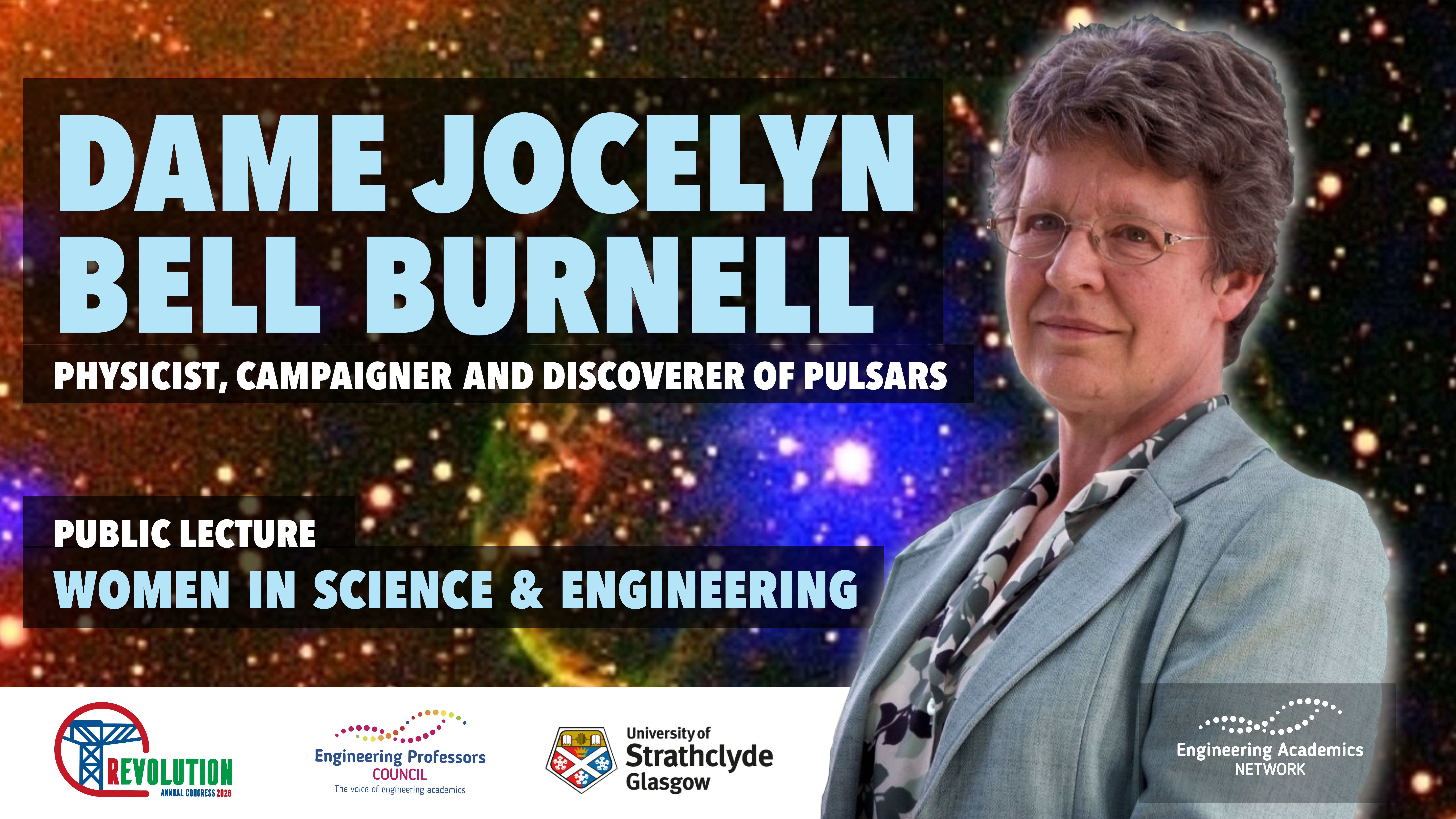
Annual lecture: Dame Jocelyn Bell Burnell, ‘Women in science and engineering’


This year’s EPC Public Lecture will be delivered by one of the greatest living scientists, Dame Jocelyn Bell Burnell CH DBE FRS FRSE FRAS FInstP HonMRIA HonFLSWn, the astrophysicist who, among her many accolades, discovered pulsars while still a doctoral student – a breakthrough that subsequently attracted a Nobel Prize for her supervisor.

Bell Burnell has worked tirelessly to support women scientists, donating and raising millions of pounds to fund scholarships. Fittingly, she will take ‘Women in science & engineering’ as her theme.

The lecture will be hosted by the University of Strathclyde as the opening session of this year’s Engineering Academics Network Annual Congress.

You do not have to register for the whole Congress to attend the lecture, but you can do so here.

If you do register to attend Congress, you do not have to register separately for the public lecture.

Jocelyn Bell Burnell inadvertently discovered pulsars as a graduate student in radio astronomy in Cambridge, opening up a new branch of astrophysics – work recognised by the award of a Nobel Prize to her supervisor. She has subsequently worked in many roles in many branches of astronomy, working part-time while raising a family. She is now a Visiting Academic in Oxford, Department of Astrophysics. She has been President of the UK’s Royal Astronomical Society, in 2008 became the first female President of the Institute of Physics for the UK and Ireland, and in 2014 the first female President of the Royal Society of Edinburgh. She was one of the small group of women scientists that set up the Athena SWAN scheme. She has received many honours, including a $3M Breakthrough Prize in 2018 (which she donated to create scholarships to support women scientists) and was made a Companion of Honour in 2026. The public appreciation and understanding of science have always been important to her, and she is much in demand as a speaker and broadcaster. In her spare time, she gardens, listens to choral music and is active in the Quakers. She has co-edited an anthology of poetry with an astronomical theme – ‘Dark Matter; Poems of Space’.
Email and confirm email are not same.
Email and Confirm email are not same.
You are already registered to attend this event.
Tickets available
Item Price
Total £0

You have already registered for this event.
Subscribe
Notify of
0 Comments
Oldest
Newest Most voted
Inline Feedbacks
View all comments
Related articles

Guest blog: Team meeting - your best thinker just stayed quiet again

Dr Jan Peters MBE shares her passion and optimism about inclusion and belonging in engineering to guide us how to...

News
Photo by Pixabay: https://www.pexels.com/photo/question-mark-on-chalk-board-356079/

Guest blog: Designing neuro-inclusive thinking spaces

Dr Joan van den Brink invites us to unlock the potential of engineering staff, their teams and students through creating...

News
Photo by www.kaboompics.com

Neurodiversity celebration week: advancing neuro-inclusion in engineering education

Neurodiversity celebration week provides an important opportunity to recognise the diversity of ways in which people think, learn and engage...

News

Guest blog: Engaging with the Neuroinclusion Maturity Framework

Dr Holly Foss, Associate Professor in the School of Engineering at the University of Birmingham, reflects on the value of...

News
Let us know what you think of our website