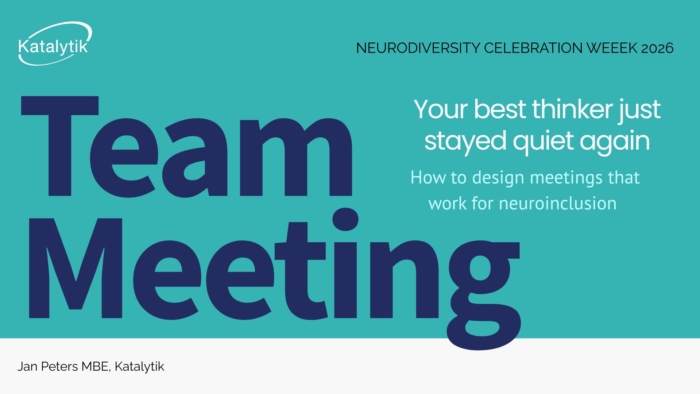
Dr Joan van den Brink invites us to unlock the potential of engineering staff, their teams and students through creating inclusive environments with a focus on neuroinclusion.
In recent years there has been focus on increasing the diversity of engineering students in higher education. Engineering subjects attract fewer females and ethnic minorities. And students with special education needs and disabilities are less likely to believe that they are good at science subjects, which are a prerequisite to study engineering. I believe it is equally, if not more, important to create an inclusive environment for students once they embark on their engineering studies.
This can be challenging for academic staff who may be unfamiliar with neurodivergence and how it may impact some of their students. Group work such as projects and industrial placements can be tricky environments for neurodivergent students, many of whom lack social skills. For instance, a student who is dyslexic or has ADHD may interrupt someone speaking because otherwise they will lose their thought. Some neurodivergent individuals may remain silent in groups because the conversation is moving too fast for them to know which point to respond to. Others may freeze when asked a question even though they know a lot about the topic being discussed, and so on. By learning about neurological differences and adopting neuroaffirming behaviours, the engineering academic can create an environment that is welcoming and supportive for their neurodivergent students.
This starts with preparing students for the transition to the specific institution or group that they are joining. Neurodivergent undergraduates may find this bewildering because the rules that governed their previous place of study do not apply. Students moving into higher education for the first time are now expected to be self-directing and able to figure out what is required of them. However, many neurodivergent individuals will mask any confusion they might feel, particularly if they believe that the other students know what to do. As a result, neurodivergent students may present as knowledgeable and not make progress on their studies.
Understanding what may be going on under the surface for their students is essential for engineering academics to provide the best conditions for them to thrive and successfully attain their qualification.
Learn and develop neuroaffirming behaviours
Learning about neurodivergence and adopting neuroaffirming behaviours will enable academics to create the best learning environment for neurotypical and neurodivergent students alike. This requires the academic to be open and curious to issues that at face value they may judge the student harshly for, so that they can enquire what might be going on underneath the surface that they are unaware of.
For example, if a student is late in submitting assignments, does not complete their task for group project as agreed, is late or fails to turn up to lectures or tutorials, it is easy to think that they are lazy, indifferent, partying, and so on. However, it could be that the student is neurodivergent and experiences time agnosia. Another reason might be that they lacked the clarity of what was expected of them and were unable to get started, or forgot the details of the task due to poor working memory. Instead of negatively judging the student, the lecturer or supervisor can provide instructions and guidance verbally and in writing, which is a neuroaffirming behaviour. Similarly, when briefing students about their projects, they can map out the key steps and the anticipated time required for each, to help neurodivergent students with time agnosia plan their work to meet specified milestones.
Another example of neuroaffirming behaviour is creating group norms. This can spell out the rules of engagements so that neurodivergent students, who may struggle with social interactions, can participate equally in group meetings.
Establish explicit group norms
Critical thinking is a key skill that undergraduate and postgraduate engineers need to formulate questions, appraise ideas and research proposals, form hypotheses, and so on. In group settings, neurodivergent students can experience significant discomfort because their way of being, sensing, processing and communicating is different from the norm. this can impede their ability to think and process what is happening in the moment. Their communication style may seem at odds with social niceties because they are blunt and direct and don’t finesse their words when they disagree with others. This can lead to a reputation of being difficult rather than honest and helpful.
By establishing explicit neuroaffirming group norms the supervisor empowers all members of the group to contribute in a meaningful way. One approach to achieving this is to implement Nancy Kline’s[1] ten components of thinking environments. These are:
- attention – listening with respect, interest and fascination
- incisive questions – removing assumptions that limit ideas
- equality – treating each other as thinking peers
- appreciation – practising a 5:1 ratio of appreciation to criticism
- ease – offering freedom from rush or urgency
- encouragement – moving beyond competition
- feelings – allowing sufficient emotional release to restore thinking
- information – providing a full and accurate picture of reality
- place – creating a physical thinking environment that says back to people, ‘You matter’
- diversity – adding quality because of the differences between us.
The key principle is that each person is given an equal opportunity to speak about their topic or issue whilst the rest of the group listens. Providing a safe, non-competitive space for thinking is neuroaffirming because the ten components provide a clear set of ground rules about how each group member needs to behave. For the student in the thinking seat, being able to explore their thoughts and express them out loud is part of an internal process that unlocks new ideas and insights.
Being given the space to think whilst the rest of the group is attentive is an invaluably rich gift of time and space for reflection for neurodivergent students who undoubtably will have received negatives messages throughout their life because they do not fit the norms of the majority. A thinking environment is liberating for all participants in the process and an invaluable way of enhancing the critical thinking capabilities of students.
As a teacher and supervisor of engineering students you are invited to reflect on:
- How effective are your group meetings in fostering diversity and collaboration?
- What methods do you employ to develop the critical thinking skills of your students?
- What norms can you put in place to promote dialogue and thinking together?
Conclusion
There are likely to be neurodivergent students in the groups that you supervise whose ways of being, thinking, feeling, sensing, behaving, moving and communicating differ from dominant norms. By adopting neuroaffirming behaviours you can build environments in which they feel safe to be vulnerable and not only showcase their successes but also explore issues and challenges and figure out new ways of furthering their research.
Dr Joan van den Brink has a PhD in Organic Chemistry from Cambridge University. She has more than twenty-five years of experience in leadership and talent development. She has supported hundreds of leaders in organisations across the world to unlock potential in themselves and their teams through her consulting and coaching engagements. Joan is passionate about creating inclusive environments with a special focus on neuroinclusion. Her latest book ‘Wired Differently, Understood Together’ explores how neurotypical and neurodivergent people can create inclusive spaces through dialogue in which all can thrive.


‘Designing Neuroinclusive Thinking Spaces’ © 2026 by Dr Joan van den Brink is licensed under Creative Commons Attribution-NonCommercial-NoDerivatives 4.0 International
[1] Kline, N (1999) Time to Think: Listening to ignite the human mind. Ward Lock