 Date: 4 Dec 2026
Time: 13:00 – 15:00 GMT
Location: Prince Philip House, SW1Y 5DG
Cost: Free (registration required)
Organised by: Engineering Professors’ Council and the Royal Academy of Engineering
Register here
Join us in person for the first of two events celebrating the launch of the Inclusive Engineering Toolkit, bringing together engineering educators, academics, industry representatives and others interested in shaping a more inclusive future for engineering.
The EPC collaborated with the Royal Academy of Engineering to develop the Inclusive Engineering Toolkit, focused on inclusive engineering outcomes. Its purpose is to support engineering educators to develop engineers who can design more inclusive, equitable and effective engineering solutions, products and outcomes.
The toolkit provides accessible, practical resources for embedding equity, diversity and inclusion (EDI) into teaching and professional practice, so that future engineers consider factors such as accessibility, bias and inclusion in the engineering work they do. The toolkit additionally provides resources that support inclusive and collaborative ways of working, with approaches to teaching that can help all engineering students to thrive.
Engineering shapes the products, technologies, systems and environments that people rely on every day. But how can we ensure that the engineers designing them consider the diverse needs, experiences and perspectives of the people who use them?
This event will bring the community together to celebrate this important milestone, discover what’s included and explore how its resources can be used to support inclusive engineering education and professional practice.
Whether you’re just beginning to explore inclusive engineering or already embedding inclusive approaches in your work, this is an opportunity to find inspiration, share perspectives and consider how you can put the Toolkit into practice.
Places are limited, so register below to secure your place!
What to expect
The event will offer an opportunity to hear from those involved in developing the Toolkit, explore its resources and consider its potential impact across engineering education.
The programme will include:
- Welcome and opening remarks: Find out more about the motivation behind the Toolkit and the collaboration that made it possible.
- Keynote presentation: Discover the project’s aims, development journey and vision for supporting more inclusive engineering outcomes.
- Introducing the Toolkit: Get an overview of what’s included, who it is designed to support and how to navigate its resources, including a live demonstration of the Toolkit on EPC Online.
- Panel discussion: Hear from members of the project leadership team and Toolkit contributors as they discuss the importance of inclusive engineering, practical applications and opportunities for embedding inclusive approaches in teaching and professional practice.
- What’s next? Explore how the Toolkit can continue to grow and how you can contribute to its development and future impact.
- Celebrations and networking: Enjoy refreshments, connect with fellow attendees and take time to explore selected Toolkit resources. Reflect on how they could be applied within your own institution or practice, share ideas and consider your next steps in putting the Toolkit into action.
The event will also provide time to connect with fellow attendees, explore selected Toolkit resources and reflect on how they might be applied within your own institution or practice.
Who should attend?
The event is aimed at anyone interested in making engineering education and practice more inclusive, including:
- Engineering academics, lecturers and educators.
- Those with responsibility for curriculum development and teaching practice.
- EDI leads and professionals working in higher education.
- Engineering industry representatives and professional practitioners.
- Anyone interested in inclusive engineering and developing more equitable engineering outcomes.
You don’t need to be an expert in EDI or inclusive engineering to attend. Whether you’re taking your first steps or looking to build on existing work, you’ll find opportunities to discover ideas, resources and practical approaches.
Join us
Come along to celebrate the launch of the Inclusive Engineering Toolkit, discover the resources available and be part of the conversation about how we can support the next generation of engineers to create more inclusive outcomes.
Next steps
The Toolkit is a growing resource, and its future development will benefit from the knowledge, experience and contributions of the engineering education community. We look forward to exploring what’s possible together.
The current toolkit is in a foundational stage, and we hope to develop it further and to add valuable new resources – with your help.
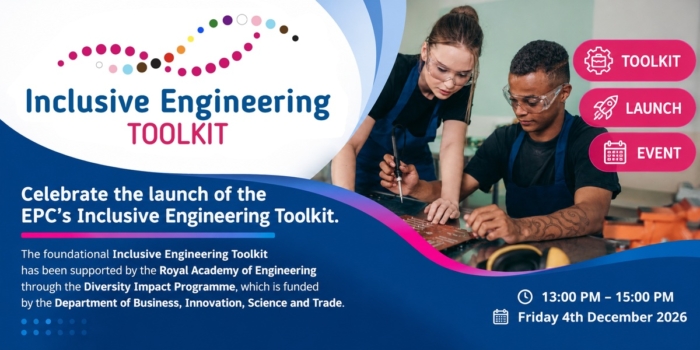
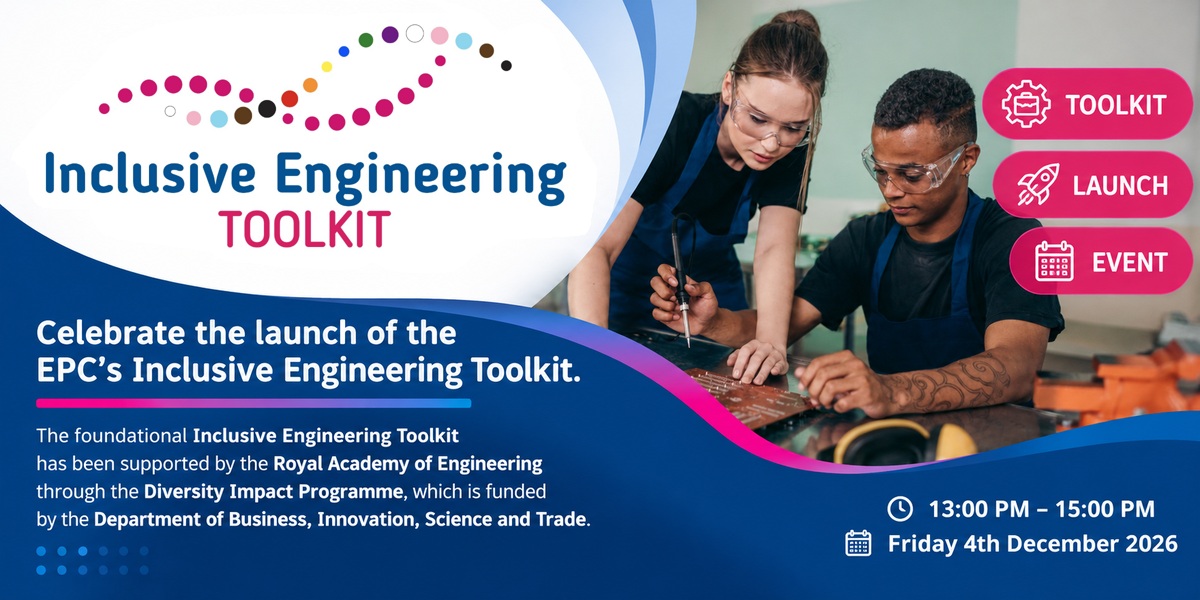
The foundational Inclusive Engineering Toolkit has been supported by the Royal Academy of Engineering through the Diversity Impact Programme, which is funded by the Department of Business, Innovation, Science and Trade.
Can’t attend in person?
We recognise that not everyone will be able to join us in person. We’ll be holding a separate webinar in January 2027, providing another opportunity to discover the Inclusive Engineering Toolkit and find out more about how you can use its resources. Further details will be shared soon.
Any views, thoughts, and opinions expressed herein are solely that of the author(s) and do not necessarily reflect the views, opinions, policies, or position of the Engineering Professors’ Council or the Toolkit sponsors and supporters.
All contributions published through the Inclusive Engineering Toolkit have been subject to a structured peer review process to support quality, relevance, and consistency.
The Inclusive Engineering Toolkit recognises that inclusive language and terminology may vary across contexts and communities, and that contributors may use different approaches depending on context and preference, including identity-first and person-first language. Users are encouraged to contact us at admin@epc.ac.uk with any questions, concerns, or feedback regarding language used within toolkit resources.
This post is also available here.