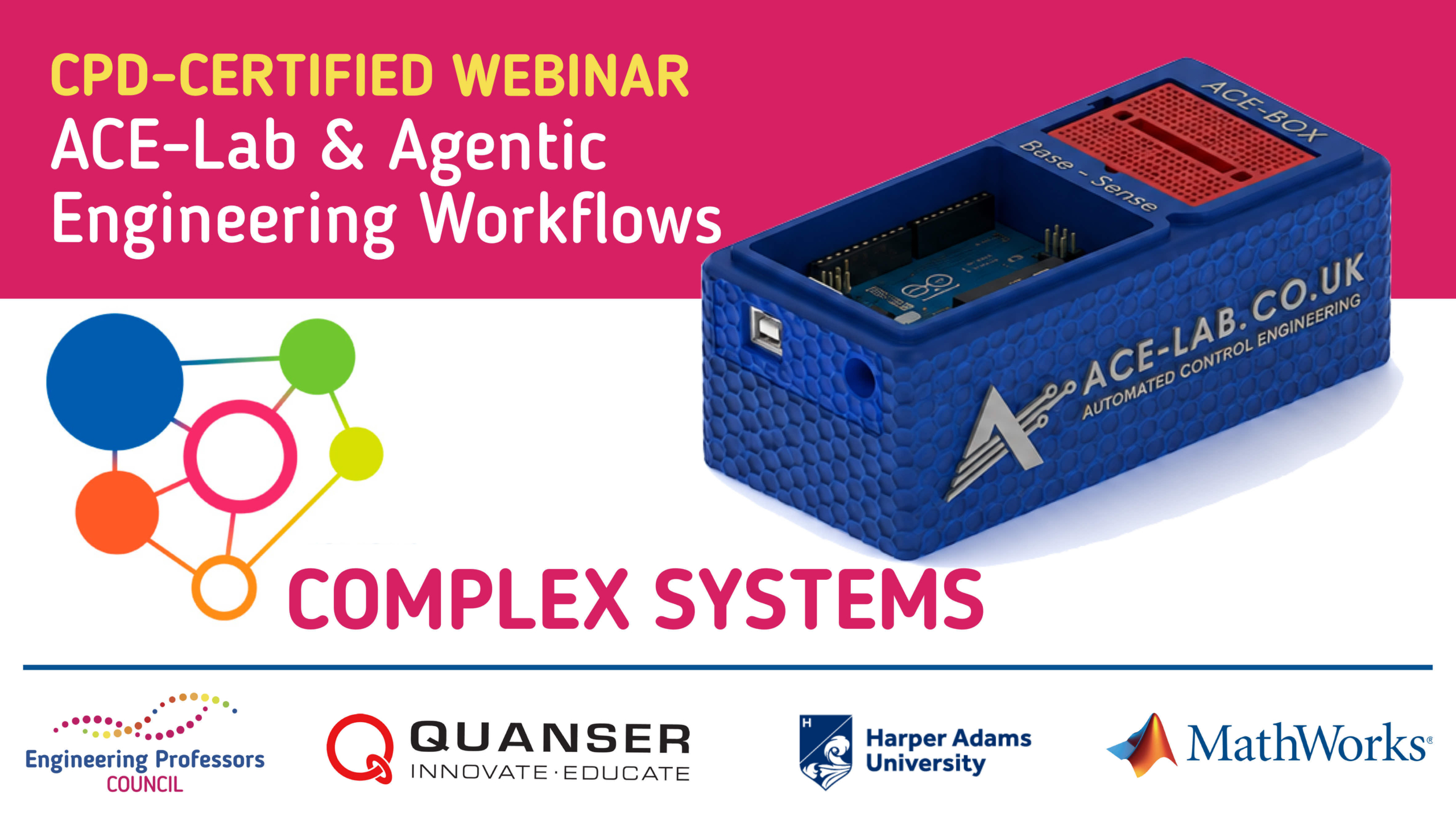
Register now for the Complex Systems Toolkit ACE-Box and agentic engineering workflows: CPD-certificated webinar.
As part of the Complex Systems Toolkit, supported by Quanser, we will be exploring the ACE-Box and agentic engineering workflows.
This free webinar introduces practical engineering workflows, from requirements capture through to verification and validation. These concepts will be demonstrated using the ACE-Box, a low-cost, hands-on engineering learning platform, alongside MATLAB and Simulink to illustrate key stages of the workflow.
The webinar will also explore the emerging role of agents in engineering workflows. Through practical examples and demonstrations, it will show how agent-enabled approaches can support engineers in solving problems more effectively.
Dr. James Pickering (Harper Adams University), who will be delivering the webinar along with Dr. George Amarantidis (MathWorks), explains what to expect:
“Most of us have used Large Language Models (LLMs) to solve an engineering problem by copying code back and forth, fixing issues manually, and with a hope that AI understands.
Using MATLAB and Simulink, this talk will explore the use of agentic AI and LLMs in engineering workflows. By connecting LLMs to MATLAB and Simulink through the Model Context Protocol (MCP) and emerging agentic toolkits, engineers can begin to develop AI-supported workflows that do more than generate suggestions, they can help write code, build models, run simulations, analyse results, respond to feedback, and support iterative refinement as part of a wider human-led engineering process.
Alongside George Amarantidis from MathWorks, I am pleased to be speaking at the upcoming Engineering Professors’ Council CPD-certificated webinar, where I will share how this work is being applied in the classroom at Harper Adams University.
We will demonstrate typical engineering workflows, from requirements capture through to validation, using a low-cost hardware platform I have developed, known as the ACE-Lab (www.ace-lab.co.uk). We will explore how we can leverage AI agents to support solving engineering problems.
From an educational perspective, this raises new and important questions about how we assess engineering students in the classroom. If AI can support modelling, analysis, testing, and refinement, then future assessment must place greater emphasis on process, judgement, and validation.
If future engineers are expected to use AI tools, then greater emphasis needs to be placed on their ability to capture requirements clearly, evaluate outputs critically, justify design decisions, and validate results.”
You can find a teaching activity from Dr. Pickering and Dr. Amarantidis – “Practical control engineering education through the ACE-Model” – in the Complex Systems Toolkit.
During this webinar we will also be launching a new call providing you with an opportunity for your content to be featured in the Complex Systems Toolkit.
Attendees will gain:
- An understanding of practical engineering workflows, from requirements capture through to verification and validation.
- Insight into how the ACE-Box, MATLAB, and Simulink can support each stage of the engineering workflow.
- An introduction to the emerging role of agents in supporting engineering practice.
- Perspectives on future directions in digital engineering, workflows, and engineering education.
CPD certification:
Attendees will be eligible for certification for 1.5 CPD hours. Please tick the box to request certification when you register.
Speakers include:
- Dr. James E. Pickering, Harper Adams University.
- Dr. George Amarantidis, MathWorks.
- Dr. Nikita Hari, University of Oxford.
- Peter Martin, Quanser.
- Johnny Rich, Engineering Professors’ Council.
To sign up for this free webinar, click the ‘Register’ button at the bottom of the event page.
This webinar is part of the Complex Systems Toolkit, supported by Quanser.
Any views, thoughts, and opinions expressed herein are solely that of the author(s) and do not necessarily reflect the views, opinions, policies, or position of the Engineering Professors’ Council or the Toolkit sponsors and supporters.