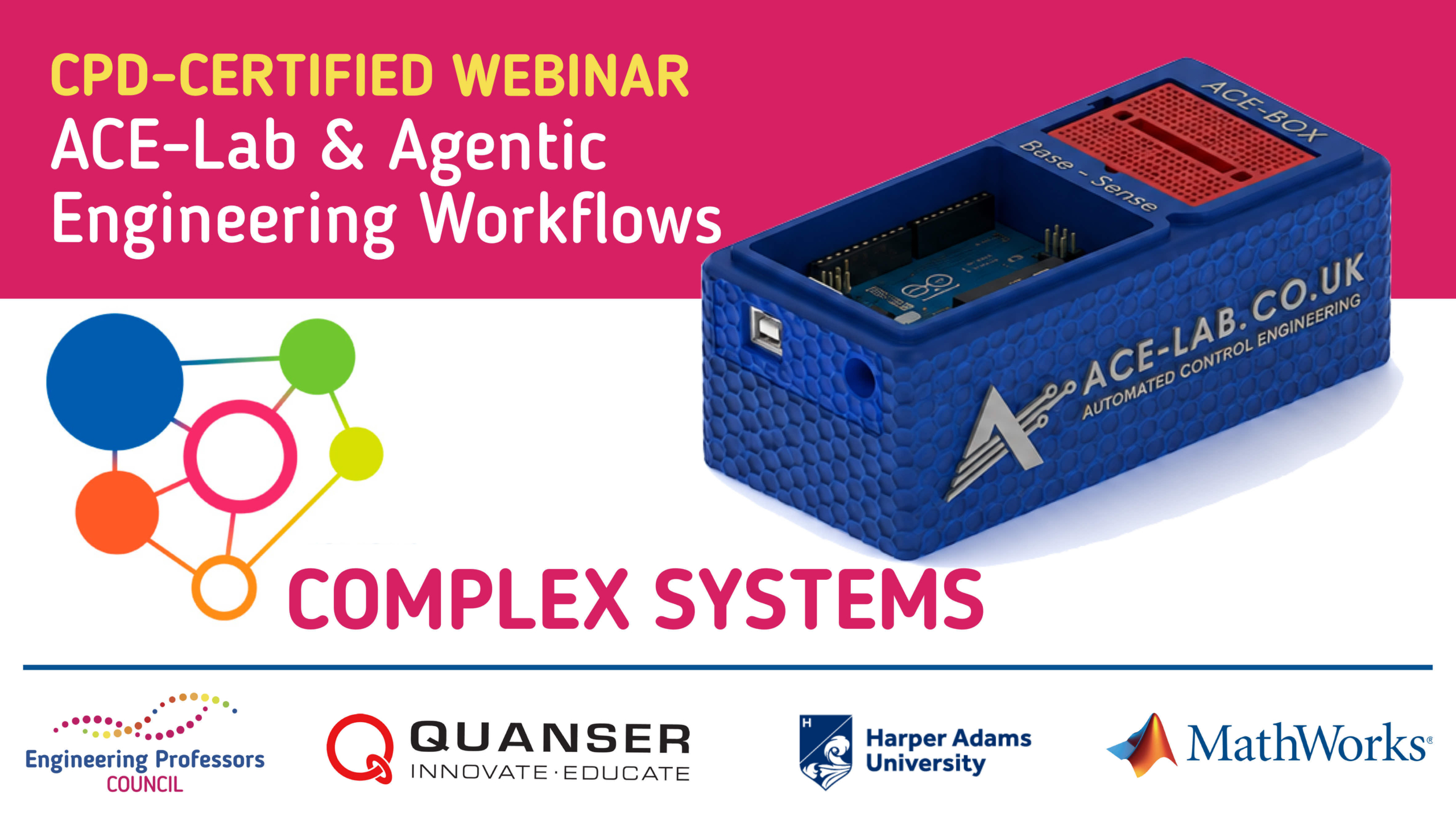
Complex Systems Toolkit: ACE-Lab and agentic engineering workflows (CPD-certificated webinar)
Online event freeDescription:
As part of the Complex Systems Toolkit, supported by Quanser, we will be exploring the ACE-Lab and agentic engineering workflows.
This free webinar introduces practical engineering workflows, from requirements capture through to verification and validation. These concepts will be demonstrated using the ACE-Lab, a low-cost, hands-on engineering learning platform, alongside MATLAB and Simulink to illustrate key stages of the workflow.
The webinar will also explore the emerging role of agents in engineering workflows. Through practical examples and demonstrations, it will show how agent-enabled approaches can support engineers in solving problems more effectively.
Dr. James Pickering (Harper Adams University), who will be delivering the webinar along with Dr. George Amarantidis (MathWorks), explains what to expect:
“Most of us have used Large Language Models (LLMs) to solve an engineering problem by copying code back and forth, fixing issues manually, and with a hope that AI understands.
Using MATLAB and Simulink, this talk will explore the use of agentic AI and LLMs in engineering workflows. By connecting LLMs to MATLAB and Simulink through the Model Context Protocol (MCP) and emerging agentic toolkits, engineers can begin to develop AI-supported workflows that do more than generate suggestions, they can help write code, build models, run simulations, analyse results, respond to feedback, and support iterative refinement as part of a wider human-led engineering process.
Alongside George Amarantidis from MathWorks, I am pleased to be speaking at the upcoming Engineering Professors’ Council CPD-certificated webinar, where I will share how this work is being applied in the classroom at Harper Adams University.
We will demonstrate typical engineering workflows, from requirements capture through to validation, using a low-cost hardware platform I have developed, known as the ACE-Lab (www.ace-lab.co.uk). We will explore how we can leverage AI agents to support solving engineering problems.
From an educational perspective, this raises new and important questions about how we assess engineering students in the classroom. If AI can support modelling, analysis, testing, and refinement, then future assessment must place greater emphasis on process, judgement, and validation.
If future engineers are expected to use AI tools, then greater emphasis needs to be placed on their ability to capture requirements clearly, evaluate outputs critically, justify design decisions, and validate results.”
You can find a teaching activity from Dr. Pickering and Dr. Amarantidis – “Practical control engineering education through the ACE-Model” – in the Complex Systems Toolkit.
During this webinar we will also be launching a new call providing you with an opportunity for your content to be featured in the Complex Systems Toolkit.
Attendees will gain:
- An understanding of practical engineering workflows, from requirements capture through to verification and validation.
- Insight into how the ACE-Lab, MATLAB, and Simulink can support each stage of the engineering workflow.
- An introduction to the emerging role of agents in supporting engineering practice.
- Perspectives on future directions in digital engineering, workflows, and engineering education.
CPD certification:
Attendees will be eligible for certification for 1.5 CPD hours. Please tick the box to request certification when you register. Please note: attendance of the live event in mandatory in order to gain a CPD certificate.
Registration:
Registration will close at 11.59pm on 28th June. If you have missed this registration window, please contact Wendy Attwell.
This webinar is part of the Complex Systems Toolkit, supported by Quanser.
Any views, thoughts, and opinions expressed herein are solely that of the author(s) and do not necessarily reflect the views, opinions, policies, or position of the Engineering Professors’ Council or the Toolkit sponsors and supporters.





To enable closed captions on Vimeo, click the CC button in the video player.
Resources mentioned in the webinar:
Attendees will be eligible for certification for 1.5 Continuing Professional Development hours.
This certification will cover:
- Practical engineering workflows
- Insight into ACE-Lab, MATLAB, and Simulink
- Role of agents in supporting engineering practice
- Future directions in digital engineering, workflows, and engineering education
Please ensure that you tick the box to request certification when you register.
Please note: attendance for the first 90 minutes of the webinar is required in order to gain a CPD certificate.
A Zoom invitation link will be sent to you prior to the event. Please ensure you check your junk/spam mail if you can’t locate the email in your inbox.
The event will be held on Zoom and you will be able to join up to five minutes before the scheduled start time.
If you have requested CPD certification it is important that you join with the link sent to you, so that we can verify your attendance.
If you have any issues, please contact Wendy and she will send another link.
Please note: If you are a speaker or panellist you must join via the link in your personal Zoom invitation.
To enable closed captions on Zoom:
-
- Click on the CC button on the meeting control bar to display the captions.
- You can adjust the size and positioning of the captions as needed.
For more information, see this guide.
Related articles

Spotlight on ethics: Engineers and public protest
As an engineer, you have a duty to ”maximise the public good and minimise both actual and potential adverse effects for...
Toolkits
Towards neuroinclusive engineering education: the EPC maturity framework
EPC introduces a new framework for engineering education The Engineering Professors’ Council is pleased to publish Towards Neuroinclusive Engineering Education:...
News
Spotlight on ethics: Microplastics in cosmetics
You're an engineering student on an industrial placement year at a company that manufactures cosmetics. You notice that a batch...
Toolkits
Intelligent Robotics: Contributions sought for the Complex Systems Toolkit
Further contributions sought for the Complex Systems Toolkit.
Toolkits