
Subject: The race to standardise the Internet
Title: How Internet Standards Grew: A Bar Chart Race of RFC Publication by Technology Domain (1969–2025)
Data source: RFC Editor
What are RFCs?
Requests for Comments (RFCs) are the technical documents that define how the internet works. Published by the Internet Engineering Task Force (IETF) since 1969, the RFC series now contains over 9,700 documents covering everything from the foundational TCP/IP protocols to modern security standards like TLS 1.3 and post-quantum cryptography.
Every time you load a webpage, send an email, connect to Wi-Fi, or make a video call, you are relying on technology defined in RFCs. They are freely available to anyone at rfc-editor.org: a core principle of the open internet.
About this visualisation
The animated bar chart race shows the cumulative number of RFCs published over time, classified into nine technology domains based on keyword analysis of each RFC’s title. The bars rank and re-sort dynamically as leadership shifts between domains, revealing how the priorities of internet standardisation have evolved over five decades.
Data: Per-year publication totals are exact figures from the RFC Editor’s official statistics page. Topic classification is derived from keyword frequency analysis of the complete rfc-index.txt file (~9,900 entries), mapped to IETF Area categories.
Final frame: The state of Internet standards in 2025
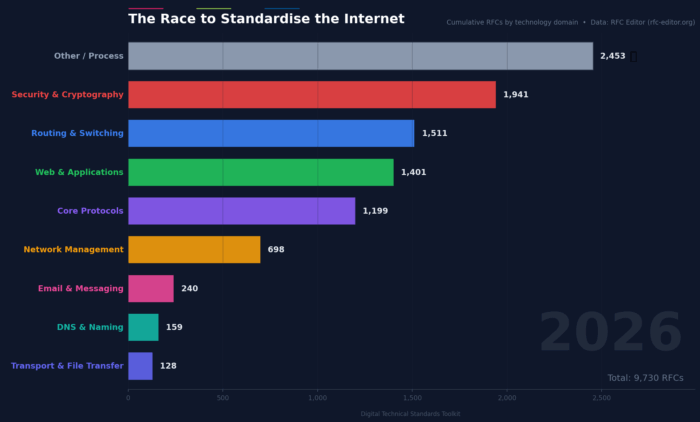
Figure 1: Cumulative RFCs by technology domain as of 2025. Data: RFC Editor (rfc-editor.org/rfcs-per-year/).
2025 rankings by technology domain
| Rank | Technology domain | Cumulative RFCs | Share | Examples |
| 1 | Security & Cryptography | 1,809 | 18.6% | TLS, IPsec, OAuth, DKIM |
| 2 | Routing & Switching | 1,359 | 14.0% | BGP, OSPF, IS-IS, MPLS |
| 3 | Network Management | 1,312 | 13.5% | SNMP, YANG, NETCONF |
| 4 | Web & Applications | 1,277 | 13.2% | HTTP, QUIC, SIP, JSON |
| 5 | Core Protocols | 1,204 | 12.4% | TCP, UDP, IP, ICMP |
| 6 | Other / Process | 941 | 9.7% | IETF process, April 1st |
| 7 | Transport & File Transfer | 688 | 7.1% | FTP, TFTP, NFS |
| 8 | Email & Messaging | 640 | 6.6% | SMTP, IMAP, MIME |
| 9 | DNS & Naming | 475 | 4.9% | DNS, DNSSEC, RDAP |
Key findings for educators
- Security went from almost nothing to #1. In the 1970s, security represented roughly 2% of new RFCs. By the 2020s, it accounts for 28% of new publications :reflecting the transformation of the internet from a trusted academic network to a global system requiring robust protection.
- The Web emerged from nothing in 1993. Before HTTP, web-related RFCs simply did not exist. The domain now accounts for over 1,200 cumulative standards, driven by HTTP/2, QUIC, WebRTC, and application-layer protocols.
- Foundational protocols are mature but still active. Core Protocols (TCP, IP, UDP) saw their highest growth in the 1970s–80s but continue to receive updates :for example, RFC 9293 (2022) formally revised the TCP specification after 41 years.
- Email standards peaked early. Email was one of the first killer applications of the internet and dominated early RFC output. Its share has declined steadily as the web and security took over, though DMARC and SPF keep it active.
- Routing remains the backbone. BGP, OSPF, and MPLS continue to generate significant standards activity. Routing has maintained a consistent 13–18% share across every era, reflecting its importance as the internet’s structural layer.
Data sources
- Per-year publication counts: RFC Editor, Number of RFCs Published per Year: rfc-editor.org/rfcs-per-year
- Topic classification: Keyword frequency analysis of the full RFC index: ietf.org/download/rfc-index.txt (~9,900 entries)
- Category mapping: Based on IETF Area structure with title keyword matching
- Animation: Generated using Python matplotlib + FuncAnimation
Any views, thoughts, and opinions expressed herein are solely that of the author(s) and do not necessarily reflect the views, opinions, policies, or position of the Engineering Professors’ Council or the Toolkit sponsors and supporters.