The EPC has been conducting analysis of the financial impact that the International Student Levy will have on Engineering higher education. Director of Policy & Research Stella Fowler summarises the findings.
The Government’s Industrial Strategy depends on a strong and growing Engineering skills base. Engineering directly underpins four of the eight sectors identified as targets in the Government’s Industrial Strategy (the “IS-8”) and provides essential technical capability across the rest – from clean energy and advanced manufacturing to digital infrastructure, defence and life sciences.
That is why the proposed international student levy is such a high-risk policy lever. It does not simply raise revenue: it threatens to weaken the financial foundations of Engineering higher education, reducing capacity in the very discipline on which the Industrial Strategy is most reliant.
In effect, it risks taxing the skills supply chain of the Industrial Strategy itself.
Engineering is strategically vital — and structurally expensive
Engineering is one of the costliest disciplines to deliver well. Laboratories, specialist equipment, workshop provision, technical staffing and compliance requirements create high fixed costs that cannot easily be reduced without affecting quality.
At the same time, domestic tuition fees have fallen significantly in real terms over the more than a decade. The result is a persistent funding gap for domestic Engineering students. The EPC estimates this shortfall at £7,591 per student on average across Engineering in 2023/24, even after the high-cost funding uplift. This means that high-quality domestic Engineering provision is widely loss-making.
International fee income is now sustaining domestic Engineering capacity
In this context, international student income is not peripheral: it has become a central component of the Engineering funding model. Engineering departments are among the most dependent on overseas recruitment, particularly at postgraduate taught level, where international demand has helped stabilise departmental finances.
Around one in four Engineering first degree students is international, compared with one in seven across all subjects. International students – and PGT students, in particular – currently provide a crucial cross-subsidy that helps sustain Engineering provision at scale, offsetting losses incurred on UK undergraduate courses.
EPC analysis suggests that international Engineering fee income widely exceeds domestic Engineering fee income and reflects a systemic sector reliance, not isolated exposure.
A £242.3m reduction in fee income to Engineering by 2026/27
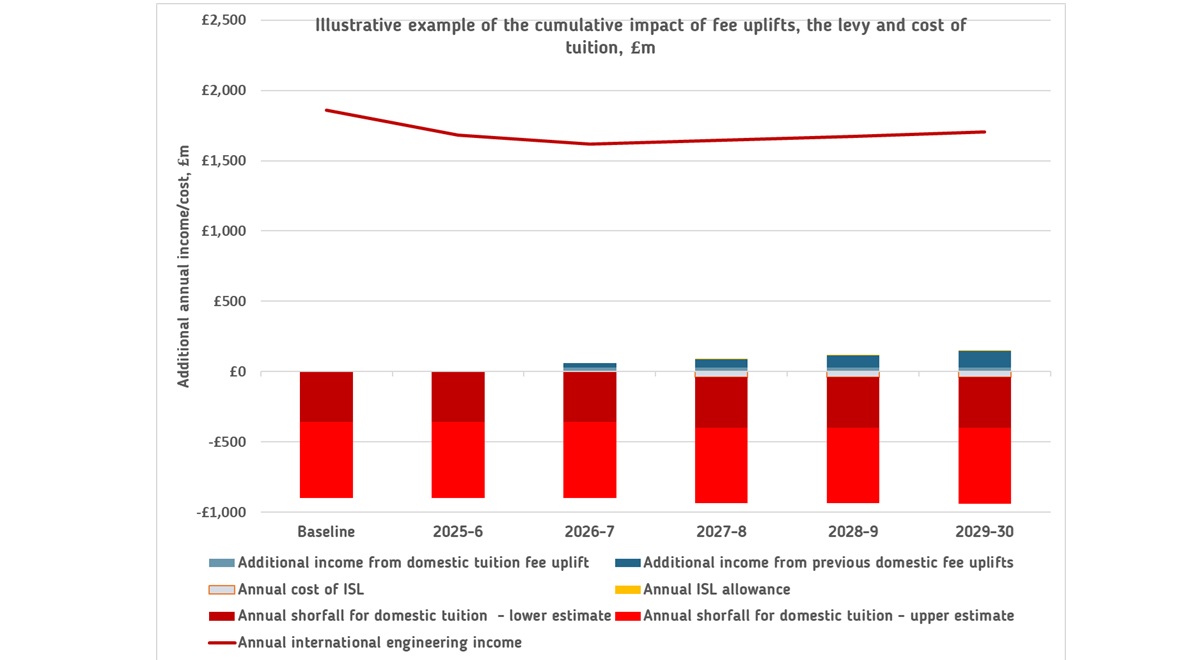
The above chart models, for Engineering, the additional income from the domestic tuition fee uplift (and, going forward, from previous tuition fee uplifts) and the annual cost of the ISL, in line with the chart provided in the technical consultation’s Impact Analysis. A small proportional adjustment for the 220 allowance (the number of international students allowed before the levy is applied) is also included.
At the bottom of the chart, we see the scale of the tuition fee shortfall range – with the variation based on a range of student number methodologies. The (top) red line represents the declining forecast annual international Engineering income, responding to the short-term Government international student number projections from the Impact Analysis and the net impact of the levy and uplift collectively on international tuition fees. The bottom line in this scenario is estimated to be a net loss to Engineering of £242.3m by 2026/27, reducing to £154.5m to 2029/30.
The model is rudimentary, but it is the best possible without access to variables that cannot be known at present. More detailed, medium- to longer-term modelling would be somewhat futile given the context of potential consequences of short-term pressures on expensive Engineering education infrastructure.
Universities will respond rationally — and Engineering will lose out
If the levy reduces demand or forces universities to absorb additional costs, institutions will face limited choices. They can attempt to raise fees or increase recruitment, but those options are constrained by international competition and price sensitivity.
The remaining responses are predictable:
- reducing domestic Engineering student numbers
- reducing costs, potentially affecting educational quality
- narrowing provision or closing courses
- increasing capacity with a greater proportion of international students
- increasing international fees
Most of these outcomes are inconsistent with the Government’s stated ambition to grow the Engineering workforce and the others, which won’t be possible for most universities, will have implications for immigration policies and local pressures.
A flat levy creates disproportionate financial pressure
In the chart modelled, the fees are based on an institutional level analysis, with Government projections of student reductions applied evenly across the sector. However, the proposed flat fee per student would not have flat effects. Institutions charging lower international fees will experience a larger proportional hit to income – many of which educate large numbers of Engineering students and play a major role in regional skills provision.
The consequence is that the levy is likely to have uneven effects across the Engineering system, increasing pressure on precisely those providers that are least able to absorb volatility.
The policy contradiction is structural
Index-linking domestic tuition fees may slow further real-terms decline, but it does not repair the long-standing funding deficit in high-cost disciplines. Engineering remains financially exposed.
The levy would directly weaken the international income stream that has been stabilising Engineering provision in the first place, both directly and through the anticipated downfall in international recruitment.
This creates a fundamental contradiction: policy would be reducing the financial viability of the discipline most critical to industrial delivery, without resolving the underlying home funding gap.
Conclusion: the levy risks weakening UK Engineering capacity at the worst possible moment
The Industrial Strategy requires expanded Engineering capacity, not contraction. Yet the proposed international student levy risks undermining the fragile funding model that currently sustains Engineering provision across the sector.
Rather than supporting growth, productivity and strategic capability, it would increase the likelihood of reduced capacity, course closures, and long-term retrenchment in Engineering education.
If the Government wants the Industrial Strategy to succeed, it must ensure that policy does not inadvertently penalise the very discipline needed to deliver it.